1994·Orcas Island (West Sound), San Juan Islands, Washington
United States.Orcas Island · flashes and electrical anomaly
On the night of September 24, 1994, a group of six to eight people gathered on a beach on Orcas Island (San Juan Islands, Washington) to watch the stars reported two or three bright blue flashes in the sky, compared to the color of old flash cubes. The National UFO Reporting Center (NUFORC) received five additional reports from independent sources about the same event, and at least one West Sound home reportedly recorded associated electrical anomalies. It is a low-strangeness, anecdotal, multi-witness case with no instrumentation.
Tier B · IndicativeWhat do they mean? →
Limited evidence: a single witness, testimony gathered years later, or an account without contemporary primary documentation.
What it was
65%natural or human cause
Most likely an ordinary cause that no one has identified
See the split across the six explanations
Natural or human cause
No known cause
Primary documents
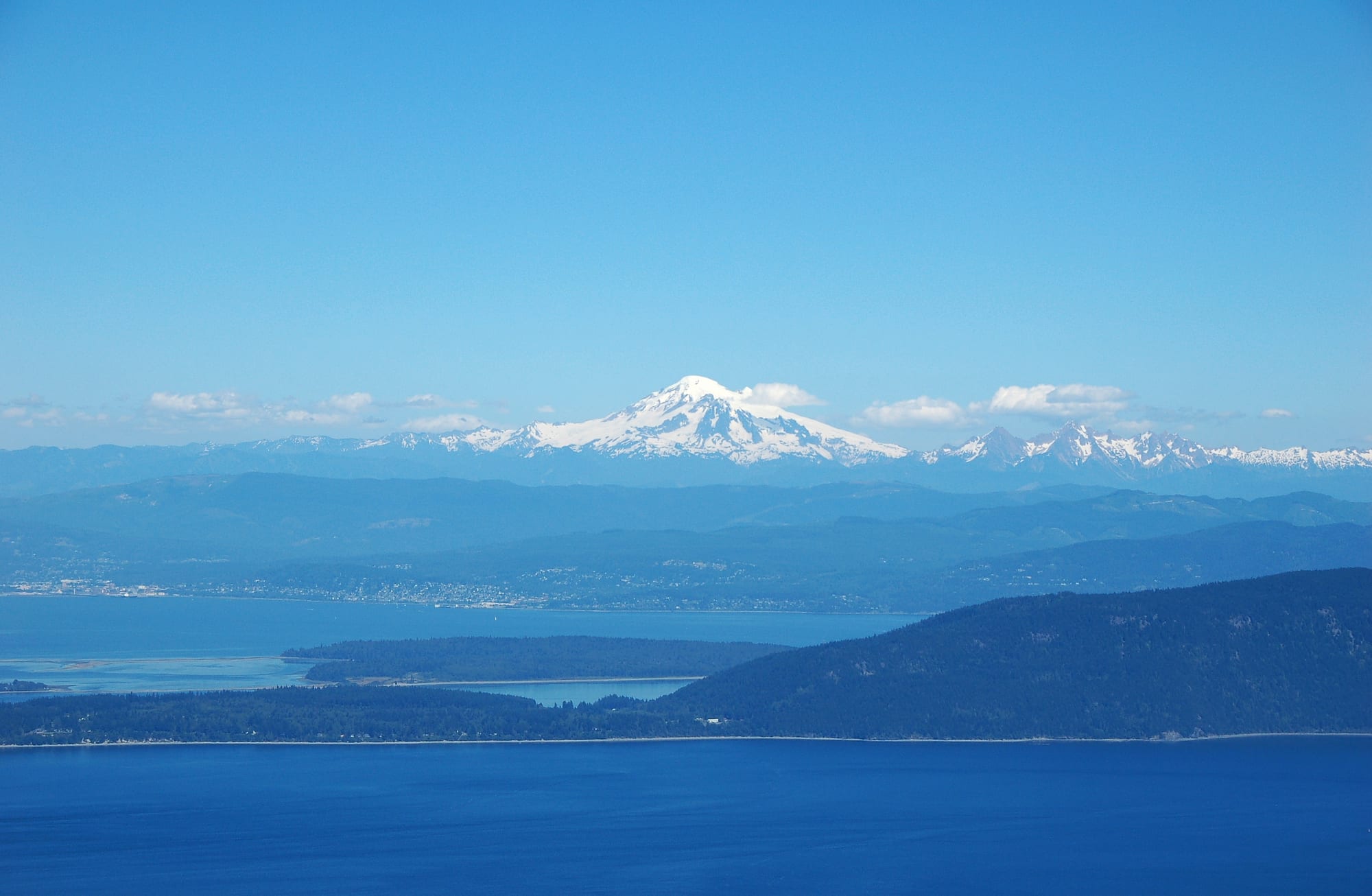
Context · Orcas Island (Washington)
Orcas Island, San Juan Islands, and Mount Baker, Washington State - panoramio.jpg · Wikimedia Commons · CC BY 3.0 · open original
NUFORC report S33261 · 'Bright blue flashes in the sky and zigzagging light - 1994'
National UFO Reporting Center report, submitted on November 20, 2003 and posted on November 26, written by a witness 'from memory'. It says six to eight women were stargazing on an Orcas Island beach when they saw two or three blue flashes the color of old flash cubes, then a light taken for a satellite that zigzagged down with a small fiery tail until lost at about 60 degrees, and a hum like an outboard motor that lasted an hour. Peter Davenport's note says the date is approximate, that he set it as Saturday, September 24, 1994, that he had five independent reports of the event, and electrical anomalies in a West Sound home.
National UFO Reporting Center (texto leído en la copia de su base de datos en Hugging Face, arieltunontdf/nuforc_reports.CSV) · view source
The night in question
The central account comes from a group of six to eight people who, on the night of Saturday, September 24, 1994, had gathered on a beach on Orcas Island, the largest of the San Juan Islands, in the Puget Sound of Washington State. They had assembled to watch the starry sky. According to the report collected by the National UFO Reporting Center (NUFORC), to their left and high in the sky two or three bright, brief blue flashes appeared, which those present described with a color comparable to that of old photographic flash cubes. According to the same summary, a bright light with a small fiery tail then shot out and zigzagged down towards the earth, disappearing from view about 60 degrees above the horizon. According to the testimony, the flashes were not accompanied by a clearly defined solid object; according to the summary of the NUFORC record reproduced by search engines (the page could not be consulted directly), the group instead heard a low hum, as if an outboard motor were running out on the lake, which lasted about an hour or until they left the beach.
What distinguishes the episode from an isolated report is corroboration. NUFORC (the civilian report-intake center based in Washington State, directed by Peter Davenport) recorded, according to that summary, five additional reports from independent sources about the same event. The NUFORC index, as captured in a public copy of its database, dates the sighting to 20:00 on 24 September 1994, gives it a duration of an hour and a half, summarizes it as 'Bright blue flashes in the sky and zigzagging light' and lists it as posted on 26 November 2003, nine years later. That concurrence of uncoordinated observers describing a simultaneous luminous phenomenon lifts the case above single testimony: whatever the cause, something visible happened in the area's sky that night. To this was added a second element: at least one home in West Sound, a locality on the same island, reportedly experienced electrical anomalies temporally associated with the phenomenon, the kind of detail that, if confirmed, would connect the flash with a physical disturbance on the ground.
The case should be read in its regional context. Puget Sound and the San Juan Islands accumulate a long tradition of anomalous reports going back to the famous Maury Island incident (1947), nearby in geography, and to the founding 'saucer' wave of that summer in the American Northwest. Orcas Island in particular has a local reputation for unusual phenomena and attracts both serious observers and low-credibility folklore (creature sightings, energy 'vortices', recent claims of supposed 'Nordics' spread by filmmakers). Separating the signal from the cultural noise is part of the analytical work: the 1994 event belongs to the sober end of the spectrum (multi-witness, logged in a civilian registry, though posted nine years later) not to the folklore.
The prosaic explanations are strong and convergent, and two in particular fit well with the combination of 'blue flashes' plus 'electrical anomaly'. The first is an electric arc from a transformer or a distribution line: a short-circuit or flashover of a transformer produces exactly intense, brief blue-white bursts, visible at a distance, and at the same time disturbances in the power supply of the connected homes, which would account, in one stroke, for the color, the brevity, and the anomaly in the West Sound home. The second is a bright bolide or meteor entering the atmosphere, which can produce colored flashes and be seen simultaneously by scattered observers; the bluish coloration is compatible with certain compositions. An aurora, distant lightning, or a reflection do not explain well the pointlike, high-intensity description. Neither of the two strong hypotheses could be confirmed or ruled out with a technical record, because there was no instrumentation: the case lives entirely in the testimonial plane.
Why it matters
Orcas Island 1994 is a minor case by design, and its value is exactly that: it serves as an example of the 'low-strangeness multi-witness' class that makes up the silent bulk of the phenomenon and is rarely examined with care. Its strength is corroboration (half a dozen witnesses on the beach plus five independent reports to NUFORC) which rules out individual hallucination or solitary fabrication: something luminous happened. Its weakness is the total absence of instrumentation and the low strangeness of the stimulus: a brief blue flash is compatible with many mundane causes.
The combination of blue-white flashes with an electrical anomaly in a nearby home has an almost tailor-made prosaic explanation: the flashover of a distribution transformer, which produces both effects at once. A bolide is the second strong candidate. Neither was confirmed, for lack of a technical record.
For methodology, the case anchors two things. First, that multi-witness corroboration is necessary but not sufficient: it confirms there was a real stimulus, not that the stimulus is anomalous. Second, that the discipline of separating a sober report from a place's accumulated folklore (Orcas Island drags along low-credibility creatures, vortices, and 'Nordics') is part of the calibration work. It is a real, corroborated case that adds little as evidence of the phenomenon.
What's left on paper
Documented evidence
- Report to the National UFO Reporting Center (NUFORC) by one of the witnesses on the beach, written from memory and logged in 2003; NUFORC later set the date as September 24, 1994
- Five additional reports from independent sources about the same event, received by NUFORC
- Electrical anomalies reported in at least one West Sound home, Orcas Island
- Documented regional context: tradition of reports in Puget Sound / San Juan Islands (nearby Maury Island 1947)
- NUFORC index (public copy of the database): 9/24/1994 20:00, duration 1.5 h, 'Bright blue flashes in the sky and zigzagging light', posted 11/26/2003
Sources
- National UFO Reporting Center (NUFORC) — reporte de avistamiento, Orcas Island WA
- The Orcasonian — reseñas históricas de avistamientos en Isla Orcas
- UFO Hunters — registro del avistamiento de Orcas Island, WA (24 septiembre 1994)
- Public copy of the NUFORC index (planetsig/ufo-reports, GitHub), Orcas Island row, 24 Sep 1994 — Record metadata: time, duration, summary and posting date (26 Nov 2003); it does not include the full report text.
- AARO — Fiscal Year 2024 Consolidated Annual Report on UAP (Nov 14, 2024)
Related cases