2011–2022·STEREO Science Center · NASA Goddard (Greenbelt, Maryland)
Space · STEREO and SOHO (NASA/ESA).STEREO and SOHO · the “UFOs” beside the Sun
Between 2011 and 2022, five images from the solar observatories STEREO (NASA) and SOHO (ESA/NASA) circulated as proof of craft beside the Sun: a triangle, a wheel, a ship with a jointed arm, a giant cube and a blob that swerved across the sky. The mission teams, and scientists who worked on them, explained each one with the telescopes' own data: internal reflections of Venus, cosmic-ray hits on the sensor, blocks of lost data and a speck of dust next to the spacecraft.
Tier S · SolidWhat do they mean? →
Strong evidence: a contemporary instrumental record (radar, sensor, film or photo of known provenance) that corroborates several independent witnesses.
What it was
98%natural or human cause
Most likely explanation: sensor or radar artifact
See the split across the six explanations
Natural or human cause
No known cause
Primary documents
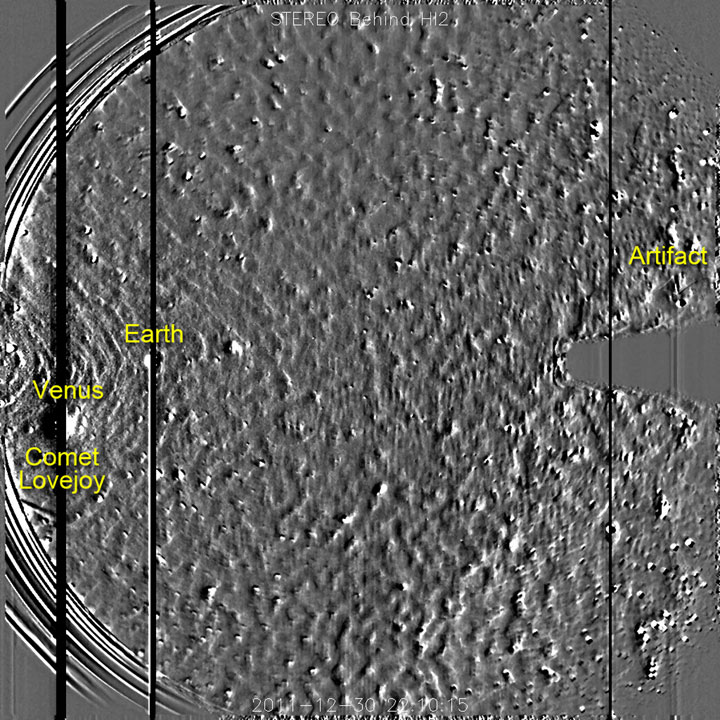
STEREO Behind HI2, 30 December 2011 · the “triangle” and Venus
Annotated image published by the STEREO Science Center to explain the triangle. It marks Venus, the Earth and the tail of Comet Lovejoy on the left, and the artifact on the right, above the occulter: the reflection sits on the opposite side of the detector from the planet that causes it.
NASA / Centro de Ciencia de STEREO · Dominio público (NASA) · open original
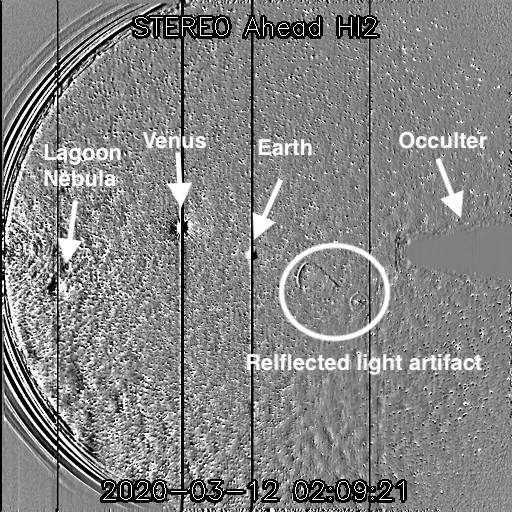
STEREO Ahead HI2, 12 March 2020 · the “wheel”
Annotated image of the 2020 episode: the STEREO team marks the Lagoon Nebula, Venus, the Earth, the occulter and, inside a circle, the reflection that was taken for a craft. It is the same mechanism as in 2011, on the other twin spacecraft.
NASA / Centro de Ciencia de STEREO · Dominio público (NASA) · open original
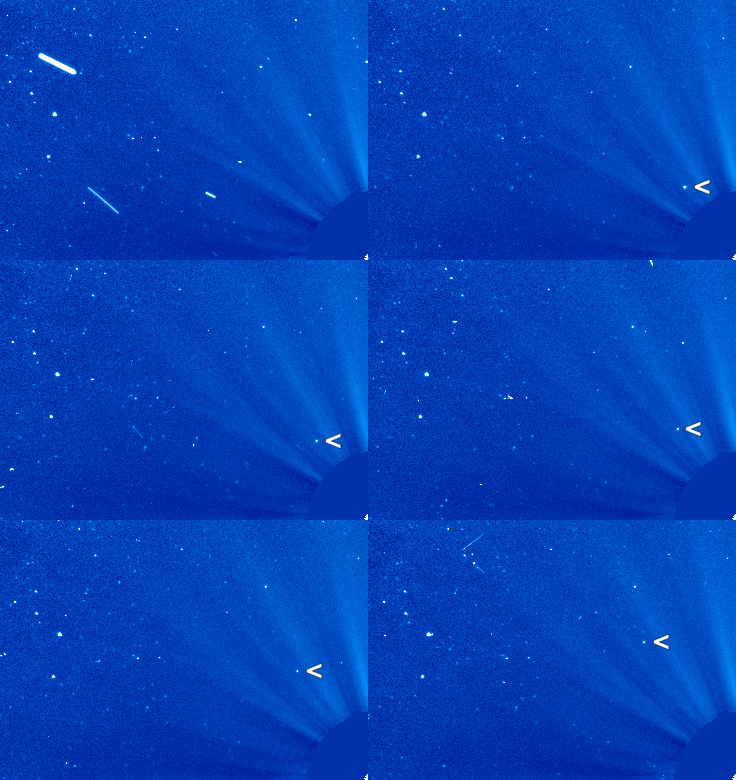
SOHO LASCO C3, 20 December 2022 · the swerving speck
LASCO C3 sequence from 06:18 to 08:30 UT showing the object curving away from the Sun. The SOHO team attributed it to a speck of dust a few metres from the spacecraft, repelled by its electric charge, after a debris shower recorded in the previous image.
ESA/NASA/NRL · SOHO LASCO · Uso libre con crédito «SOHO (ESA & NASA)» · open original
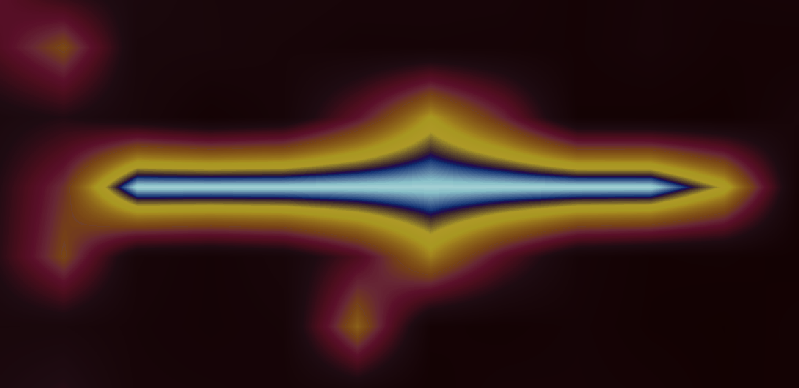
SOHO EIT, 18 January 2001 · “how to make your own UFO”
Final step of the demonstration the SOHO team published in 2003: a cosmic-ray hit in an EIT telescope image, enlarged, interpolated and given a different colour table, looks like a craft with a glow and an exhaust trail. The same image, after a strikingly similar enhancement, had been published as proof of a UFO.
ESA/NASA · SOHO EIT · Uso libre con crédito «SOHO (ESA & NASA)» · open original
The years in question
SOHO, the solar observatory of ESA and NASA, posts its images online, and NASA's twin STEREO spacecraft, Ahead and Behind, do the same. Their coronagraphs and wide-field cameras block the Sun's disc to see what surrounds it, and that view, full of stars, planets, comets and sensor defects, has been a steady source of supposed UFOs. In January 2003 the SOHO team devoted a page to explaining it: ever since launch, it wrote, a number of people had claimed to see flying saucers in its images, and they had always turned out to have an ordinary cause when examined by experienced scientists. The page showed step by step how a single cosmic-ray hit in an image from the EIT telescope of 18 January 2001, enlarged and interpolated and given a different colour table, became a craft with a glow and exhaust fumes, and noted that this same image, after a strikingly similar enhancement, had appeared as proof in the Perth Sunday Times.
At the end of December 2011 came the STEREO episode. Around the 26th, a triangular or diamond shape entered the field of view of the HI2 camera on STEREO Behind, moving from right to left just above the occulter on the right-hand side. The STEREO Science Center published the explanation together with the original movies: at the same moment the very bright planet Venus was entering from the lower left corner, and the shape and the planet moved in step, always in nearly opposite positions across the centre of the detector. It was an internal reflection of Venus in the telescope optics, an effect the team had seen many times before; the same sequence showed the Earth, dimmer, and the tail of Comet Lovejoy.
On 24 April 2012, SOHO's LASCO C2 coronagraph recorded beside the Sun what a blogger described as a metallic, jointed ship with a gigantic extension, and a YouTube video spread it. Nathan Rich, lead ground systems engineer in the solar physics branch of the US Naval Research Laboratory, which analyzes LASCO data, explained that the streaks were consistent with energetic particle (proton) impacts on the camera's sensor, and that such artifacts do not persist from image to image. According to the article that carried his explanation, a particle crossing the sensor at a shallow angle lights up a line of pixels, and the ship's supposed arm was one of those lines.
In July 2020, Scott Waring, who has posted sightings on his website for years, showed a black cube in images from SOHO's EIT telescope that the Daily Express said was ten times bigger than the Earth. Alex Young, a NASA solar astrophysicist who worked on SOHO, told the fact-checking agency Lead Stories that it was a simple data dropout: the images are assembled from blocks, and a block that does not arrive shows up black and square. Lead Stories documented similar cubes that Waring had attributed to SOHO in 2011, 2013, 2016 and 2017.
In February 2020, STEREO Ahead repeated the 2011 phenomenon: a cross inside a circle, and later a cone, entered its HI2 camera at the same time as Venus did on the opposite side, and the team explained it the same way. The last episode, on 20 December 2022, was different. Zesheng Yang, a Sungrazer project volunteer who has discovered many comets in SOHO data, reported an object that appeared in both cameras, LASCO C2 and C3, and that over about two hours swerved sharply away from the Sun. The team acknowledged that in 27 years SOHO had never seen anything quite like it. Wavy particle trajectories are common within a single exposure of about 25 seconds; what was new was that this one showed up for hours, in many images and in both cameras.
Why it matters
None of these images had a witness looking at the sky: the object exists only on the detector, so the question is not what someone saw but what the instrument recorded and why. What sets them apart is that the data are public and that the people who operate the telescopes answered with those same data. Each explanation comes with a test anyone can repeat. The Venus reflection gives itself away because it moves as a mirror image of the planet on the other side of the detector's centre. A cosmic ray appears in a single image and not in the next one, although in the web images it can repeat if a lost block was filled in from the previous image; the raw data settle it. A lost block of data shows up as a black square, because the image arrives in blocks. The 2003 page summed up the rule that applies to all of them: a claim without the date and time of the image is close to worthless, because nobody can check how it was processed.
The 2022 case also shows the limits of that method. The SOHO team did not see the speck of dust; it inferred it. If the object were near the Sun, it would have to be planet-sized to shine like that, amateur astronomers would have seen it long before, and no body at that distance can bend its path so quickly. If it were halfway, even at the size of the Space Station, it would saturate the images. Only something very small and very close fits, a few metres from the spacecraft, and the previous image showed exactly a shower of debris thrown up by a micrometeorite, with a bright streak aligned with the object's first appearance. It attributed the curve to the Lorentz force, effectively static electricity: the spacecraft carries a net charge, and the speck moved away repelled by it. It is a deduction, not a direct observation, although the team considered it quite conclusive and the debris shower was indeed recorded.
Taken together, the episodes show how a UFO is born in a scientific image. The first step is almost always a real defect of the instrument; the second, an enlargement or a change of colours that makes it look solid; the third, a size figure calculated as if the object were beside the Sun, which is not checked. The SOHO team wrote in 2003 that when it explained, it was accused of covering up, and when it stopped answering someone who would not accept the explanation, of clamming up. The answer of the teams of both missions was transparency: STEREO's published the movies and marked on the image where Venus, the Earth and the artifact are, and SOHO's explained step by step how a “UFO” is made. That material, with its institutional provenance and first-hand analysis, is what gives this set its evidential strength, even though what it documents is an instrument defect and not an object.
The explanation of the 2020 cube is the weakest in the set, not because of its content, which matches what the 2003 page already described, but because it comes through the reply Alex Young gave to a fact-checking agency rather than from a mission page.
What's left on paper
Documented evidence
- Movies and annotated image from the STEREO Science Center (December 2011, STEREO Behind HI2): the triangle and Venus move in step on opposite sides of the detector, with the Earth and the tail of Comet Lovejoy in the same sequence
- Movie from STEREO Ahead HI2 (February 2020) and annotated image (12 March 2020) marking Venus, the Earth, the Lagoon Nebula, the occulter and the reflection
- STEREO artifacts page with earlier reflections of the same kind: Venus in HI1-B in January 2009 and the Earth in HI2-B on 5 May 2007
- Statement by Nathan Rich (Naval Research Laboratory) on the LASCO C2 image of 24 April 2012: streaks consistent with proton impacts on the sensor, which do not persist from image to image
- Reply by Alex Young (NASA) to Lead Stories about the July 2020 cube: “A simple data dropout”
Show 2 more items
- SOHO team analysis of 20 December 2022 (credit NASA/ESA/NRL/Karl Battams): object visible in LASCO C2 and C3, debris shower in the immediately preceding image and curved path attributed to electrostatic forces
- SOHO team page of January 2003 reproducing, step by step, how a cosmic-ray hit of 18 January 2001 turns into a “UFO” when it is enlarged and recoloured
Sources
- NASA, Centro de Ciencia de STEREO — «Triangular shaped object in STEREO data explained» (episodio de diciembre de 2011; revisada el 15 sep 2016) — Explanation by the mission team, with the original movies and the annotated image.
- NASA, Centro de Ciencia de STEREO — «Circular wheel shaped reflection in STEREO data explained» (revisada el 20 mar 2020) — The STEREO Ahead episode of February 2020, with movies and an annotated image.
- NASA, Centro de Ciencia de STEREO — «Image artifacts: internal reflections» — Earlier reflections of Venus (2009) and the Earth (2007) in the HI cameras.
- ESA/NASA, equipo de SOHO — «How to Make Your Own UFO» (17 de enero de 2003) — The usual causes of “UFOs” in SOHO images, with the step-by-step demonstration.
- ESA/NASA/NRL, equipos de SOHO y Sungrazer — «Dashing through the sky...» (23 de diciembre de 2022) — Analysis of the 20 December 2022 object in LASCO C2 and C3; credit NASA/ESA/NRL/Karl Battams.
- Natalie Wolchover — «UFO Spaceship Orbiting the Sun, or a Camera Glitch?» (Life's Little Mysteries, reproducido en NBC News, 26 de abril de 2012) — Carries the statement by Nathan Rich, of the Naval Research Laboratory, on the LASCO C2 image of 24 April 2012.
- Maarten Schenk — «Fact Check: NASA Did NOT Capture 'Alien Cube Ship' On Photo Shared By UFO Hunter» (Lead Stories, 30 de julio de 2020) — Reply by Alex Young (NASA) and the record of cubes attributed by Scott Waring to SOHO since 2011.
Related cases
same object · same country · same period
When the sensor itself explains why the object flickers
2019 · Tier A
same explanation · same country
Colorado 2023 · the orb a police officer filmed
2023 · Tier A
same object
Star-shaped object over the Yellow Sea
2025 · Tier A
same object
Canary Islands · the Fokker IB-098 and the Gando radar echoes (1974)
1974 · Tier A