1998·NASA Johnson Space Center (Houston, Texas)
Earth orbit · STS-88 mission (NASA).The “Black Knight” · the cover lost on the STS-88 mission
On 11 December 1998, the crew of the shuttle Endeavour photographed a dark, angular object floating above the Earth during the first assembly mission of the International Space Station. Years later, those photos became the image of the “Black Knight”, a supposed alien satellite orbiting for millennia. The official mission report records that, the day before, a thermal cover came loose during a spacewalk and floated away; the catalogue of objects in orbit lists it and dates its reentry to 14 December.
Tier S · SolidWhat do they mean? →
Strong evidence: a contemporary instrumental record (radar, sensor, film or photo of known provenance) that corroborates several independent witnesses.
What it was
98%natural or human cause
Most likely explanation: space object
See the split across the six explanations
Natural or human cause
No known cause
Primary documents
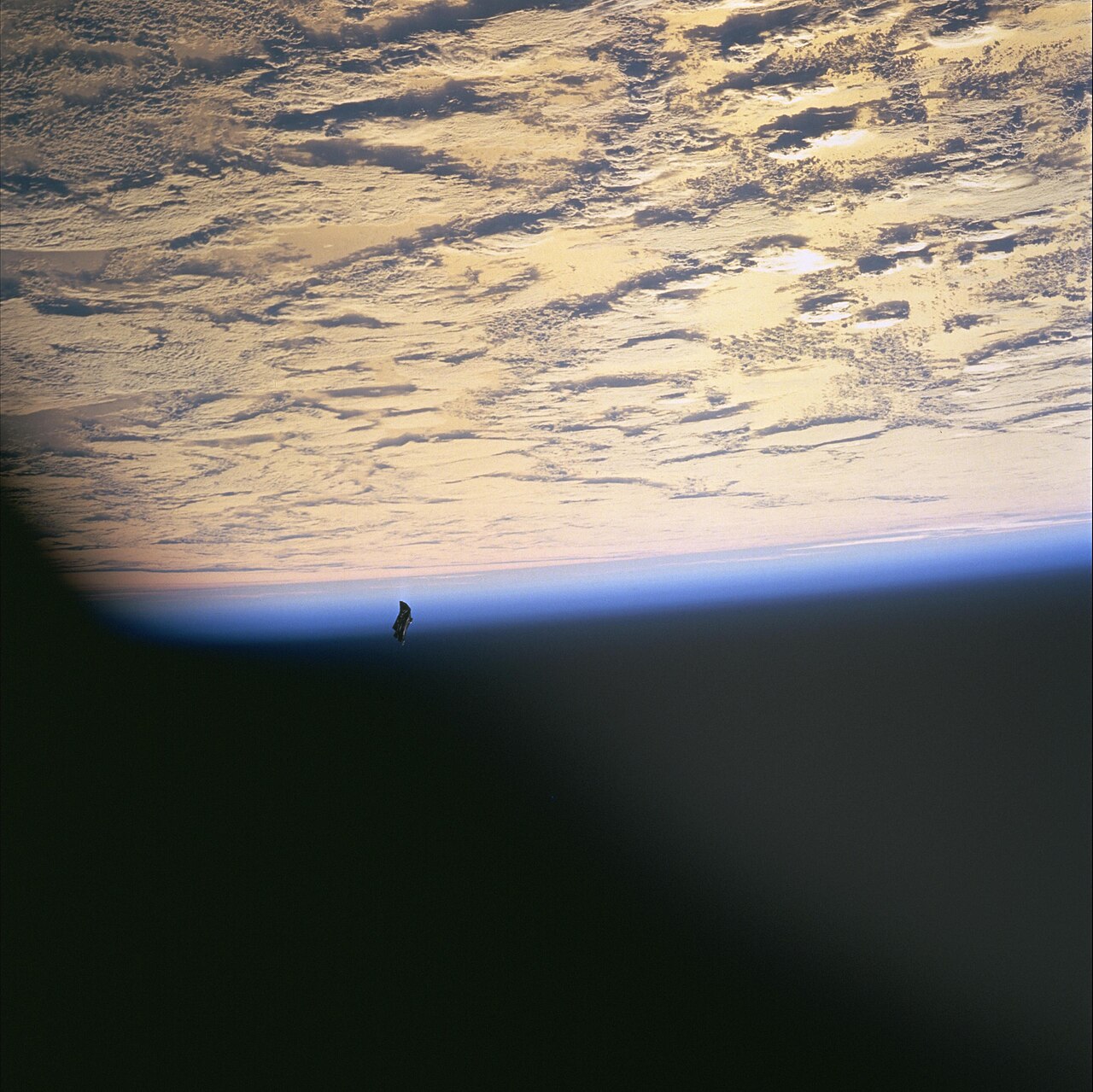
STS088-724-66 · the object above the Earth's limb (11 Dec 1998)
The photo that became the image of the “Black Knight”. The Endeavour crew took it on 11 December 1998 at 20:17:04 universal time, with a 250 mm lens, while the shuttle was still docked to the Space Station. NASA's astronaut photography archive describes it as space debris.
NASA · archivo fotográfico de los astronautas (STS088-724-66), vía Wikimedia Commons · Dominio público (NASA) · open original
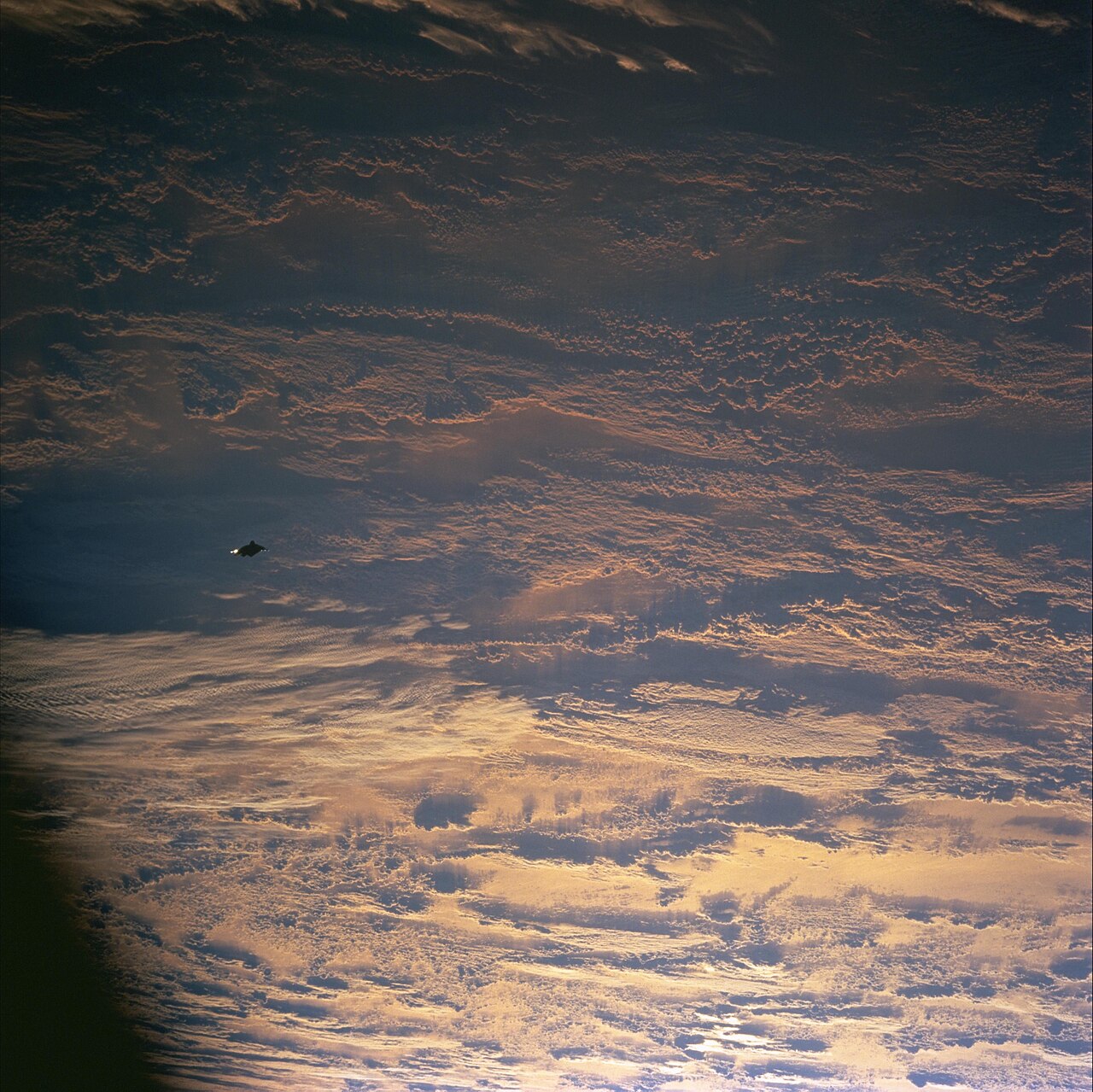
STS088-724-70 · the same object, a minute and a half later
Last frame of the series, taken at 20:18:44 universal time. It shows the object over the clouds, looking different from frame 66 and with a glint at one end; according to Skeptoid, the lost blanket was silver on one side and black on the other.
NASA · archivo fotográfico de los astronautas (STS088-724-70), vía Wikimedia Commons · Dominio público (NASA) · open original
STS-88 mission report (extract: cover and spacewalk pages)
Extract from the official mission report, prepared by the Johnson Space Center in February 1999. The included pages record the pieces lost on the first spacewalk and the trunnion pin cover that separated and floated away on the second, at 00:52 on 10 December, with the note that only three of the four were installed.
NASA · Centro Espacial Johnson (NSTS-37423) · Dominio público (NASA) · open original
The night in question
The shuttle Endeavour lifted off on 4 December 1998 on mission STS-88, the first assembly flight of the International Space Station: it was to join the American Unity module to the Russian Zarya module, already in orbit. Among the spacewalk tasks was installing on Unity four covers for the trunnion pins that had held the module in the shuttle's payload bay; according to the list of objectives in the official mission report, they were there for the module's thermal stability, to reduce heat leak.
The report, published by the Johnson Space Center in February 1999, records what was lost along the way. On the first spacewalk, in the early hours of 8 December universal time, a slide-wire carrier came loose from the crewmember, and later a work-site interface socket and a retractable tether, which floated away from the shuttle and the station with no impact hazard. On the second, at about 00:52 on 10 December, a trunnion pin cover separated and floated away, so only three of the four were installed, and the report noted that a new one would be fabricated for installation on a later mission, STS-96. Jonathan McDowell's satellite catalogue, which lists every tracked object in orbit, carries those spacewalk losses: the wire carrier and the socket, which reentered in the spring of 1999, and the cover, object 25570, separated on 10 December at 00:52 and reentered on 14 December.
On 11 December, between 20:16 and 20:18 universal time, with the shuttle still docked to the station, the crew took a series of photos of a dark, angular object hanging over the sunlit limb of the Earth; they are frames 65 to 70 of roll 724 in NASA's astronaut photography archive, where they are listed as space debris.
As they spread online, the photos came to illustrate a much older legend. According to the summary by science writer Brian Dunning, the “Black Knight” brings together unrelated pieces: radio signals that Nikola Tesla believed he received from space in 1899; the delayed radio echoes observed by Norwegian researchers in 1928, from which Duncan Lunan derived in 1973 a star map pointing to the star Epsilon Boötis, and which he later retracted; 1954 press stories about two unknown satellites, which relayed the claims of a UFO promoter; and a “dark satellite” picked up in February 1960 by a US Navy radar, which Air Force Secretary Dudley Sharp attributed to a piece of the Discoverer VIII satellite, an attribution that, according to Dunning, was soon confirmed. In 2013, the Armagh observatory in Northern Ireland summed up the whole as a jumble of completely unrelated stories. In May 2024, a TikTok video again presented the photo as an object that had supposedly been in orbit for 13,000 years.
Why it matters
The case has something unusual: the object in the photos and the most likely explanation come from the same institutional record, with timestamps. The mission report, written for engineers and not to answer anyone, notes that a cover came loose on 10 December at 00:52; the catalogue of objects in orbit carries it with the same time and its reentry four days later; and the crew photographed a dark, loose object next to the station about 43 hours later, while still docked. For the “Black Knight” to be an ancient satellite, one would have to assume that an unknown object appeared next to the station on precisely the days when the mission had lost several pieces.
It must also be said what the record does not say. No NASA document expressly identifies the object in the photos with the cover: the photo archive describes it only as space debris. It is identified with a thermal cover or blanket lost on a spacewalk by the fact-checkers of Lead Stories and by science writer Brian Dunning, and former space engineer James Oberg devoted a 43-page study in 2014 to the cover as the origin of the legend. And the cover was not the only thing floating nearby: the catalogue also records the slide-wire carrier and the socket lost on the first spacewalk, which stayed in orbit until 1999. Any of them is an ordinary candidate, and the catalogue lists no object of unknown origin associated with the mission.
The rest of the legend has the same structure the case shows in miniature. Each piece had an explanation at the time —a star map its author withdrew, a “dark satellite” the Air Force attributed to a Discoverer, press stories repeating a promoter—, but the explanation ended up on an inside page while the mystery kept circulating. What ties the pieces together is not an object but the name given to them afterwards. They do not even fit with each other: according to Dunning, the 1960 “dark satellite” orbited at about 79 degrees from the equator, while STS-88 flew, like the station, at an inclination of 51.6 degrees.
As evidence, the case is solid: NASA photos with date, time and focal length, taken by the crew; a first-hand official report documenting the loss; and a catalogue that dates each piece. What that evidence documents is a piece of the mission itself lost in orbit.
What's left on paper
Documented evidence
- Frames STS088-724-65 to 70 of NASA's astronaut photography archive, taken on 11 December 1998 between 20:16 and 20:18 universal time, described as space debris
- Official STS-88 mission report (NSTS-37423, Johnson Space Center, February 1999): a trunnion pin cover separated and floated away at about 00:52 on 10 December, during the second spacewalk, and only three of the four were installed
- The same report records that on the first spacewalk a slide-wire carrier, a work-site interface socket and a retractable tether came loose and floated away
- Jonathan McDowell's satellite catalogue: object 25570, “trunnion pin cover”, separated on 10 December 1998 at 00:52 and reentered on 14 December; also the first-spacewalk debris, which reentered in 1999
- The shuttle was still docked to the station when the photos were taken: undocking began on 13 December
- Lead Stories (2024) and Skeptoid (2013) identify the object with a thermal blanket lost on a spacewalk; according to Skeptoid, silver on one side and black on the other
Sources
- NASA, Centro Espacial Johnson — «STS-88 Space Shuttle Mission Report» (NSTS-37423, febrero de 1999), copia en ibiblio — Primary source for the pieces lost on the spacewalks and for the time the cover came loose and for the purpose of the covers (pp. 7-8, 11 and 37).
- NASA, archivo fotográfico de los astronautas — fotograma STS088-724-66 — Original record of the photo, with date, time and focal length; the same roll holds frames 65 to 70.
- Wikimedia Commons — «Black Knight Satellite.jpg» (STS088-724-66, NASA, dominio público) — Copy of the photo with the NASA archive metadata: 11 December 1998, 20:17:04 GMT, 250 mm focal length.
- Jonathan McDowell — catálogo general de objetos en órbita (GCAT), satcat.tsv — Entries 25564, 25565 and 25570: the STS-88 spacewalk debris, with separation and reentry dates.
- Sarah Thompson — «Fact Check: 'Black Knight Satellite' Is NOT 13,000-Year-Old Craft -- It Was Thermal Cover Lost In Space» (Lead Stories, 24 de mayo de 2024) — The 2024 TikTok video, the identification with the thermal cover, James Oberg's 2014 study (which describes the trunnion pins locked into the shuttle's payload bay) and the Armagh observatory quote.
- Brian Dunning — «The Black Knight Satellite» (Skeptoid, episodio 365, 4 de junio de 2013) — Origin of the pieces of the legend (Tesla, the 1928 echoes, Lunan, the 1954 press and the 1960 “dark satellite”), with their period references.
- Observatorio y Planetario de Armagh — «The truth about the Black Knight satellite mystery» (18 de julio de 2013) — Sums up the legend as a set of unrelated stories.
Related cases
same explanation · same country · same period
STS-80 · unidentified object in orbital photography (1996)
1996 · Tier A
same explanation · same country · same period
STS-48 NASA
1991 · Tier A
same explanation · same country
Skylab · light flashes and reddish object (NASA, PURSUE)
1973 · Tier B
same explanation · same country
Apollo 11 · Technical Crew Debriefing observations (NASA, PURSUE)
1969 · Tier B