2026·South-central Chile, from the Santiago region to Los Ríos
Chile.Chile · a fireball streaks by and booms over Ñuble and Biobío
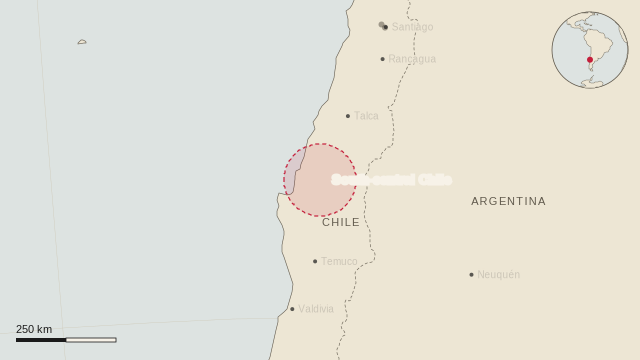
On the night of Friday, November 13, 2026, at 9:32 p.m., a light crossed the sky of south-central Chile in a few seconds and turned into a fireball. It was seen from the Santiago region to Los Ríos, and in Ñuble and Biobío a boom was heard afterward. Security cameras and phones recorded it, and that night people talked of space junk and of SpaceX's Starship. The lightning sensor on the GOES-19 satellite recorded the flash near Cabrero, in Biobío, and the regional science secretary for Biobío and Ñuble attributed it to a natural meteor.
Tier A · AcceptableWhat do they mean? →
Institutional evidence: several identified independent witnesses, or contemporary official documentation, without an instrumental record to corroborate them.
What it was
95%meteor or fireball
The most likely explanation.
- 95% meteor or fireball
- 2% other earthly causes
- 3% no known cause
See the split across the six explanations
Earthly origin (human or natural)97%
No known cause3%
Ordinary cause the sources propose: meteor or fireball
What happened
On Friday, November 13, 2026, shortly after 9:30 p.m. Chile time, a light crossed the sky over the south-central part of the country in just a few seconds. In the videos shared that night, recorded by security cameras and phones, a point of light moves forward and, seconds later, turns into a bright fireball before fading out. According to reports gathered by the news site BioBioChile, in Chiguayante, next to Concepción, the object passed from north to south over Manquimávida hill.
The light was seen across hundreds of kilometers. At 9:44 p.m., the Chilean Geoscience Network (RedGeoChile), a group that promotes public understanding of the earth sciences, wrote on X that people were reporting "the passage of a kind of fireball between the Metropolitan and Los Ríos regions." A fireball, or bolide, is a meteor brighter than the planet Venus. Later the same network put the time at 9:32 p.m., according to the newspaper Emol. At 9:53 p.m., the NGO Red de Emergencia wrote that, according to several reports from the public, "a possible fall of space junk or #meteor" had been seen at least from Talca to Temuco. It added that SpaceX had launches and missions that day and that it was checking whether they were related.
In several towns in Ñuble and Biobío, a boom was heard shortly after the flash. According to the Mexican newspaper Excélsior, RedGeoChile attributed the vibrations felt in windows and buildings to the fireball's shock wave. That same night, according to BioBioChile, astronomer and science communicator Francisca Contreras said the video showed "an object burning up as it entered the atmosphere," which "could be of natural or artificial origin," though it should not be related to that day's spacecraft launch, and asked people to watch for any report of an impact. According to the TV channel T13, which published her words the next morning, she had asked people in both regions and "there's nothing like an impact." According to Portal Innova, she attributed the noise to the shock wave of an object traveling faster than sound.
The flash was recorded from space. The GOES-19 weather satellite, run by the U.S. agency NOAA, carries a sensor that counts lightning from orbit and also picks up fireballs. According to Excélsior, RedGeoChile reported that the sensor detected a very intense flash about 15 kilometers north-northwest of Cabrero, on the border between Biobío and Ñuble. According to the same paper, that point marks where the fireball shone brightest or broke apart, not necessarily an impact site. The data NOAA publishes from that sensor confirm the time: a single flash lasting just over a tenth of a second, at 9:32:31 p.m., at that same point, and no other flash in the area in the minutes around it.
On Saturday, November 14, the regional secretary (seremi) of Science, Technology, Knowledge and Innovation for Biobío and Ñuble, Pedro Ramírez Glade, said: "We want to call for calm. These events, known as meteors, are natural and more frequent than we think, and in the vast majority of cases they disintegrate completely in the atmosphere." Astronomer Rodrigo Herrera Camus, of the University of Concepción and director of the MINGAL Millennium Nucleus, a research center on galaxies, said the most likely cause was a rock "perhaps tens of centimeters" across, far larger than the grains that produce shooting stars. The light, he estimated, was likely produced 80 to 100 kilometers up, which is why it was seen from regions so far apart.
RedGeoChile, according to Excélsior, concluded that there was no sign that any fragment had reached the ground, so it classified the event as a fireball and not as a meteorite fall, the term for a rock recovered on the ground.
Where it happened
Why it matters
The coincidence that gave Red de Emergencia pause was real. That same afternoon, at 7:47 p.m. Chile time, SpaceX had launched the 15th flight of its Starship rocket from Texas. Minutes before the fireball, between 9:25 and 9:30 p.m. Chile time according to reports from Mexico, the ship had crossed the night sky over Mexico and Central America as a slow-moving, cone-shaped cloud of light (↗ Honduras). But the ship stayed in orbit, and the next day, about 22 hours after liftoff, the tower at its base in Texas caught it in midair. The booster, the first stage, had been destroyed in the Gulf of Mexico.
Francisca Contreras ruled out any link. According to Radio Agricultura and Portal Innova, she added that the mission had been cut to three orbits and had come back into the atmosphere north of Hawaii, which canceled a final pass over the Pacific off Chile. That account does not match the one in the international press, which reported the ship's return to Texas and its capture by the tower. Under either version, the ship was not falling over Chile at 9:32 p.m.
The other artificial cause raised that night, space junk, does not show up in the records either. The catalog of space objects kept by astrophysicist Jonathan McDowell lists no reentry at a time close to the fireball. For November 14 in universal time, a day that began at 9 p.m. on the 13th in Chile, its satellite list shows only the fall of a 15-kilogram Canadian microsatellite, GHGSat-C1, with no time and no location, so nothing ties it to the light over Chile. According to Excélsior, natural fireballs are fast, while those from space junk are slower and leave a trail: in Australia in 2023, cameras followed the debris of a reentering Soyuz rocket for 68 seconds (↗ Melbourne). In Chile, the light lasted a few seconds and the GOES-19 sensor saw a single flash.
The case left data that anyone can check. A science outreach group raised the alert within twelve minutes, and the next day a regional official and an astronomer gave the same explanation. The satellite sensor fixed the time and place of the flash over the area where the boom was heard. It remains to be seen whether a camera network will work out its path and where the rock came from. As of November 24, NASA's public list of fireballs detected by that sensor ran only to October 6, and the fireball database of NASA's Center for Near Earth Object Studies (CNEOS) listed none from November. No fragments are known to have been found on the ground.
Documents and sources
Documented evidence
- Chilean Geoscience Network post on X at 9:44 p.m. Chile time on November 13 (00:44 UTC on the 14th): "Se reporta el paso de una especie de bólido entre las regiones Metropolitana y Los Ríos" (people are reporting the passage of a kind of fireball between the Metropolitan and Los Ríos regions).
- Post by the NGO Red de Emergencia on X at 9:53 p.m. Chile time (00:53 UTC on the 14th): according to several reports from the public, "a possible fall of space junk or #meteor" was seen around 9:30 p.m., at least from Talca to Temuco.
- Data file from the GLM lightning sensor on the GOES-19 satellite (NOAA) starting at 00:32:20 UTC on November 14: a single flash of about 0.12 seconds at 00:32:31 UTC (9:32:31 p.m. Chile time), at 36.90° S, 72.44° W, about 15 kilometers north-northwest of Cabrero, with no other flashes over Ñuble or Biobío between 00:30 and 00:36 UTC.
- According to Excélsior (November 14), the Chilean Geoscience Network reported the GOES-19 flash, put the vibrations in windows and buildings down to the shock wave, and classified the event as a fireball because there was no sign of fragments on the ground.
- Statements by astronomer Francisca Contreras reported by BioBioChile (November 13): an object "burning up as it entered the atmosphere," of natural or artificial origin, that "should not be linked" to that day's launch; and by T13 (November 14): "there's nothing like an impact" in Ñuble or Biobío.
Show 3 more facts
- Statement by the Biobío and Ñuble regional science secretary, Pedro Ramírez Glade, reported by Radio Agricultura (November 14) and Portal Innova (November 16): meteors "are natural and more frequent than we think."
- Statements by astronomer Rodrigo Herrera Camus (University of Concepción, MINGAL Millennium Nucleus) in Portal Innova: a likely natural meteor "perhaps tens of centimeters" across, giving off light 80 to 100 kilometers up.
- Jonathan McDowell's GCAT catalog (updated November 23, 2026): no reentry at a time close to 00:32 UTC on November 14; for that day its satellite list shows only, with no time, the decay of the 15-kilogram microsatellite GHGSat-C1. Its list of auxiliary stages shows two stages that day from a Soyuz rocket launched at 01:25 UTC, almost an hour after the fireball.
Sources
- Chilean Geoscience Network (@RedGeoChile), post on X (Nov 13, 2026, 9:44 p.m. Chile time) — Primary source: the network's first alert about the fireball, with the range of regions where it was seen.
- Red de Emergencia NGO (@reddeemergencia), post on X (Nov 13, 2026, 9:53 p.m. Chile time) — Primary source: reports from Talca to Temuco and the first hypothesis of "space junk or #meteor."
- NOAA, GOES-19, Geostationary Lightning Mapper (GLM), Level 2 product, file for Nov 14, 2026, 00:32:20 to 00:32:40 UTC — Primary source: the sensor's public data, with the 00:32:31 UTC flash near Cabrero.
- Portal Innova, "Bólido que iluminó el cielo del centro-sur de Chile habría sido un meteoro de origen natural" (Nov 16, 2026) — Press: statements by regional secretary Pedro Ramírez Glade, Rodrigo Herrera Camus and Francisca Contreras.
- Radio Agricultura, "Video | Bólido sorprende a Chile: fenómeno cruzó el cielo y fue visto desde varias regiones" (Nov 14, 2026) — Press: the regional secretary's statement and Francisca Contreras's account of the Starship mission, which does not match that of AP and Reuters (Al Jazeera, Nov 15, 2026): 14 orbits of Earth and the ship's catch in Texas.
- Excélsior, "Bólido sorprende e ilumina el cielo nocturno de Chile" (Nov 14, 2026) — Press: reports what the Chilean Geoscience Network said about the GOES-19 sensor, the shock wave and the classification as a fireball.
- BioBioChile, "Videos | Paso de meteoro iluminó cielo entre las zonas centro y sur del país" (Nov 13, 2026) — Press: the north-to-south heading seen from Chiguayante and Francisca Contreras's first statement.
- T13, "¿Fue un meteorito? Qué se sabe del destello que iluminó el cielo y generó reportes en varias regiones del país" (Nov 14, 2026) — Press: the description of the videos and Francisca Contreras's statement that there was no impact.
- Emol, "Videos | Bólido ilumina los cielos de Chile: Fue observado desde la Región Metropolitana hasta la de Los Ríos" (Nov 14, 2026) — Press: the 9:32 p.m. time and the boom, according to the Chilean Geoscience Network.
- El Dínamo, "Video | ¿Fue un meteorito? Todo lo que se sabe del destello que iluminó el cielo en Ñuble y Biobío" (Nov 14, 2026) — Press: collects the posts on X by the Geoscience Network, Red de Emergencia and users with videos.
- Jonathan McDowell, General Catalog of Artificial Space Objects (GCAT), satellite and auxiliary stage catalogs (updated Nov 23, 2026) — Catalog: reentries on November 13 and 14, 2026, including that of GHGSat-C1, listed with no time.
- NASA, GLM Bolide Detections, public list of fireballs detected by the GLM sensor (checked Nov 24, 2026) — Database: the latest event published as of the date checked was from October 6, 2026.
- NASA, Center for Near Earth Object Studies (CNEOS), fireball database (checked Nov 24, 2026) — Database: listed no event from November 2026 as of the date checked.
Related cases
Cases this case cites and cases with the same likely cause.
Cited in this case · Within 10 years
Honduras · witnesses in many places see a light cross the sky
2026 · Tier A
Cited in this case · Within 10 years
Melbourne · residents see a fireball and hear a sonic boom
2023 · Tier S
Meteor or fireball · Within 10 years
Las Vegas · a family reports two aliens in its backyard
2023 · Tier A
Meteor or fireball · Within 10 years
Ireland · pilots on two airlines see fast-moving lights
2018 · Tier A