1950·Farmington, New Mexico
United States.Farmington · residents see silvery discs over town
On March 17, 1950, dozens of residents of Farmington, New Mexico, said they saw fast silvery discs in the sky between 10 and 11:30 a.m. One was red and seemed to lead the rest. Clayton J. Boddy, business manager of the local newspaper, estimated "about 500" objects; in later recollections the witnesses, he included, spoke of between three and a hundred. The head of a federal soil office said he had worked out about 1,000 miles per hour by triangulation. No photographs or radar records survive. The Air Force gave no explanation at the time; Ruppelt later proposed a burst balloon, with no launch record.
Tier A · AcceptableWhat do they mean? →
Institutional evidence: several identified independent witnesses, or contemporary official documentation, without an instrumental record to corroborate them.
What it was
50%ordinary cause, unidentified
The most likely explanation.
- 50% ordinary cause, unidentified
- 8% other earthly causes
- 42% no known cause
See the split across the six explanations
Earthly origin (human or natural)58%
No known cause42%
Why no ordinary cause is identified
What happened
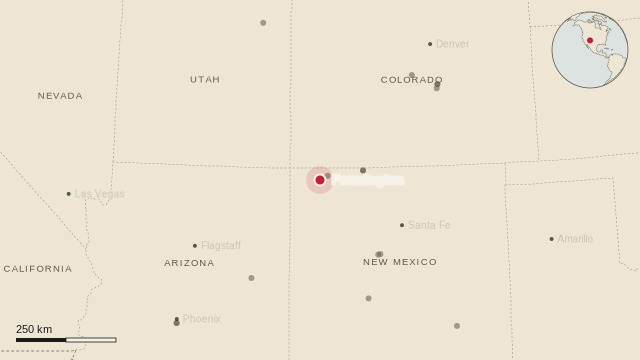
In 1950 Farmington was an oil town in the far northwest corner of New Mexico, with between 3,000 and 5,000 residents depending on the source. It lay about 120 miles (195 km) from Los Alamos, where the United States built its atomic bombs. Friday, March 17, St. Patrick's Day, dawned clear. According to Clayton J. Boddy, business manager of the local newspaper (the Farmington Daily Times) and a former Army Engineers captain, there were only a few high clouds and no strong wind capable of picking up paper. The paper wrote afterward that it was the third day in a row that "flying saucers" had been reported over town, each time between 11 a.m. and noon.
Edward J. Ruppelt, who would later head Project Blue Book, the Air Force program that investigated such reports, wrote that the 17th was "the big day." By the chronology the paper put together from witness accounts, at about 10:15 a.m. between five and nine objects passed for about ten minutes over the middle of town and moved off to the northeast. The same chronology records, at 10:00, a report of "hundreds" to the west, at 10:30 a red object, and at 10:35 a dogfight of three objects over town. The paper's main story puts the first reports a little before 11 and the AP just before noon, so the times do not agree.
Boddy was on Broadway when, as he told the paper, "all of a sudden I noticed a few moving objects high in the sky." "Moments later there appeared what seemed to be about 500 of them," he added. He could not estimate their size or speed, and put them at about 15,000 feet (about 4,600 m). Joseph and Francis Kelloff, grocers from Antonito, Colorado, who were passing through, and local men Bob Foutz and John Burrell confirmed his account. The same day Boddy told the AP it was "possibly 100 or more" and that at least 20 were close enough to look exactly like saucers.
Scores of witnesses described silvery discs. Several agreed that one was red, bigger and faster than the rest, and took it for the leader. Johnny Eaton, an insurance and real estate salesman, and Edward Brooks, an employee of the Perry Smoak garage, were the first to report the red object. Brooks, a B-29 tail gunner during the war, said he was positive they were not airplanes: "The very maneuvering of the things couldn't be that of modern aircraft."
His coworker John Bloomfield estimated they were about ten times faster than a jet and made right-angle turns. He said they seemed to come at each other head-on and, at the last second, one would veer upward and the other downward. Marlow Webb, also from the garage, said that to the naked eye they looked about eight inches (20 cm) across, like a dinner plate, and flew "sideways, on edge and at every conceivable angle."
Harold F. Thatcher, head of the local Soil Conservation Service office, said he had worked out the speed of one of the objects by triangulation, about 1,000 miles per hour (about 1,600 km/h), and according to the paper its size, twice that of a B-29. He was not a professional engineer, he said, but had engineers working under him and knew how to do a rough triangulation. State patrolman Andy Andrews attributed to residents the idea that they were bits of cotton floating by. Those residents denied it, and Thatcher answered: "It was not cotton. I saw several pieces of cotton fuzz floating around in the air at the time, but I was not sighting on any cotton."
By the paper's chronology, the clearest view of a large group came at about 11:15, and by 11:30 they had all gone. A second wave came at 3 p.m.: Mrs. Wilson Jones and Mrs. Roy Hicks, both housewives, saw objects north of town flying in perfect formation, and others said the same.
At 3 p.m. the same day, a captain and three sergeants of the Eighth Air Force saw three objects from the operations ramp at Kirtland Air Force Base, in Albuquerque, about 150 miles (240 km) southeast of Farmington. They put them at between 10,000 and 12,000 feet. At first they took them for parachutes, but ruled that out because of their tumbling, which showed a silver side and a dark side in turn. They then thought of fuel tanks dropped by fighters, until one of the three rose vertically at high speed and vanished into scattered clouds.
The other two, which the captain said seemed to be carried along by the wind at 50 or 60 miles per hour, separated and descended, one toward the north and the other toward the northeast. They followed the latter for 15 minutes until it disappeared behind the mountains. The captain stated they were not parachutes, balloons or the reflectors used on weather balloons. The four men estimated their size very differently, from a desk to a fighter plane, and none described their shape. They did not report it at the base until they read about other sightings in the area. The officer who wrote the report asked for information on weather forecasting activities and special projects before it could be analyzed.
On March 18, according to Ruppelt, the Air Force, prodded by the press, said "there's nothing to it" but offered no explanation. A newspaper clipping reports that astronomer Lincoln La Paz of the University of New Mexico, who studied the region's green fireballs (↗ New Mexico), said about 99 percent of flying saucer stories are "nothing other than hoax or illusion," but that "about one percent must be taken quite seriously," and he put this case in that "serious" class. On March 21 it was reported that True magazine would send investigators.
On April 20, more than a month later, the Air Force Office of Special Investigations (OSI) at Kirtland interviewed two residents, whose names are blacked out in the surviving copy. They said that at about 11 a.m. on March 16 (the paper dates the wave to the 17th) they saw 12 to 15 round, elongated objects, bright aluminum in color and 1 to 6 inches in apparent size. They spun on their axes and changed course at sharp angles for 3 to 5 minutes, with about ten observers nearby. The report, signed April 25 by Lt. Col. Doyle Rees, commander of that OSI district, lists speed as "unknown, faster than conventional aircraft."
In his 1956 book, Ruppelt wrote that there was an explanation that was never made public: that day a Skyhook balloon, one of the big plastic ones, launched from Holloman Air Force Base, near White Sands, had burst near Farmington. At about 60,000 feet, at 50 to 60 degrees below zero, the plastic would have turned brittle and burst into a thousand pieces that the wind carried over town and that would have looked like saucers. He conceded that no piece of plastic was ever found at Farmington, and supposed that, light as feathers, the pieces blew far away. The Blue Book folder on Kirtland holds a book page with that same explanation, labeled "(BALLOON) Observation."
Between 1967 and 1970, physicist James E. McDonald of the University of Arizona interviewed seven witnesses. Boddy no longer spoke of 500 objects but of 20 to 30, with a red one in front; in 1982 he told the newspaper it was between 50 and 100. Burrell recalled three. Webb said the press accounts were overblown and that he saw only six to eight spots of light. Eaton recalled five or six round objects and one elongated, fast one, and Andrews a rust-colored disc that tipped and climbed at a very steep angle. McDonald noted that, seventeen years on, the recollections were confused.
Where it happened
Why it matters
Farmington has something almost always missing from sightings of the period: a town looking at the sky and witnesses with names, ages and occupations. A newspaper noted what people told it, and the wire services carried it that day and the next. But no photographs or radar records are known, and the OSI reports on the town were written from interviews held more than a month later, with the names blacked out.
The "500 discs" figure that circulates in many retellings comes from an eyeball estimate by Boddy, published the next day. The paper itself spoke of "several" to more than 500, and the AP of 20 to more than 100. McDonald concluded that several groups of witnesses, at different places and times, saw different phenomena, and wrote in 1970 that the accounts contained "a lot of Venus noise."
An AP clipping of March 17 already said that most people took an object seen the day before for the planet Venus, but that "today's whole squadron" could not be explained that way. By a calculation made for this case, between 10:00 and 11:30 a.m. Venus stood between 33° and 40° high, from south to southwest, at magnitude −4.4. It is visible to the naked eye in daylight to anyone who knows where to look. It set at about 2:50 p.m., so it does not explain the afternoon group or the objects to the north and west.
None of the other explanations covers everything reported. Ruppelt's balloon cites no launch record. McDonald told a House committee in 1968 that Holloman and the Office of Naval Research, which hold the records of Alamogordo launches, informed him that no Skyhook or other experimental balloon had been released on or near that date, anywhere in the country. He conceded that Skyhooks do shatter in extreme cold, but thought it unreasonable that transparent fragments at 40,000 or 50,000 feet could confuse dozens of people into describing fast disc-shaped objects.
Two checks made for this case point the same way. The StratoCat balloon-launch catalog lists only two Holloman balloons in March 1950, on the 2nd and the 14th, which came down in Norway and Algeria. And the NCEP/NCAR reanalysis for March 17, at 12 and 18 UTC (5:00 and 11:00 a.m. local), shows at no level between 925 and 50 hPa a wind that would carry anything to the north-northwest, the heading from Holloman to Farmington, 293 miles (472 km) away. These are plausibility checks: the catalog is incomplete and the reanalysis is coarse for 1950. What no document settles is what the groups who described fast, red or formation-flying objects saw.
Documents and sources
Primary documents
Blue Book file on Kirtland AFB, March 17, 1950
Eighth Air Force air intelligence information report of March 21, 1950, on three objects seen at 3:00 p.m. on March 17 by a captain and three sergeants from the ramp at Kirtland Air Force Base in Albuquerque.
Read more
Three pages: the record card and the two sheets of the report, with each observer's statement and the comment of the officer who prepared it. The Blue Book folder also holds a book page on Farmington labeled "(BALLOON) Observation," not reproduced here because it comes from a copyrighted work; it is in the archive.org copy.
Project Blue Book (NARA), via archive.org · Public domain · US Government work · open original
OSI report on Farmington, April 25, 1950
Spot intelligence report of the Office of Special Investigations (OSI), 17th District, Kirtland, signed by Lt. Col. Doyle Rees on April 25, 1950, and addressed to OSI headquarters in Washington.
Read more
It summarizes the April 20 interview with two residents, names blacked out: 12 to 15 aluminum-colored objects of 1 to 6 inches for 3 to 5 minutes, with about ten observers. The file also includes a page listing the March 1950 sightings and their evaluations.
Documented evidence
- Farmington Daily Times, Saturday, March 18, 1950, front page: "Huge 'Saucer' Armada Jolts Farmington." For the third day in a row, objects were reported over town, each time between 11 a.m. and noon. Estimates ran from "several" to more than 500. No account mentioned trails, engine noise, windows or markings. The AP (March 17) spoke of several hundred residents and UP (March 18) of more than 50 witnesses.
- Named witnesses in the paper: Clayton J. Boddy (32, the paper's business manager, former Army Engineers captain), Joseph and Francis Kelloff, Bob Foutz, John Burrell, Harold F. Thatcher (Soil Conservation Service), Johnny Eaton, Edward Brooks (former B-29 gunner), John Bloomfield, Marlow Webb and, at 3 p.m., Mrs. Wilson Jones and Mrs. Roy Hicks.
- Boddy told the AP on March 17 that the day was clear, with scattered high clouds and no wind capable of picking up paper, and that the objects numbered "possibly 100 or more." State patrolman Andy Andrews attributed the sighting to bits of cotton; the residents he quoted denied it and Thatcher rebutted it in the paper.
- OSI report (Kirtland) signed April 25, 1950, by Lt. Col. Doyle Rees: two residents interviewed April 20 said that on March 16, at about 11:00, they saw 12 to 15 objects of 1 to 6 inches, aluminum in color, for 3 to 5 minutes, with about ten observers. Speed "unknown, faster than conventional aircraft." Gross transcribes a second OSI report, for 10:00 on March 16: 3 to 5 objects for 30 minutes, seen by two naval reserve officers who flew. Names blacked out.
- Eighth Air Force report (March 21, 1950), Kirtland Air Force Base: a captain and three sergeants saw three objects at 10,000 to 12,000 feet at 3:00 p.m. on March 17, one of which rose vertically and disappeared into clouds. Weather: clear, wind calm. The captain said two of the objects seemed carried by the wind at 50 or 60 miles per hour. The report indicates "definite objects, unidentifiable to the observers," and adds that information on "weather forecasting activities, special projects etc." is needed before it can be properly analyzed.
Show 2 more facts
- Ruppelt (1956, ch. 6): on March 18 the Air Force said "there's nothing to it" and had no explanation. He proposes a Skyhook balloon launched from Holloman that burst at 60,000 feet; he admits no piece of plastic was ever found at Farmington and cites no launch record.
- McDonald (statement to the House of Representatives, July 29, 1968): he interviewed seven witnesses 17 years later. He says he consulted Holloman and the Office of Naval Research and that no Skyhook or experimental balloon was released on or near that date, anywhere in the country. He concedes that Skyhooks do shatter in extreme cold.
Sources
- Farmington Daily Times, "Huge 'Saucer' Armada Jolts Farmington" (Mar 18, 1950, front page); NICAP transcription — First source for the day: the main story with the named witnesses, the number estimates and the rebuttal of the cotton explanation.
- Project Blue Book, file 1950-03, Kirtland AFB, New Mexico (NARA, archive.org mirror) — Eighth Air Force air intelligence report on the 3:00 p.m. sighting at Kirtland on March 17, with its record card, and a book page on Farmington labeled "(BALLOON) Observation."
- OSI spot intelligence report, 17th District, Kirtland AFB (Apr 25, 1950), in NICAP's dossier of Blue Book documents — Scanned copy of Lt. Col. Doyle Rees's report on the April 20 interviews with two residents; the names are blacked out.
- E. J. Ruppelt, The Report on Unidentified Flying Objects (1956), ch. 6 (Project Gutenberg) — The later head of Blue Book tells the case and proposes the Skyhook balloon explanation without citing a launch record; he says no piece of plastic was found.
- J. E. McDonald, statement in the Symposium on Unidentified Flying Objects, U.S. House of Representatives (Jul 29, 1968), Case 9 — Interviews with seven witnesses 17 years later and his inquiry to Holloman and the Office of Naval Research about balloon launches.
- Loren E. Gross, UFOs: A History, vol. 5 (Jan-Mar 1950) and supplemental notes (secondary compilation) — Secondary source: reproduces the AP and UP clippings, including the Portales Daily News of March 17 and the Albuquerque Tribune on La Paz, the paper's chronology, McDonald's handwritten notes, the 1982 interview with Boddy and the text of the second OSI report.
- StratoCat, 1950 balloon launches (Holloman AFB, March 2 and 14) — Catalog of stratospheric balloon launches: for Holloman in March 1950 it lists only March 2 (came down at Myrdal, Norway) and March 14 (came down in northeast Algeria). The catalog is not complete.
- NOAA PSL, NCEP/NCAR Reanalysis 1 (pressure-level winds, 1950) — Wind data (uwnd and vwnd) for March 17, 1950, 2.5° grid, used in the calculation made for this case on a balloon from Holloman. A coarse reanalysis, with few observations in 1950.
Related cases
Cases this case cites and cases with the same likely cause.