Case No. 156·El Salvador
2009·First Air Brigade, Ilopango Airport, San Salvador
El Salvador.Ilopango · unidentified object photographed at air base (El Salvador, 2009)
In April 2009, a member of the Salvadoran Air Force — who asked to remain anonymous — photographed aircraft parked on the military ramp from the second floor of the First Air Brigade building at Ilopango Airport. On reviewing the image, an unidentified object appeared near the threshold of the old runway 08, in broad daylight, that had not been noticed at the moment of capture. The case, together with antecedents such as the January 1969 sighting over San Salvador, is documented by the Salvadoran aviation community. Its value is geographic: it opens El Salvador in the corpus. Its evidence is weak: a single frame from an enthusiast source, an anonymous photographer, with no analysis or chain of custody — the classic pattern of an object captured but not seen, compatible with a mundane artifact.
Year
2009
Tier
B
Probability
25%
Category
Incident
Limited evidence: single-witness, local or without primary verification. Three independent axes: the «tier» measures the strength of the evidence; the «probability» estimates how genuinely unexplained the case is —a natural phenomenon can remain unexplained, so it does not equal «non-prosaic»—; and the partition of explanations (below) says what it most plausibly was. So a well-documented case can have a possible hoax as its most plausible cause, and a Tier B is not, for that reason, a hoax.
Primary documents · viewer
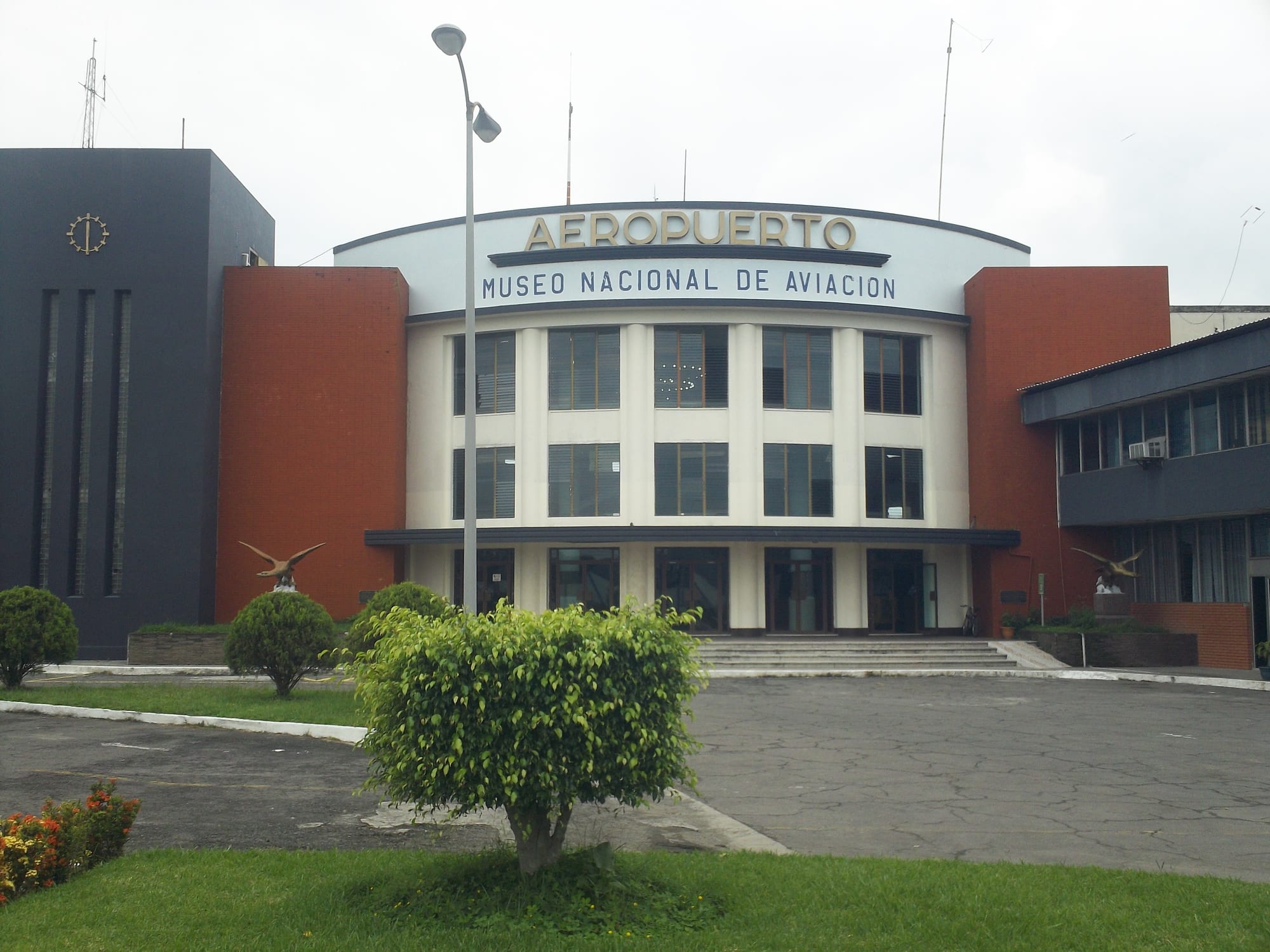
Context · Ilopango Airport (El Salvador)
32-0001 Aeropuerto de Ilopango.jpg · Wikimedia Commons · CC BY-SA 3.0 · open original
Part 01
The night in question
In April 2009, a member of the Salvadoran Air Force went up to the second floor of the First Air Brigade building at Ilopango Airport intending to photograph aircraft parked on the military ramp. He noticed nothing anomalous while shooting. On reviewing the photographs afterward, he found in one of them an unidentified object flying very close to the threshold of the old runway 08. The object, captured in broad daylight, appeared to move at high speed and did not correspond to any known aircraft or common atmospheric phenomenon. The witness chose to remain anonymous; the image circulated among personnel and was compiled by the Salvadoran aviation community.
The episode belongs to a tradition of less-documented Salvadoran sightings. The most cited antecedent is that of January 15, 1969: around 3:30 in the afternoon, a bright ovoid object flew over San Salvador with rapid movements; two carpenters working on the terrace of El Diario de Hoy alerted journalists, and witnesses described it as a fast disc that at times released black smoke before moving off toward Cerro de San Jacinto. At the time a prosaic explanation was suggested: the Soviet crewed mission Soyuz 4, launched on January 14 of that year, whose re-entry or pass could have been seen from the region. There was also, decades later, a wave on February 29, 1996, when numerous people across the country reported lights crossing the sky at high speed, triggering a flood of calls to the media and even to the meteorology office at Ilopango airport itself; episodes of this kind —fast luminous points seen by many at once— usually correspond to re-entries of space debris or meteoric fireballs.
None of these episodes has the multiple instrumentation, chain of custody or independent re-analysis that distinguish the corpus's high-tier cases. They are press and aviation-community records, valuable as regional coverage but fragile as evidence. The 2009 photograph, in particular, presents the weakest possible pattern: a single frame, with no original negative or verified metadata, from an anonymous photographer, in which the supposed object was seen by no one at the moment of capture and appeared only on reviewing the image.
Part 02
Why this case moved the needle
It matters for geographic coverage, not probative strength: it opens El Salvador in the corpus and densifies an almost-empty Central American isthmus (until now only Costa Rica and Panama). But its tier is B for an explicit reason: the 2009 photograph comes from an enthusiast source, with an anonymous photographer, no verified original negative, no photogrammetric analysis and no chain of custody. The case's central feature — an object that appears in the image but that no one saw while shooting — is precisely the hallmark of mundane artifacts: birds, insects near the lens, a distant aircraft, or a sensor defect. The 1969 antecedent reinforces the skeptical reading, because the press of the day itself offered a concrete candidate (Soyuz 4). It is included with that honest label: a low-confidence case that completes the Central American map and serves as contrast with the region's instrumented anchors.
The file teaches something concrete about 'objects that appear only in the photo'. In photography this phenomenon has a banal and demonstrable cause: a small, nearby object —a bird, an insect, a droplet, or a speck near the lens— crosses the frame during the exposure and is recorded out of focus and blurred, giving the false impression of a large, fast body at middle distance; the photographer's eye, focused on the distant aircraft, simply does not notice it. That the witness is military does not raise the quality of the evidence: what is decisive is not who pressed the shutter, but the absence of the negative, the metadata, and a photogrammetric analysis to estimate size and distance. That is why Ilopango enters the corpus as a geographic, not probative, datum, and its probability reflects that the mundane reading covers the case effortlessly.
Part 03
What's left on paper
Documented evidence
- April 2009 photograph taken from the second floor of the First Air Brigade (Ilopango) showing an unidentified object near the threshold of the old runway 08
- Photographer identified as a member of the Salvadoran Air Force, anonymous by his own choice
- The object was not perceived at the moment of capture — it appeared only on reviewing the image — and was captured in broad daylight
- January 15, 1969 antecedent: a bright ovoid object over San Salvador, witnesses at El Diario de Hoy (carpenters Daniel Lauda Martínez and Manuel Martínez)
- For the 1969 case, the contemporary press proposed as a prosaic candidate the Soviet Soyuz 4 mission (launched January 14, 1969)
- Compilation by the Salvadoran aviation community (Flotilla Aérea) — with no verified original negative, photogrammetric analysis or chain of custody
Sources
- Flotilla Aérea — 'Luces y enigmas en el cielo' — Compilation of the 2009 Ilopango case by the Salvadoran aviation community.
- El Salvador.com — 'Enero 1969: OVNI sobrevuela San Salvador y genera alarma entre capitalinos' — Historical precedent with the prosaic candidate Soyuz 4.
Location
First Air Brigade, Ilopango Airport, San Salvador · 13.70°, -89.12°
Distribution of explanations
This case is classified among the model's hypotheses: the bar splits 100% by how much each explanation weighs (the uncertainty is spread across the hypotheses the case supports). Summed across the corpus they produce the comparable partition. It is a different question from the Probability above: that one estimates how likely the case is a genuinely unexplained phenomenon; this one splits which the explanation would be.
Modal hypothesis: Misidentification 91% · sums to 100%
Confused with: No single object identified
Structured analytical judgment, not a calibrated frequency. Forced classification: the mass the evidence cannot assign is spread across the hypotheses the case does support.