Case No. 157·South Africa
1996·Pretoria / Mamelodi / Cullinan, Gauteng
South Africa.Pretoria / Mamelodi · police helicopter chase (South Africa, 1996)
At 4:00 a.m. on August 28, 1996, Sergeant Nico Stander, on duty at the Adriaan Vlok police station in Pretoria, videotaped a pulsating luminous disc; resident Johann Becker saw it over Erasmuskloof. A chase ensued involving some 200 policemen and a police Bo-105 helicopter, piloted by Superintendent Fred Viljoen, who spotted the object over Mamelodi. During the pursuit the object made undulating movements and outpaced the helicopter at its maximum speed (~270 km/h); the chase was abandoned at 10,000 feet in the Cullinan area when fuel ran low and the object ascended vertically. Viljoen kept contact with the Waterkloof Air Force Base tower, whose radar reported 'clutter' in the area. It is the best-documented South African event in institutional multi-witness terms, though its hard instrumentation is ambiguous.
Year
1996
Tier
A
Probability
58%
Category
Incident
Institutional evidence: multiple verifiable witnesses or official documentation. Three independent axes: the «tier» measures the strength of the evidence; the «probability» estimates how genuinely unexplained the case is —a natural phenomenon can remain unexplained, so it does not equal «non-prosaic»—; and the partition of explanations (below) says what it most plausibly was. So a well-documented case can have a possible hoax as its most plausible cause, and a Tier B is not, for that reason, a hoax.
Primary documents · viewer
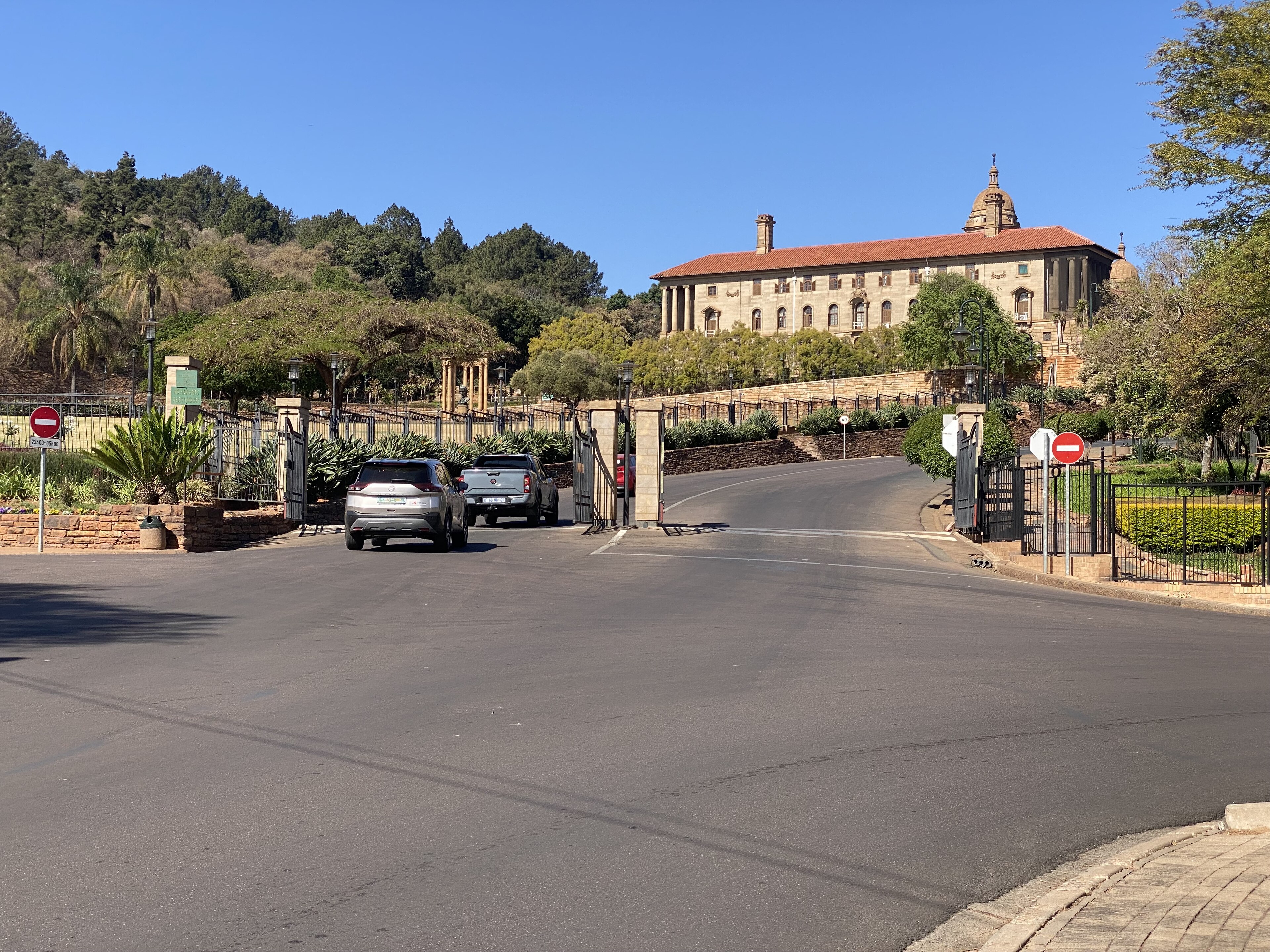
Context · the Union Buildings in Pretoria (South Africa)
Union Buildings Pretoria 05.jpg · Wikimedia Commons · CC BY 4.0 · open original
Part 01
The night in question
On August 28, 1996, around 4:00 a.m., Sergeant Nico Stander, on duty at the Adriaan Vlok police station in Pretoria, observed and videotaped a pulsating luminous disc in the sky. The object, described as a throbbing disc that included a red triangle and at one point emitted bright green 'tentacles', was also seen independently by Johann Becker, a Pretoria resident, hovering over the Erasmuskloof area, southeast of the capital.
The observation escalated into an unusually coordinated chase. Some 200 police on the ground took part, along with a South African police Bo-105 helicopter, which took off at 5:30 with five officers aboard under Superintendent Fred Viljoen. The crew spotted the object over Mamelodi, the large township east of Pretoria. During the pursuit, which covered kilometers, the object performed undulating vertical and horizontal movements and outpaced the helicopter, which was flying at its maximum speed of about 270 km/h. The chase was abandoned at 10,000 feet (about 3,000 m) in the Cullinan area, to the northeast, when the helicopter's fuel ran low and the object made a vertical ascent that took it out of range.
Viljoen stated that he did not request that an Air Force Mirage fighter be scrambled, but that he kept radio contact with the control tower at Waterkloof Air Force Base, the main military base in the area; operators told him their radar showed 'clutter' (diffuse echo) in the area where the disc was flying. This datum is at once suggestive and limiting: a radar registering 'clutter' confirms that something was disturbing the signal in that direction, but it is not a clean, trackable return fixing the position, speed and altitude of a solid object. Viljoen, a veteran pilot, emphasized that it was the first time in his life he had seen anything like this and that he had always been skeptical about UFOs and visitors from other planets — a detail that weighs in favor of the testimony's credibility, though it does not resolve the object's nature. Stander's video, shot at night with 1996 technology, circulated for years but never allowed a conclusive optical analysis separating the object from possible lens artifacts or a bright background body.
Part 02
Why this case moved the needle
It is the best-documented South African event in institutional multi-witness terms and the only African case in the corpus, alongside Ariel School, with coordinated official observers: a police videotape, ~200 officers on the ground, a helicopter crew with a named pilot, and real-time contact with an air base. The reported behavior —undulations, outpacing a helicopter at 270 km/h, vertical ascent as the chase ran out— strains explanations of a passive natural phenomenon or simple astronomical confusion. But the case is not Tier S for two honest reasons: the Waterkloof radar reported diffuse 'clutter', not a clean trackable return, and the more exotic visual descriptions (red triangle, green tentacles) admit combined prosaic readings (a bright body like Venus in the background plus video and lens artifacts in a 1996 nighttime recording). It stands as a strong South African anchor — strong in witnesses, soft in hard instrumentation — exactly the contrast the corpus seeks when densifying an underrepresented region.
Two considerations sharpen the reading. The first is the quality of the main witness: a police superintendent with flight hours and declared skepticism is hard to dismiss as credulous, and his description of the object's behavior —not his interpretation— is what really weighs. The second is the accumulated technical fragility: the chase took place before dawn, when a bright astronomical body (Venus was well placed in southern-hemisphere skies at that time of year) can appear to 'follow' and 'evade' a moving vehicle through a parallax effect, and a 1996 nighttime video amplifies that ambiguity with halos and lens artifacts. The radar 'clutter' settles the dispute in neither direction. The case is therefore robust institutionally and in its chain of witnesses, but it remains one step short of the hard proof that would definitively separate a maneuverable object from a well-documented illusion of pursuit.
Part 03
What's left on paper
Documented evidence
- Video recorded by Sergeant Nico Stander (on duty, Adriaan Vlok police station, Pretoria) of the pulsating luminous disc, Aug 28, 1996 ~4:00 a.m.
- Independent observation by resident Johann Becker over Erasmuskloof
- Coordinated chase with some 200 police on the ground
- South African police Bo-105 helicopter (5 officers) piloted by Supt. Fred Viljoen; sighting over Mamelodi
- The object outpaced the helicopter at ~270 km/h with undulating movements and a final vertical ascent at 10,000 ft over Cullinan
- Real-time contact with the Waterkloof Air Force Base tower; radar reported 'clutter' in the area (diffuse echo, not a clean track)
- Viljoen, the pilot and main witness, was a self-declared skeptic about UFOs before the event
Sources
- Wikipedia — UFO sightings in South Africa — Chronology of the 1996 Pretoria incident with names and details.
- HandWiki — UFO sightings in South Africa — Detail of Viljoen's account and the contact with Waterkloof.
- UFO Casebook — 1996 South Africa Police Chase / Film UFO — Compilation of the case and the video material.
Patterns it exhibits (1)
Location
Pretoria / Mamelodi / Cullinan, Gauteng · -25.72°, 28.39°
Distribution of explanations
This case is classified among the model's hypotheses: the bar splits 100% by how much each explanation weighs (the uncertainty is spread across the hypotheses the case supports). Summed across the corpus they produce the comparable partition. It is a different question from the Probability above: that one estimates how likely the case is a genuinely unexplained phenomenon; this one splits which the explanation would be.
Modal hypothesis: Misidentification 65% · sums to 100%
Confused with: Astronomical
Structured analytical judgment, not a calibrated frequency. Forced classification: the mass the evidence cannot assign is spread across the hypotheses the case does support.
Related cases