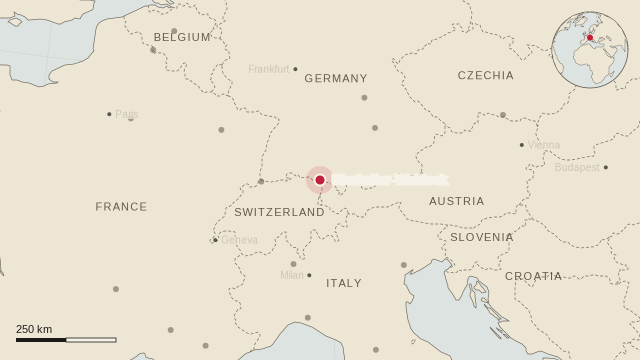
1977·Bierkeller-Waldeck, Langenargen (Lake Constance), Germany
Germany.Langenargen · two witnesses see lights; one sees two small beings
In the early hours of Thursday, February 24, 1977, Lothar Schäfler and Rudi Grutsch, owner of the Waldeck café, saw two objects with very intense blue-white lights at Langenargen on Lake Constance. Schäfler later said he saw two small beings, broke the glass of a door to escape, and police took him to a hospital. A neighbor and a farmer saw glows from other spots. MUFON-CES investigated in 1977: its psychologist judged the light real and the physical reality of the beings doubtful.
Tier A · AcceptableWhat do they mean? →
Institutional evidence: several identified independent witnesses, or contemporary official documentation, without an instrumental record to corroborate them.
What it was
55%psychological, medical or social cause
The most likely explanation.
- 55% psychological, medical or social cause
- 4% other earthly causes
- 41% no known cause
See the split across the six explanations
Earthly origin (human or natural)59%
No known cause41%
Ordinary cause the sources propose: psychological, medical or social cause
What happened
On the night of Ash Wednesday into Thursday, February 24, 1977, the sky over Lake Constance was overcast. Lothar Schäfler, a 27-year-old employee of the German Federal Railways, was driving Rudi Grutsch, 52, home in his Citroën 2CV. Grutsch owned the Waldeck café, in Bierkeller-Waldeck, a district of Langenargen two kilometers north of the town center. They came from the Magg bar and left around 2:00 a.m. As Grutsch got out of the car, Schäfler saw something bright in the sky. Between the spruce trees and the roof of the house, the two saw two points of light approaching in a straight line from the lake.
Grutsch estimated they were flying about 1,000 meters up. At about 500 meters away they stopped and hung motionless for some five minutes. Each object had four circular lamps on its front, with a blue-white light so intense that Grutsch had to shield his eyes with his hand; he could not make out more. Schäfler thought he saw oval outlines and spoke of a high whistle. After about two minutes they moved toward each other until they seemed to touch and went out all at once. Grutsch looked at his watch and said it was exactly 2:10.
Grutsch said goodbye shortly after 2:30 and went in through the back door. From the ground-floor window he saw the two objects reappear from the northeast, about 150 meters away and 50 to 60 meters up, with four lamps each lighting the yard and the neighboring houses as bright as day. He saw Schäfler running outside and, in front of the kitchen, a shadow shaped like a small barrel. After two or three minutes the lamps merged: he counted eight, then six, four, two, and finally a single one. Right away he heard cries for help and breaking glass, and his wife phoned the Friedrichshafen police.
Schäfler described what happened outside. When the objects went out and he was about to get into his car, he saw the light flare up again: now a single object, enormous and very near, with a high, piercing tone, not loud. He threw himself to the ground among some bushes by the fence and, as the light kept coming closer, ran to the back entrance of the neighboring house, the Burkharts'; he estimated the object at 50 to 80 meters away, and the investigators put its height at about 18 meters. There he heard a short whistle, felt a slight draft, and saw two beings standing behind him, the larger about a meter away.
They were 1.30 and 1.10 meters tall, with a body like a human's, long arms, cramped fingers, a harlequin-like frill at the neck, a round hairless head, a round mouth, slanted eyes, and no visible nose or ears. They swayed slowly and stared at him. Schäfler said he then lost control. He threw himself against the Burkharts' door, broke a pane with his hand, opened it from inside, and fell into the hallway without looking back. When the people of the house came, the beings and the lights were gone.
The Burkharts said that around 3:30 their doorbell rang for almost a quarter of an hour, there were cries, and glass broke. Mrs. Burkhart waited five to eight minutes before calling to the Grutschs from the roof window. Going downstairs, they found Schäfler, a stranger to them, lying in the hallway with his hand bleeding and pointing at the sky, and took him for drunk. The police arrived within minutes, saw it was not a burglary, and around 4:00 took him to the hospital in Friedrichshafen, where two cut fingers were bandaged. The officers suspected alcoholic delirium, but the blood test showed 0.3 per mille, or 0.03%. According to his colleague Wolfram Nafts, he later had insomnia and a stomach ulcer.
Nafts persuaded him to tell the press. On March 2, Bild ran a note headed "Ufos über dem Bodensee: 8 Menschen haben sie gesehen," and the Schwäbische Zeitung of Friedrichshafen expanded the story on March 4. There Schäfler refused to say whether he had seen occupants and answered that he would discuss that only with experts. MUFON-CES, the Central European section of the Mutual UFO Network, then led by Illobrand von Ludwiger, learned of the case from Bild and spoke with the main witnesses on March 25.
Other witnesses came forward days later, when the story was already public. Mrs. Brielmaier, about 65, lived less than 100 meters away: she heard a deep, powerful engine sound and a high whistle, as if two objects wanted to land, and saw the sky lit up beside the Grutschs' house; the light vanished after a shout and the sound of breaking glass. The farmer Karl Brugger, 1.4 kilometers away, saw in the middle of the night a round light brighter than stadium floodlights, without noting the time. Two women, 10 kilometers away, saw lights toward Langenargen, according to a railwayman who told Nafts. In Oberdorf, Wilhelm Mehr saw at 12:45 a.m., more than an hour earlier, a distant white light, at first still like a star, which after eight minutes moved on at the speed of an airliner and vanished at once.
Captain Kotz of the direction-finding station of signals regiment 72, one kilometer from the café, said that no observations or disturbances were noted that night. Fritz Meier, an editor of the Schwäbische Zeitung, asked the radar station at Kempten and, through a Swiss colleague, Zurich air traffic control, with the same result. On April 6 a Geiger counter registered no raised radioactivity and a compass showed no magnetization of the fence. No physical trace was found. Other neighbors saw nothing and the dogs did not bark.
MUFON-CES put Schäfler through psychological tests. The MMPI test, three months later, showed no abnormal personality, but it did show anxiety; the psychologist Siegfried Streubel also gave him the Rorschach test. In 1977 the hypnotherapist Bick questioned him under hypnosis: Schäfler added details of the beings and said he felt he had been lifted off the ground, but he recovered nothing of the hour that seemed lost.
According to von Ludwiger's book, in September 1978 a cyclist in a black coat told Schäfler to stop talking about his experience and dissolved ten meters ahead. Von Ludwiger proposes a psychic projection. Weeks after the first encounter Schäfler began to faint, which Streubel had predicted as the beginning of epilepsy; by 1989 the attacks were weaker and rarer.
Where it happened
Why it matters
Almost the whole case rests on the investigators' own report, written in 1977 by I. Brand and A. Schneider, and on a 1998 book by von Ludwiger. The attention of the police and the hospital to Schäfler is known only from the witnesses and that report; no police or military file has been published. Brielmaier and Brugger described a very intense glow over the café, and the investigators took the existence of that light as certain, but they spoke after the news was already out and without pinning down the time.
The psychological evaluation in the 1977 report gives a reliability of 90% for Schäfler and concludes that his beings were not invented under hypnosis. Schäfler offered himself for the lie detector and hypnosis, his reality index on the Rorschach was 6 out of 8, and Streubel said his fear symptoms were the most serious he had seen in witnesses of a shock. But Streubel also concluded that the objectivity of what Schäfler experienced after the light was very limited: it was most likely a product of his processing of the experience, lived for real but as a self-projected daydream. He found neurotic disorders and absences and a high tone in the ear that can be small epileptic seizures, which would explain the missing half hour.
The psychiatrist Bjarsch, of Berlin, noted that it was the night after Shrove Tuesday: a pre-delirious state from alcohol required heavy drinking the day before, which was met, and severe sleep deprivation, which was not. For Bjarsch fear alone does not cause hallucinations and a psychotic predisposition would be needed, and a bright object with strange beings is not the usual content of a hallucination; whether it was hallucination or projection, he could not decide. The investigators call the beings projections, because the two-meter fence would have kept them from approaching, and conclude that the object more likely caused them: Grutsch and Brielmaier agree that the light went out when Schäfler began to scream, though perhaps by chance. They found no beings with such clothing or such a mouth in the literature. They also cite a depth psychologist: the frog Kermit.
Grutsch, the only one who saw the lights with Schäfler, gave different versions at each interview: on March 25 he said he had also seen the beings, one on each side of Schäfler, and on April 6 only a barrel-shaped form, in another place. On the third day he saw little musicians on the furniture, he refused the psychological tests, and the investigators concluded that he was not sober enough that night; they rated his reliability at 50%. The physicist Schiebeler, who visited him a week later, did not find his account credible. The six witnesses of the light in the report are Schäfler and Grutsch, who were together, Brielmaier, Brugger, and the two women known second-hand. Brielmaier saw the surrounding houses dark and Grutsch saw them lit as bright as day.
The time does not add up either. Grutsch dated the first sighting at 2:10, but the Burkharts heard the doorbell around 3:30, and the investigators put the end of the light around 3:35. The owner of the Magg bar said he closed at 2:00, which does not fit the police arrival around 3:45. The investigators mention that the bar may have closed at 3:00 and Grutsch been off by an hour, but they judge it unlikely. Schäfler felt he had lost an hour of memory.
The alcohol is also disputed: according to the report Schäfler drank four to five viertele of wine and according to Bild four beers at most. Rudolf Henke, in a 1993 reassessment quoted on Roland M. Horn's blog, held that 0.3 per mille was low for that amount and that his later symptoms pointed to alcohol; Horn answers that, with the drinks spread between 10:00 p.m. and 2:00 a.m., the value is compatible. In September 1977 his doctor found him addicted to a sleeping drug.
The 1998 book says that seven years later it emerged that the military had indeed detected an object. According to the Münchner Merkur of November 11, 1980, the Italian Defense Ministry reported that in the night of February 23 to 24, 1977, a UFO followed an Italian fighter for 23 minutes over some 375 kilometers and disappeared after a 270-degree turn over the Po Valley. Between 1977 and 1980 there are three years, not seven, and neither the newspaper nor the report could be read.
The Italian UFO center CUN cites the report of an F-104G pilot: around 9:00 p.m., after passing over Civitanova Marche toward Macerata, he saw a white light 800 or 900 meters away that kept pace with him on a southeast to northwest heading; during a turn to the west, the light moved away and vanished at once. An Italian forum adds 23 minutes and the mouth of the Po. Everything suggests it is the event in the Merkur, but it happened about five hours before the first sighting at Langenargen and 370 to 580 kilometers to the southeast, depending on the point, by a calculation made for this case. No source links it to Langenargen except the date.
No analysis identifies an object for the lights. The only suggestion, French Puma helicopters, came from Mrs. Brielmaier's son-in-law and was not tested. She recalled the roar of the Pumas in the area, but the son-in-law added that landing among the houses would have been forbidden to them and that the whistle of the objects was louder. Schäfler, who had served in an army helicopter unit, ruled it out because of the light and the noise. Houben, owner of the Bierkeller, said he saw a yellow sports car with French plates pull out with all its headlights on, which woke him. The GCAT catalog records only fragments with a reentry on those days, with no time, and a reentry lasts seconds.
Documents and sources
Documents
1977 MUFON-CES report on Langenargen (I. Brand and A. Schneider), pp. 43-82
The investigators' own report, written in 1977, with interviews of Schäfler, Grutsch, Mrs. Brielmaier, Brugger, and Mehr, site plans, the timeline of the night (p. 68), the Bild clipping of March 2, 1977 (p. 44), Streubel's psychological assessment (pp. 64-67), and the psychiatrist Bjarsch's (pp. 75-76). Not an official file. It is a scan in German; the original is linked.
I. Brand and A. Schneider, MUFON-CES Bericht 4, pp. 43-82 · view source
Documented evidence
- Around 2:10 a.m. on February 24, 1977, according to Grutsch, he and Schäfler saw in the parking lot of the Waldeck café in Langenargen two objects with four lamps of blue-white light each, about 500 meters away and motionless for some five minutes (1977 MUFON-CES report).
- Mrs. Brielmaier, less than 100 meters away, and the farmer Brugger, 1.4 kilometers away, described a very intense glow over the café; neither noted the time and both told their stories days later, when the case was already public (1977 MUFON-CES report).
- The Friedrichshafen police came after Mrs. Grutsch's call and took Schäfler to the hospital around 4:00 a.m.; two fingers cut by the glass of a door were bandaged and the blood test showed 0.3 per mille (1977 MUFON-CES report).
- Bild of March 2, 1977, "Ufos über dem Bodensee: 8 Menschen haben sie gesehen," and the Schwäbische Zeitung of March 4 published the account; in the latter Schäfler refused to say whether he had seen occupants.
- The direction-finding station of signals regiment 72, one kilometer from the café, noted no observations or disturbances that night; the Kempten radar station and Zurich air traffic control, consulted by the Schwäbische Zeitung editor, gave a negative result.
Show 3 more facts
- On April 6, 1977, a Geiger counter registered no raised radioactivity and a compass showed no magnetization of the fence posts; no physical trace was found.
- Schäfler passed the MMPI test with no values of an abnormal personality. The psychologist Streubel concluded in 1977 that the light was real and that the later account of the beings could be a product of the processing of the experience; the investigators call them projections.
- Grutsch gave different versions at each interview, refused the psychological tests, and the investigators rated his reliability at 50%; on March 25, 1977 he said he had also seen the beings and on April 6 he recalled a single barrel-shaped form.
Sources
- I. Brand and A. Schneider, "Untersuchungen von UFO-Berichten aus Deutschland 1977 durch MUFON-CES" (MUFON-CES Bericht 4), pp. 43-82 — The investigators' own report, written in 1977: interviews with the witnesses, site plans, timeline (p. 68), the Bild clipping (p. 44), Streubel's Rorschach assessment (pp. 64-67), and the psychiatrist's evaluation (pp. 75-76). Not an official file.
- Illobrand von Ludwiger, "Best UFO Cases: Europe" (NIDS, 1998), ch. 5.2, "The Langenargen/Lake Constance Case" — A 1998 summary by the same investigator, with the 1980 Italian press note, the man in black on a bicycle, and Schäfler's medical course up to 1996; those items appear only here.
- Roland M. Horn, "Die klassische UFO-Sichtung bei Langenargen, Pseudoskeptiker und Dr. Bick" (blog, Dec 2, 2020) — A secondary source that favors the case's authenticity: it summarizes the account and quotes Rudolf Henke's skeptical reassessment (JUFOF 3/1993) with its rebuttal on the alcohol.
- Luigi Barone (CUN Milan), "UFO e autorità militari e governative in Italia" — Quotes the report of an F-104G pilot of February 23, 1977 written for the Italian Defense Ministry; a secondary source from a UFO group.
- Ufoforum.it, "UFO e Abductions" (catalog of Italian cases, 2/23/1977, F-104G) — A forum with a case catalog; it adds the 23 minutes and the mouth of the Po to the pilot's report. Not a primary source.
- Jonathan McDowell, GCAT, General Catalog of Artificial Space Objects (satcat.tsv) — Reentries dated February 23 and 24, 1977: fragments only, with no time.
- AARO — Fiscal Year 2024 Consolidated Annual Report on UAP (Nov 14, 2024) — Base rate: 174 cases finalized as resolved, all as conventional objects.