1960·Near Leibnitz, Styria, Austria
Austria.Leibnitz · a press photographer snaps a glowing "spider"
At about 1:30 a.m. on Wednesday, March 2, 1960, near Leibnitz in Styria, Austria, Edgar Schedelbauer, a correspondent for the Vienna newspaper Wiener Montag, was riding home on his motorcycle when, according to his paper, he saw a glowing object hold still for about ten seconds over a wood, some 14 meters up, felt its heat and photographed it. The paper ran the photo on its front page on March 7. The U.S. Air Force never received the negative and filed the case as insufficient data; its comment suggested the photographer had probably made up most of the story.
Tier A · AcceptableWhat do they mean? →
Institutional evidence: several identified independent witnesses, or contemporary official documentation, without an instrumental record to corroborate them.
What it was
75%possible hoax
The most likely explanation.
- 75% possible hoax
- 3% other earthly causes
- 22% no known cause
See the split across the six explanations
Earthly origin (human or natural)78%
No known cause22%
Ordinary cause the sources propose: possible hoax
What happened
On Monday, March 7, 1960, Wiener Montag, an independent Vienna paper that came out on Mondays, gave its whole front page to a photo of a bright white object against a dark background and called it "the most sensational photograph of our century." A United Press International (UPI) wire from Vienna reported it that same day, and the wire ended up in the U.S. Air Force's file. According to the wire, the photographer was Edgar Schedelbauer, 36, the paper's correspondent in the province of Styria. At 1:30 a.m. the previous Wednesday, March 2, he was on his way home near Leibnitz, a small town about 35 km south of Graz, when he saw a "glowing object" moving about 45 feet (some 14 meters) up.
Still according to the paper, the object was rotating, moved slowly and held still for about ten seconds over a wood. "It looked like a white-glowing spider," Schedelbauer said. He said he immediately grabbed his camera and took a few shots, some of which came out well. He also said he clearly felt the heat it gave off, and that when the object vanished after a few seconds he heard a noise like a jet aircraft. The paper added that it published the story only after careful thought and after experts had checked the negative and found no sign of a trick shot. It also admitted that several Austrian scientists and the aerospace engineer Eugen Sänger, who worked in West Germany, had been consulted before publication and were skeptical.
On the same day, March 7, the Special Security Office at Air Force headquarters in Washington sent the text of a press item about the photo by teletype to the Air Technical Intelligence Center (ATIC), which ran Project Blue Book, the Air Force program that studied sightings, and asked for an evaluation. On March 8, a routing slip passed the matter to Major Friend, who headed Blue Book, for action. A penciled note on the slip says a call had gone to Germany to try to get a copy of the picture.
The undated Blue Book record card sums up the published account: on March 2, at 1:30 a.m., at Leibnitz, a civilian witness on the ground watched one object for ten seconds, course not given. It checks the box for photos but adds "Not Received," and notes that the negatives never reached ATIC. The conclusion checked is "Insufficient Data for Evaluation." The comment says no evaluation is possible without analyzing the negative, and that the witness may have seen a leaking weather balloon carried along by surface winds. It adds that the witness "probably made up most of the story in order to create sensationalism, which in turn sells more newspapers," and that the picture is too unclear for any valid conclusion.
The rest of the file is clippings and notes with no date or signature. A clipping from an unidentified American paper reproduces the photo, a blurred white C-shaped smear, and says C. W. Fitch, a UFO investigator in Cleveland, received it from Wiener Montag. Its version changes details: the photographer was riding his motorcycle through the countryside at 1 a.m., first thought he was seeing a falling star, the object hung motionless over the road, the picture was taken from 50 feet away, and the object left after six or seven seconds.
Another clipping, with similar wording that names neither Fitch nor the paper, carries the handwritten note "Source: IAPA - Sep 63," initials the file does not explain. There are also three different typed notes, one of them copied on two sheets, that sum up the case with errors and additions. The first places the event "near Vienna," some 170 km from Leibnitz, and says the photographer suffered burns. The second specifies burns on his face and hands and says the photos were taken near "Labuttendorf," a village about 7 km east of Leibnitz. The third places it "in Vienna."
Where it happened
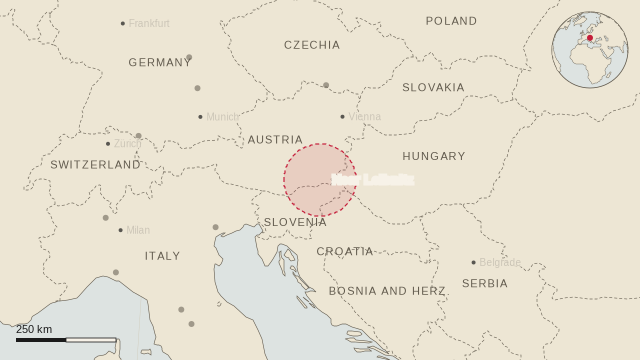
Why it matters
The case entered Blue Book through a press item, not a witness report: the teletype from Washington asked for an evaluation of what had been published. ATIC never had the negative, so its finding of insufficient data records what it lacked, and its comment admits as much: the leaking-balloon idea and the notion of a story invented to sell papers are guesses written without analyzing the negative. Everything known about the event comes from one witness, told by his own newspaper, and no one else is known to have seen it.
The details shift with each teller. The UPI wire speaks of an object about 14 meters up and of the heat the photographer felt. The American clipping speaks of a photo taken from about 15 meters away, and the typed notes, of burns. The duration ranges from six or seven seconds to "over 10," and the time from 1:00 to 1:30 a.m. Schedelbauer likened the object to a spider; the notes describe it as a "glowing round device" shaped like a saucer.
The Spanish researcher Vicente-Juan Ballester Olmos gathered the period coverage on the blog of his FOTOCAT photo catalog (2013), and he quotes another version from Wiener Montag itself: the object was 15 meters off the ground and 45 meters from the photographer. In that version, Schedelbauer jumped off his motorcycle, hid in a ditch and for three days had red spots on his face and hands, which neither itched nor hurt.
According to Ballester Olmos, in the United States the photo appeared in the Niagara Falls Gazette (April 21, 1960), in Saucer News magazine (June 1960) and in Fate (October 1960), where an article by Harlan Wilson carried the endorsement of Norbert Gariety, editor of Space magazine, and of the well-known journalist Frank Edwards, both presented as experienced photographers. Richard Hall, of the civilian group NICAP, asked the photographer for the picture and got no reply, listed it in 1964 as an incomplete case and said he was skeptical because it was the kind of photo that is easy to fake.
Ballester Olmos obtained a print of the photo from the paper itself in 1969 and in 2013 asked the Italian photography consultant Paolo Bertotti for his opinion. Bertotti proposed several ways to fake the image: first, a small C-shaped object, perhaps a bent drinking straw, lit by the flash 5 to 10 cm from the camera and moved during the exposure; others, a paper cutout in front of the lens or a light deliberately thrown out of focus. He also pointed to some sharp streaks at the bottom that he put down to scratches or retouching on the negative. He concluded it was a faked photo, while warning that, because it is blurred, only hypotheses are possible. After reading that analysis, the skeptical writer Tim Printy moved the case, in his newsletter SUNlite (2020), from insufficient data to probable hoax. The original negative is not in the Blue Book file.
Documents and sources
Primary documents
Blue Book file on the Leibnitz photo (March 1960), 8 pp., with the teletype, the ATIC card and the press clippings
The Air Force's complete file on the photo Edgar Schedelbauer said he took near Leibnitz on March 2, 1960. It opens with ATIC's undated record card, which concludes insufficient data because the negative never arrived; then come the Special Security Office teletype of March 7, the March 8 routing slip addressed to Major Friend and the UPI wire of March 7.
Read more
The last four pages are press clippings with the photo and undated, unsigned typed notes; one places the event "near Vienna" and another at Labuttendorf. The photographer's name is blacked out except in the UPI wire and in a clipping headed "UAO Photographed in Vienna," which summarizes the story and places the photo over a wooded area of Styria.
Project Blue Book (NARA), via archive.org · Public domain · US Government work · open original
Documented evidence
- UPI wire from Vienna (Monday, March 7, 1960), copied in the Blue Book file: Wiener Montag ran a full front-page photo by Edgar Schedelbauer, 36, its Styria correspondent, taken at 1:30 a.m. the previous Wednesday near Leibnitz; the object was rotating, about 45 feet up, and held still for about ten seconds over a wood
- The same wire: Schedelbauer said he felt heat from the object and heard a jet-like noise when it vanished; the paper said experts checked the negative and found no trick, and admitted that Austrian scientists and Eugen Sänger, consulted beforehand, were skeptical; the paper presented the object as a "flying saucer," and the wire quotes Schedelbauer using the same words
- Teletype from the Special Security Office at Air Force headquarters to ATIC (March 7, 1960) asking for an evaluation of the press item, and routing slip of March 8 passing it to Major Friend; a penciled note says a call went to Germany to get a copy of the picture
- Blue Book record card (ATIC Form 329, undated): March 2, 1960, 1:30 a.m., one object, ten seconds, civilian source; photos "Not Received"; negatives not received; conclusion "Insufficient Data for Evaluation"; the comment points to a leaking weather balloon and a story probably made up
- Undated clippings and notes in the same file: an unidentified American paper gives 1 a.m., a distance of 50 feet and six or seven seconds, and typed notes speak of burns on his face and hands, "near Vienna" or at Labuttendorf
- Ballester Olmos (FOTOCAT, 2013) obtained a print of the photo from Wiener Montag in 1969; consultant Paolo Bertotti judged it faked, a small C-shaped object lit by the flash very close to the camera, and Tim Printy (SUNlite, 2020) reclassified the case as a probable hoax
Sources
- Project Blue Book (NARA), file "1960-03-6970661, Leibnitz, Austria," 8 pp., copy at archive.org — Primary source. PDF p. 1: ATIC record card; p. 2: teletype of March 7, 1960 with the press item; p. 3: routing slip of March 8; p. 4: UPI wire naming the photographer; pp. 5 to 8: press clippings with the photo and undated typed notes. The photographer's name is blacked out except in the UPI wire and one clipping.
- Vicente-Juan Ballester Olmos, "Oldies Oddities: Near-Landing in Austria in 1960," UFO FOTOCAT Blog, June 12, 2013 — Summarizes the Wiener Montag article of March 7, 1960, the coverage in the U.S. and Germany, the print the paper sent him in 1969, and Paolo Bertotti's analysis.
- Tim Printy, "March 2, 1960 Lebnitz, Austria case reclassification," SUNlite, vol. 12, no. 5 (September-October 2020), p. 21 — Moves the case from insufficient data to probable hoax after reading Ballester Olmos's analysis. The title spells it "Lebnitz."
Related cases
Cases with the same likely cause.