1960·Lusaka and Ndola, Northern Rhodesia (now Zambia)
Zambia.Lusaka · a greenish sphere crosses the sky before dawn
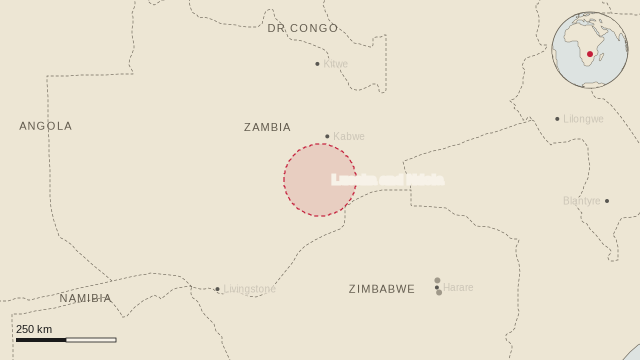
Before dawn on May 20, 1960, several observers in Northern Rhodesia, now Zambia, among them staff of the Department of Civil Aviation, saw a greenish sphere the size of a tennis ball cross the sky from southwest to northeast. According to the cable the U.S. consulate general in Salisbury sent to Washington that day, it passed over Lusaka at 0355 Greenwich time and over Ndola three minutes later. Project Blue Book classified it as a probable fireball, a very bright meteor, although the reported speed was far below a meteor's.
Tier B · IndicativeWhat do they mean? →
Limited evidence: it falls short of what Tier A requires. Any one of these is enough: a single testimony (or several witnesses who saw it together), testimony gathered years later, or an account without contemporary primary documentation.
What it was
82%meteor or fireball
The most likely explanation.
- 82% meteor or fireball
- 4% other earthly causes
- 14% no known cause
See the split across the six explanations
Earthly origin (human or natural)86%
No known cause14%
Ordinary cause the sources propose: meteor or fireball
What happened
In May 1960, Northern Rhodesia, now Zambia, was a British territory within the Federation of Rhodesia and Nyasaland. The Federation's capital was Salisbury, now Harare, where the United States had a consulate general. The Federation's military air arm was the Royal Rhodesian Air Force (RRAF).
On Friday, May 20, shortly before dawn, several observers in Northern Rhodesia saw a greenish sphere cross the sky. Among them were staff of the Department of Civil Aviation, but no paper gives their names or says where they were watching from. By a calculation made for this case from the time and Lusaka's position, sunrise was about half an hour away and the sky was starting to brighten.
That same day, RRAF headquarters reported the event to the consulate general, which passed it to the State Department in cable number 335. It was signed by Edward W. Mulcahy, the consulate's second-ranking officer. The object, it said, was a greenish sphere the size of a tennis ball traveling from southwest to northeast at about 3,000 miles per hour. It was seen over Lusaka at 0355 Greenwich time and over Ndola, 150 miles (about 240 km) away, at 0358. The speed is what comes from dividing that distance by the three minutes. The RRAF asked for any information on what it had been. The cable reached Washington on May 21 at 5:28 a.m.
On June 7, James Frederick Green, politico-military adviser in the State Department's Bureau of African Affairs, sent the cable to Major Robert Friend at Wright-Patterson Air Force Base in Dayton, Ohio, home of Project Blue Book, the Air Force office that studied UFO reports. He wrote that the Pentagon had referred him to Friend and asked what reply to make to the consul general.
The reply, prepared in Friend's office, was typed on June 16 in the name of Nicholas Post, "for the commander." It said that so little information allowed no firm conclusion, but that the Air Force's technical center believed the object had been a fireball, a very bright meteor. It explained that such meteors can appear in many colors, green among them. It acknowledged that the speed in the cable was far below a meteor's, and put this down to errors in the timepiece of one or all of the witnesses. If a fuller study was wanted, it suggested sending the witnesses' names or positions, the duration, the weather, the brightness, how the object disappeared and whether it left a trail.
The case's Blue Book record card gives the date and time from the cable, a civilian source, one object and the southwest-to-northeast course. It checks the box "Probably Astronomical," with "Meteor" written beside it, and comments "Probably a fireball." It also gives a duration of 3 seconds, a figure the cable does not contain and the June 16 letter asked for, so its origin is unknown. The five sheets of the file include no reply from Rhodesia with the data requested.
Where it happened
Why it matters
The cable's figures do not describe a measured motion. By a calculation made for this case from the coordinates of the two cities, Ndola lies about 275 km (171 miles) from Lusaka in a straight line, farther than the cable's 150 miles, and almost due north, not northeast. The 3,000 mph comes from dividing the distance by two times read on different clocks. For a meteor's speed, the passage over both cities would have to fit in under half a minute, so one of the clocks would have to be off by almost three minutes, the kind of error the Air Force suggested.
Meteoroids enter the atmosphere at between 11 and 72 km per second, according to the American Meteor Society (AMS). At that speed, a meteor would have crossed the 275 km between the two cities in less than half a minute, not three. There is another possible reading. According to the AMS, a fireball that drops meteorites stops glowing at 15 to 20 km of altitude, and by a calculation made for this case, an object 20 km up stays above the horizon out to about 500 km. A single fireball could have been seen at the same moment from Lusaka and from Ndola, and each group of witnesses could have believed it passed over their own city. The cable does not make it possible to tell which reading is right.
A re-entry of space debris does not fit. Five days earlier, on May 15, the Soviet Union had launched Korabl-Sputnik, the test craft of the Vostok program known in the West as Sputnik 4. According to astrophysicist Jonathan McDowell's catalog of space objects (GCAT), none of its pieces fell back into the atmosphere before July 17, and the catalog lists no re-entry of an orbiting object in May or June 1960.
The case shows the path of a UFO report in colonial Africa in 1960. It went from the Federation's air force to a U.S. consulate, the State Department, the Pentagon and Blue Book in two and a half weeks, and the reply came almost a month after the sighting. The answer was cautious: a probable fireball, with the speed as a weak point and a list of data that would have made it possible to check. The Blue Book collection on archive.org holds no other African file from May 1960 recording the same object. As in the Karachi case ↗ Karachi, where an air attaché's report was also filed as a meteor, the card summarizes the case with a figure, the 3 seconds, that the original message does not contain.
Documents and sources
Primary documents
Blue Book file on Rhodesia (May 1960): record card, cable 335 and the Air Force reply, 5 pp.
The five sheets of Project Blue Book file 1960-05-7812601, with the only account of the event and the Air Force's conclusions.
Read more
The first is the record card (ATIC Form 329): May 20, 1960, 0355 Greenwich time, "Rhodesia, Africa," civilian source, one object, 3 seconds, a southwest-to-northeast course and the conclusion "Probably Astronomical: Meteor," with the comment "Probably a fireball." The second is the State Department note of June 7 in which James Frederick Green, politico-military adviser in the Bureau of African Affairs, passed the case to Major Friend at Wright-Patterson Air Force Base. The third is cable 335 from the consulate general in Salisbury, dated May 20, signed by Mulcahy and received in Washington on the 21st at 5:28 a.m. The last two are the Air Force reply, typed on June 16 in the name of Nicholas Post, which judges it a fireball and suggests sending the missing data. Grayscale scan of the archive.org original.
Project Blue Book (NARA), via archive.org · Public domain · US Government work · open original
Documented evidence
- State Department incoming telegram, "FROM: Salisbury," "TO: Secretary of State," "NO: 335, May 20," received ("Rec'd") May 21, 1960, at 5:28 a.m., for action by the African bureau (AF) with copies to, among others, the CIA, Army, Navy and Air Force; signed "MULCAHY." Text: "Headquarters RRAF informs CONGEN unidentified flying object (UFO) seen over Northern Rhodesia today May 20 by several observers including Civil Aviation Department personnel. RRAF would appreciate any information available re identity." Sheet 3 of the Blue Book file.
- Description in cable 335: "UFO described as follows: greenish colored, tennis-ball sized sphere travelling approximately 3,000 MPH from SW to NE. Observed at 0355Z over Lusaka; 0358Z over Ndola, distance of 150 miles." Neither the cable nor any other sheet names the witnesses.
- State Department note (Form DS-14, "Interdepartmental Reference") of June 7, 1960, from James Frederick Green, "Politico-Military Adviser, Bureau of African Affairs," to "Major Friend, Wright-Patterson Air Force Base, Dayton, Ohio": "The Pentagon has referred me to you for possible information with regard to telegram No. 335 from the American Consulate General at Salisbury, which is attached. It would be appreciated if you could advise me what reply to make to the Consul General." Sheet 2.
- Letter AFCIN-4E2, "Maj Friend," "typed 16 June 60," "Unidentified Flying Object (Rhodesia)," to the politico-military adviser of the Bureau of African Affairs. Paragraph 2: "The information is very limited; therefore, no positive conclusion can be reached. However, it is the opinion of the Aerospace Technical Center that the object responsible for this sighting was a very bright meteor called a fireball." Paragraph 4: "The speed reported in the referenced message is far below that of a meteor. However, this may be due to errors in the timepiece of one or all of the witnesses." Sheets 4 and 5.
- The same letter defines a fireball ("as bright or brighter than -3 magnitude, bright enough to cast shadows") and lists its possible colors, green among them; it asks for the witnesses' names or positions, duration, weather, apparent brightness, how the object disappeared and any trail, and cites paragraph 15 of regulation AFR 200-2 of September 14, 1959. Signed "Nicholas Post, Acting Deputy, Science and Components," "for the commander"; under coordination, the signature of Robert Friend (AFCIN 4E2) and another handwritten signature from the same office, both dated June 16, 1960.
Show 3 more facts
- Blue Book record card ("Project 10073 Record Card," ATIC Form 329) marked "MULTIPLE": date May 20, 1960, GMT "200355Z May 60," location "Rhodesia, Africa," ground-visual observation, no photos, source "Civilian," length "3 sec," one object, course "SW-NE"; summary "Greenish colored, size of tennis ball, traveling aprox 3000 mph"; conclusion "Probably Astronomical" with "Meteor"; comment "Probably a fireball." Sheet 1.
- Calculation made for this case: Lusaka (15.42° S, 28.28° E) and Ndola (12.97° S, 28.64° E) are 275 km apart, on a bearing of 8° from Lusaka; at 0355 Greenwich time on May 20, 1960, the Sun stood 7.1° below the horizon at Lusaka, and at 0358, 5.3° below at Ndola; an object 20 km up stays above the horizon out to about 505 km; at 11 to 72 km/s (AMS), 275 km takes 4 to 25 seconds.
- J. McDowell's GCAT catalog (satcat): Korabl-Sputnik (1960 Epsilon), launched May 15, 1960, and none of its pieces, neither the third stage nor those that separated from the craft on May 18 at 2352 Greenwich time, re-entered before July 17, the third stage's date; the satcat lists no re-entry in May or June 1960. In archive.org's "project-blue-book" collection, the Rhodesia file is the only African one among those from May 1960.
Sources
- Project Blue Book — file 1960-05-7812601, Rhodesia, Africa (record card, cable 335 from Salisbury, State Department note and Air Force letter), NARA, archive.org mirror — Primary document, embedded in this case's viewer: the file's five sheets.
- Jonathan McDowell — General Catalog of Artificial Space Objects (GCAT), satcat: 1960 Epsilon (Korabl-Sputnik) — Launched on May 15, 1960; the first piece to re-enter, the third stage, did so on July 17. The satcat lists no re-entries in May or June 1960.
- American Meteor Society — Fireball FAQs — Entry speed of meteoroids, 11 to 72 km/s, and the altitude at which a meteorite-dropping fireball stops glowing, 15 to 20 km.
- Association for Diplomatic Studies and Training — Zimbabwe Country Reader (interview with Edward W. Mulcahy) — Mulcahy was Deputy Principal Officer of the consulate general in Salisbury from 1959 to 1962; he describes Salisbury as the capital of Southern Rhodesia and of the Federation.
Related cases
Cases this case cites and cases with the same likely cause.
Cited in this case · Within 10 years
Karachi · two officers see three pink lights cross the sky
1961 · Tier A
Meteor or fireball · Within 10 years
Ayoayo · three people see a fiery silver object fall
1962 · Tier B
Meteor or fireball · Within 10 years
Santa Cruz · two people see a bright light fall, trailing sparks
1962 · Tier B
Meteor or fireball · Within 10 years
Managua · a light crosses the sky and is said to fall at sea
1962 · Tier B