1961·Karachi, Pakistan
Pakistan.Karachi · two officers see three pink lights cross the sky
In the early hours of April 23, 1961, in Karachi, Pakistan, two U.S. Air Force officers serving with the American military advisory mission saw three pink lights, fainter than a star, cross the northern sky in formation toward the North Star. The U.S. air attaché passed on their report as a possible rocket, and the case shows how the debris of the first Soviet spaceflights was being tracked at the time.
Tier A · AcceptableWhat do they mean? →
Institutional evidence: several identified independent witnesses, or contemporary official documentation, without an instrumental record to corroborate them.
What it was
78%meteor or fireball
The most likely explanation.
- 78% meteor or fireball
- 4% other earthly causes
- 18% no known cause
See the split across the six explanations
Earthly origin (human or natural)82%
No known cause18%
Ordinary cause the sources propose: meteor or fireball
What happened
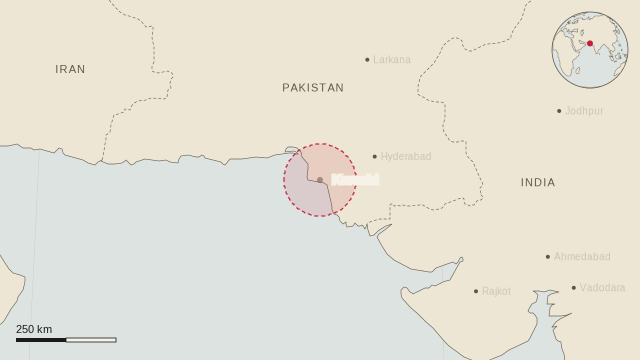
At about 3:30 a.m. on Sunday, April 23, 1961, two U.S. Air Force officers were looking north from Karachi, Pakistan. They were Major Merlin L. Chardi and a lieutenant colonel whom the teletype carrying their report calls "James Ciazdke Larse." Both belonged to the U.S. Military Assistance Advisory Group in Pakistan (MAAG), the mission that advised the country's armed forces. The Big Dipper and the North Star were in view. The time comes from the case's record card at Blue Book, the Air Force project that studied UFOs, because in the teletype the figures came through jumbled and cannot be read in full.
According to their report, three lights crossed in a straight line from almost directly overhead, passed the lower part of the Big Dipper's handle and kept descending toward the North Star. They were slightly elongated, like cigars, gaseous-looking and pink, and fainter than a star. They traveled close together in a diagonal line, each slightly to the right of the one before, like steps, spaced apart by half their own length, and kept the same positions and the same brightness to the end. They looked about one inch long, with nothing said about what they were comparing it to, and grew shorter until they vanished. The whole sighting lasted eight to ten seconds at most.
The two officers judged that the lights were at a tremendous height, "as though travelling directly beneath stars," at the edge of the atmosphere, and moving at a tremendous speed compared with the stars. They also noticed a jerky motion, which they put down to distortion of the light as it passed through the atmosphere.
The U.S. air attaché in Karachi forwarded the two officers' report about 22 hours after the sighting. He sent it to Air Force headquarters in Washington, to the technical intelligence center at Wright-Patterson Air Force Base, Ohio, which ran Blue Book, and to two other units. He presented it as a possible rocket sighting and marked it as a Moon Dust message, the U.S. program to locate and recover fallen space vehicle debris, above all Soviet.
The attaché added a hypothesis. The lights might be the body of the rocket that had carried Yuri Gagarin, the first man in space, into orbit on April 12, eleven days earlier. He asked what time that body would pass over Pakistan, if it had not yet fallen back into the atmosphere.
Blue Book closed the case as astronomical: a meteor. The comment on its card says that a duration of eight to ten seconds fits a fireball, a very bright meteor, and that the distance covered in so short a time ruled out a rocket. The card is dated April 22 because it records Greenwich time, when it was still the night before, and it lists the source as a "civilian," although the witnesses were two Air Force officers.
Where it happened
Why it matters
Of the two explanations the file itself proposes, the attaché's can be checked, and it fails. According to astrophysicist Jonathan McDowell's catalog of space objects (GCAT) and CelesTrak's, the last stage of Gagarin's rocket fell back into the atmosphere on April 16, a week before the sighting, and GCAT's main catalog lists no other re-entry on April 22 or 23. An orbiting satellite does not fit either. A calculation from the card's time and Karachi's position puts the Sun far below the horizon, so a low satellite would have been in the Earth's shadow, and it would have taken almost a minute, not ten seconds, to cross that stretch of sky.
Blue Book's explanation, a meteor, still stands, with a weak point that comes from the same report. A straight path lasting a few seconds and several pieces traveling together and shortening until they vanish are typical of a meteor breaking up as it enters the atmosphere. But the card calls it a fireball, the word used for the brightest meteors, and the officers described lights fainter than a star.
The Lyrid meteor shower also peaked that week, but a Lyrid does not fit. Working out where the stars stood that night, one seen above the witnesses would have moved away toward the southwest, the opposite direction from the North Star. If it was a meteor, it was not part of that shower. The same calculation raises another doubt. At the card's time, the Big Dipper's handle did not lie on the path of a light dropping from overhead toward the North Star, as the officers described it; around local midnight it did, so the card's time may be wrong.
The case shows how the watch for space debris worked in the first weeks of crewed spaceflight. Eleven days after Gagarin's flight, an air attaché in Pakistan read three pink lights as possible Soviet debris and asked for orbital data to check it; the three pages of the file do not include the answer. As in the Ayoayo case ↗ Ayoayo, where the attachés' cable from Bolivia about a burning object was also filed as a meteor, the Blue Book card summarizes the case with errors, such as the civilian source, that the original message makes it possible to correct.
Documents and sources
Primary documents
Blue Book file on Karachi (April 1961): record card and the air attaché's message, 3 pp.
The three sheets of Project Blue Book file 1961-04-8677021, with the two officers' report and Blue Book's conclusion. The first is the record card (ATIC Form 329), which records April 22, 1961, 2230 Greenwich, civilian source, 8 to 10 seconds, a descending course and the conclusion "Was Astronomical: Meteor," with a comment that rules out a rocket and considers it a fireball-type meteor.
Read more
The other two are incoming message AF IN 31450, sent by the air attaché in Karachi on April 23 at 2040 Greenwich and received on April 25: it quotes the report of Major Merlin L. Chardi and the lieutenant colonel the teletype calls "James Ciazdke Larse," of the U.S. Military Assistance Advisory Group in Pakistan, and adds the attaché's hypothesis about Gagarin's rocket. The message bears the Moon Dust program marking, blacked-out classification stamps and a handwritten declassification note citing regulation AFR 205-1. The scanned card is very faint and is best viewed enlarged.
Project Blue Book (NARA), via archive.org · Public domain · US Government work · open original
Documented evidence
- Department of the Air Force incoming message AF IN 31450 (2 pp.), date-time group 232040Z (April 23, 1961, 2040 Greenwich) and received on April 25: from the air attaché in Karachi (USAIRA) to the Air Force Chief of Staff (AFCIN-1B1), ATIC at Wright-Patterson (AFCIN-4A), the AFCRC research center at Hanscom and the 6937th Communications Group at Peshawar; it reads "THIS IS A PROJECT MOON" with "RUAT" struck out and, above it, a handwritten correction that appears to read "Dust." Blue Book file on archive.org, sheets 2 and 3.
- Witnesses according to message AF IN 31450: "UNIDENTIFIED OBJECT SIGHTING BY CLN MERLIN LIMA CHARDI MAJOR CMM USAF," "CONFIRMED BY CLN JAMES CIAZDKE LARSE LT SLASH COL USAF," introduced as "TWO MAAG PAKISTAN OFFICERS"; the teletype also gives their service numbers. The message does not say where in Karachi they were watching from.
- Time: the teletype reads "TIME OF SIGHTING TWO X RK THREE ZERO HRS ZULU TWO TWO APRIL ONE NINE SIX ONE," the figure garbled in transmission, with "2," "3" and "0" written above by hand; the Blue Book card records "GMT 22/2230Z." 2230 Greenwich on April 22 is 3:30 a.m. on Sunday, April 23, in Karachi (Pakistan time, five hours ahead). According to a calculation from Karachi's position, a straight path from above the witnesses across the Big Dipper's handle to the North Star fits the sky between 1800 and 2000 Greenwich; at 2230 the handle lay about 30° west of that line.
- Description in the report quoted in AF IN 31450: "THREE DISTINCT OBLONG GASEOUS PINK COLOR PRN LESS BRIGHTNESS THAN A STAR," in close formation echeloned to the right at 45 degrees, constant brightness, "APPEARING TO BE ONE INCH IN LENGTH," duration "MAXIUMUM OF ONLY EIGHT TO ONE ZERO SECONDS" and a "DEFINITE INDICATION OF JERKINESS" put down to atmospheric distortion. The straight path runs "TOWARD NORTH STAR APPROXIMATELY ONE ZERO DEGREES DOWN TOWARD HORIZON FROM STRAIGHT UP OVER HEAD," which reads as a start about 10° from the zenith.
- Second part of the message, from the attaché: "THIS MAY BE SIGHTING OF SPUTNIK MAN IN SPACE ROCKET BODY REFERENCED IN AFCIN DASH ONE BRAVO ONE DASH SIX TWO THREE SEVEN ZERO X REQUEST ANTICIPATED ZULU ORBIT TIME OVER PAKISTAN IF BODY NOT YET DECAYED." An earlier message from the intelligence directorate at headquarters (AFCIN-1B1-62370), which is not in the file, had already mentioned that rocket body.
Show 3 more facts
- Blue Book record card (ATIC Form 329): April 22, 1961, Karachi, GMT 22/2230Z, source "Civilian," length "8-10 sec," course "Descending," no photos, number of objects illegible in the scan; conclusion "Was Astronomical" with "Meteor"; comment: "Duration of 8-10 sec in line with bolide observation. Rocket ruled out due to distance traveled by objt in relatively short time. Objt considered as sighting of a bolide type meteor." Sheet 1.
- J. McDowell's GCAT catalog (satcat): the third stage of Vostok 8K72 No. 16 (1961 Mu 2), launched with Gagarin on April 12, 1961, re-entered on April 16; CelesTrak (SATCAT 104, 1961-012B) gives the same date. In the satcat, the only re-entries in April 1961 fall on the 2nd, 12th, 16th and 20th; none on the 22nd or 23rd.
- Astronomical calculation for Karachi (24.86° N, 67.01° E) at 2230 Greenwich on April 22, 1961: Alkaid, the tip of the Big Dipper's handle, at 45° altitude and 316° azimuth; the North Star at 24° in the north; the Moon below the horizon; the Sun 32.5° below the horizon, which puts in shadow any object less than about 1,200 km above the zenith; a satellite at 200 km would take about 55 seconds from the zenith to 24° altitude; the Lyrid radiant (right ascension 18h04m, declination +34°) at 74° altitude and 52° azimuth.
Sources
- Project Blue Book — file 1961-04-8677021, Karachi, Pakistan (record card and the air attaché's message AF IN 31450), NARA, archive.org mirror — Primary document, embedded in this case's viewer: the only three sheets in the file.
- Jonathan McDowell — General Catalog of Artificial Space Objects (GCAT), satcat: 1961 Mu 2 (Vostok 8K72 No. 16, third stage) — Launched on April 12, 1961, re-entered on April 16. In the satcat, the April 1961 re-entries fall on the 2nd, 12th, 16th and 20th; none on the 22nd or 23rd.
- CelesTrak — SATCAT, record 104 (SL-3 R/B, 1961-012B) — Confirms the re-entry on April 16, 1961.
Referenced by 1 case
Related cases
Cases this case cites and cases with the same likely cause.
Cited in this case · Within 10 years
Ayoayo · three people see a fiery silver object fall
1962 · Tier B
Meteor or fireball · Within 10 years
Santa Cruz · two people see a bright light fall, trailing sparks
1962 · Tier B
Meteor or fireball · Within 10 years
Managua · a light crosses the sky and is said to fall at sea
1962 · Tier B
Meteor or fireball · Within 10 years
Lusaka · a greenish sphere crosses the sky before dawn
1960 · Tier B