Caso Nº 300Case No. 300·Estados UnidosUnited States
1984–1988·EE.UU. — documentos en circulación; investigados por el FBI (expediente en The Vault)USA — documents in circulation; investigated by the FBI (file in The Vault)
Estados UnidosUnited States.Majestic 12 · los documentos 'MJ-12' y el veredicto BOGUS del FBIMajestic 12 · the 'MJ-12' documents and the FBI's BOGUS verdict
El conjunto 'Operation Majestic-12' es la serie de documentos OVNI más famosa y más estudiada como falsificación. Aparecidos entre 1984 y 1987 en manos de los ufólogos William Moore, Jaime Shandera y Stanton Friedman, describen un comité secreto de doce altos funcionarios (MJ-12) que Truman habría creado en 1947 para gestionar OVNIs estrellados y cuerpos recuperados (Roswell/Aztec). En 1988 dos oficinas del FBI recibieron copias del memo; el Bureau consultó a la Fuerza Aérea (AFOSI), que respondió que los documentos eran 'completamente falsos' (bogus). El expediente del FBI —disponible en su sala de lectura ‘The Vault’, sección 'Unexplained Phenomenon'— documenta ese veredicto. Examinadores de documentos hallaron firmas calcadas de otras cartas, formatos de fecha anacrónicos y tipografía inconsistente. Su valor para el corpus es de calibración: es el caso-documento que enseña cómo se fabrica y se desmonta un 'documento filtrado'.The 'Operation Majestic-12' set is the most famous UFO document series and the most thoroughly studied as a forgery. Surfacing between 1984 and 1987 in the hands of ufologists William Moore, Jaime Shandera and Stanton Friedman, the documents describe a secret committee of twelve senior officials (MJ-12) that Truman allegedly created in 1947 to manage crashed UFOs and recovered bodies (Roswell/Aztec). In 1988 two FBI offices received copies of the memo; the Bureau consulted the Air Force (AFOSI), which replied that the documents were 'completely bogus'. The FBI file —available in its reading room, The Vault, under 'Unexplained Phenomenon'— documents that verdict. Document examiners found signatures traced from other letters, anachronistic date formats and inconsistent typography. Its value to the corpus is calibration: it is the document-case that teaches how a 'leaked document' is fabricated and dismantled.
AñoYear
1984–1988
TierTier
B
ProbabilidadProbability
8%
CategoríaCategory
DocumentoDocument
Evidencia limitada: testigo único, local o sin verificación primaria. Tres ejes independientes: el «tier» mide la fuerza de la evidencia; la «probabilidad» estima cuán genuinamente inexplicado está el caso —un fenómeno natural puede seguir sin explicación, así que no equivale a «no-prosaico»—; y la partición de explicaciones (abajo) dice qué fue más plausiblemente. Por eso un caso bien documentado puede tener como causa más plausible un posible fraude, y un Tier B no es, por eso, un fraude.Limited evidence: single-witness, local or without primary verification. Three independent axes: the «tier» measures the strength of the evidence; the «probability» estimates how genuinely unexplained the case is —a natural phenomenon can remain unexplained, so it does not equal «non-prosaic»—; and the partition of explanations (below) says what it most plausibly was. So a well-documented case can have a possible hoax as its most plausible cause, and a Tier B is not, for that reason, a hoax.
Documentos primarios · visorPrimary documents · viewer

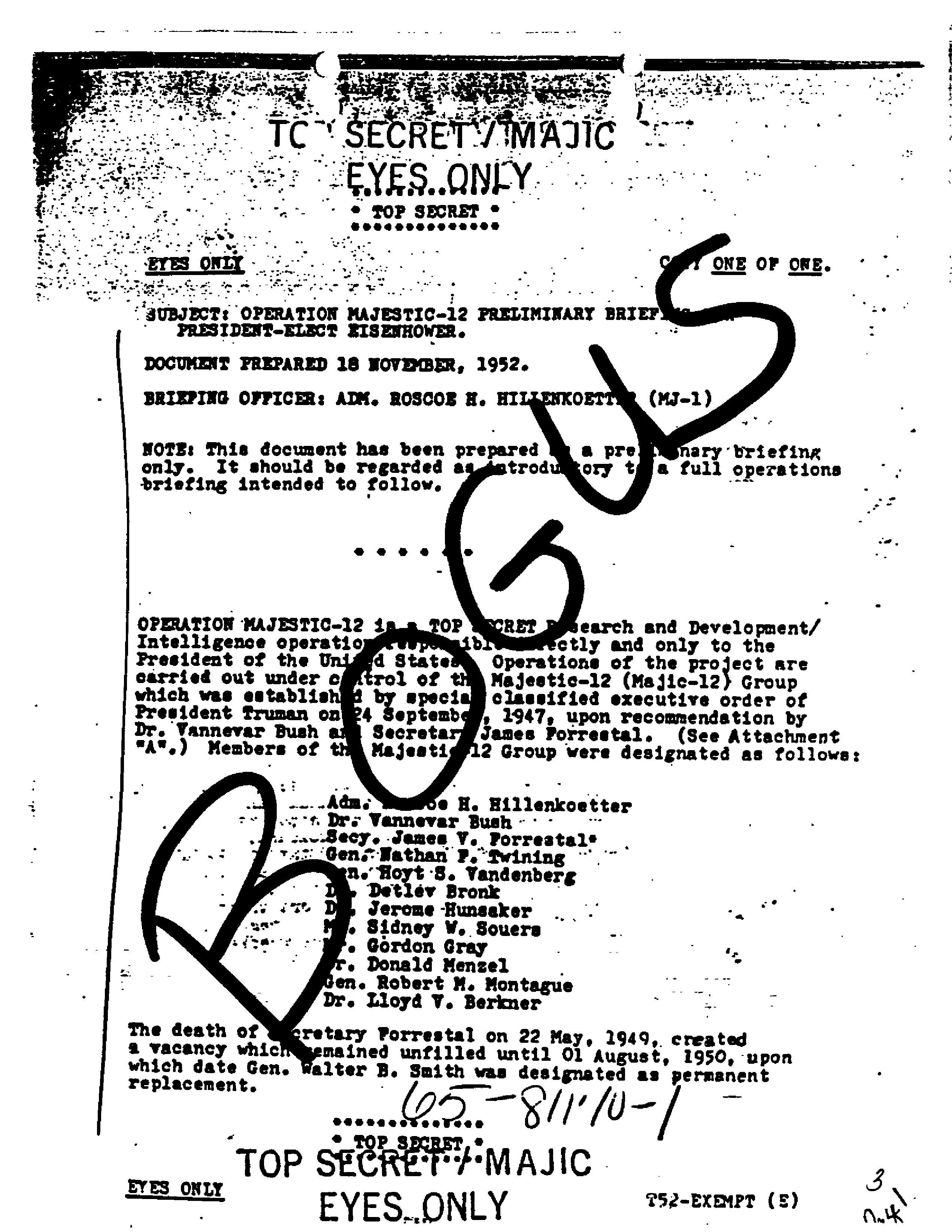
Uno de los documentos Majestic-12 en circulación, investigados por el FBIOne of the circulating Majestic-12 documents, investigated by the FBI
Majestic 12 Part 1 of 1 (page 4 crop).jpg · Wikimedia Commons · Dominio público · abrir originalopen original
Parte 01Part 01
El expediente en cuestiónThe file in question
En diciembre de 1984, el productor de cine y ufólogo Jaime Shandera recibió por correo, sin remitente, un rollo de película fotográfica. Revelado, contenía un supuesto documento clasificado 'TOP SECRET / MAJIC — EYES ONLY' titulado 'Operation Majestic-12', fechado el 18 de noviembre de 1952 y presentado como un briefing preparado para el presidente electo Eisenhower. El texto describía un comité secreto de doce —de ahí 'MJ-12' o 'Majestic 12'— que el presidente Truman habría constituido en 1947, tras el supuesto recobro de una nave estrellada y de cuerpos no humanos cerca de Roswell, para administrar el secreto. La lista nombraba a figuras reales y de máximo nivel: el almirante Roscoe Hillenkoetter (primer director de la CIA), el científico Vannevar Bush, el secretario de Defensa James Forrestal, los generales Nathan Twining y Hoyt Vandenberg, el astrónomo Donald Menzel y otros.
“, fechado el 18 de noviembre de 1952 y presentado como un briefing preparado para el presidente electo Eisenhower. El texto describía un comité secreto de doce —de ahí ”
Shandera, junto con los investigadores William Moore y Stanton Friedman, dio a conocer los documentos en 1987. Poco después apareció una pieza aparentemente corroborante —el 'memo Cutler-Twining'— hallada por los propios investigadores en los Archivos Nacionales (NARA), lo que reforzó la impresión de autenticidad. La comunidad ufológica se dividió: Friedman, físico nuclear, defendió la autenticidad durante años; otros sospecharon de inmediato un montaje elaborado.
El punto institucional que ancla este caso ocurrió en 1988, cuando dos oficinas de campo del FBI recibieron copias del material 'Majestic-12'. El Bureau abrió una indagación y consultó a la Oficina de Investigaciones Especiales de la Fuerza Aérea (AFOSI), que respondió que los documentos eran 'completamente falsos' (la nota del expediente quedó marcada como BOGUS). Ese expediente está hoy disponible en la sala de lectura digital del FBI, ‘The Vault’, bajo la categoría 'Unexplained Phenomenon', junto a otros archivos OVNI del Bureau (el expediente 62-HQ-83894, el memo Hottel, la investigación de mutilaciones de ganado).
El análisis documental posterior reforzó el veredicto. Los examinadores señalaron: una firma de Truman en el memo de Forrestal aparentemente calcada de una carta genuina de 1947 (mismo tamaño y trazo, lo que delata un copiado mecánico); formatos de fecha de estilo militar inconsistentes con la práctica de la época y con los hábitos de los firmantes; numeración y membrete que no correspondían a documentos auténticos comparables; y anacronismos de estilo. El consenso de archivistas, escépticos e incluso de buena parte de la propia ufología es que los documentos MJ-12 son una fabricación de los años ochenta, cuyo origen exacto (broma de inteligencia, operación de desinformación o montaje de aficionados) sigue sin esclarecerse.
La lectura calibrada es directa: no hay aquí evidencia de OVNIs ni de un comité secreto, sino un fraude documental bien estudiado. Lo que el caso sí documenta —y por eso entra al corpus— es cómo se fabrica un 'documento filtrado' y cómo las instituciones (FBI, AFOSI) y los métodos de análisis forense lo desmontan.
In December 1984, film producer and ufologist Jaime Shandera received in the mail, with no return address, a roll of photographic film. Developed, it contained a purported 'TOP SECRET / MAJIC — EYES ONLY' classified document titled 'Operation Majestic-12', dated November 18, 1952 and presented as a briefing prepared for president-elect Eisenhower. The text described a secret committee of twelve —hence 'MJ-12' or 'Majestic 12'— that president Truman had allegedly set up in 1947, after the supposed recovery of a crashed craft and non-human bodies near Roswell, to manage the secret. The list named real, top-level figures: Admiral Roscoe Hillenkoetter (the first CIA director), scientist Vannevar Bush, Defense Secretary James Forrestal, Generals Nathan Twining and Hoyt Vandenberg, astronomer Donald Menzel and others.
Shandera, together with researchers William Moore and Stanton Friedman, made the documents public in 1987. Soon afterward an apparently corroborating piece —the 'Cutler-Twining memo'— turned up, found by the researchers themselves in the National Archives (NARA), which reinforced the impression of authenticity. The ufology community split: Friedman, a nuclear physicist, defended authenticity for years; others immediately suspected an elaborate hoax.
The institutional anchor of this case came in 1988, when two FBI field offices received copies of the 'Majestic-12' material. The Bureau opened an inquiry and consulted the Air Force Office of Special Investigations (AFOSI), which replied that the documents were 'completely bogus' (the file note was marked BOGUS). That file is today available in the FBI's digital reading room, The Vault, under the 'Unexplained Phenomenon' category, alongside other Bureau UFO files (the 62-HQ-83894 file, the Hottel memo, the cattle-mutilation investigation).
Later document analysis reinforced the verdict. Examiners noted: a Truman signature on the Forrestal memo apparently traced from a genuine 1947 letter (identical size and stroke, betraying mechanical copying); military-style date formats inconsistent with the period's practice and with the signers' habits; numbering and letterhead that did not match comparable authentic documents; and stylistic anachronisms. The consensus of archivists, skeptics and even much of ufology itself is that the MJ-12 documents are a 1980s fabrication, whose exact origin (an intelligence prank, a disinformation operation, or an amateur hoax) remains unresolved.
The calibrated reading is straightforward: there is no evidence here of UFOs or of a secret committee, but a well-studied documentary forgery. What the case does document —and why it enters the corpus— is how a 'leaked document' is fabricated and how institutions (FBI, AFOSI) and forensic analysis dismantle it.
Parte 02Part 02
Por qué este caso movió la agujaWhy this case moved the needle
Majestic 12 importa como calibrador, no como evidencia. Es, probablemente, el conjunto de 'documentos OVNI' más influyente de la historia: sembró el mito del comité secreto 'Majestic' que reaparece en décadas de literatura, testimonios y ficción (y que resuena en relatos contemporáneos de 'programas de recuperación' atribuidos a juntas secretas). Que su pieza fundacional sea una falsificación documentada por el propio FBI es, por eso, una de las lecciones más útiles del corpus.
El caso enseña tres cosas. Primera: un documento puede ser internamente impresionante —membretes, nombres reales, jerga de clasificación— y aun así ser falso; la verosimilitud estética no es autenticidad. Segunda: las instituciones sí dejaron rastro verificable —el expediente del FBI con el veredicto 'bogus' de la AFOSI está público en ‘The Vault’—, lo que permite tratar el episodio con fuentes primarias en lugar de rumor. Tercera: el método forense (firmas calcadas, anacronismos de formato) es replicable y derrota a la autoridad del 'parece secreto'. Frente a la era post-PURSUE, en la que vuelven a circular afirmaciones de juntas de control y programas ocultos, MJ-12 es el recordatorio permanente de que un 'documento filtrado' debe pasar por análisis de procedencia antes de pesar como evidencia. El corpus lo incorpora como caso-documento de fraude, fuente primaria en ‘The Vault’ del FBI.
Majestic 12 matters as a calibrator, not as evidence. It is probably the most influential set of 'UFO documents' in history: it seeded the myth of the secret 'Majestic' committee that recurs across decades of literature, testimony and fiction (and that echoes in contemporary accounts of 'recovery programs' attributed to secret boards). That its founding piece is a forgery documented by the FBI itself is, for that reason, one of the corpus's most useful lessons.
The case teaches three things. First: a document can be internally impressive —letterheads, real names, classification jargon— and still be fake; aesthetic plausibility is not authenticity. Second: institutions did leave a verifiable trail —the FBI file with AFOSI's 'bogus' verdict is public in The Vault—, which lets the episode be treated with primary sources rather than rumor. Third: the forensic method (traced signatures, format anachronisms) is reproducible and defeats the authority of 'it looks secret'. Facing the post-PURSUE era, in which claims of control boards and hidden programs again circulate, MJ-12 is the standing reminder that a 'leaked document' must pass provenance analysis before it counts as evidence. The corpus incorporates it as a fraud document-case, primary source in the FBI's Vault.
Parte 03Part 03
Lo que queda en papelWhat's left on paper
Evidencia documentadaDocumented evidence
- Documentos 'Operation Majestic-12' aparecidos vía rollo de película anónimo recibido por Jaime Shandera (dic 1984); difundidos por W. Moore, Shandera y S. Friedman (1987)'Operation Majestic-12' documents surfaced via an anonymous film roll received by Jaime Shandera (Dec 1984); publicized by W. Moore, Shandera and S. Friedman (1987)
- Contenido: comité secreto de 12 (Truman, 1947) para gestionar OVNIs estrellados/cuerpos (Roswell); nombres reales (Hillenkoetter, V. Bush, Forrestal, Twining, Vandenberg, Menzel…)Content: secret committee of 12 (Truman, 1947) to manage crashed UFOs/bodies (Roswell); real names (Hillenkoetter, V. Bush, Forrestal, Twining, Vandenberg, Menzel…)
- 1988: dos oficinas de campo del FBI reciben los documentos; la AFOSI informa al FBI que son 'completamente falsos' (BOGUS) — expediente en ‘The Vault’, sección 'Unexplained Phenomenon'1988: two FBI field offices receive the documents; AFOSI informs the FBI they are 'completely bogus' (BOGUS) — file in The Vault, 'Unexplained Phenomenon' section
- Análisis forense: firma de Truman calcada de una carta de 1947, formatos de fecha anacrónicos, membrete/numeración inconsistentesForensic analysis: Truman signature traced from a 1947 letter, anachronistic date formats, inconsistent letterhead/numbering
- Consenso de archivistas y escépticos (y parte de la ufología): fabricación de los años 1980; origen exacto sin esclarecerConsensus of archivists and skeptics (and part of ufology): a 1980s fabrication; exact origin unresolved
- Sin evidencia de OVNIs ni del comité; valor de calibración (cómo se fabrica y se desmonta un 'documento filtrado')No evidence of UFOs or of the committee; calibration value (how a 'leaked document' is fabricated and dismantled)
FuentesSources
- FBI Records: The Vault — Majestic 12 — Expediente del FBI con el veredicto 'bogus' de la AFOSI sobre los documentos MJ-12.FBI file with the AFOSI's 'bogus' verdict on the MJ-12 documents.
- Wikipedia — Majestic 12 — Síntesis de la historia, la lista de miembros y el análisis de falsificación.Synthesis of the history, the membership list and the forgery analysis.
Patrones que exhibe (1)Patterns it exhibits (1)
UbicaciónLocation
EE.UU. — documentos en circulación; investigados por el FBI (expediente en The Vault)USA — documents in circulation; investigated by the FBI (file in The Vault) · 38.90°, -77.03°
Casos relacionadosRelated cases
mismo país · 1 patrónsame country · 1 pattern
Abducciones de AllagashThe Allagash Abductions
1976 · Tier B · 16%
mismo país · 1 patrónsame country · 1 pattern
Mothman · Point PleasantMothman · Point Pleasant
1966 · Tier B · 16%
mismo país · 1 patrónsame country · 1 pattern
Boyd Bushman · confesión en el lecho de muerteBoyd Bushman · Deathbed Confession
2014 · Tier B · 8%
1 patrón1 pattern
Familia Knowles · Llanura de NullarborKnowles Family · Nullarbor Plain
1988 · Tier A · 45%