Case No. 418·Finland
1969·Pori airfield, Finland
Finland.Pori · the Finnish Air Force's seven 'balloons' (1969)
On 12 April 1969, during Finnish Air Force exercises, a controller asked a pilot in training to check what seven motionless 'balloons' over Pori airfield were. According to the pilots and the control staff, they were seven round, yellowish objects; when the Fouga Magister jet approached, they formed up and left towards the north so fast that the aircraft could not follow. It is the only case the Finnish Air Force has acknowledged: the Defence Forces magazine Ruotuväki published it in 2012 and pointed to possible foreign spy aircraft. There is no public file; everything known comes from the witnesses, above all the pilot Jouko Kuronen.
Country
Finland
Year
1969
Tier
B
Probability
35%
Category
Incident
Limited evidence: single-witness, local or without primary verification. Three independent axes: the «tier» measures the strength of the evidence; the «probability» estimates how genuinely unexplained the case is —a natural phenomenon can remain unexplained, so it does not equal «non-prosaic»—; and the partition of explanations (below) says what it most plausibly was. So a well-documented case can have a possible hoax as its most plausible cause, and a Tier B is not, for that reason, a hoax.
Primary documents · viewer
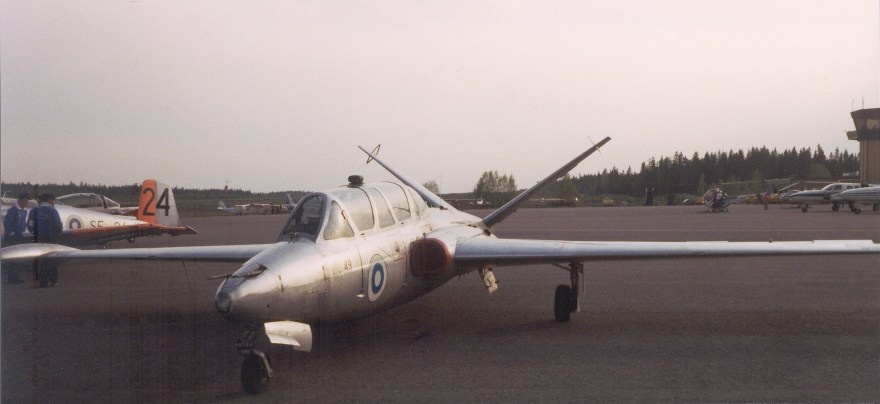
Finnish Air Force Fouga Magister FM-49 at Tampere-Pirkkala (1982), the jet trainer type that chased the objects at Pori. Context image, not of the event.
J-P Kärnä, Wikimedia Commons («Fouga Magister Pirkkalassa.jpg») · CC BY-SA 3.0 · open original
Part 01
The night in question
On Saturday 12 April 1969 the Finnish Air Force was holding exercises at Pori airfield, on the country's west coast, facing the Gulf of Bothnia. Several Fouga Magister jet trainers were practising gunnery dives over the area. One of the pilots there, Jouko Kuronen, of the Karelia wing, was about to take off for Kuopio with a mechanic on a navigation flight.
According to the account Kuronen gave Finnish public radio in 1982, he was taxiing down the runway when he heard on the radio the exercise controller asking one of the pilots to break off his dive and go and see what seven balloons over the airfield were. Kuronen stopped and turned his aircraft to look. High above the middle of the field were seven round, yellowish objects, 'like pieces cut out of the moon', in a loose arrangement, as if watching something, and apparently motionless. The tower, a kilometre away, said it could see them too, and according to Kuronen there were also radar returns over the field.
The pilot sent up, trainee Tarmo Tukeva, approached in his Fouga Magister. He saw the objects as round but blurred, and without reference points he could not judge the distance; later testimony places them between 1,500 and 3,000 metres up. As the aircraft drew near, the objects formed up and moved off to the north, accelerating ever faster. The squadron leader told him over the radio that he would not catch them. Kuronen recalled that a wind of about a hundred knots was blowing aloft that day and that the objects were moving against it. In his version, between twenty and twenty-five people, pilots and control staff, saw them from different positions, and the tower at Vaasa, some 200 kilometres to the north, picked them up in the same minute.
The case became known outside the military in the 1980s and 1990s, through radio and a 1994 book by Finnish ufologists. In 2009 Kuronen, who went on to run an airport, confirmed it again to public radio: he could not explain it and believed no one ever could. In May 2012 Ruotuväki, the magazine of the Finnish Defence Forces, published the case and presented it as the only sighting the Air Force acknowledges as real. It noted features shared with other foreign cases, an ongoing military exercise and the proximity of large bodies of water, and suggested foreign spy aircraft as a possible explanation.
Part 02
Why this case moved the needle
Pori is unusual for the institution that backs it rather than for the quality of its documentation. Finland had no official UFO study programme, and its Air Force never published files. That the Defence Forces' own magazine presented this episode in 2012 as the only acknowledged sighting gives it a status other Nordic cases lack. But it is worth being precise about what is acknowledged: that the event happened and that military personnel saw it, not that it was anything extraordinary. The explanation the magazine suggests, spy aircraft from another country during exercises, is mundane, even if it fits the witnesses' description poorly.
The problem lies in the source. Everything known comes from testimony given thirteen, twenty-five and forty years later, mainly by Jouko Kuronen, and from a book by ufologists. The versions do not fully agree: in one Kuronen is on the ground, taxiing; in another he is flying his own Fouga. The most striking details are also the least verifiable: that the objects moved against a hundred-knot wind and that the Vaasa radar caught them in the same minute, which would mean covering 200 kilometres in sixty seconds, more than ten thousand kilometres an hour. There are no published radar records, no flight reports and no statement from the pilot who chased them, Tarmo Tukeva.
There is also a prosaic lead in the account itself. The controller called them 'balloons', and a cluster of balloons, meteorological or research ones for instance, can look motionless from below, yellowish in reflected sunlight and hard to place. A pilot approaching without references can read a change of perspective or light as a sudden acceleration. With a strong wind aloft, balloons would be expected to drift with it; that the witnesses remember the opposite may be a trick of memory, or the detail that makes the case interesting.
That is why the case enters as Tier B: there are qualified military witnesses and institutional acknowledgement, but no primary document, and the acknowledgement comes through a magazine, not a file. It remains an open case, with a substantial prosaic weight and honest indeterminacy. If the Air Force's reports or the Vaasa radar records ever surface, they could settle it one way or the other.
Part 03
What's left on paper
Documented evidence
- Testimony of military pilot Jouko Kuronen on the Finnish public radio programme Mystillistä (1982): seven round, yellowish objects over the airfield, also seen from the tower
- Account in 100 ufoa Suomessa (Kuningas, Laitinen and Löfman, 1994): pilot Tarmo Tukeva approaches in a Fouga Magister and the objects move off north in formation
- Kuronen's confirmation to Yle (2009): he cannot explain what he saw
- Ruotuväki, the Finnish Defence Forces magazine (May 2012): the only sighting acknowledged by the Air Force; possible foreign spy aircraft
- No file, radar records or flight reports have been published; the alleged detection at Vaasa comes only from the witnesses
Sources
- Yle Living Archive — 'The only Finnish UFO case whose reality the Air Force has acknowledged was seen over Pori in the 1960s' (2024), with the 1982 audio — Pilot Jouko Kuronen's testimony on Finnish public radio.
- Yle — 'Pori's UFO sighting still talked about' (3 Dec 2009) — Quotes the 1994 book's account and Kuronen's renewed confirmation.
- Uusi Suomi — 'Ruotuväki: Two Air Force pilots encountered 7 fireballs in the sky' (8 May 2012) — Coverage of the Defence Forces magazine article acknowledging the case.
Location
Pori airfield, Finland · 61.46°, 21.80°
Distribution of explanations
This case is classified among the model's hypotheses: the bar splits 100% by how much each explanation weighs (the uncertainty is spread across the hypotheses the case supports). Summed across the corpus they produce the comparable partition. It is a different question from the Probability above: that one estimates how likely the case is a genuinely unexplained phenomenon; this one splits which the explanation would be.
Modal hypothesis: Misidentification 60% · sums to 100%
Confused with: Aircraft
Structured analytical judgment, not a calibrated frequency. Forced classification: the mass the evidence cannot assign is spread across the hypotheses the case does support.
Related cases