1962·Northern Upper Volta (now Burkina Faso), near Ouahigouya
Burkina Faso.Upper Volta · two pieces of burned metal fall from the sky
In early October 1962, field workers in Upper Volta, now Burkina Faso, picked up a metal object that had fallen to the ground, and a second piece turned up about 40 km away, in the north of the country. The U.S. air attaché examined both and reported by cable on October 12 that they looked like part of a rocket of U.S. design, with signs of an explosion and intense heat. Project Blue Book closed them as debris from the Atlas rocket that put astronaut Walter Schirra into orbit on October 3, identified by numbers on the metal that the papers do not transcribe.
Tier A · AcceptableWhat do they mean? →
Institutional evidence: several identified independent witnesses, or contemporary official documentation, without an instrumental record to corroborate them.
What it was
90%reentry
The most likely explanation.
- 90% reentry
- 5% other earthly causes
- 5% no known cause
See the split across the six explanations
Earthly origin (human or natural)95%
No known cause5%
Ordinary cause the sources propose: reentry
What happened
On October 3, 1962, U.S. astronaut Walter Schirra lifted off from Cape Canaveral, Florida, in the Sigma 7 capsule on NASA's Mercury-Atlas 8 mission. He circled the Earth six times in just over nine hours and splashed down in the Pacific the same day. He was launched by an Atlas rocket, number 113-D.
According to the space-object catalog kept by astrophysicist Jonathan McDowell, the body of the Atlas, a cylinder about 20 meters long weighing 3.4 metric tons, also reached orbit, between 157 and 277 km up. That orbit carried it over every latitude between 32.5 degrees north and south, including that of Upper Volta, the former French colony in West Africa that became independent in 1960 and has been called Burkina Faso since 1984. The catalog gives its re-entry into the atmosphere as October 4, with no time or place.
The first card from Project Blue Book, the U.S. Air Force office that studied UFO reports, is dated October 5, 1962, and gives the location as Ouagadougou, the capital. It says a metal object fell to the ground and was picked up by field workers. It records a civilian source, a single object, a length of observation "not reported" and a visual observation from the ground of something falling, but it does not say who saw it fall or at what time. As references it cites three report numbers, among them IR 1497987, which turns up again in the later papers.
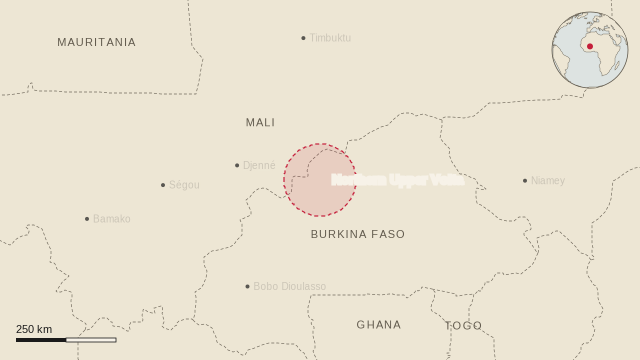
On October 12 at 3 p.m., the U.S. embassy in Ouagadougou sent the State Department priority cable number 115, carrying a text from the air attaché, who had already reported the find on October 10 from Abidjan, in neighboring Ivory Coast. The attaché had examined "two pieces of material" found near a point the cable gives in coordinates. By a calculation made for this case from those coordinates, the point is not in Ouagadougou but about 180 km to its northwest, about 23 km from the town of Ouahigouya.
Both pieces, he wrote, "suggest explosion" and had been "subjected to intense heat." They did not look like part of an aircraft but like cowling from a rocket booster "of US design," and the piece described as an exhaust pipe in earlier messages, which are not in the file, resembled a guidance control rocket. They had been found 40 km apart. The pieces were in the hands of the Voltaic government: the ambassador was asking the Foreign Office to hand them over, and the attaché promised to send them as soon as he had them, with photos to follow by diplomatic pouch. The published sheets of the two files include no photos.
The second Blue Book card, from a separate file, is dated October 7 to 8, 1962, and gives the location as Upper Volta. It describes an "additional piece of metal" found about 40 km from the one recovered on October 5, with the reference IR 1497987. Both cards close the case as "Atlas Booster." The October 5 card says the piece was identified as part of the Atlas from Schirra's flight (spelled "Shirra") by numbers on the metal submitted for analysis; the October 7 to 8 card, that it was evaluated that way "by identification numbers on the metal." Neither transcribes those numbers or says when the identification was made.
On December 6, 1962, U.S. Air Forces in Europe, from Lindsey Air Station in Germany, sent the Air Force's Foreign Technology Division at Wright-Patterson Air Force Base, Ohio, a message headed "Moon Dust," the U.S. program to locate and recover fallen space vehicle debris. It asked for an immediate reply on the results of the analysis of the metal piece that "fell near Ouagadougou" on the night of October 7 to 8, because the air attaché's office in Ivory Coast had asked for it to be identified. The message barred passing the information to any foreign government. Neither file preserves the reply.
Where it happened
Why it matters
Two pieces of metal that fell in northern Upper Volta entered the Air Force's UFO files and left them as debris from a U.S. rocket. The first was picked up on October 5, one day after the Atlas re-entry given in McDowell's catalog, and a week later the air attaché, who had seen them, was already describing them as part of a rocket of U.S. design.
The link to Schirra's Atlas is made by the Blue Book cards, and it rests on numbers that are not transcribed. The catalog confirms that this Atlas was in orbit, that its orbit passed over Upper Volta and that it re-entered on October 4, but it does not say where it came down. The second piece does not quite fit: its card dates it October 7 to 8 without saying whether that is when it was found or when it fell. The December message speaks of a piece that fell that night, three days after the re-entry in the catalog, although it cites the reference both cards share and does not say which one it is.
If October 7 to 8 is the date it was found, everything fits a single re-entry on the 4th. If it is the date it fell, the piece cannot be from the Atlas according to the catalog, which lists other re-entries on October 8: debris from the Soviet satellite Kosmos 9 and a U.S. satellite. In favor of reading it as the date of the find, the cards identify the pieces by the numbers on the metal, and the October 12 cable already spoke of two pieces found 40 km apart, with no date of fall. Both cards also share the reference IR 1497987, which the December message calls an Ivory Coast report.
The papers also show how a piece of space debris that fell in West Africa made its way up the chain: from the field workers to the Voltaic government, then to the embassy and the attaché, and from the State Department to the Air Force. Two months after the fall, U.S. Air Forces in Europe was asking for an immediate reply on the analysis under the Moon Dust name, with orders not to share it with any foreign government, including the Voltaic government, whose Foreign Office had held the pieces.
Documents and sources
Primary documents
Blue Book files on Upper Volta (October 1962): two record cards, the air attaché's cable and the Moon Dust message, 4 pp.
All four sheets of the two Blue Book files on the Upper Volta metal pieces, in grayscale. Page 1: the October 5, 1962 card (file 1962-10-8725974), with the conclusion "Other: Atlas Booster" and the identification by numbers on the metal.
Read more
Page 2: State Department telegram no. 115 of October 12, with the air attaché's examination, the coordinates of the find and the 40 km between the pieces; it bears the declassification of May 12, 1969. Page 3: the October 7–8 card (file 1962-10-8726195), for the additional piece. Page 4: the December 6, 1962 message from U.S. Air Forces in Europe to Wright-Patterson, subject "Moon Dust," asking for the results of the analysis.
Project Blue Book (NARA), via archive.org · Public domain · US Government work · open original
Documented evidence
- Blue Book record card (ATIC Form 329), file 1962-10-8725974: October 5, 1962, "Ouagadougou, Upper Volta, Africa"; observation type "Ground-Visual," physical specimen, civilian source, one object, course "falling," length "not reported"; summary: "Metal object fell to ground recovered by field workers in Upper Volta, Africa. IR 792290, IR 1497987.1497985"; comment: "Identified as part of Atlas Booster fm Shirra flight by numbers on piece of metal submitted for analysis"; conclusion "Other: Atlas Booster."
- State Department incoming telegram no. 115, from Ouagadougou, October 12, 1962, 3 p.m. (received the same day at 4:41 p.m.), priority, "FROM USAIRA," to be passed to Air Force intelligence (AFCIN), U.S. Air Forces in Europe (USAFE) and the 1127th Field Activities Group at Fort Belvoir: two pieces found near 13° 35′ N, 2° 38′ W, 40 km apart, showing signs of explosion and "intense heat and burning"; "Apparently not an aircraft. Appears to be cowling from rocket booster of US design."
- The same telegram: the piece earlier described as an exhaust pipe "resemble a guidance control rocket"; the ambassador was asking the Voltaic Foreign Office to hand over the material, and photos would go by pouch. It refers to the attaché's message from Abidjan of October 10 and to embassy cables 109 and 111, which are not in the files.
- Blue Book record card, file 1962-10-8726195: "7-8 October 1962," "Upper Volta, Africa"; observation type "Ground-Visual," civilian source, one object, course "fell to ground"; summary: "Additional piece of metal found about 40 km fm similar piece of metal recovered on 5 October 1962. IR 1497987"; comment: "Evaluated as section of Atlas Booster by identification numbers on the metal"; conclusion "Other: Atlas Booster."
- Message from U.S. Air Forces in Europe (USAFE, Lindsey Air Station, Germany) to the Foreign Technology Division at Wright-Patterson, December 6, 1962, NOFORN, subject "Moon Dust": asks for an immediate reply on the analysis of the "metal piece that fell near Ouagadougou, Haute Volta, night of 7-8 Oct 62, Ivory Coast IR 1497987," which the air attaché's office in Ivory Coast had asked to have identified; bars dissemination to any foreign government.
- Jonathan McDowell's GCAT catalog, object S00434 (1962 Beta Delta 2, Atlas D 113D): in orbit on October 3, 1962 at 12:20 UTC, 157 × 277 km, inclination 32.55°, about 3,400 kg and 20 m; re-entry October 4, 1962, no time given. The Sigma 7 capsule (S00433) splashed down on October 3 at 21:28 UTC in the Pacific.
Sources
- Project Blue Book — file 1962-10-8725974, "Ouagadougou, Upper Volta, Africa" (October 5, 1962 card and State Department telegram no. 115), NARA, archive.org mirror — Primary document, embedded in this case's viewer: both sheets in the file.
- Project Blue Book — file 1962-10-8726195, "Upper Volta, Africa" (October 7–8, 1962 card and the Moon Dust message of December 6, 1962), NARA, archive.org mirror — Primary document, embedded in this case's viewer: both sheets in the file.
- Jonathan McDowell — General Catalog of Artificial Space Objects (GCAT), satcat: S00433 (Sigma Seven) and S00434 (Atlas D 113D, 1962 Beta Delta 2)
- NASA — "Mercury-Atlas 8: Sigma 7" (mission page)
Related cases
Cases with the same likely cause.
Reentry · Within 10 years
Sisaket · an object “fallen from the sky” turns up in Thailand
1965 · Tier A
Reentry · Within 10 years
Barbados · a blue ball trailed by twenty red objects
1958 · Tier B
Reentry · Within 10 years
General Terán · residents see smoke and find a metal sphere
1967 · Tier A
Reentry · Within 10 years
Saudi Arabia · King Faisal keeps a fallen metal sphere
1967 · Tier A