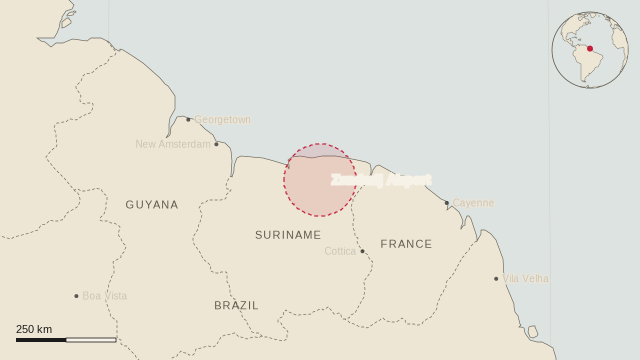
1962·Zanderij Airport, south of Paramaribo, Suriname
Suriname.Zanderij · a radio operator sees a fast, silent light
On the night of Saturday, November 3, 1962, Sergeant First Class Robert F. Herrebrugh, a radio operator with the Dutch armed forces in Suriname, watched through night binoculars as a lighted object crossed the sky over Zanderij Airport, near Paramaribo, rather fast and from northwest to southeast, with no engine noise and none of an airplane's navigation lights. In a letter dated that same day, he asked Cape Canaveral whether it had been a U.S. satellite. Project Blue Book filed it as a satellite without identifying which one.
Tier B · IndicativeWhat do they mean? →
Limited evidence: it falls short of what Tier A requires. Any one of these is enough: a single testimony (or several witnesses who saw it together), testimony gathered years later, or an account without contemporary primary documentation.
What it was
85%satellite
The most likely explanation.
- 85% satellite
- 5% other earthly causes
- 10% no known cause
See the split across the six explanations
Earthly origin (human or natural)90%
No known cause10%
Ordinary cause the sources propose: satellite
What happened
In 1962, Suriname was part of the Kingdom of the Netherlands and had a Dutch army garrison. Its main airport was at Zanderij, south of Paramaribo, the capital. Serving there was Sergeant First Class Robert F. Herrebrugh, a radio operator with the Dutch armed forces in Suriname, posted to the Princess Beatrix camp at the airport.
According to his statement, on Saturday, November 3, 1962, at about 7 p.m. local time, he saw "a rather fast moving, lightened object" and followed it through night binoculars. It was heading almost from northwest to southeast. At first he took it for a star, until he saw that it was moving. He heard no jet engine noise and did not see the red and green lights that airplanes carry on their wingtips, even though he was looking through the binoculars.
Nor did it follow the straight line of an airplane on its route; instead it followed what the sergeant called "a parabolic course," a curved path. The letter does not say how long the sighting lasted or how high above the horizon the object passed, and it names no other witnesses.
The statement is a typed letter in English, signed and dated at Zanderij Airport on November 3, 1962, the same day as the sighting. It is addressed to the "Commanding Officer, Launching Base, Cape Canaveral," the head of the launch base at Cape Canaveral, Florida. It opens with "This is to certify," gives his service number and rank, and asks one question: "could this have been a U.S. satelite?" It ends with a request for information. The two pages in the file do not show how the letter got from Cape Canaveral to the Air Force, or whether anyone answered it.
The time can be read two ways. The letter gives "about 1900 PQ," around 7 p.m. local time (the file does not explain "PQ"), and in parentheses "2330 Z," 23:30 Universal Time. According to the international time zone database (tz), Suriname's legal time was then 3 hours and 30 minutes behind Universal Time. On that basis, the letter's two figures do not match: 7 p.m. local time equals 22:30 Universal Time, an hour before the 23:30 it gives in parentheses. The Air Force card copied only the Universal Time. Either way it was night: by a calculation made for this case from the Sun's position, the Sun set at Zanderij at about 5:50 p.m. local time.
The case reached Project Blue Book, the U.S. Air Force program that studied UFO reports, which opened an undated record card on it. The card gives the source as "Dutch Military" and records one object, a southeast course, a visual sighting from the ground, no photos and a length of observation "not rptd," not reported. It sums up the account in six short sentences: a fast-moving lighted object, possibly a satellite, "No noise and no lights," first taken for a star, on a parabolic course and off the air routes. The missing lights, according to the letter, were an airplane's navigation lights. In the conclusions box, the card checks "Other" and writes "Satellite."
The card's comment gives the reason. The sighting came from a South American country "where airlanes would be followed," meaning that airplanes would keep to the air routes, and according to the letter the object followed none; and "since witness indicated that object possibly satellite, case is carried as a satellite." It adds two notes: "No ECHO data available for this location" and "Duration not included." Echo 1 was a NASA balloon satellite, in orbit since August 1960. The card names no specific satellite and does not say what other data it consulted.
Where it happened
Why it matters
The Air Force's conclusion repeats the witness's question. The card says so in its comment: the case was filed as a satellite because the sergeant thought it might be one, and there was no Echo data for Suriname. It identifies no satellite and does not check whether any passed over Zanderij at that hour.
What the sergeant describes resembles what one sees when a satellite passes: a star-like point of light crossing the sky with no noise and no navigation lights. To be seen at night, a satellite has to be lit by the Sun while the ground is already dark, and that depends on the time and on its height. By the same calculation from the Sun's position, if the letter's local time is right, an object passing over the witness was still in sunlight if it flew higher than about 300 km; if its Universal Time is right, only if it flew higher than about 1,100 km. At the first time many satellites would qualify; at the second, only very high ones.
The space-object catalog kept by astrophysicist Jonathan McDowell (GCAT) shows what was in orbit. By a count made for this case from that catalog, on November 3, 1962, about 80 satellites and rocket bodies were circling the Earth, not counting fragments or other detached pieces. Among them was Echo 1, which in 1960 orbited between 1,517 and 1,684 km up at an inclination of 47°, so its track crossed Suriname's latitude. The catalog does not give each satellite's position at a given minute, so whether Echo 1 or another satellite passed over Zanderij that night remains unchecked.
Two details of the account go unexamined: the sergeant saw the object move "rather fast," and on a curved path. The card copies them without discussing them, and the letter gives neither the duration nor the heights above the horizon, the data needed to compare that pass with a satellite's. What remains is an identified witness who wrote on the same day, a question left unanswered in the file and a conclusion that went no further than that question.
Documents and sources
Primary documents
Blue Book file on the light seen at Zanderij (November 1962): record card and the witness's letter, 2 pp.
The two sheets of the Air Force file on the object that Sergeant Robert F. Herrebrugh saw on the night of November 3, 1962, at Zanderij Airport.
Read more
The first is Project Blue Book's undated record card, which concludes "Other: Satellite" because the witness thought it might be a satellite, and notes that there was no Echo data for that location. The second is the typed English letter the sergeant dated that same day and addressed to the commander of the Cape Canaveral launch base, with his signature, his service number and the time "about 1900 PQ ( 2330 Z )." Scan of the U.S. National Archives microfilm, in grayscale and at reduced resolution.
Project Blue Book (NARA), via archive.org · Public domain · US Government work · open original
Documented evidence
- Typed letter in English, "Zanderij Airport, 03 - 11 - 1962" (p. 2 of the Blue Book file PDF): sender "Robert F. Herrebrugh," number 340118136, "Stafcie - TRIS, Afd. VbdD ( SZ ), Prins Bernhard Kampement, Paramaribo"; addressed to the "Commanding Officer, Launching Base, Cape Canaveral, U.S.A."; signed "( sgt.1st.class NAFS )."
- Same letter: sergeant first class radio operator "in the Netherlands Armed Forces in Surinam," "detached at Princess Beatrix Camp, Zanderij Airport"; "a rather fast moving, lightened object," seen through night binoculars; "Direction: from almost North-West to almost South-East"; "Date: Saturday, November 3, 1962"; "Time: about 1900 PQ ( 2330 Z )."
- Same letter: "could this have been a U.S. satelite?"; no noise of "( jet )" engines and no red and green navigation lights despite the binoculars; he first took it for a star; it did not follow an airplane's straight course, "but a parabolic course"; he asks for information. It gives no duration and names no other witnesses.
- "Project 10073 Record Card" (ATIC Form 329, p. 1, undated): "3 November 1962," "Paramaribo, Surinam, S America," local time blank, "GMT 03/2330Z," ground-visual, no photos, source "Dutch Military," length "not rptd," one object, course "SE"; conclusion "Other: Satellite."
- Same card, comment: "Observation from South American country where airlanes would be followed. Since witness indicated that object possibly satellite, case is carried as a satellite. No ECHO data available for this location. Duration not included."
Show 2 more facts
- International time zone database (tz), "southamerica" file, zone America/Paramaribo: UTC −3:30 from October 1945 to October 1984.
- Jonathan McDowell's GCAT catalog: Echo 1 (1960 Iota 1) was launched on August 12, 1960, and re-entered on May 24, 1968, in an orbit of 1,517 by 1,684 km at an inclination of 47.24° (1960 data). By a count made for this case, about 80 payloads and rocket bodies were still in Earth orbit on November 3, 1962.
Sources
- Project Blue Book (NARA), file 1962-11-9316209, "Paramaribo, Surinam, S America," 2 pp., archive.org mirror — Primary document, embedded in this case's viewer. P. 1: undated record card (ATIC Form 329); p. 2: Robert F. Herrebrugh's letter dated November 3, 1962.
- Jonathan McDowell, General Catalog of Artificial Space Objects (GCAT), satcat.tsv, entry 1960 Iota 1 (Echo 1) — Launch and re-entry dates and orbital elements of Echo 1; basis of the count of objects in orbit on November 3, 1962. It does not give a satellite's position on a given date.
- tz time zone database (IANA), "southamerica" file, zone America/Paramaribo — Suriname's legal time: UTC −3:30 from October 1945 to October 1984.
Related cases
Cases with the same likely cause.
Satellite · Within 10 years
Ambergris Caye · a brilliant object changes course and fades
1962 · Tier B
Satellite · Within 10 years
Mayaguana · a star-like light sinks toward the east
1963 · Tier B
Satellite · Within 10 years
Courcelles · a witness at a window sees a light cross the sky
1965 · Tier B
Satellite
Patagonian Ice Field · a flashing light crosses ahead of a jet
2019 · Tier A