1965·Courcelles, Hainaut province, Belgium
Belgium.Courcelles · a witness at a window sees a light cross the sky
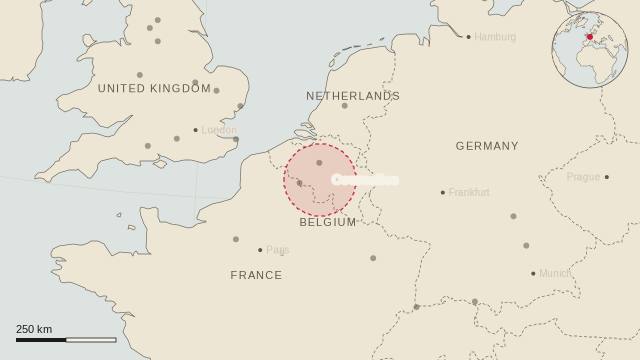
At about 12:55 a.m. local time on August 14, 1965 (11:55 p.m. GMT on the 13th), in Courcelles, west of Charleroi, Belgium, a person resting an elbow on an open bedroom window frame saw a point of light, like a second-magnitude star, cross the sky from south to north at 55° above the horizon, in a straight line and at a steady speed, for about two minutes. By the witness's own account, no one else saw it. The handwritten French account reached the U.S. Air Force, which concluded it had been a satellite without trying to identify which one.
Tier B · IndicativeWhat do they mean? →
Limited evidence: it falls short of what Tier A requires. Any one of these is enough: a single testimony (or several witnesses who saw it together), testimony gathered years later, or an account without contemporary primary documentation.
What it was
90%satellite
The most likely explanation.
- 90% satellite
- 3% other earthly causes
- 7% no known cause
See the split across the six explanations
Earthly origin (human or natural)93%
No known cause7%
Ordinary cause the sources propose: satellite
What happened
What is known about the event comes from a two-page handwritten account in French, undated and arranged in sections A to E. It is kept in the file of Project Blue Book, the U.S. Air Force program that studied sightings, along with a typed English translation and an evaluation card. The author's name is blacked out in both the original and the translation. The handwritten original describes the author as an "étudiant," a student, born on June 17 in Mons, in the Belgian province of Hainaut. The translation calls the author "Miss," against the masculine of the original, and reads the birth year as "1925 (?)"; in the handwriting the third digit looks more like a 4, which would make it 1945. The author noted their eyesight, 0.7 in the left eye and 1 in the right, and wrote "Témoin unique," sole witness.
According to the account, on August 13, 1965, at 11:55 p.m. GMT, that is, at 12:55 a.m. on August 14 local time, the witness was in a bedroom in Courcelles, a half-industrial, half-farming town with the old Courcelles-Nord coal mines, about 110 meters above sea level. The window was open and faced west, and the witness was leaning an elbow on the frame. In the handwriting, the hour figures are written over earlier ones, which leaves some doubt about the time, though what can be read is "0h54." The sky was almost cloudless and visibility was perfect; humidity was 53%, the barometer pointed to rain, and gusts of cooler air came through. The handwritten lines for wind and temperature are blacked out, but the English translation keeps them: wind of "0.05 Beaufort" and 22 degrees.
The object the witness saw looked like a second-magnitude star, about as bright as the North Star. It moved from south to north at 55° above the horizon, in a straight line, at a steady speed and without speeding up. Its speed, the witness wrote, was "à peu près identique à celle d'Echo II," almost the same as that of Echo II (Echo 2 in the catalogs), a NASA satellite: a balloon 41 meters across launched in January 1964. The sighting lasted "à peine 2 minutes," barely two minutes; a parenthesis with seconds follows that the translation marks as illegible, and the translation renders the duration as "Almost 2 minutes."
In a note at the bottom, the witness added that three hours earlier they had prayed to God to see a flying saucer, and that "vers 0h54," at about 12:54 a.m., "une force inconnue," an unknown force, had abruptly torn them from sleep, as if their brain had received a message from outside acting on the neurons that control sleep and the eyelids. The translation read that time as "9 hours and 54 minutes"; in the handwriting, the first digit is gone over twice and looks more like a 0, which puts the awakening one minute before the sighting. The handwritten note goes on: "Depuis le phénomène, je n'ai plus su me rendormir," since then the witness had not been able to get back to sleep. The translation says the opposite: "I was able to get back to sleep."
The note ends with visions the witness said they had had since then, among them the coming "disparition brutale," sudden disappearance, of a presidential couple. The end of the sentence has words crossed out; the translation renders it as "the Lady President of the United States."
The evaluation card is a form of the Air Force's Foreign Technology Division (FTD), headed "Project 10073 Record," Blue Book's project number, and it carries no date. It sums up the case this way: civilian source, one object, two minutes, seen with the naked eye from the ground, heading north, no photos and no physical evidence. Its conclusion is "Satellite": the description is similar to a satellite sighting, and the duration and flight agree with that analysis. It adds that "More than 30 satellites are visible to the eye" and that "No specific object identification attempted." The four pages of the file do not say how the account reached the Air Force or who translated it.
Where it happened
Why it matters
The Air Force named the cause without checking it against any particular satellite, and the geometry of the case at least allows a check on whether it was possible. By a calculation made for this case from the Sun's position and the Earth's shadow, at 11:55 p.m. GMT the Sun was about 25° below the horizon at Courcelles. An object 55° up in the western sky was in sunlight if it flew higher than about 700 km, and in shadow if it flew lower than about 500 km; between those heights it depended on the exact direction. That is the sky the witness saw from the window, which faced west. So at that hour only a high satellite could look like a star.
The satellite catalog kept by the astronomer Jonathan McDowell (GCAT) shows that Echo 2, the satellite whose speed the witness used for comparison, was in orbit that night: it was launched on January 25, 1964, and reentered on June 7, 1969. In 1964 its orbit ranged from about 1,000 to 1,340 km up, at an inclination of 81.5°, nearly polar, so its passes over Belgium ran almost south to north or north to south, and at that height it was in sunlight. Echo 1, NASA's other balloon, had an inclination of 47°, so its track never went north of 47° latitude and it could not cross the sky over Courcelles, at 50° north, from south to north.
Where Echo 2 was at that minute remains unchecked: that needs its orbital elements for that week, which the catalog does not include. Nor was it the only candidate: the catalog lists hundreds of objects in near-polar orbits above 700 km on that date, most of them debris.
The account mixes the sighting with a personal experience: the prayer beforehand, being woken by an unknown force a minute earlier, and the visions afterward. The Air Force card does not mention that note. What the witness describes of the object, a point of light as bright as a star crossing in a straight line at an unchanging speed for a couple of minutes, is what a passing satellite looks like. Using Echo II as a yardstick shows the witness knew what it looked like, although they did not write that it was Echo II.
The skeptical writer Tim Printy, in his review of the Blue Book cases of July and August 1965 in his newsletter SUNlite (2022), accepts the conclusion and narrows it down in one line: "Agreed. Echo 2." He does not say what calculation it rests on. A reader who relies only on the file's English translation comes away with two errors: an awakening at 9:54 that does not fit the rest of the account, and a witness who went back to sleep when the handwritten original says they could not.
Documents and sources
Primary documents
Blue Book file on the Courcelles sighting (August 1965), 4 pp.: FTD card, English translation and handwritten French account
The Air Force's complete file on the light a witness saw from a window in Courcelles on the night of August 13 to 14, 1965.
Read more
It opens with the Foreign Technology Division's undated "Project 10073 Record" card, which concludes "Satellite" without trying to identify which one. Next comes the typed English translation and, on the last two pages, the original handwritten account in French, arranged in sections A to E, with a closing note about a prayer, an abrupt awakening and some visions. The witness's name is blacked out in both versions; in the handwriting, the wind and temperature lines are blacked out too, though the translation keeps them. The translation reads the time of awakening as "9 hours and 54 minutes" where the handwriting says "vers 0h54," and it reverses the sentence about sleep.
Project Blue Book (NARA), via archive.org · Public domain · US Government work · open original
Documented evidence
- Handwritten French account, undated (pp. 3 and 4 of the Blue Book file PDF): sole witness, August 13, 1965, at 11:55 p.m. GMT, 12:55 a.m. local time; bedroom with a west-facing window in Courcelles; one object like a second-magnitude star, south to north at 55° above the horizon, in a straight line at a steady speed, "à peine 2 minutes," with a speed "à peu près identique à celle d'Echo II"
- The same handwritten account, closing note: three hours earlier, a prayer to see a flying saucer; "vers 0h54," an abrupt awakening by "une force inconnue"; "je n'ai plus su me rendormir"; visions of the "disparition brutale" of a presidential couple
- Typed English translation (p. 2): calls the witness "Miss," gives the birth year as "1925 (?)," the duration as "Almost 2 minutes" with an illegible parenthesis, the time of awakening as "9 hours and 54 minutes," and the sleep sentence as "I was able to get back to sleep"; it keeps the wind and temperature that are blacked out in the handwriting
- "Project 10073 Record" card (FTD Form 0-329, p. 1, undated): 13/2355Z, Courcelles, civilian source, one object, two minutes, heading north, no photos or physical evidence; the summary notes "Speed that of ECHO II"; conclusion "Satellite"; "No specific object identification attempted"
- Jonathan McDowell's GCAT catalog: Echo 2 (1964-004A), a 41 m balloon, was launched on January 25, 1964, and reentered on June 7, 1969, in a 1,008 by 1,338 km orbit inclined 81.48° (February 1964 figures); Echo 1 had an inclination of 47.24°
- Tim Printy, SUNlite, vol. 14, no. 3 (May-June 2022), p. 15: in his review of the Blue Book cases of July and August 1965, he notes for Courcelles "Agreed. Echo 2." without detailing the calculation
Sources
- Project Blue Book (NARA), file "1965-08-7475549, Courcelles, Belgium," 4 pp., copy at archive.org — Primary source. PDF p. 1: FTD "Project 10073 Record" card; p. 2: typed English translation; pp. 3 and 4: original handwritten account in French. The witness's name is blacked out in both versions.
- Jonathan McDowell, General Catalog of Artificial Space Objects (GCAT), satcat.tsv, entries 1964-004A (Echo 2) and 1960 Iota 1 (Echo 1) — Launch and reentry dates, size and orbital elements of the two Echo balloons. It does not give a satellite's position on a given date.
- Tim Printy, "Project Blue Book case review: July-August 1965," SUNlite, vol. 14, no. 3 (May-June 2022), p. 15 — Table of August 1965 cases; for Courcelles: "Satellite" / "Agreed. Echo 2."
Related cases
Cases with the same likely cause.
Satellite · Within 10 years
Mayaguana · a star-like light sinks toward the east
1963 · Tier B
Satellite · Within 10 years
Zanderij · a radio operator sees a fast, silent light
1962 · Tier B
Satellite · Within 10 years
Ambergris Caye · a brilliant object changes course and fades
1962 · Tier B
Satellite
Patagonian Ice Field · a flashing light crosses ahead of a jet
2019 · Tier A