1963·Airstrip on Mayaguana Island, Bahamas
Bahamas.Mayaguana · a star-like light sinks toward the east
On January 5, 1963, at 1124 Greenwich time, shortly before sunrise, two employees of Pan American, one of the two companies that ran the missile tracking station on Mayaguana Island, in the Bahamas, saw a point of light like a large star over the airstrip. It was descending toward the east and was lost at the horizon four minutes later. Seventeen days later, the Air Force missile test center reported that no space objects had been scheduled at that time. Project Blue Book closed the case for lack of data.
Tier B · IndicativeWhat do they mean? →
Limited evidence: it falls short of what Tier A requires. Any one of these is enough: a single testimony (or several witnesses who saw it together), testimony gathered years later, or an account without contemporary primary documentation.
What it was
74%satellite
The most likely explanation.
- 74% satellite
- 7% other earthly causes
- 19% no known cause
See the split across the six explanations
Earthly origin (human or natural)81%
No known cause19%
Ordinary cause the sources propose: satellite
What happened
Mayaguana is an island in the southeastern Bahamas. In 1963 it had one of the stations of the Atlantic Missile Range, the chain that tracked missiles and rockets launched from Cape Canaveral, Florida, with other stations on Grand Bahama, Eleuthera, San Salvador and Grand Turk. According to the range history written by Mark C. Cleary, chief historian of the Air Force's 45th Space Wing, the network was operated and maintained for the U.S. Air Force by Pan American World Services and RCA. In the Air Force message, Mayaguana appears as station number 6.
On Saturday, January 5, 1963, at 1124 Greenwich time, two Pan American employees saw a point of light like a large star over the island's airstrip. By a calculation made for this case from the time in the message, sunrise was about ten minutes away, and dawn was breaking. The light was descending toward the east, slightly to the south, toward the part of the sky where the Sun was about to rise. The two followed it until 1128, when it was lost at the horizon.
According to the message that carries their account, the light was estimated to be about 50 miles up (about 80 km), 150 to 200 feet long (45 to 60 meters) and moving at about 2,500 mph (about 4,000 km/h); the Blue Book card copied the speed as 2,550. These are naked-eye estimates of a point of light with no other reference in the sky: to give a height one has to assume a size, and to give a size, a distance. The message adds that no electronic interference was noticed.
The station reported by teletype to the Air Force Missile Test Center (AFMTC) at Patrick Air Force Base, next to Cape Canaveral. The station's text ended with "No further info available." The center checked with the North American Air Defense Command (NORAD) and the Air Force's Air Defense Command (ADC), and also ran checks "locally."
On January 22, seventeen days after the sighting, the center quoted the teletype's text in a message to the Foreign Technology Division (FTD) at Wright-Patterson Air Force Base, Ohio, home of Project Blue Book, the Air Force program that studied sightings. The message, sent at 1929 Greenwich time, asked for immediate attention and gave the center's conclusion: no space objects had been scheduled at those times, and no possibility other than a meteorite was known locally.
The Blue Book record card for the case, undated, sums up the message: one object, four minutes of naked-eye observation from the ground, a civilian source and apparently straight flight. Its comment says that NORAD and the ADC ruled out known satellites and that the missile schedule was not available to check a possible intercontinental missile. Even so, a satellite unknown to that check or a missile was not ruled out, but there were no data to back either one, and the case was filed as insufficient data.
Where it happened
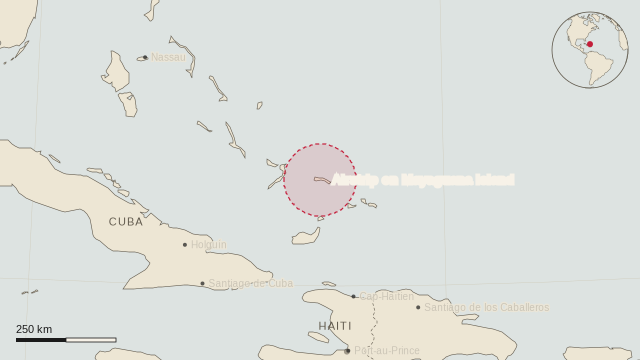
Why it matters
The witnesses worked for one of the companies that ran a station built to track missiles, on the path of those launched from Cape Canaveral, and still did not recognize what they saw. What survives of their account is the teletype quoted by the center at Patrick: the file's three sheets hold neither their names nor their jobs, nor a sketch of the path, nor any follow-up questions to the witnesses. The message went out to Blue Book seventeen days later, even though it asked for immediate attention.
The causes the file mentions can be checked. The center at Patrick saw only a meteorite as possible, but according to the American Meteor Society a fireball "usually lasts only a few seconds," and the light was seen for four minutes. NORAD ruled out known satellites, but the card did not exclude a satellite or a missile; for a missile it lacked the launch schedule. The GCAT catalog kept by astronomer Jonathan McDowell, which records launches and reentries of rockets and satellites, lists no launch anywhere in the world dated January 5, 1963. At Cape Canaveral, the one before was a small sounding rocket on the 4th and the next was a Minuteman missile on the 7th. The center's message, from its headquarters next to the Cape, mentions no launch either.
The GCAT records one reentry that day: the third stage of a Soviet rocket launched on January 4 with a probe bound for the Moon. The probe, which never left low orbit, came down days later. The catalog gives the date but not the time. By a calculation made for this case from the inclination of its orbit, the stage crossed Mayaguana's latitude heading north-northeast or south-southeast. That does not rule it out, because the witnesses' course is not the object's path: it is the point on the horizon toward which they saw it sink.
The time of the sighting explains how a point of light could shine like a star at dawn. By another calculation made for this case from the same time, any object more than about 7 kilometers above the island was already in direct sunlight, even though the Sun had not yet risen on the ground. It remains to be seen whether the station's original teletype and the names of the two witnesses survive in another archive, and whether anyone on the other islands of the chain also saw the light.
Documents and sources
Primary documents
Blue Book file on Mayaguana (January 1963): record card and the message from Patrick Air Force Base, 3 pp.
The three sheets of Project Blue Book file 1963-01-9316566, with the only account of the event and the Air Force's conclusion.
Read more
The first is the record card (ATIC Form 329, undated): January 5, 1963, 05/1124Z, one object, four minutes, civilian source, and the conclusion "Insufficient Data for Evaluation"; the location was first typed as "Mayaguana, South America" and the course as "southerly," and both were corrected by hand. The other two are the message from the Air Force Missile Test Center at Patrick Air Force Base, dated January 22 at 1929 Greenwich time, which copies the teletype from Mayaguana station number 6 and sums up the checks with NORAD. Grayscale scan of the archive.org original.
Project Blue Book (NARA), via archive.org · Public domain · US Government work · open original
Documented evidence
- Message from the Air Force Missile Test Center (AFMTC), Patrick Air Force Base, Florida, to the FTD at Wright-Patterson, with a copy to Systems Command (AFSC) at Andrews Air Force Base, dated "22/1929Z JAN" (pp. 2 and 3 of the file's PDF): "For your immediate attention," quoting the teletype received from "Mayaguana, Station Number 6, of AMR."
- Quoted text from the station (p. 2): "UFO sighted 5 Jan 63 at 1124Z"; "pinpoint of light similar to a large star over airstrip at Mayaguana"; "descending on a course approximately 5 degrees south of due east"; estimated altitude of 50 miles, length of 150 to 200 feet and speed of 2,500 mph (the last digits of each figure are faint in the copy); "No electronic interference was noted"; "observed by two PAA employees from 1124Z to 1128Z when object was lost from sight at horizon" (p. 3).
- AFMTC conclusion (p. 3): "Checks were made with NORAD/ADC and locally. No space objects scheduled passing at those times. No locally known possibilities other than meteorite."
- Blue Book record card, ATIC Form 329, undated (p. 1): January 5, 1963; "05/1124Z"; ground-visual observation; civilian source; one object; 4 minutes; no photos; speed "2,550 mph"; "Apparent straight flight"; comment "NORAD/ADC ruled out known satellites. Missile schedule not available to correlate possible ICBM"; conclusion "Insufficient Data for Evaluation." The location "South America" and the course "southerly" are struck out and corrected by hand to "BAHAMA, ISLANDS" and "EAST."
- Jonathan McDowell's GCAT catalog (launch.tsv): no launch dated January 5, 1963 (the ten January launches with no known day flew from White Sands, New Mexico, or Kapustin Yar, USSR); at Cape Canaveral, a Nike sounding rocket on January 4 at 2000 GMT and a Minuteman 1B on the 7th at 2230 GMT.
Show 2 more facts
- GCAT catalog (satcat.tsv): the Blok-I stage of the Molniya 8K78 rocket that launched the E-6 No. 2 lunar probe on January 4, 1963 (1963-001A), in an orbit of about 152 km inclined 64.6 degrees, reentered on January 5, with no time recorded.
- By a calculation made for this case from the time in the message and the position of the airstrip (22.38° N, 73.01° W): at 1124 GMT the Sun was 2.5 to 3 degrees below the horizon, it rose around 1133 GMT, and the Earth's shadow above the island reached about 7 km up.
Sources
- Project Blue Book (NARA), file "1963-01-9316566, Mayaguana, Bahama Islands," 3 pp., copy at archive.org — Primary source, embedded in this case's viewer. PDF p. 1: record card (ATIC Form 329); pp. 2 and 3: AFMTC message of January 22, 1963, with the teletype from the Mayaguana station.
- Jonathan McDowell, General Catalog of Artificial Space Objects (GCAT), launch.tsv — Launches in January 1963: none dated the 5th; at Cape Canaveral, a Nike sounding rocket on the 4th and a Minuteman 1B on the 7th.
- Jonathan McDowell, General Catalog of Artificial Space Objects (GCAT), satcat.tsv — Reentry on January 5, 1963, with no time, of the Blok-I stage (1963-001A) from the Soviet launch of the E-6 No. 2 probe; orbit of 152 km inclined 64.6 degrees.
- Mark C. Cleary, The 6555th: Missile and Space Launches Through 1970, ch. III, section 2 (45th Space Wing History Office) — Range stations in Florida and on Grand Bahama, Eleuthera, San Salvador, Mayaguana and Grand Turk; operated and maintained for the Air Force by Pan American and RCA from 1954.
- American Meteor Society — Fireball FAQs — Duration of a fireball: "A fireball usually lasts only a few seconds."
- All-domain Anomaly Resolution Office (AARO), Fiscal Year 2024 Consolidated Annual Report on Unidentified Anomalous Phenomena (Nov 14, 2024) — Base rate (p. 3): the 174 closed cases were resolved to prosaic objects; many others remain unresolved.
Related cases
Cases with the same likely cause.
Satellite · Within 10 years
Zanderij · a radio operator sees a fast, silent light
1962 · Tier B
Satellite · Within 10 years
Ambergris Caye · a brilliant object changes course and fades
1962 · Tier B
Satellite · Within 10 years
Courcelles · a witness at a window sees a light cross the sky
1965 · Tier B
Satellite
Patagonian Ice Field · a flashing light crosses ahead of a jet
2019 · Tier A