1962·Ambergris Caye, British Honduras (now Belize)
Belize.Ambergris Caye · a brilliant object changes course and fades
On July 8, 1962, at 7:30 p.m., a woman on Ambergris Caye, in British Honduras (now Belize), saw a brilliant object in the southwestern sky moving south-southwest. She went for binoculars and found it in almost the same place; then it turned north-northeast, passed overhead, stopped about 20° above the horizon and slowly faded. According to her letter, her parents and older brother saw it too. The letter reached Project Blue Book through the Strategic Air Command, and Blue Book closed it for insufficient data.
Tier B · IndicativeWhat do they mean? →
Limited evidence: it falls short of what Tier A requires. Any one of these is enough: a single testimony (or several witnesses who saw it together), testimony gathered years later, or an account without contemporary primary documentation.
What it was
74%satellite
The most likely explanation.
- 74% satellite
- 5% other earthly causes
- 21% no known cause
See the split across the six explanations
Earthly origin (human or natural)79%
No known cause21%
Ordinary cause the sources propose: satellite
What happened
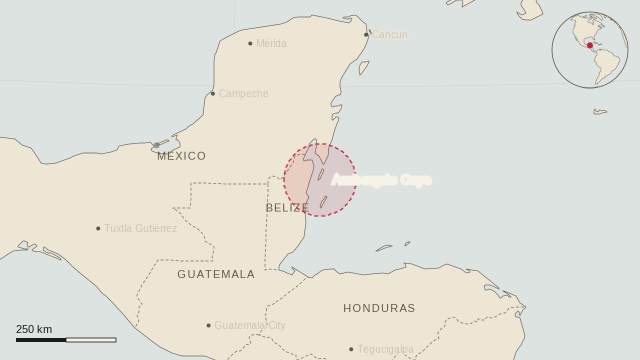
In July 1962, British Honduras, now Belize, was a British colony on the Caribbean coast of Central America. Ambergris Caye is an island off the country's northern coast. From a place on the caye that her letter's heading calls "Buena Vista," a woman wrote down by hand, in English, what she had seen on the evening of July 8. Her name is blacked out in the archive copy; the military note that forwarded the letter calls her "Miss."
According to the letter, at 7:30 p.m. Central Standard Time (CST), she saw in the southwest quadrant of the sky "a brilliant object" moving south-southwest. She gave her position in degrees and minutes of latitude and longitude, which place her a few kilometers from San Pedro, the caye's main town. She stopped watching to fetch binoculars and, when she came back, found the object in almost the same position.
Almost at once, the letter goes on, the object changed course toward the north-northeast and passed straight overhead on an erratic course toward the northeast. It stopped about 20 degrees above the horizon and, as it lost height, slowly faded until it was out of sight. The letter does not say how long it all lasted. Her mother, father and older brother also saw it. The writer closed by hoping the information would be of use and asking to be told what it was, if they knew.
The letter ended up at the Strategic Air Command (SAC), the U.S. Air Force's bomber command, headquartered at Offutt Air Force Base in Nebraska; the surviving pages do not say how it got there. Some six or seven weeks after the event, Lieutenant Colonel Jack A. Steffensen, of SAC's Directorate of Information, forwarded it to the Office of Information of the Secretary of the Air Force, in Washington, "for necessary action." His note is stamped August 1962; the day reads 20, though the second digit is faint and could be an 8, making it the 28th. His note adds that the writer had not been told of the referral.
The file went to Project Blue Book, the Air Force program that studied sightings, and it has three pages: the record card, the SAC note and the letter. The card sums up the account as the letter tells it, adds that there were "Multiple witnesses," and checks the conclusion "Insufficient Data for Evaluation." None of the three pages is a reply to the writer or a request for more details.
Where it happened
Why it matters
The only cause the file considers is a satellite, and the card does not adopt it. In its comments, whoever filled it out wrote that at a distance it was hard to tell whether the object was approaching or moving away. Since all the movement ran along a northeast-southwest line and the last leg went northeast, the comment went on, "the possibility of a Satellite sighting is evident." The comment then objects that Echo would have passed over the area half an hour earlier and that, in the twilight, it might not have been visible even then. It closes with "No duration rptd. Insuf data," no duration reported, insufficient data.
Echo 1 was a NASA balloon 30 meters across, launched in August 1960, that reflected sunlight. According to the satellite catalog of astronomer Jonathan McDowell (GCAT), its orbit, according to its 1960 launch data, ran from 1,517 to 1,684 km up, at an inclination of 47°, so its passes did cross the sky over Belize, at 18° north latitude. The card does not say where the time of that pass came from, and none of the three pages contains a calculation. The card puts the object's apparent back-and-forth down to distance: from afar, it wrote, there was no telling whether it was approaching or moving away.
By a calculation made for this case from the letter's position and time, at 7:30 p.m. the Sun had been down for an hour and was about 13° below the horizon: the last of twilight, with the sky nearly dark. None of the three pages works out the light or the positions of the Moon and planets that night.
The case rests on a single letter. Four members of the same family saw the object together, with no instrument recording anything, and the letter gives no duration, the very detail the card found missing. The letter came by a roundabout route: a bomber command in Nebraska forwarded it to Washington some six or seven weeks later. In the Blue Book collection on archive.org, no other file names British Honduras in its title.
Documents and sources
Primary documents
Blue Book file on Ambergris Caye (July 1962): record card, SAC note and the witness's letter, 3 pp.
The three pages of Project Blue Book file 1962-07-8678995, with the only account of the event and the Air Force's conclusion. The first is the record card: July 8, 1962, 7:30 p.m.
Read more
Central time, seen through binoculars, several witnesses, and the conclusion "Insufficient Data for Evaluation," with a comment that considers and objects to a satellite. The second is the Strategic Air Command note, stamped August 1962 (day 20, or 28: the second digit is faint), forwarding the letter to Washington. The third is the witness's handwritten letter, from Ambergris Caye, with the signature blacked out. Copy of the archive.org original with contrast raised.
Project Blue Book (NARA), via archive.org · Public domain · US Government work · open original
Documented evidence
- Handwritten letter in English (Blue Book file 1962-07-8678995, p. 3), headed "Buena Vista, Ambergris Cay" and dated July 1962; the day in the heading is faint and reads as 8. It says that "On the evening of July 8th," at "19:30 C.S.T.," the writer saw in the southwest quadrant a brilliant object moving south-southwest. The name at the foot, after a faint closing that looks like "(Signed," is blacked out.
- The same letter gives the position as "Latitude 17°54.5'N, Longitude 87°56.5'W"; the first digit of the minutes is faint in both numbers and could read as 3, which would put the point at sea, far from the caye named in the heading.
- The letter goes on: the writer went for binoculars and found the object without much change in position; almost at once it changed course to the north-northeast, crossed her zenith toward the northeast, stopped about 20 degrees up and slowly faded. "My Mother, Father, and older brother all saw this object." It gives no duration.
- Note from Strategic Air Command, Offutt Air Force Base (p. 2), reference "DXIML-2," stamped "20 AUG 1962" (the second digit of the day is faint and could be an 8), addressed to the "Secretary of the Air Force (SAFOI-2c)," with a 3 handwritten over the 2. It reads: "Attached letter concerning an Unidentified Flying Object is forwarded for necessary action" and "Correspondent has not been advised of this referral." Signed "for the Commander in Chief" by Lieutenant Colonel Jack A. Steffensen, Directorate of Information; attachment: "Ltr fr Miss," with the surname blacked out.
- Blue Book record card (p. 1, ATIC Form 329 of 1952): 8 Jul 62; "British Honduras, Central America"; local "1930CST," GMT "09/0130Z"; "Ground-Visual" observation with "Binoculars"; source "Civilian"; duration "not rptd"; one object; course "SSW then NE"; summary ending in "Multiple witnesses"; conclusion checked: "Insufficient Data for Evaluation."
Show 3 more facts
- Card comments: "When viewed at distance difficult to determine whether obj was approaching or going away fm obsvr. Since all movement was NE-SW oriented w/the final flight to the NE the possibility of a Satellite sighting is evident. However, Echo would have passed the area half an hour earlier & the light conditions (dusk) are such that the Satellite might not be visible even then. No duration rptd. Insuf data."
- Jonathan McDowell's GCAT catalog: Echo 1 (1960 Iota 1), launched August 12, 1960, a 30 m sphere, launch orbit of 1,517 × 1,684 km at 47.24° inclination, reentered May 24, 1968.
- Calculation made for this case with 17.91° N, 87.94° W and 0130 GMT on July 9, 1962: the Sun was about 13° below the horizon (it had set around 0031 GMT), at the end of nautical twilight, and the Earth's shadow over the site reached no higher than about 180 km, far below Echo 1's orbit, which was still in sunlight; the Moon, 41% lit, was 53° up at azimuth 247°; Venus, magnitude −4, was 21° up at azimuth 279°.
Sources
- Project Blue Book (NARA), file 1962-07-8678995, "British Honduras, Central America" (record card, Strategic Air Command note and the witness's letter), 3 pp., archive.org mirror — Primary document, embedded in this case's viewer. P. 1: record card; p. 2: SAC note stamped August 1962 (day 20, or 28: the second digit is faint); p. 3: the witness's handwritten letter, with the signature blacked out.
- Internet Archive, "project-blue-book" collection (index of files by identifier) — Identifier and title search of November 23, 2026: no other file has Honduras or Belize in its identifier or title.
- Jonathan McDowell, General Catalog of Artificial Space Objects (GCAT), satcat.tsv — Echo 1 entry (1960 Iota 1): launch and reentry dates, diameter, orbit and inclination.
- All-domain Anomaly Resolution Office (AARO), Fiscal Year 2024 Consolidated Annual Report on Unidentified Anomalous Phenomena (Nov 14, 2024) — Base rate (p. 3): the 174 closed cases were resolved to prosaic objects; many others remain unresolved.
Related cases
Cases with the same likely cause.
Satellite · Within 10 years
Zanderij · a radio operator sees a fast, silent light
1962 · Tier B
Satellite · Within 10 years
Mayaguana · a star-like light sinks toward the east
1963 · Tier B
Satellite · Within 10 years
Courcelles · a witness at a window sees a light cross the sky
1965 · Tier B
Satellite
Patagonian Ice Field · a flashing light crosses ahead of a jet
2019 · Tier A