1956·Sky between Ube and Shimonoseki, Yamaguchi Prefecture, Japan
Japan.Ube · a fighter's radar picks up an object its pilot then sees
On the afternoon of December 17, 1956, near Ube in southwestern Japan, U.S. Lieutenant R. N. Brumet was practicing intercepts with another F-86D fighter when his radar picked up a large blip 20 miles away. He followed it for seven or eight minutes, saw a golden-tan, half-sphere object on and off, and had interference like that of electronic warfare gear, until the blip pulled away at an estimated 1,500 to 1,800 knots. Neither the other pilot nor ground radar detected it. Blue Book closed it as a balloon and a false radar return.
Tier S · SolidWhat do they mean? →
Strong evidence: a contemporary instrumental record (radar, sensor, film or photo of known provenance) that corroborates several independent witnesses.
What it was
45%balloon
No explanation reaches half.
- 45% balloon
- 11% other earthly causes
- 44% no known cause
See the split across the six explanations
Earthly origin (human or natural)56%
No known cause44%
Ordinary cause the sources propose: balloon
What happened
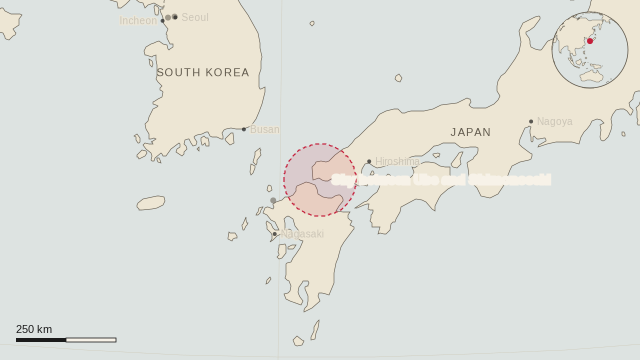
The U.S. Air Force's 68th Fighter-Interceptor Squadron, based at Itazuke in the north of Japan's Kyushu island, flew the F-86D Sabre, a fighter with a radar in its nose for intercepts at night or in bad weather. On December 17, 1956, two of its pilots, First Lieutenants R. N. Brumet and R. A. Sneary, were practicing intercepts on each other near Ube, on the southern coast of Yamaguchi Prefecture. A ground radar station guided them by radio from about 50 nautical miles (about 90 km) away, according to the report; the report's sketch places it on Mishima island, in the Sea of Japan.
At about 3:20 p.m. local time, Brumet was flying west and closing on his wingman from the side. His radar showed the other fighter 12 miles away, a little to the left, when another, larger blip appeared 20 miles away and slightly further left. According to the report, it looked like the return from an island and, by its size, like what a B-29 bomber would give at that range. When Brumet was within 5 miles of his wingman, the unknown blip was still at 20. He asked the ground station whether it had anything there; it said no and cleared him to find out what it was.
As soon as he turned toward the blip, his radar showed a closing speed of 600 to 700 knots. At 8 miles, Brumet looked out and saw something where the radar placed it: the size and shape of the eraser of an ordinary pencil held against the windscreen, and he drew it as half a sphere. By then Sneary had moved in behind him, four to five miles back. When Brumet was four to five miles from the object, it was dead ahead: according to the report, either the fighter had turned left or the object had moved right. By now the radar was tracking it automatically.
Then pulses of interference ran across Brumet's scope, not strong enough to make the radar lose the object. The anti-jamming procedure, which changes frequency, cleared them for ten seconds. Brumet had flown practice runs against B-36 and B-47 bombers carrying electronic warfare gear to jam radars, and this interference was like that, though weaker. Sneary's radar picked up Brumet's fighter but not the object; instead it showed a cluster of small bright points, stationary and at his own altitude, 12 miles away.
At its closest, the object seemed to make a shallow left turn, and its underside looked circular. Although the sun was in a position to glint off a metal object, there was no reflection; the color was golden tan. Then the blip climbed and pulled away off the top of the scope. The report gives its speed, 1,500 to 1,800 knots, as an estimate, because it was faster than the radar could measure for a receding target. In all, the object was on the scope for seven or eight minutes and in sight, on and off, for three or four.
After the mission, another pilot flew Brumet's fighter and everything worked; ground crews checked it after it landed and found it in order. No ground radar station had logged unidentified tracks. The officers who wrote the report warned that this silence meant little: the station could follow the two fighters only through their IFF transponders, the beacons that identify each aircraft, because its radar did not pick up the return from their airframes.
The first report, from the commander of the 43rd Air Division at Itazuke, reached the United States in a Far East Air Forces (FEAF) teletype stamped December 18 or 19; the second digit of the day is hard to read. Several figures differ from the later report.
According to the teletype, the blip measured a quarter by half an inch on the scope. The teletype gives positions as on a clock face, with 12 o'clock straight ahead of the fighter's nose: the radar first picked the object up at 10 o'clock, to the left and 20 miles out, and Brumet first saw it at 2 o'clock, to the right and 8 miles out, after turning toward it. Brumet lost sight of it at about 7 miles, and the blip vanished from the radar when the object was 12 miles away. Sneary was 6 miles back and neither detected nor saw it, but the teletype says both pilots had interference. The fighter was at 25,000 feet and, according to the teletype, it and the object held a westward heading (270°) throughout the chase. The 43rd Air Division's report concluded it was a material object of unknown origin and type.
Where it happened
Why it matters
In that teletype, FEAF presented the case as the first report in its theater of operations in which an object was seen and tracked by radar at the same time. It also linked it to a report from Moscow the same day that B-57 aircraft had flown over the Vladivostok area; the Air Technical Intelligence Center (ATIC), at Wright-Patterson Air Force Base in Ohio, judged in an internal note on December 20 that the link was not valid.
FEAF's liaison office then questioned the pilots: its report, dated February 20, 1957 and signed by Captains Alan G. Pound and William J. Buchanan, gives December 20 as the date of information and the debriefing as its source. Brumet had 1,275 flying hours, 687 of them in the F-86D, and told it "in a straight forward, slightly embarrassed manner": he himself would doubt such a thing had it not happened to him.
That same December 20, an ATIC analysis prepared by Captain G. T. Gregory proposed a weather balloon. Latex balloons are tan, and the wind was from the west-northwest. Stations launched them at Pusan, Chinhae and Taegu in Korea, and another was "almost directly under" the sighting, on Tsushima island. And seen from the same altitude, sometimes only the top of a balloon shows. On that basis and with data from the 6th Weather Group, it concluded, as a preliminary opinion, that the pilot had come across a regularly launched or "runaway" balloon, which could have come from Communist China. But it placed the teletype's coordinates near Tsushima, and they actually fall on Honshu, next to Shimonoseki, about 160 km (100 miles) from that island: the Tsushima station was not underneath.
ATIC's radar office, over the signature of Colonel Gordon C. Hoffman, wrote that it was "extremely difficult" to discount a sighting both seen and tracked, and that a physical object could not be ruled out. Even so, it judged the blip false: it was much larger than a normal return from a single target, and an object that large would also have been picked up by the wingman and the ground station. It suggested that the pilot had associated a real object with a false radar target; someone added by hand "i.e. balloon." The Blue Book card closed the case that way: the visual sighting, "balloon," and the radar, "spurious returns."
Both explanations leave loose ends in the file itself. The ground radar argument is the one the February report asked readers not to weigh, because that station could not see the fighters either without their transponders. And the teletype gives a 130-knot wind from the west at 25,000 feet while saying the object headed west throughout the chase; a balloon carried by that wind would have moved east, although the object's heading is the pilot's estimate. Blue Book's conclusion also requires the balloon Brumet saw to have been exactly where the radar showed a false blip.
In August 1957, the National Investigations Committee on Aerial Phenomena (NICAP), a civilian group, received the unclassified part of the report and published it in its bulletin without names, place or exact dates. From the pencil-eraser comparison it calculated a diameter of about 350 feet, a figure the report does not give, and the UP news agency spread the story in October. The Blue Book file holds the teletype, the ATIC analyses, that bulletin and the UP wire.
Documents and sources
Primary documents
DOW-UAP-D205 — Air Intelligence Information Report on the object an F-86D's radar picked up near Ube
AF Form 112 (report IR-12-57) from the Far East Air Forces technical intelligence liaison office, dated February 20, 1957 and prepared by Captains Alan G. Pound and William J. Buchanan from the pilots' debriefing; date of information, December 20, 1956; evaluation "B-2."
Read more
It has five pages: the cover page, with the summary, the number 1079475 and the NARA declassification stamp with authority NW 78452; two pages with the account in twelve paragraphs and a hand-drawn sketch on chart WAC 388, showing the Kyushu and Honshu coast, the Mishima radar station and the points where the object was first and last seen; the fourth, with the officers' comments and the note that written statements from the 68th Squadron, the 8th Fighter-Bomber Wing and the 41st Air Division (the teletype credits the first report to the 43rd) were on file in their office; and a fifth that reproduces the fourth scanned in mirror image. The coordinates for Ube differ between pages: 33°59' N on the cover and 33°39' N in paragraph 1, both with 131°18' E. The first is the city's and fits the 50 nautical miles the report gives to the ground station: from Mishima it is about 48, against about 68 with the second (a calculation from the island's coordinates). The official description accompanying the document in the PURSUE release warns that its descriptive and estimative language reflects the reporter's subjective judgment at the time.
U.S. Air Force, Far East Air Forces (PURSUE Release 08) · Public domain · US Government work · open original
Documented evidence
- Air Intelligence Information Report IR-12-57 (AF Form 112) from the FEAF technical intelligence liaison office, February 20, 1957, by Captains Alan G. Pound and William J. Buchanan; date of information, December 20, 1956; source, the pilots' debriefing; evaluation "B-2"
- Same report: on December 17, 1956, at about 3:20 p.m. local time, First Lieutenant R. N. Brumet of the 68th Fighter-Interceptor Squadron picked up a second blip at 20 miles on his F-86D's radar, saw it at 8 miles as a golden-tan half sphere, closed to about 5 miles but could get no closer, and had it on the scope for seven or eight minutes and in sight, on and off, for three or four
- Same report: interference on Brumet's radar like, though less intense than, that of practice runs against bombers with electronic warfare gear; Lieutenant R. A. Sneary's radar did not pick up the object and showed a cluster of stationary bright points at 12 miles; departure speed estimated at 1,500 to 1,800 knots
- Same report: the aircraft and its systems were checked and found working; no ground radar station logged unidentified tracks, which the authors ask readers not to weigh because the station could see the fighters only through their IFF transponders
- FEAF teletype with the 43rd Air Division's initial report (stamped December 18 or 19, 1956): object "round on top, flat on bottom," while the February report says it looked circular on the bottom; blip a quarter by half an inch, detected at 10 o'clock at 20 miles and seen at 2 o'clock at 8 miles, each at first contact; both at 12 o'clock when it disappeared; lost from sight at about 7 miles and from radar at 12; interference on both fighters; 25,000 feet; 130-knot winds from the west at that altitude; "material object of unknown origin and type"
Show 2 more facts
- ATIC analyses: Captain G. T. Gregory, on December 20, 1956, proposes a weather balloon, regular or runaway, possibly from Communist China, and places the coordinates 34° N, 131° E near Tsushima, although they fall on Honshu, next to Shimonoseki, about 160 km from the island by a calculation made for this case; Colonel Gordon C. Hoffman, in an undated note, judges the radar blip false, rules out an aircraft, B-57 included, by its speed, does not rule out a real visual object, and suggests that unusual weather could also distort what was seen
- Blue Book card (December 17, 1956, 0620Z, Itazuke Air Base): the visual sighting, "Was Balloon"; the radar, "spurious returns," because the object did not appear on other radars in the area
Sources
- war.gov/UFO — DOW-UAP-D205, 'Air Intelligence Information Report, Japan, 1956' (PURSUE Release 08) — Primary document, embedded in this case's viewer: report IR-12-57 of February 20, 1957, with Brumet's account, the officers' comments and the sketch.
- Official war.gov/UFO description of DOW-UAP-D205 (copy on the probed.space mirror; war.gov is not reachable from here) — Declared substitute: it reproduces the official description, which summarizes the report and warns that its descriptive and estimative language reflects the reporter's subjective judgment. The mirror gives December 17, 1956 as the document date; the form itself is dated February 20, 1957.
- Project Blue Book — file 1956-12-6786110, Itazuke AB, Japan (archive.org) — Primary document: the case card (balloon and spurious returns), the FEAF teletype with the 43rd Air Division's report, the ATIC analyses (Gregory's of December 20, 1956, and Hoffman's, undated), NICAP's August-September 1957 bulletin, the October UP wire, an uncaptioned photo of a pale arc behind a building, and an index card citing Keyhoe (1960, p. 104).
- Project Blue Book — file 1956-12-7277027, Itazuke AFTB, Japan, file 4567 (archive.org) — Primary document: a cover sheet ("File 4567, December 17, 1956, Itazuke AFB, Japan, 1 photo") and an uncaptioned photo of a pale arc behind the silhouette of a building; the file does not say what it shows or who took it.
- Wikipedia — 'Mishima Island, Yamaguchi' (secondary source) — Secondary context source: Mishima island, in the Sea of Japan off Hagi, lies at 34°46' N, 131°08' E.
- Wikipedia — 'Tsushima Island' (secondary source) — Secondary context source: Tsushima island lies at 34°25' N, 129°20' E, between Kyushu and Korea.
- Wikipedia — 'North American F-86D Sabre' (secondary source) — Secondary context source: the F-86D was an all-weather interceptor with a radar in its nose.
Context (not images of the event)
DOW-UAP-D198 — Translation of a Tokyo Shimbun article on a Soviet "flying disk" (1957)
This is a different document, not a record of the Ube sighting, and it concerns no sighting at all: an air intelligence report that translates an article from the Japanese daily Tokyo Shimbun of October 2, 1957, which said the Soviet Union was building a "flying disk."
Read more
The article quoted a professor whose name the report spells only phonetically ("M. S. Zzonjain") in the Soviet science magazine it calls "Knowledge is Power": the disk rose and descended vertically; its engine drew air through a hole in the round wing, creating a vacuum on part of its surface and strong air pressure beneath; the cockpit was gyroscopic so that it turned toward the disk's direction of travel, and its shape resembled the "flying disks" heard of in Western Europe. The main obstacle was heat, to be solved by letting the wing vibrate and by holes through which a special cooling liquid would flow out. It is a two-page AF Form 112 (report IR 5407-57) of October 17, 1957, prepared by Captain Anthony M. Pereira, head of the technical intelligence section of the 6004th Air Intelligence Service Squadron, as part of its routine screening of the Japanese press, and approved on behalf of Colonel Frank L. Dunn, commander of the 6002nd Group; the evaluation is "C-3." Pereira noted that the Tokyo Shimbun was an openly pro-American newspaper and that this was the first information his section had received on that type of Soviet aircraft. It is preceded by both sides of the distribution control record (four pages in all). It is included here because it is the document closest to this case by country and date: it shows what U.S. air intelligence in Japan was following ten months later.
U.S. Air Force, 6004th Air Intelligence Service Squadron (PURSUE Release 08) · Public domain · US Government work · open original
Related cases
Cases with the same likely cause.
Balloon · Within 10 years
Guam · a fighter pilot chases a blinking light he cannot catch
1956 · Tier B
Balloon · Within 10 years
Panama Canal · U.S. military radars track unknown objects
1958 · Tier S
Balloon · Within 10 years
Operation Mainbrace · sightings during a naval exercise
1952 · Tier A
Balloon · Within 10 years
Chorwon · two guards see a light rise and fall over a radar
1952 · Tier A