1968·Demilitarized Zone (DMZ) and Tiger Island, central Vietnam coast
Vietnam.Vietnam DMZ · the June 1968 lights and friendly-fire incident
In June 1968 U.S. Marines reported slow night-time lights and contacts over the Vietnamese Demilitarized Zone and the sea off Tiger Island; on the night of 15 June about 15 unidentified aircraft 'believed to be enemy helicopters' (other accounts speak of about 30 lights) triggered an incursion alarm. The Allied response degenerated into friendly fire: F-4 Phantom fighters sank the swift boat PCF-19 and struck the cruiser USS Boston and the Australian destroyer HMAS Hobart, with fatalities. The naval inquiry blamed radar confusion and misidentification.
Tier A · AcceptableWhat do they mean? →
Institutional evidence: several identified independent witnesses, or contemporary official documentation, without an instrumental record to corroborate them.
What it was
82%natural or human cause
Most likely an ordinary cause that no one has identified
See the split across the six explanations
Natural or human cause
No known cause
Read the full reasoning
According to Jon Wyatt, Australian naval histories cite 'unusual atmospheric conditions over the DMZ', 'insect swarms' or 'bird flocks', without favouring any. The absence of a published analysis is not evidence against an ordinary cause: AARO's FY2024 report says 'all 174 cases have been finalized as resolved to prosaic objects', while 'many other cases remain unresolved'.Primary documents
III Marine Amphibious Force Command Chronology, June 1968: cover, transmittal letters and pp. 16-17 of the intelligence summary, 6 pp.
Extract from the III MAF command chronology for 1-30 June 1968, forwarded to the Commandant of the Marine Corps on 9 August 1968 (serial 00176768) and endorsed onward by Fleet Marine Force, Pacific on 23 September; classified secret and since declassified. In section 5, "Intelligence", it records that during the late evening hours of 15 June approximately 15 unidentified aircraft, "believed to be enemy helicopters", were reportedly sighted in the DMZ area, that since then there had been numerous sightings, both visual and by radar, of slow-moving "UFO's" in the DMZ area and seaward toward Tiger Island, and that "no hard evidence of these aircraft has yet been received".
Cuerpo de Marines de EE. UU., III MAF (copia desclasificada publicada por Project 1947) · Public domain · US Government work · open original
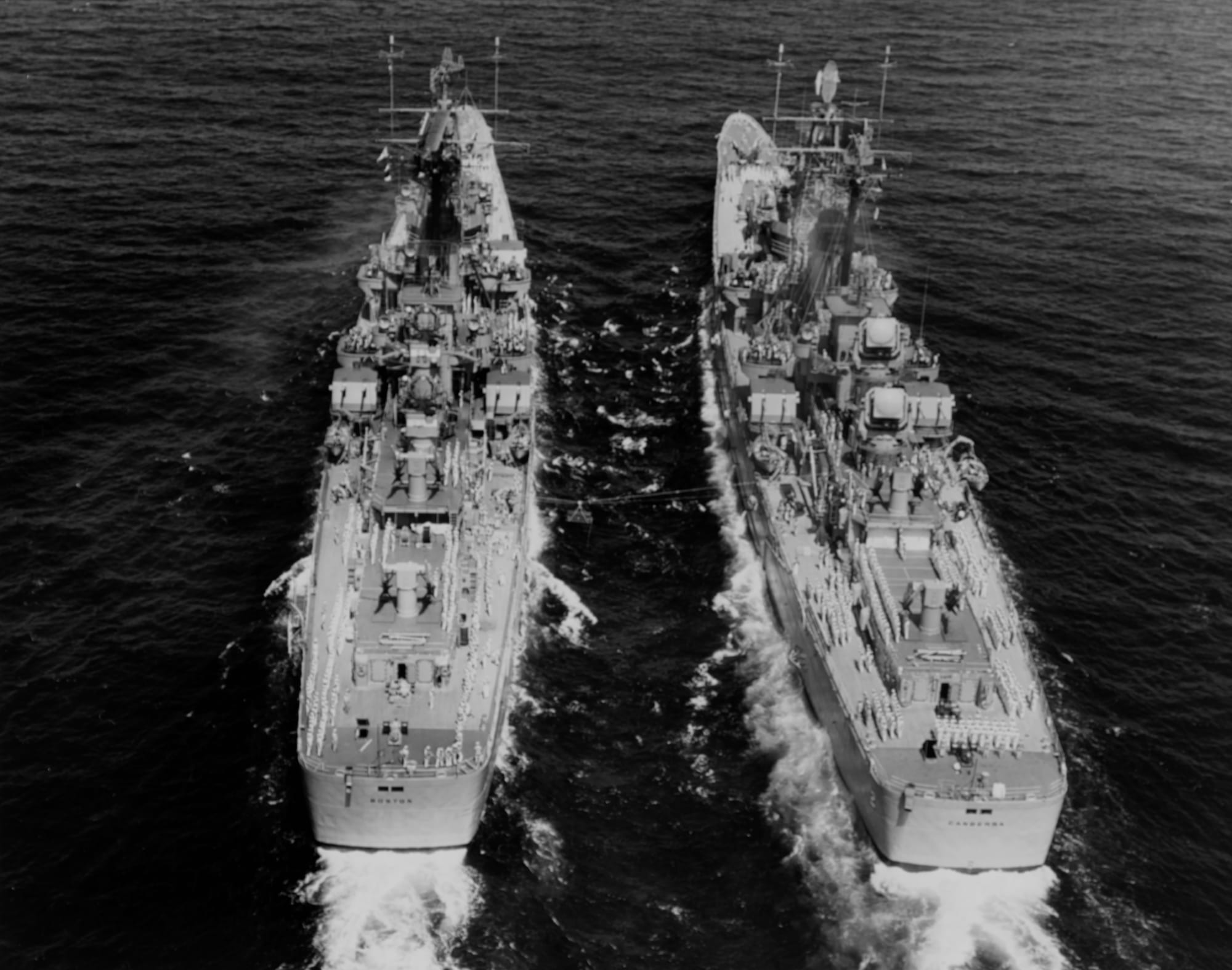
Context · the cruiser USS Boston, hit by friendly fire during the DMZ incident
USS Boston (CAG-1) and USS Canberra (CAG-2) underway in the Caribbean Sea on 22 April 1958 (NH 98289).jpg · Wikimedia Commons · Public domain · open original
The night in question
In 1968, U.S. Marine Corps observers and other forward posts along the Demilitarized Zone (DMZ) (the roughly 9.6 km strip separating North and South Vietnam) had been reporting hovering "lights" that appeared at night just north of the zone and even out over the water between North Vietnam and Tiger Island (held by the North Vietnamese). In the troops' habitual black humour, these contacts were nicknamed "UFOs". The context was the year of the Tet Offensive: any sign of a build-up across the border read as the prelude to an attack.
On the night of 15-16 June the alarm went off. According to the III Marine Amphibious Force command chronology for that month, during the late evening of the 15th approximately 15 unidentified aircraft, 'believed to be enemy helicopters', were reportedly sighted in the DMZ area, and 'since that time there have been numerous sightings, both visual and by radar, of unidentified, slow-moving UFO's in the DMZ area and seaward toward Tiger Island'; other accounts speak of about 30 lights; the immediate reading was that these were North Vietnamese Soviet-built M-14 'Hound' helicopters ferrying men and materiel across the border. Fearing another Tet-style build-up, Allied Command rushed more anti-aircraft guns to the border, placed F-4 Phantom fighter-bombers on standby at Da Nang air base, and asked available warships to patrol the DMZ coast.
What followed was a cascade of friendly fire. Shortly after midnight, the U.S. Navy swift boat PCF-19 was hit by two rockets fired from an unidentified source and sank within minutes; five of its seven crew died, and the cutter USCGC Point Dume pulled two badly wounded survivors from the water before itself coming under fire from an unidentified aircraft. On the night of 16-17 June, the cruiser USS Boston (CA-69) was damaged by shrapnel from near-miss air-to-air missiles and by automatic-weapons fire; and off Tiger Island the Australian destroyer HMAS Hobart, after detecting an aircraft evaluated as "friendly" that kept closing, was struck by three missiles (the first amidships on her starboard side) that killed two sailors, Ordinary Seaman R. J. Butterworth and Chief Electrician R. H. Hunt, and wounded several more; her forward gun fired five rounds at the attacker, which turned away. The crew collected missile fragments that were later identified as being of U.S. origin.
The U.S. Navy Board of Inquiry, which examined the case for the Australian government too, recovered fragments of American Sparrow air-to-air missiles and concluded that the ships had been attacked, by mistake, by U.S. Air Force F-4 Phantoms. One technical factor was decisive: to stop large targets flooding the scope, the Phantom's radar had a cut-off mechanism, so the return from a warship and that of a slow, low-flying helicopter could look nearly identical. The Marine command chronology confirms the "UFO activity" that preceded the attacks and notes that 'no hard evidence of these aircraft has yet been received'; the lights were the trigger, but the deaths were caused by friendly fire.
Why it matters
The case matters for two distinct reasons. The first is documentary: an episode in a war theatre with first-hand official documentation (the U.S. Navy inquiry and the Naval History and Heritage Command H-grams).
The second is analytical, and it is what makes the case valuable beyond the exotic. This is not a case where the interesting question is "what were the lights?" (the readings put forward range from ambiguous radar returns or propagation inversions to, outside the prosaic, real North Vietnamese helicopters, or a mix) but a textbook study of how the ambiguity of an unidentified aerial phenomenon turns lethal in a combat environment. The "lights" were the trigger, but the deaths were caused by friendly fire: own F-4 fighters shooting at targets their radar could not tell apart from a warship. This chain recurs again and again (ambiguous radar-visual contact → armed response → mistaken identification) and the 1968 DMZ is its most tragic expression, with a boat sunk, a cruiser and a destroyer struck and several dead.
That is why the reading does not reduce to "pure error". The contemporaneous official hypothesis (genuine incursions by North Vietnamese helicopters or aircraft) was plausible on that front, although the Marines' own chronology noted that 'no hard evidence of these aircraft has yet been received'; and the slow contacts, visual and on radar, that recurred toward Tiger Island were never fully pinned down. It is militarily documented and well explained by prosaic candidates, significant not as evidence of anomaly but as a witness case to the operational danger of UAP ambiguity.
What's left on paper
Documented evidence
- III Marine Amphibious Force command chronology (June 1968): about 15 unidentified aircraft 'believed to be enemy helicopters' on 15 June and, since then, 'numerous sightings, both visual and by radar, of unidentified, slow-moving UFO's' in the DMZ and toward Tiger Island; 'no hard evidence of these aircraft'.
- Night of 15-16 June 1968: about 30 slow lights over the eastern sector of the DMZ, interpreted as North Vietnamese M-14 'Hound' helicopters.
- Allied response: reinforcement of anti-aircraft guns at the border, F-4 Phantom fighters on standby at Da Nang, and warships patrolling the DMZ coast.
- Sinking of the swift boat PCF-19 by two rockets from an unidentified source; 5 of 7 crew killed; USCGC Point Dume rescued two survivors and then came under fire.
- Damage to the cruiser USS Boston (CA-69) and Sparrow-missile hits on HMAS Hobart off Tiger Island: 2 dead (Ordinary Seaman R. J. Butterworth and Chief Electrician R. H. Hunt) and several wounded; missile fragments identified as American.
Show 2 more items
- U.S. Navy Board of Inquiry: fragments of American Sparrow air-to-air missiles → the attackers were USAF F-4 Phantoms by mistake; the Phantom radar's cut-off mechanism confused a warship's return with a slow helicopter's.
- The Marine command chronology confirms the "UFO activity" preceding the attacks (declassified Vietnam-era document).
Sources
- Naval History and Heritage Command, H-Gram 019-1: «Swift Boat Disappearance» (PCF-19 y el incidente de la DMZ, junio de 1968) — Official U.S. Navy source on the sinking of the PCF-19 and the friendly fire over Boston and Hobart.
- Project 1947, UFO Historical Revue #14: «Air Force UFO Documents, Vietnam Era — HMAS Hobart» — Reproduces the Royal Australian Navy's official account of the attack on Hobart and the intelligence excerpt from the III Marine Amphibious Force command chronology (June 1968).
- Royal Australian Navy — «Hobart UFOs» (memorando de veteranos de la RAN) — Australian account of the impact on HMAS Hobart and its casualties.
- «Navy ship HMAS Hobart hit during Vietnam UFO encounter?» — UFO Evidence (agregador, fuente secundaria; archivo del caso, DMZ, 15 jun 1968) — Compilation of the chronology of the DMZ episode.