1970–1979·Bukit Mertajam, Penang (and peninsular Malaysia)
Malaysia.Malaysia's tiny-humanoid wave
A wave of tiny-humanoid sightings (only a few centimetres tall) reported mostly by schoolchildren across peninsular Malaysia between 1970 and 1979. The Straits Times of 22 August 1970 tallied '39 spaceships and 31 spacemen' three inches tall, all seen by pupils of a single Bukit Mertajam school between 19 and 21 August. Catalogued by Ahmad Jamaludin (Flying Saucer Review; CUFOS, 1981).
Tier B · IndicativeWhat do they mean? →
Limited evidence: a single witness, testimony gathered years later, or an account without contemporary primary documentation.
What it was
74%natural or human cause
Most likely explanation: collective contagion
See the split across the six explanations
Natural or human cause
No known cause
Context image (not a document from the case)
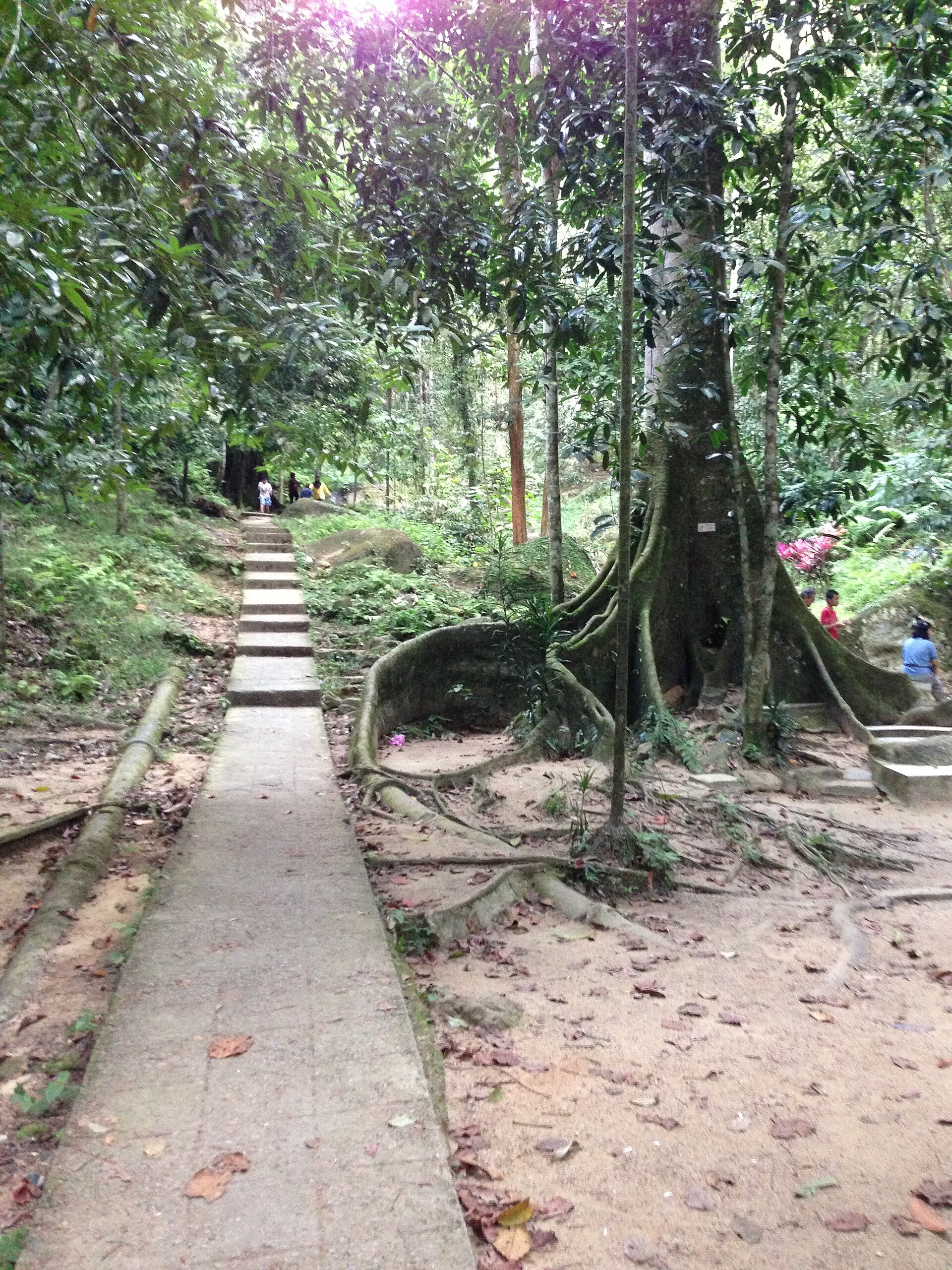
Context · Bukit Mertajam (Penang, Malaysia), epicentre of the 1970 schoolyard wave
Bukit Mertajam Recreational Forest.JPG · Wikimedia Commons · CC BY-SA 3.0 · open original
The years in question
According to Ahmad Jamaludin's account, in Johor Bahru (The Straits Times of August 1970 places that episode near a school and 'last year', that is, in 1969) four schoolboys said they had watched a silver, plate-sized object settle on the ground and disgorge five humanoid figures only a few centimetres tall, dressed in reddish one-piece suits. The beings crawled down a hole and the craft vanished, leaving behind a small patch of scorched grass. The boys told their headmaster and, within weeks, the west coast of peninsular Malaysia filled with near-identical reports.
The most cited episode took place on 19 August 1970 at Stowell Primary School in Bukit Mertajam, in the state of Penang. According to The Straits Times the next day, six pupils aged 8 to 11 said that, while playing in the scrub beside the school, a soup-plate-sized saucer landed near them and five 'little men' about three inches tall (some 8 centimetres) came down a gangway: the apparent leader wore yellow and the other four blue uniforms; they saw them install an aerial on a tree branch and ran away scared. The youngest, aged 8, said one of the beings took out what looked like a tiny gun and shot him: 'It struck me on my hand, but didn't hurt very much.' The following day other boys reported more: a 10-year-old described one with horns and said that, when he tried to capture it, he was shot, was left with a small red dot on his right leg and fainted, and prefects carried him to a classroom; a 7-year-old came home with a small cut on his hand that, according to his father, a police corporal, one of the beings had made. The headmaster, Ooi Keat Guan, went to the spot with another teacher and found no trace of a ship or the aliens.
The phenomenon behaved like a wave. The Straits Times kept the tally with some irony: by lunchtime on 21 August 'the score ... was 39 spaceships and 31 spacemen', all seen by Stowell School boys in the nearby scrub. The headmaster questioned the pupils, who stuck to their story, and said he did not believe them: 'They might have seen some leaves or insects moving and mistaken them for tiny spacemen.' CID officers came to question them and thousands of onlookers flocked to the spot, so that the school closed its main gate. Over 90 % of the catalogued witnesses were schoolchildren, and many encounters were placed on school premises. The wave did not end that year: around 1975-76, at the Royal Malaysian Air Force (RMAF) base in Kuantan, a nine-year-old boy said he had seen one of these creatures drinking water from a drain; he described it as brown, "with two feelers on its head, a steel-like rod in its hand and a pistol at its waist", and said he returned that same evening with two friends to see it again. Reports flared up once more in 1979.
Malaysian researcher Ahmad Jamaludin collected and systematised these cases. He published the Kuantan episode in Flying Saucer Review (Vol. 26, No. 5, January 1981) and compiled the national casuistry in "A Summary of Unidentified Flying Objects and Related Events in Malaysia (1950–1980)", issued by the Center for UFO Studies (CUFOS) in 1981. His most distinctive finding was precisely the miniature scale: unlike Western casuistry, many Malaysian close encounters involved UFOs and entities measured in inches, not feet.
Why it matters
The case matters for three reasons. First, it closes a genuine coverage gap: Southeast Asia in the 1970s, with a phenomenon that barely appears in the dominant Anglophone literature yet was massive at the local scale. Second, it is an almost pure laboratory of one concrete mundane mechanism: cultural contagion and collective confabulation among children. When more than 90 % of the witnesses are children, the encounters happen at schools, and the details (eight-centimetre beings with laser pistols drinking from drains) flatly violate physics and biology, the misidentification-and-folkloric-fabrication reading is not a lazy dismissal: it is the hypothesis best supported by what is known of the case, and the headmaster himself suggested the boys had mistaken leaves or insects. The morphology itself (miniature humanoids, antennae, star-spangled uniforms) reproduces the imagery of the era's toys, comics and television, a marker of cultural construction rather than observation.
Third, and in tension with the above, the Malaysian wave is a methodological reminder: volume is not evidence. Dozens of reports correlated by media diffusion and schoolyard word of mouth do not add up independently, despite its scale. It is treated as a single wave, not as thirty-nine separate confirmations.
Even so, the episode keeps elements that do not fit entirely: the occasional adult witness, the repeated encounter at a military base, and the persistence of the pattern across nearly a decade. The Vallée-style reading remains open, in which the "miniature" would be a trait of the phenomenon rather than of the witness. The case shows how an almost entirely testimonial wave is weighed with discipline.
What's left on paper
Documented evidence
- The Straits Times, 22 August 1970: '39 spaceships and 31 spacemen' three inches tall, all seen by Stowell School pupils (figure taken up by Ahmad Jamaludin).
- School case of 19 August 1970 at Stowell Primary School, Bukit Mertajam (Penang): six pupils aged 8 to 11 describe five ~8 cm humanoids, the leader in yellow and four in blue; one says he was shot in the hand, which 'didn't hurt very much'; the headmaster found no trace and suggested leaves or insects.
- Initial encounter in Johor Bahru, dated by The Straits Times to 1969: four schoolboys describe a plate-sized disc and five reddish-suited beings that crawled into a hole, leaving scorched grass.
- Encounter at the Kuantan (RMAF) air base, ~1975-76: a nine-year-old boy describes a brown creature with feelers, a metal rod and a pistol drinking from a drain; re-observed that evening with two more witnesses.
- Over 90 % of the catalogued witnesses were schoolchildren; five of the reports were placed on school premises.
Show 2 more items
- Ahmad Jamaludin's systematisation in "A Summary of Unidentified Flying Objects and Related Events in Malaysia (1950–1980)", Center for UFO Studies (CUFOS), 1981.
- Publication of the Kuantan case in Flying Saucer Review, Vol. 26, No. 5 (January 1981).
Sources
- Ahmad Jamaludin, «A Summary of Unidentified Flying Objects and Related Events in Malaysia (1950–1980)», Center for UFO Studies (CUFOS), 1981 — Systematic catalog by the investigator who documented the wave; the basis for most of the figures.
- Ahmad Jamaludin, «The Malaysian UFO Scene» / «A Further Report», Flying Saucer Review, Vol. 26, Nº 5 (enero de 1981) — Includes the encounter at Kuantan air base.
- «The Malaysian UFO Scene: A Further Report», archivo de UFO Evidence — Reproduces Jamaludin's material on the Malay casuistry of tiny humanoids.
- «1970: Aerial Invasion in Malaysia», Think About It Docs — Compilation of the August 1970 schoolyard episode.
- The Straits Times, 21-22 Aug 1970, transcribed in UFO Sightings Malaysia, 'Stowell School UFO Incident 1970' — Period reports: the '39 spaceships and 31 spacemen' count, the headmaster's opinion and the mention of the Johor Bahru case 'last year'.
- Malcolm Smith, «Anomalies: Tiny Craft, Tiny Pilots», Malcolm's Musings (mar 2017) — The author first read the accounts as 'contagious confabulations', a schoolboy craze, and asks whether that is the full explanation.
Entity form (1)
Related cases
same object · same period
The Great Mexican UFO Wave (1965)
1965 · Tier B
same explanation · same period
Buff Ledge · Lake Champlain
1968 · Tier B
same explanation · same period
Pascagoula · abduction reported by two fishermen (USA, 1973)
1973 · Tier B
same explanation · same period
Herbert Schirmer · the Ashland patrolman
1967 · Tier A