1976·Talavera la Real Air Base (Ala 23), Badajoz, Extremadura, Spain
Spain.Talavera la Real · the 'Green Man' (1976)
In the early hours of 12 November 1976, three soldiers on guard in the fuel area of Talavera la Real Air Base (Badajoz, Spain) reported interference, a whistle, a partial blackout and an agitated dog. José Manuel Trejo described a figure some three meters tall made of points of green light before losing consciousness; his companions fired on it, it vanished, and no casings or impacts were found. The file declassified in 1996 contains no report of the incident: the Air Staff says it has no 'record of the event'. Nothing in it supports an object or a being.
Tier B · IndicativeWhat do they mean? →
Limited evidence: a single witness, testimony gathered years later, or an account without contemporary primary documentation.
What it was
67%natural or human cause
Most likely explanation: psychological, medical or social cause
See the split across the six explanations
Natural or human cause
No known cause
Primary documents
Air Operations Command file 761112, "Sighting of strange phenomena at Talavera air base" (declassified 1996), 10-page extract
Summary and index by the Intelligence Section of the Air Operations Command, the note from the defence attaché in Caracas (April 1982) forwarding the Diario de Caracas article, the event card ("humanoid apparition"; witnesses J. M. Trejo, Hidalgo and another, three soldiers; "file reliability: missing") and four official replies: the Air Staff's deputy chief (1984) says an examining judge was appointed and the event is not recorded at the Air Staff; the Air Force Public Relations Office (1984) and DRISDE (1985) repeat the judge, mistakenly dating the event 12 December, and the acting commander of Wing 23 (1991) finds no document at all. The summary notes that the report sent to the judicial authority does not appear.
Fuente: Biblioteca Central del Ejército del Aire y del Espacio / Biblioteca Virtual de Defensa · CC BY 4.0 · open original
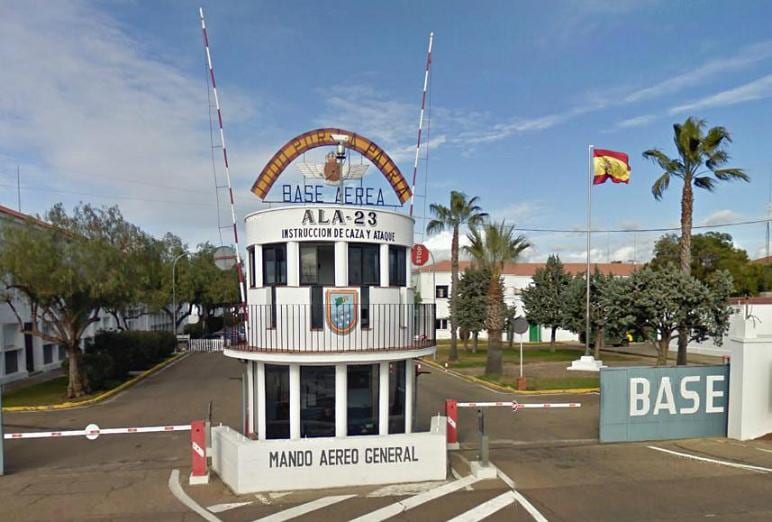
Context · Talavera la Real (Badajoz, Spain)
Base Aerea - Talavera la Real.JPG · Wikimedia Commons · CC BY-SA 3.0 · open original
The night in question
In the early hours of 12 November 1976, at Talavera la Real Air Base (Badajoz, Extremadura), three conscript soldiers were on guard in the fuel area: José Manuel Trejo, who by his own account was the corporal of the guard, José Hidalgo, on guard with the dog Nerón, and Juan Carrizosa Luján. An earlier version, reported by Extremadura Misteriosa, places Trejo and Carrizosa each in his own sentry box, about sixty metres apart. According to the testimonies, the sequence began with an anomalous noise, first comparable to radio interference and then to a high-pitched whistle that lasted several minutes, together with a partial blackout of the perimeter lighting and interference in communications; Trejo also recalls 'an explosion of very white light'. The dog became intensely agitated and, according to Trejo, led them toward the centre of the poplar grove, where there was 'a very large whirlwind of air'.
When the whirlwind stopped, Trejo described beside the wall a large figure (close to three metres tall), apparently formed by small points of green light, with its arms outstretched in a cross, of anomalous proportions and with no defined hands or feet. His weapon jammed; he felt 'an energy that went through his chest' and fell unconscious. His two companions opened fire on the apparition (two 20-round magazines according to Trejo, 'up to 50 shots' according to COPE) and the figure, still according to the account, vanished. The next day more than fifty servicemen combed the area and found neither the casings nor bullet impacts on the wall. Trejo spent twenty-five days in hospital in Badajoz with convulsions and a month in a military hospital in Madrid, and says he was in a coma for thirteen days; he and his companions were accused of having taken drugs and invented the testimony, which he denies. Hidalgo and Carrizosa have died; Trejo is the only living witness.
The account became public through the press: J. J. Benítez published it in the magazine Mundo Desconocido (no. 17, November 1977), and in 1981 the Diario de Caracas reprinted it. The file the Ministry of Defense declassified in 1996 (no. 761112, Air Operations Command, 28 pages, now in the Virtual Library of Defense) grows from there, not from a base report: it is opened by the defense attaché in Caracas, who in April 1982 forwards the article in case the Intelligence Section had not seen it, and it is completed by letters from private citizens asking for information. The official answers say little. In 1984 the Air Staff's second-in-command sets the reply to a citizen: to establish the cause of the events, the judicial authority 'appointed an Examining Judge' who sent it the summary information, 'there being no record of the event at the Air Staff', and all information on UFOs remained classified; in 1985 the Defense Information and Social Relations Directorate (DRISDE) repeats to another citizen that, to clarify what happened, 'an Examining Judge was appointed, who forwarded the relevant conclusions to the Judicial Authority'; in 1991 the acting commander of Wing 23 writes that no document on the matter exists, and the Air Operations Command's enquiries to the base and to DRISDE found neither that report nor any other. The case sheet the Command itself drew up on declassification marks 'file reliability: missing!' and summarizes the event from the press feature. The file, then, documents that there was a military judicial investigation whose outcome has not survived, not a report of the alarm, and it does not establish what happened that morning.
Why it matters
Talavera la Real is an extraordinary close-encounter account wrapped in a real institutional chain of custody. The case shows the distance between two facts that are often confused: the existence of a declassified military file does not mean the Air Force validated an anomalous phenomenon; here it does not even document the alarm: it documents a press feature, some letters and the mention of an examining judge whose report has not survived.
Vicente Juan Ballester Olmos (a researcher who took part in the declassification of the files themselves) points to a possible 'hallucinatory delirium by a person with a psychiatric history, combined with contagious hysteria', which, added to the fear and confusion of young recruits in the dead of night, degenerated into the reported account. He also holds that the base command never regarded it as a UFO-type event and that the file was opened because of letters reaching the Ministry asking for information. The isolated night watch, the loaded weapons, the tension of a military base in late-Franco Spain, and the absence of any conclusive physical evidence (no trace, no photograph, no radar contact) all fit that picture. One unknown remains that the picture does not resolve: according to the main witness, his companions fired two 20-round magazines, and 'the 40 bullets were never found; not even the casings were recovered'.
The file proves the Ministry dealt with the matter; the internal evidence is a sentry's testimony, with no instrumental corroboration. It is an example of why 'documented by a military' and 'unexplained' are not synonyms for 'non-human,' and of how an episode of perception and suggestion can be fixed forever in an official archive.
What's left on paper
Documented evidence
- Spanish Air Force file 761112, declassified in 1996 (Virtual Library of Defense): no incident report; press feature, letters, 'no record of the event exists' (Air Staff, 1984) and mention of an examining judge whose conclusions have not survived (DRISDE, 1985)
- Three soldiers on guard in the fuel area (José Manuel Trejo, José Hidalgo and Juan Carrizosa Luján); an earlier version places Trejo and Carrizosa in sentry boxes ~60 m apart
- Reported sequence: radio interference / high-pitched whistle, partial perimeter blackout, agitated military dog, gunfire with service weapons
- Humanoid description: ~3 m tall, points of green light, long arms with no hands or feet; Trejo lost consciousness
- No conclusive physical evidence: no material trace, no photograph, no radar contact
Show 3 more items
- Skeptical reading (V. J. Ballester Olmos): a possible 'hallucinatory delirium by a person with a psychiatric history, combined with contagious hysteria'; in his account, the base command never treated it as a UFO-type event
- According to the main witness, two 20-round magazines were fired and 'the 40 bullets were never found; not even the casings were recovered' (Planvex, 2017); The next day more than fifty servicemen combed the area and found neither casings nor bullet impacts on the wall (COPE, 2026)
- Trejo: 25 days in hospital in Badajoz with convulsions, a month in a Madrid military hospital and, by his account, 13 days in a coma; the soldiers were accused of having taken drugs, which he denies (Planvex, 2017)
Sources
- Virtual Library of Defense — UFO file, sighting at Talavera la Real air base (Spanish Air Force, declassified) — Primary source: the official file declassified by the Ministry of Defence.
- Extremadura Misteriosa — 'El Hombre Verde de Talavera la Real'
- Planvex — 'José Manuel Trejo, principal testigo del caso OVNI de Talavera la Real' (2017)
- COPE Extremadura — 'El misterio del hombre verde de Talavera la Real, medio siglo después' (23 Feb 2026) — Verbatim quotation of V. J. Ballester Olmos on the psychological explanation and the origin of the file. His own text (Expedientes insólitos, 1995) could not be consulted.
Entity form (1)
Related cases
same explanation · same country · same period
Burgos 1975 · the light four soldiers saw on the Santander road
1975 · Tier B
same country · same period
Canary Islands
1976 · Tier A
same explanation · same period
Carlos de los Santos
1975 · Tier A
same country · same period
Bardenas Reales · the lights over the firing range
1975 · Tier B
Associated actors (1)