2019·Djalelo, Assamo, Arta and the Goda Mountains, Djibouti
Lazarus taxa·Somali sengi
Djibouti.Somali sengi · biologists trap eight animals in Djibouti
In February 2019, a team of biologists from the United States and Djibouti trapped eight Somali sengis at three sites in Djibouti and saw four more. This mouse-sized, long-nosed mammal was known only from about 39 museum specimens, almost all from northern Somalia, and no museum had received a new one since the early 1970s. The specimens went to the California Academy of Sciences, and their DNA showed that the species did not belong to the genus it had been placed in. The paper was published in August 2020.
Tier S · SolidCryptidWhat do they mean? →
Strong evidence: a contemporary instrumental record (radar, sensor, film or photo of known provenance) that corroborates several independent witnesses.
What it was
98%real species, now described
The most likely explanation.
- 98% real species, now described
- 1% other known cause
- 1% unexplained
See the split across the six explanations
Known cause (ordinary, hoax or species now described)99%
Unexplained1%
Separate collection: these figures do not count toward the UAP case totals. How it is split →
Record of the event
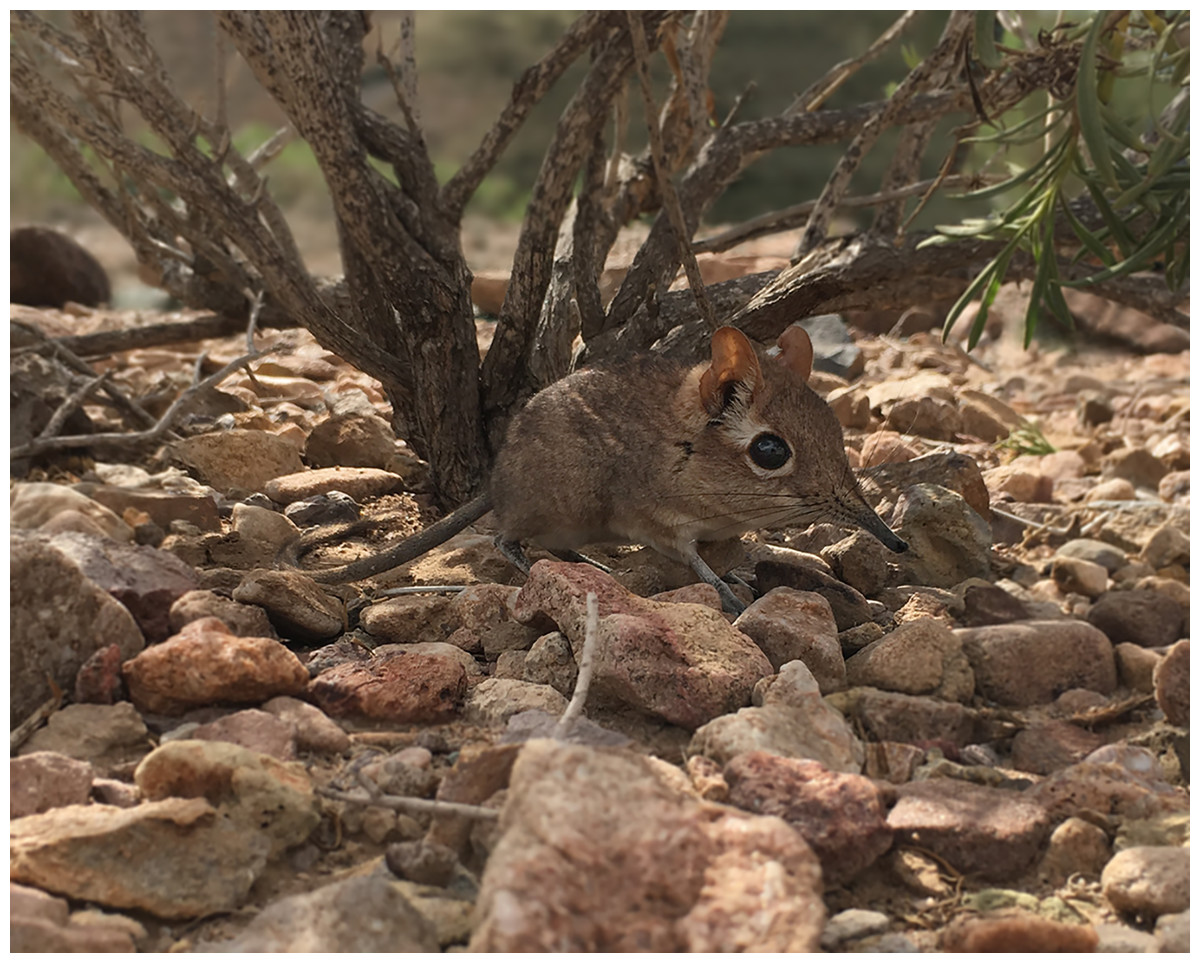
A Somali sengi at Assamo, Djibouti, in February 2019 (figure 1 of the paper)
Photograph by Steven Heritage, taken at Assamo, in the far southeast of Djibouti, of specimen CAS MAM 32728, a male trapped there on February 12, 2019. The animal stands on reddish stones at the foot of a shrub.
Read more
The pale eye ring and the dark spot that breaks it behind the eye are visible. According to the caption, the Assamo sengis have redder backs than those from elsewhere in the country, matching the rocks at the site. Figure 1 of Heritage et al. (2020), published under a CC BY 4.0 license; hosted unchanged.
Heritage, Rayaleh, Awaleh and Rathbun, "New records of a lost species and a geographic range expansion for sengis in the Horn of Africa," PeerJ 8: e9652 (2020), figure 1 · CC BY 4.0 · open original
What happened
The Somali sengi is a mouse-sized African mammal with a long, flexible nose, from a group once called elephant shrews. The French naturalist Georges Révoil obtained the first specimen during his 1878–1881 expedition through the Majeerteen territory of northern Somalia. The species was described in 1881 as Macroscelides revoilii, in his honor, and that specimen is kept at the National Museum of Natural History in Paris. Between 1891 and 1973, British, American and Italian expeditions gathered the rest of the roughly 39 specimens now held by eight museums. Almost all are from northern Somalia, most from sites less than 150 kilometers from the Gulf of Aden coast.
According to the 2020 paper, the scientific literature held no data on living Somali sengis: the little that was known came from museum specimens and their notes. The International Union for Conservation of Nature (IUCN) Red List classed it as data deficient, and the group Global Wildlife Conservation counted it among the 25 most wanted lost species. The only study of several specimens, by the zoologists Corbet and Hanks, came out in 1968, so that year is often cited as the last record; Global Wildlife Conservation's press release on the rediscovery speaks of a species lost "since 1968." According to the paper, that date is inaccurate: the natural history museum of the University of Florence holds specimens collected up to five years later.
The lead came from Djibouti, Somalia's neighbor to the northwest, where no earlier survey of small mammals had obtained a sengi specimen. Houssein Rayaleh, an ecologist with the group Association Djibouti Nature, had seen sengis, or animals that might have been sengis, in some of the areas the team later covered, and two other people told the team where they had seen them. Rayaleh worked with Steven Heritage, a researcher at the Duke Lemur Center at Duke University, in the United States, and with Galen Rathbun, of the California Academy of Sciences, who had spent more than four decades studying sengis. Djibouti's Department of Environment and Sustainable Development authorized the work, the trapping and the export of specimens.
Fieldwork began on February 1, 2019, and ran for 15 days in a row. Each afternoon, around five o'clock, the team set 80 to 90 aluminum live traps baited with oats, peanut butter and yeast, and collected them the next morning before seven. In all it set 1,259 traps at 12 sites. The catch was 263 spiny mice, 18 rodents of other species and 8 sengis. According to Global Wildlife Conservation's press release, the first one turned up in the very first trap they set, in rocky, boulder-strewn terrain. The first capture listed in the paper's table is from February 2, on Hansane Hill in the Djalelo Protected Area, in the Arta region.
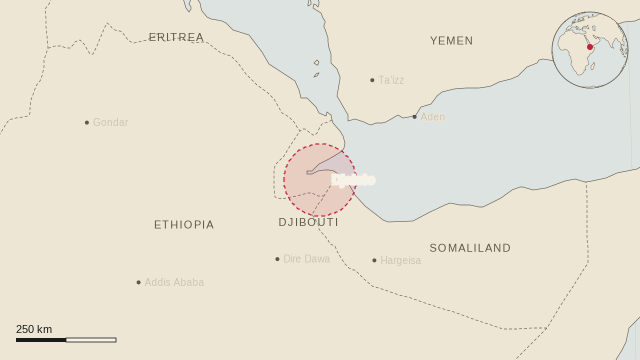
The eight sengis came from three sites: two from Djalelo, two from Assamo, in the far southeast of the country, and four from a hill next to the town of Arta. The team saw three more at Assamo and Arta without trapping them. On February 8, Rayaleh photographed another one sunning itself next to a woodpile in the Day Forest village, in the Goda Mountains, nearly 100 kilometers north-northwest of Assamo. All the sites were rocky, with little vegetation. There were five males and three females, weighing 41 to 59 grams and measuring 120 to 138 millimeters without the tail. One female was pregnant with a single fetus, which was preserved with her.
The authors identified all of them as Somali sengis by the traits Corbet and Hanks had set out: a pale ring around the eye broken by a dark spot behind it, hair on the underside of the tip of the nose, a tuft at the end of the tail, a tail longer than the body and upper incisors of similar size. Of the two other species with that eye ring, only the rufous sengi lives in the Horn of Africa, and its almost naked tail has no tuft. According to the paper, in Djibouti the team found no sign of the rufous sengi or of the sandy, bushy ground where it usually lives.
The specimens were preserved in formalin and alcohol, or as skin and skeleton, and deposited at the California Academy of Sciences. From the livers of three, one from each capture site, the team extracted DNA, read two nuclear genes and rebuilt the complete mitochondrial genome, just over 16,500 bases long. The sequences are in GenBank, the public database of genetic sequences. The team compared them with those of almost every sengi species and with a previously published sequence from a Somali sengi collected in October 1896 west of Hargeisa, in Somalia. The three from Djibouti formed a sister group to that specimen.
The paper was written by Heritage, Rayaleh, Djama Goumaneh Awaleh, of Djibouti's Department of Environment and Sustainable Development, and Rathbun. It was published on August 18, 2020, in PeerJ, a peer-reviewed open-access scientific journal. Rathbun did not live to see it: according to Global Wildlife Conservation, he died of metastatic melanoma a few months after the expedition.
Where it happened
Why it matters
The species was still alive, and in Djibouti it does not seem scarce. The authors conclude that the Somali sengi should no longer be considered missing. They base this on captures at several sites and on a trapping success equal to or better than that of surveys for other sengi species. They also cite what local people said: many knew the animal, recognized it in photos and call it wali or wali sandheer, sandheer meaning "long nose." According to the paper, the lack of data seems to come from a gap in research aimed at the species in the Horn of Africa. Rayaleh said in Global Wildlife Conservation's press release that in Djibouti they had never considered it lost.
The findings extend the species' known range. With the Djibouti sites, the estimated area grows from about 88,500 to about 106,000 square kilometers, 20% more, and the Djibouti records are the northernmost of any sengi south of the Sahara; the Day photo marks the species' known northern limit. Assamo lies 3 kilometers from the Ethiopian border and 10 from the Somali one, and the authors saw no barriers that would stop the animal: they believe it also lives in Ethiopia, though it has not yet been documented there. They said they would recommend that the IUCN move it from "data deficient" to "least concern," because it lives in protected areas, its habitat is fairly continuous, as a rock dweller it may tolerate goat grazing, and the arid climate makes it unlikely that farming will break up its habitat.
The DNA also changed its place among the sengis. The species does not descend from the Elephantulus lineage, the genus it had been placed in, but from another sengi lineage, the tribe Macroscelidini, and its closest relative is the branch formed by Petrodromus, the four-toed sengi, and Petrosaltator, the North African sengi. According to the paper's dating model, the two branches split about 20.6 million years ago. A 2011 study, with few genes from a 19th-century specimen, had left its position unresolved. The authors created the genus Galegeeska, and the species became Galegeeska revoilii. Geeska means "corner" or "horn" in Somali, as in Geeska Afrika, the Horn of Africa, and gale, the ancient Greek word for weasel, also recalls Galen Rathbun (1944–2019).
The paper leaves some questions open. The authors could not estimate whether the population is growing or shrinking, the presence in Ethiopia is an inference, and the count of 39 old specimens could rise because, they write, a museum unknown to them might hold others. The confirmation, by contrast, does not rest on anyone's account: the eight specimens have catalog numbers in a museum, the DNA of three of them is in a public database and every record has a date and coordinates.
Documents and sources
Primary documents
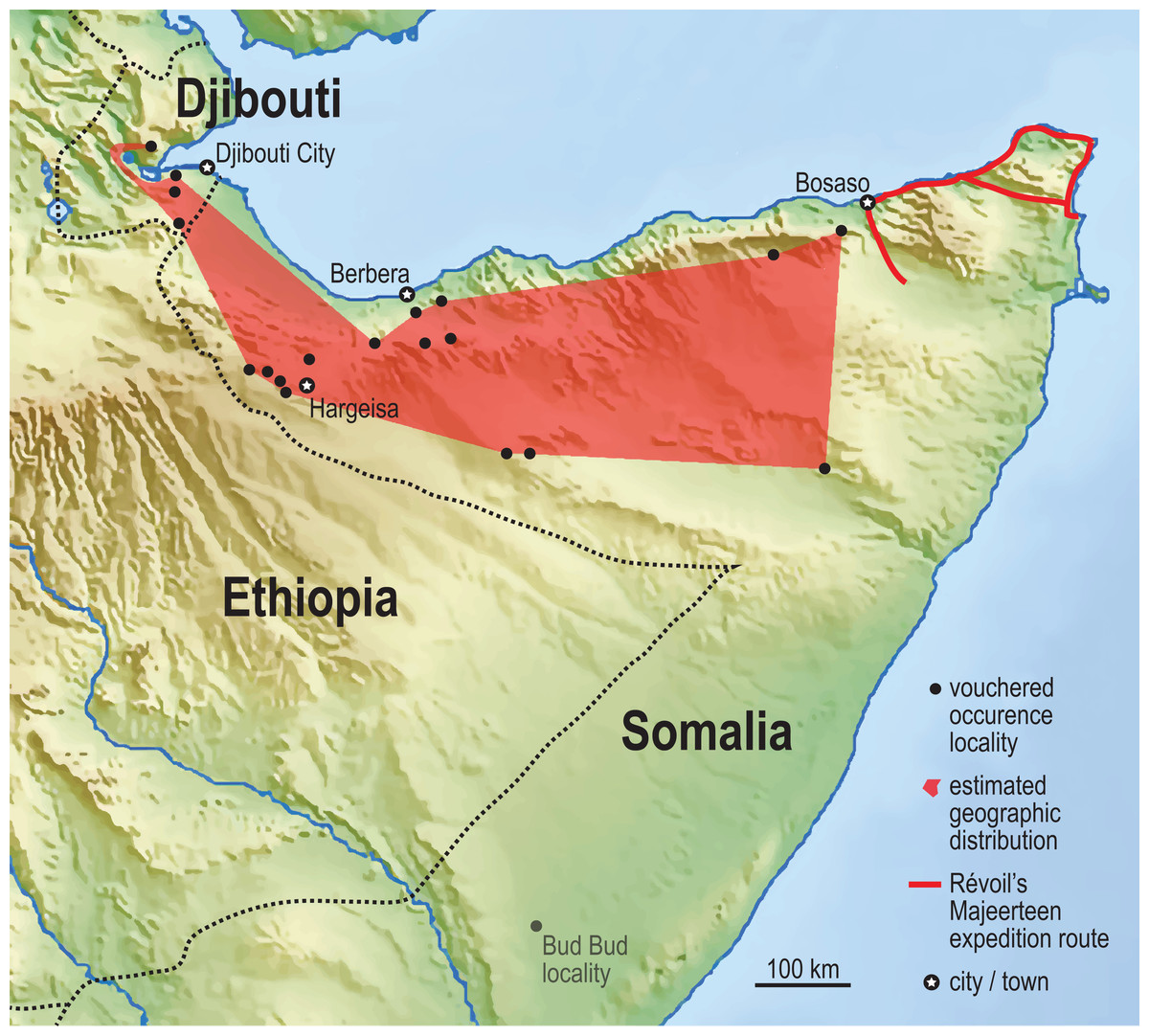
Where the Somali sengi has been recorded, with the new Djibouti sites (figure 5 of the paper)
Map of the Horn of Africa with the sites of the museum specimens from northern Somalia and the new ones in Djibouti (black dots), the species' estimated range (in red, about 106,000 square kilometers with Djibouti) and the route of Révoil's expedition through the Majeerteen territory, where the first specimen was obtained.
Read more
In gray, Bud Bud, a site farther south that the authors leave out of the calculation as anomalous. Figure 5 of Heritage et al. (2020), with a Mapswire base map, published under a CC BY 4.0 license; hosted unchanged.
Heritage, Rayaleh, Awaleh and Rathbun, "New records of a lost species and a geographic range expansion for sengis in the Horn of Africa," PeerJ 8: e9652 (2020), figure 5 · CC BY 4.0 · open original
Documented evidence
- Heritage, Rayaleh, Awaleh and Rathbun, PeerJ 8: e9652 (August 18, 2020), abstract and introduction: the species was known from about 39 museum specimens, with no new vouchered records since the early 1970s, and there had never been a scientific report of living individuals. The University of Florence specimens date up to five years after Corbet and Hanks's 1968 study.
- Paper, methods and results: 15 days of fieldwork from February 1, 2019; 1,259 traps at 12 sites in Djibouti; 263 spiny mice, 17 gerbils, one gundi and 8 sengis, plus three more seen at Assamo and Arta and one photographed at Day. The permit is document 619|DEDD|18 from Djibouti's Department of Environment and Sustainable Development.
- Paper, Table 1: the eight specimens (CAS MAM 32723 to 32730), with date, site, coordinates, altitude, sex and measurements; two from Djalelo (February 2 and 3), two from Assamo (February 11 and 12) and four from Arta (February 15 and 16). The Day photo, with no capture, is from February 8.
- Paper, results and Figure 3: the identification as Somali sengi rests on the eye ring broken by a dark spot, the hair on the underside of the nose, the tail tuft, the proportions of the incisors and a tail that averages 117% of body length; the paper says the rufous sengi was not found in Djibouti.
- Paper, methods and results: DNA from the livers of three specimens (CAS MAM 32723, 32725 and 32726), two nuclear genes and complete mitochondrial genomes of 16,578, 16,571 and 16,581 bases, deposited in GenBank (MT354760 to MT354768). The analysis places them with 100% probability in the tribe Macroscelidini, next to Petrodromus and Petrosaltator, and not in Elephantulus.
Show 2 more facts
- Paper, discussion: new genus Galegeeska Heritage and Rayaleh, 2020 (ZooBank record urn:lsid:zoobank.org:act:68FACC58-A04D-44E5-AA86-30FB87B86611); estimated range from 88,500 to 106,000 square kilometers; according to the authors, the records near the border indicate that the species lives today in Djibouti, Somalia and Ethiopia; recommendation to the IUCN to move the species from "data deficient" to "least concern."
- Global Wildlife Conservation (now Re:wild), press release of August 18, 2020: calls the species "lost to science since 1968," says Rathbun and Heritage got tips that it could be in Djibouti, that the first sengi turned up in the very first trap and that Rathbun died of metastatic melanoma a few months after the expedition.
Sources
- Steven Heritage, Houssein Rayaleh, Djama G. Awaleh and Galen B. Rathbun, "New records of a lost species and a geographic range expansion for sengis in the Horn of Africa," PeerJ 8: e9652 (2020) — Primary source, open access (CC BY 4.0); full text consulted in Europe PMC (PMC7441985). Table 1 gives, specimen by specimen, date, site, coordinates, measurements and catalog number.
- Global Wildlife Conservation (now Re:wild), "FOUND: Romantically Monogamous, Mouse-sized Elephant-Shrew Rediscovered Dashing Around the Wilds of Djibouti," press release (August 18, 2020) — Context: the first trap, the tips about Djibouti, Rathbun's death and Rayaleh's words. It dates the loss to 1968, five years earlier than the paper.