2017·Himalayas and Tibetan Plateau (samples from Nepal, India and the plateau)
Hairy hominids·Yeti
Nepal.Yeti · DNA from nine samples points to bears and a dog
In November 2017, a team led by geneticist Charlotte Lindqvist of the University at Buffalo published a DNA analysis of nine samples attributed to the yeti: hair, bone, skin, a tooth and droppings from a museum, monasteries and private owners in the Himalayas and on the Tibetan Plateau. Eight turned out to come from bears that live in the region, six Tibetan brown bears, one Himalayan brown bear and one Asian black bear, and the tooth came from a dog. The study answered a 2014 study that had linked two Himalayan hairs to the polar bear.
Tier S · SolidCryptidWhat do they mean? →
Strong evidence: a contemporary instrumental record (radar, sensor, film or photo of known provenance) that corroborates several independent witnesses.
What it was
95%ordinary cause
The most likely explanation.
- 95% ordinary cause
- 5% unexplained
See the split across the six explanations
Known cause (ordinary or hoax)95%
Unexplained5%
Separate collection: these figures do not count toward the UAP case totals. How it is split →
Cause the sources propose: ordinary cause
Record of the event
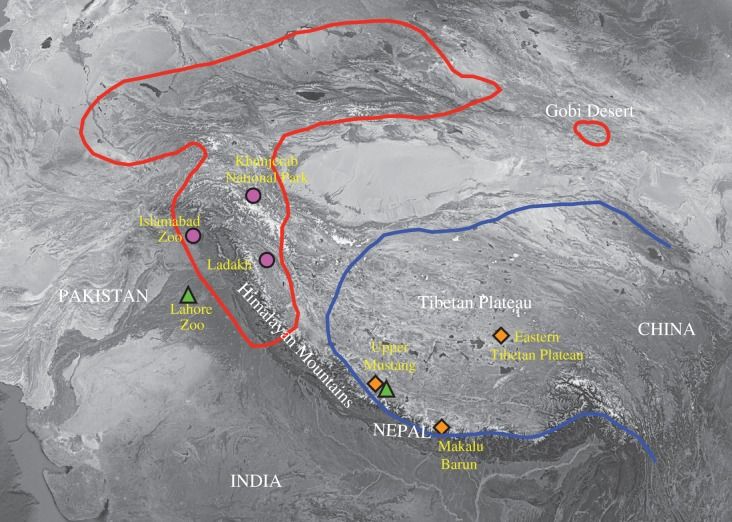
Where the 2017 study's samples were collected and which bear each one matched (figure 1 of the paper)
Map of the Himalayas and the Tibetan Plateau with the approximate collection sites of the samples and the bear lineage that each one's DNA matched: triangles for the Asian black bear (Lahore zoo and Upper Mustang), diamonds for the Tibetan brown bear (Upper Mustang, the Barun Valley near Makalu and the eastern Tibetan Plateau) and circles for the Himalayan brown bear (Khunjerab, Islamabad zoo and Ladakh).
Read more
The red and blue lines mark the approximate historical range of the Himalayan and Tibetan brown bears. The stuffed chemo's hair, the 1996 paw and the cave femur, which the paper's table places only on the "Tibetan Plateau," have no point of their own, and the dog tooth is not shown. Figure 1 of Lan et al. (2017), published under a CC BY 4.0 license; hosted recompressed, with no other changes.
Lan et al., "Evolutionary history of enigmatic bears in the Tibetan Plateau–Himalaya region and the identity of the yeti," Proceedings of the Royal Society B 284: 20171804 (2017), figure 1 · CC BY 4.0 · open original
What happened
In May 2012, the Museum of Zoology in Lausanne, Switzerland, and the University of Oxford issued a joint press release asking museums and collectors to send hair attributed to the Himalayan yeti, the almasty of Central Asia, North America's Bigfoot and other supposed unknown primates. The project behind it was led by Oxford geneticist Bryan Sykes. Fifty-seven samples came in. Among those who sent them were mountaineer Reinhold Messner and Peter Byrne, the Bigfoot researcher who in 1976 had asked the FBI to test some hairs (↗ Bigfoot).
The team ruled out one sample of plant material and one of glass fiber, and picked 37 for genetic analysis. It cleaned each hair to strip away foreign DNA and read a short fragment of a mitochondrial gene, the DNA passed down only from mother to offspring. Seven samples yielded no DNA. The other 30 matched exactly the sequences of known animals stored in GenBank, the public database of genetic sequences.
The paper was published in July 2014 in Proceedings of the Royal Society B, a peer-reviewed scientific journal. The supposed Bigfoot and almasty samples turned out to be American black bears, brown bears, horses, cows, a sheep, raccoons, a porcupine, canids (wolf, coyote or dog), a deer and a human. Of the three Himalayan samples, the one from Nepal came from a serow, a goat-like mountain animal. The other two, one from Ladakh, in India, and one from Bhutan, matched a polar bear.
According to the paper, the golden-brown Ladakh hair came from an animal shot about 40 years earlier by an experienced hunter. The hunter said the animal behaved very differently from a brown bear, which he knew well. The reddish-brown Bhutan hair had been picked up in a bamboo forest at about 3,500 meters, in what was identified as the nest of a migyhur, the name for the yeti in Bhutan.
Sykes and his co-authors wrote that the two sequences matched DNA from a polar bear fossil more than 40,000 years old, and not that of modern polar bears. They warned that the fragment was only 104 base pairs long and that the result was preliminary. Even so, they suggested the hairs came from an unrecognized bear species, a color variant of the polar bear or an ancient hybrid of brown and polar bear. If such bears were widespread in the Himalayas, they added, they might well contribute to the biological basis of the yeti legend.
In February 2015, the same journal published an objection by Ceiridwen Edwards, of the University of Oxford's archaeology laboratory, and R. Barnett, of the Natural History Museum of Denmark. The exact match, they explained, was not with the fossil but with a modern polar bear from Little Diomede Island, Alaska. What set those sequences apart from most brown bears was a single letter of the genetic code. It sat in a run of six cytosines, just where old DNA breaks down and a C ends up being read as a T. Some modern brown bears from Alaska, Bulgaria and France also carry that T. They proposed that the hairs came from Himalayan brown bears, whose fur is usually sandy or reddish brown.
Sykes replied in the same issue with Terry Melton, of the Mitotyping Technologies laboratory, and Michel Sartori, of the Lausanne museum. They acknowledged the error: an incomplete GenBank search had credited the match to the fossil, which was described in the same paper as the Diomede bear. They held that this did not change the conclusion that the sequences were related to the polar bear, and that the DNA of both samples was of excellent quality, with no ambiguity at that letter. They also gave the age of the hairs: more than 40 years for the Ladakh hair and more than 10 for the Bhutan one.
In March 2015, Eliécer Gutiérrez, of the Smithsonian Institution, and Ronald Pine, of the University of Kansas, repeated the comparison in the journal ZooKeys. In that fragment they found only four positions that varied between brown and polar bears, and no letter, alone or combined, that told one species from the other. They concluded that there was no reason to believe the two samples came from anything other than brown bears.
The 2017 study grew out of that dispute. It was written by Tianying Lan, Charlotte Lindqvist and four other researchers from the University at Buffalo, in New York, and from institutions in France, Norway, Pakistan and Singapore. It was published in the same journal on November 29, 2017. They analyzed 24 samples of hair, bone, skin and feces. Fifteen came from bears with no link to the yeti: 12 droppings collected in Khunjerab National Park, in northern Pakistan, hair from two bears at the Lahore and Islamabad zoos and a bone from the American Museum of Natural History. The other nine, purported yeti remains according to the university's press release, came from Messner's mountain museum, in Italy, and the British production company Icon Films.
Messner's museum supplied four: a tooth and hair from a stuffed "chemo," collected in 1938 or 1939; dried skin from a bear's paw, from 1996, and droppings collected where a chemo had reportedly been seen, on the eastern Tibetan Plateau. "Chemo" is one of the local names for the yeti. Of the other five, one was hair from a mummified animal in a monastery in Zanskar, in Ladakh, collected in 2014 and supplied by Harry Marshall of the British production company Icon Films. Another was a piece of femur, and another the so-called Lisanovich hair, collected by a Jesuit priest in 1959 in the Barun Valley, near Mount Makalu, in Nepal.
The femur came from the spiritual healer Pemba Tashi, who in 2008 or 2009 found a decayed body, supposedly a yeti, in a cave on the Tibetan Plateau. The list was rounded out by hair collected in 2014 by the nomadic herdsman Sonam Norbu in Upper Mustang, Nepal, and dried skin from a hand or paw, kept as a relic in a monastery in the village of Tsarang, also in Upper Mustang.
The older samples were processed in a separate clean room set up for ancient DNA, with controls for every extraction. The team first read fragments of mitochondrial genes and, for four samples, rebuilt the complete mitochondrial genome. It compared the sequences with 341 bear sequences in GenBank. The tooth from the stuffed chemo came from a dog. The other 23 samples came from bears. Of the nine attributed to the yeti, six were Tibetan brown bear: the chemo's hair, the paw, the droppings, the Barun hair, the cave femur and the Upper Mustang hair. The Zanskar hair was Himalayan brown bear, and the Tsarang relic was Asian black bear.
The Zanskar hair was the link to the 2014 study. According to National Geographic, Lindqvist's team could not obtain Sykes's samples. The paper says the Zanskar hair might come from the same animal as the Ladakh hair, because it was collected in the same area and because of other anecdotal information from Icon Films. Its complete mitochondrial genome placed it unambiguously among today's Himalayan brown bears. The two sources describe the Zanskar animal differently: in 2014, an animal shot by a hunter some 40 years earlier; in 2017, a mummified animal from a monastery. The 2017 paper does not say whether they are the same, so it is not certain. The Bhutan hair was not among the 2017 samples.
Where it happened
Why it matters
The 2017 study answered the question the 2014 study had left open, with more data. Instead of a single 104-base-pair fragment, it read fragments of several more variable mitochondrial genes and, for four samples, the complete mitochondrial genome, and all nine yeti samples it analyzed turned out to come from animals that live in the region today. The authors concluded that the biological basis of the legend lies in local brown and black bears. The paper sides with the 2015 replies: the short fragment is useful for a first identification, but not for telling apart species as close as the brown and the polar bear.
Both studies have limits that their own pages acknowledge. Neither proves that the yeti does not exist. Sykes wrote that absence of evidence is not evidence of absence, and that his survey had not found any evidence in favor of an unknown primate either. The 2017 study speaks only of the samples it received, and the origin of several rests on the word of whoever handed them over: two of the nine have no collection date, and the link between the Zanskar and Ladakh hairs rests on anecdotal information from the production company. Both studies read only mitochondrial DNA, which traces the mother's line. The 2014 paper already warned that genome data were needed to decide among its hypotheses, and the 2017 paper calls for nuclear DNA to study the region's black bears in more depth.
The same production company stood behind both studies. The 2014 paper thanks Harry Marshall and Icon Films for their contribution to the cost of the analysis. The 2017 paper thanks Icon Films for financial support, lists it among those who supplied samples and states that the authors have no competing interests. According to the University at Buffalo's press release, Icon Films had featured Lindqvist in "Yeti or Not," a 2016 Animal Planet special. The sequences from both studies are deposited in GenBank, and the 2014 ones were exactly those that Edwards, Barnett, Gutiérrez and Pine compared again.
For the biology of bears, the study produced a result of its own. According to the paper, it was the first time complete mitochondrial genomes had been published for the Himalayan brown bear and the Himalayan black bear, two scarce and little-studied populations. With them, the authors estimated that the Himalayan brown bear lineage split from all other brown bears about 658,000 years ago, within a range of 336,000 to 1,258,000, and the Tibetan lineage split from its North American and Eurasian relatives about 342,000 years ago. They linked those splits to the Pleistocene glaciations on the Tibetan Plateau. Seven of the nine yeti samples belong to those two brown bear lineages.
Documents and sources
Documented evidence
- Sykes, Mullis, Hagenmuller, Melton and Sartori, Proceedings of the Royal Society B 281: 20140161 (published online July 2, 2014): of 57 samples received after the May 14, 2012, press release, 37 were analyzed and 30 yielded DNA; a 104-base-pair fragment of the mitochondrial 12S gene was read. All matches with GenBank were 100%.
- Sykes et al. 2014, Table 1: sample 25025 (Ladakh, India, "yeti") and sample 25191 (Bhutan, "yeti/migyhur") match Ursus maritimus, the polar bear; sample 25092 (Nepal, "yeti") matches Capricornis sumatraensis, the serow. The paper calls the result for the first two preliminary. The only sample from Sumatra, attributed to the orang pendek, matched the Malayan tapir.
- Edwards and Barnett, Proceedings of the Royal Society B 282: 20141712 (February 2015): the two sequences are identical to that of a modern polar bear from Little Diomede, Alaska (GU573490), and the fossil differs by one transition; the letter that separates them from almost all brown bears sits in a run of six cytosines, where degraded DNA turns C into T. They propose Himalayan brown bears.
- Melton, Sartori and Sykes, "Response to Edward and Barnett," Proceedings of the Royal Society B 282: 20142434 (February 2015): they acknowledge that the match was with the Diomede bear, not the fossil, because of an incomplete GenBank search; they maintain the link to the polar bear and give the Ladakh hair an age of more than 40 years and the Bhutan hair more than 10.
- Gutiérrez and Pine, ZooKeys 487: 141–154 (March 2015): the fragment has four positions that vary between brown and polar bears and no combination that diagnoses either species; they conclude there is no reason to believe the two samples came from anything other than brown bears. In their GenBank search, the two best matches were still polar bear, only slightly ahead of 94 brown bear sequences.
Show 2 more facts
- Lan et al., Proceedings of the Royal Society B 284: 20171804 (November 29, 2017), supplementary Table S1: 24 samples; the tooth from the stuffed "chemo" in Messner's museum is dog; of the other eight attributed to the yeti, six are Tibetan brown bear, the hair from the Zanskar monastery (Ladakh) is Himalayan brown bear and the Tsarang relic (Upper Mustang, Nepal) is Asian black bear.
- Lan et al. 2017: complete mitochondrial genomes for four samples (the Zanskar hair, the Lisanovich hair, the Tsarang relic and a bone from the American Museum of Natural History), deposited in GenBank (MG066702–MG066705). The paper says the Zanskar hair might come from the same animal as Sykes's Ladakh sample and thanks Icon Films for financial support.
Sources
- Tianying Lan, Stephanie Gill, Eva Bellemain, Richard Bischof, Muhammad Ali Nawaz and Charlotte Lindqvist, "Evolutionary history of enigmatic bears in the Tibetan Plateau–Himalaya region and the identity of the yeti," Proceedings of the Royal Society B 284: 20171804 (2017) — Primary source, open access (CC BY 4.0); full text consulted in Europe PMC (PMC5740279).
- Lan et al. (2017), supplementary material: Tables S1 to S4 — Table S1 gives, sample by sample, the type of material, the place, who supplied it, the collection date when known and the species the DNA matched.
- Bryan C. Sykes, Rhettman A. Mullis, Christophe Hagenmuller, Terry W. Melton and Michel Sartori, "Genetic analysis of hair samples attributed to yeti, bigfoot and other anomalous primates," Proceedings of the Royal Society B 281: 20140161 (2014) — Open access (CC BY 3.0). The correction published in 2015 (282: 20150892) only changes the first author's institution and email; the polar bear error is acknowledged in the reply to Edwards and Barnett.
- C. J. Edwards and R. Barnett, "Himalayan 'yeti' DNA: polar bear or DNA degradation? A comment on 'Genetic analysis of hair samples attributed to yeti' by Sykes et al. (2014)," Proceedings of the Royal Society B 282: 20141712 (2015) — Full text consulted in PubMed Central (PMC4298200).
- Terry W. Melton, Michel Sartori and Bryan C. Sykes, "Response to Edward and Barnett," Proceedings of the Royal Society B 282: 20142434 (2015) — Full text consulted in PubMed Central (PMC4298211). The title spells Edwards as "Edward."
- Eliécer E. Gutiérrez and Ronald H. Pine, "No need to replace an 'anomalous' primate (Primates) with an 'anomalous' bear (Carnivora, Ursidae)," ZooKeys 487: 141–154 (2015) — Open access (CC BY 4.0); full text consulted in Europe PMC (PMC4366689).
- University at Buffalo, "Abominable Snowman? Nope. Study ties DNA samples from purported Yetis to Asian bears," press release (November 28, 2017), on EurekAlert — Counts the nine samples as purported yeti remains and says Icon Films supplied samples and featured Lindqvist in the Animal Planet special "Yeti or Not" (2016).
- John Pickrell, "Yeti Legends Are Based on These Real Animals, DNA Shows," National Geographic (November 29, 2017) — Says Lindqvist's team could not obtain the hair samples analyzed in 2014.
Referenced by 4 cases
Related cases
Cases this case cites and cases with the same likely cause.