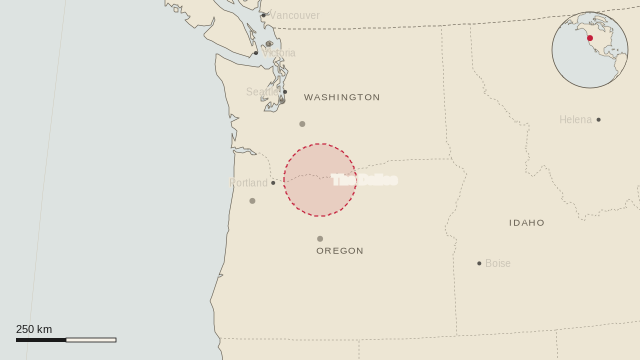
1976–1977·The Dalles, Oregon, U.S. (center that sent the hairs)
Hairy hominids·Bigfoot
United States.Bigfoot · FBI lab tests hairs sent from Oregon
In 1976, Peter Byrne, who ran a Bigfoot research center in Oregon, asked the FBI about a hair analysis that, according to a 1975 Army atlas, matched no known animal. The FBI replied that it could find no such analysis in its files. Byrne then asked it to test about 15 hairs attached to a tiny piece of skin, and the Academy of Applied Science, which sponsored his center, brought them to the FBI. The laboratory examined them under the microscope and in February 1977 concluded they were of deer family origin. The FBI posted the letters online in 2019.
Tier A · AcceptableCryptidWhat do they mean? →
Institutional evidence: several identified independent witnesses, or contemporary official documentation, without an instrumental record to corroborate them.
What it was
96%ordinary cause
The most likely explanation.
- 96% ordinary cause
- 4% unexplained
See the split across the six explanations
Known cause (ordinary or hoax)96%
Unexplained4%
Separate collection: these figures do not count toward the UAP case totals. How it is split →
Cause the sources propose: ordinary cause
Record of the event
FBI "Bigfoot" file: the analysis of Peter Byrne's hairs (1976–1977), excerpt
FBI letter of February 24, 1977, giving the result of the analysis: the hairs sent by the Bigfoot Information Center and Exhibition were "of deer family origin."
Read more
This is an excerpt of 15 of the 22 pages the FBI released, in this order: the result letter and its note (pp. 1 and 2); the two photos of the sample next to a centimeter ruler (p. 3); Byrne's first letter, of August 26, 1976, and the FBI's reply of September 10 (pp. 4 and 5); Byrne's letter of November 24 asking for the analysis and the FBI's letter of December 15 agreeing to it (pp. 6 and 7); Cochran's memo of December 13, 1976, with the inquiry to the atlas's editor (pp. 8 to 11); the memo of February 22, 1977, with the result (pp. 12 and 13); Howard S. Curtis's thank-you letter of March 8, 1977 (p. 14); and the Washington Star-News clipping of July 6, 1975, about the atlas (p. 15). The two duplicate copies, the New York Times article and a blank page are left out. The redacted names (exemptions b6 and b7C) are redacted in the original.
FBI, "Bigfoot" file (FBI Vault); copy of the release to John Greenewald (The Black Vault), May 14, 2018 · Public domain · US Government work · open original
What happened
On August 26, 1976, Peter Byrne wrote to the FBI from The Dalles, a small town on the Columbia River in Oregon. There he ran the Bigfoot Information Center and Exhibition, a research center and exhibit about Bigfoot. According to a New York Times article that summer, he was a former professional hunter in Nepal who had switched from shooting tigers and hunting the yeti to tiger conservation and the search for Bigfoot. In the letter he explained that the center had been studying the phenomenon in the Pacific Northwest for nearly six years and was sponsored by the Academy of Applied Science in Boston. Several times, he wrote, he had been told that the FBI had examined supposed Bigfoot hair and could not match it to any known creature on the continent. He asked to know, "once and for all," whether that analysis existed, when it took place and what it found.
According to the FBI, the rumor had a printed source. In January 1975, the Seattle District of the U.S. Army Corps of Engineers published the "Washington Environmental Atlas," an inventory of the natural resources of Washington state. Page 53 had a section on Sasquatch, the other name for Bigfoot, with a map of tracks and sightings. The text said its existence was "hotly disputed" and that alleged Sasquatch hair samples inspected by FBI laboratories had led to the conclusion that no such hair existed on any human or known animal for which data were available. On July 6, 1975, the Washington Star-News summed up the atlas in a photo caption in different words: the hair the FBI had analyzed belonged to "no known animal."
The FBI answered Byrne on September 10 with a letter from Jay Cochran Jr., the FBI assistant director for the Laboratory Division. Since the atlas came out, he wrote, the bureau had received several inquiries like his, but it had found no reference to such examinations in its files. An internal memo from December adds that the laboratory's experts had no record or memory of that examination. According to that memo, the FBI called Steve Rice in Seattle, whom it describes as the atlas's editor, and he could not trace the source of the claim either.
On November 24, Byrne wrote to Cochran again, this time with a specific request. He wanted the laboratory to compare some hairs his center could not identify: "about 15 hairs attached to a tiny piece of skin." It was, he said, the first find in six years that he thought might matter. He enclosed the New York Times article, from June 30, 1976, about his search. The letter does not say where or when the hairs were collected.
On December 13, Cochran recommended in an internal memo that the examination be granted. His argument was that the laboratory had served the Smithsonian Institution, museums and universities "in the interest of research and legitimate scientific inquiry," besides analyzing evidence for the police. On December 15, Cochran, who now signed as assistant director of the Scientific and Technical Services Division, wrote to Byrne that the FBI would make an exception to its policy, told him where to send the sample and asked for background on where it came from. The 22 pages the FBI released contain no answer to that request.
According to an internal memo of February 22, 1977, Howard S. Curtis, executive vice president of the Academy of Applied Science, brought the sample to the laboratory. The examiners looked at the hairs under the microscope, studied the root, the core and the thickness of the outer layer, and compared them side by side with hairs of known origin. On February 24, Cochran signed the result: the hairs were "of deer family origin." The letter was addressed to Curtis, who had asked for it because Byrne would be out of the country for several months. The FBI returned the sample with it, and the letter listed a copy for Byrne. On March 8, Curtis wrote to thank the bureau and said Byrne, due back from Nepal in a week or two, would receive copies of the correspondence.
Where it happened
Why it matters
The file tells apart two hair analyses credited to the FBI. The first, the one in the atlas, which supposedly found hair from an unknown animal, does not appear in the file. The FBI could not find it in its files, its experts did not remember it and the atlas's editor could not say where it came from. The second, the only one the file documents, was done on Byrne's sample and pointed to an ordinary animal. One unsourced sentence in an Army publication, repeated by a newspaper, brought the FBI several inquiries, and one of them led to a real analysis with the opposite result to the one the atlas had credited to it. Even the internal memo of December 1976 quotes the Star-News wording, "found to belong to no known animal," as if it came from the atlas, rather than the atlas's own words.
The method had limits. In 1977 there was no DNA testing: the laboratory compared the shape of the hairs with hairs of known origin, and the letter names the family, not the species. The sample went back to Curtis in 1977, and no later analysis of it has been published.
Nor does the file say where the hairs came from. Byrne gave that account in June 2019, more than four decades later, when the FBI posted the file. According to The Seattle Times, he said two U.S. Forest Service employees had reported a sighting in Oregon's Coast Range, near the California line, had found barefoot tracks about 14 inches (36 cm) long and had collected hair snagged there. His own team, he said, searched on its own and also found hairs. None of the 1976 letters mentions those witnesses.
In May 2018, the FBI released the papers to John Greenewald, who runs The Black Vault, an online archive of declassified documents, in answer to a Freedom of Information Act request. On June 5, 2019, it posted them in its online reading room, the FBI Vault. Many outlets picked up the story. The Washington Post ran the headline "He waited four decades for FBI analysis of 'Bigfoot' hair," although the 1977 result letter already listed Byrne among those receiving copies. The 22 pages do not say whether it reached him. According to The Seattle Times, Byrne, then 93, accepted the FBI's finding and still believed that Sasquatch exists.
Documents and sources
Primary documents
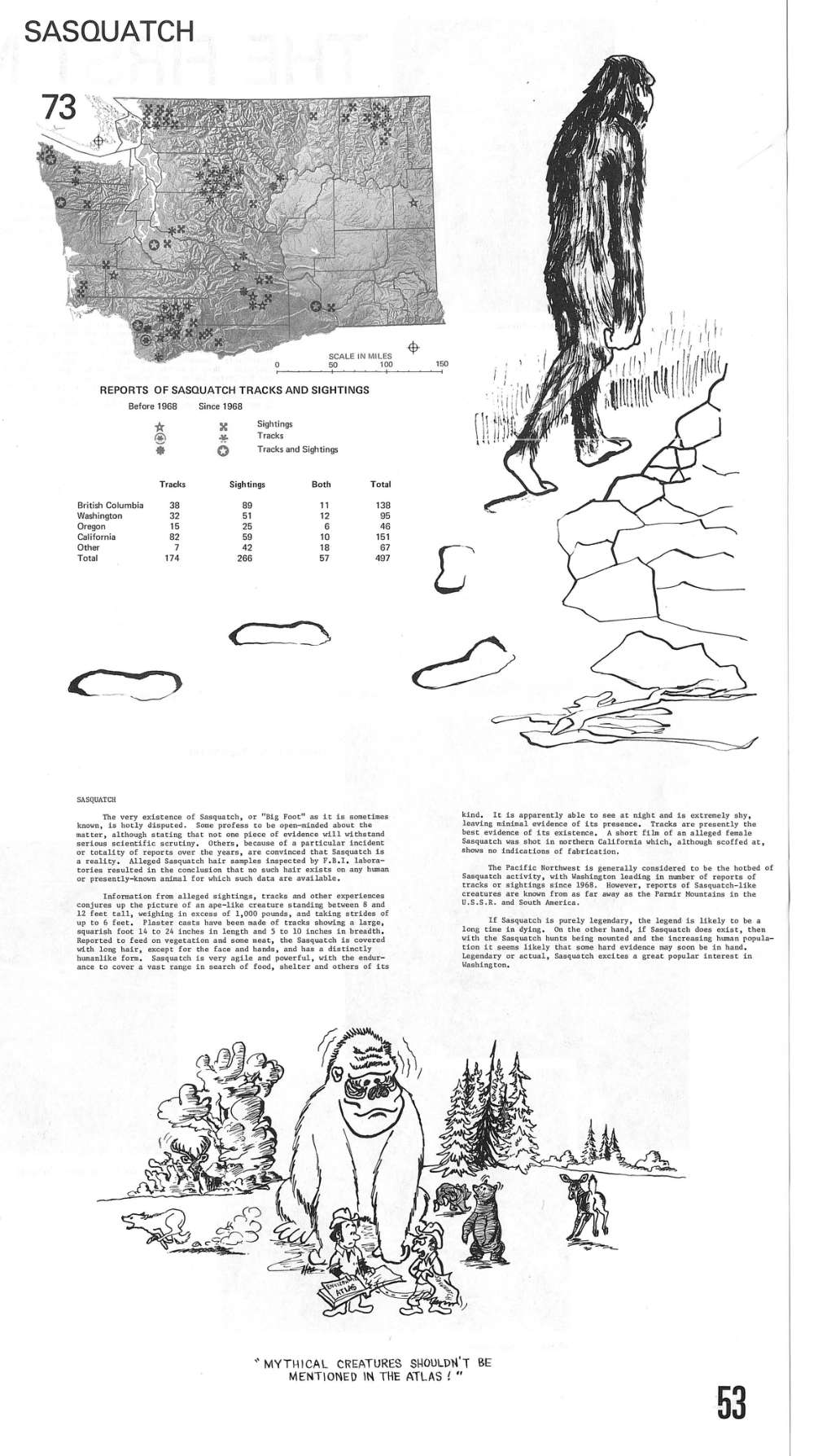
The "Sasquatch" section of the "Washington Environmental Atlas" (1975), page 53
Page 53 of the U.S. Army Corps of Engineers atlas that the FBI linked to inquiries like Byrne's: the text says hair samples inspected by FBI laboratories matched no human or known animal.
Read more
Next to it are map number 73 of reported tracks and sightings and a table that adds up to 497, 95 of them in Washington. The cartoon at the bottom reads "Mythical creatures shouldn't be mentioned in the atlas!" The Corps of Engineers released the atlas to John Greenewald (The Black Vault) on February 6, 2018, in answer to a Freedom of Information Act request.
U.S. Army Corps of Engineers, Seattle District, "Washington Environmental Atlas," January 1975 (The Black Vault copy) · Public domain · US Government work · open original
Documented evidence
- Letter from Peter C. Byrne, director of the Bigfoot Information Center and Exhibition (The Dalles, Oregon), to the FBI, August 26, 1976: asks whether the FBI examined hair said to be from a Bigfoot and with what result. The file holds two copies.
- Letter from Jay Cochran Jr., FBI assistant director, Laboratory Division, to Byrne, September 10, 1976: since the "Washington Environmental Atlas" came out in 1975 the FBI has received several similar inquiries, but it cannot find any reference to such examinations in its files.
- "Washington Environmental Atlas," Seattle District, U.S. Army Corps of Engineers, January 1975, page 53, "Sasquatch" section (with map number 73): says hair samples inspected by FBI laboratories led to the conclusion that no such hair exists on any human or known animal for which data are available. It cites no source.
- Letter from Byrne to Cochran, November 24, 1976: asks for a comparison of "about 15 hairs attached to a tiny piece of skin" and encloses Boyce Rensberger's New York Times article of June 30, 1976. It does not say where the hairs were collected.
- Memo from Cochran, December 13, 1976 (four pages): recommends examining the 15 hairs and tissue; records that the laboratory's experts had no record or memory of the atlas analysis and that its editor, Steve Rice, reached by phone, could not trace his source. Letter from Cochran to Byrne, December 15: the FBI agrees and asks for background on the sample's origin.
Show 2 more facts
- Memo to Mr. Cochran, February 22, 1977, from a sender whose name is redacted: Howard S. Curtis of the Academy of Applied Science delivered the sample (photograph attached), and the hairs were found to be from a member of the deer family.
- Letter from Cochran to Curtis, February 24, 1977, copied to Byrne: examination by transmitted and incident light microscopy (root and medullary structure, cuticle thickness, scale casts) and direct comparison with hairs of known origin; conclusion: "the hairs are of deer family origin." The sample is returned. Letter from Curtis to Cochran, March 8: Byrne will be back from Nepal in a week or two.
Sources
- FBI, "Bigfoot" file in the FBI Vault (22 pages, 1976–1977; posted June 5, 2019) — Primary source: the letters between Peter Byrne, the Academy of Applied Science and the FBI Laboratory, the internal memos and the result of the analysis.
- Internet Archive, "Bigfoot" (copy of the FBI release to John Greenewald, FOIPA request 1396714-000, May 14, 2018) — Full copy consulted: the FBI cover letter for the release and the same 22 pages. The letter says those pages had been processed before under the Freedom of Information Act.
- U.S. Army Corps of Engineers, Seattle District, "Washington Environmental Atlas" (January 1975), page 53 — Primary source of the claim about the FBI analysis. Full copy released to The Black Vault by the Corps of Engineers (about 300 MB).
- Erik Lacitis, "Oh, deer: Documents reveal FBI once tested hair an Oregon man thought was from Bigfoot," The Seattle Times (June 6, 2019), republished by the Anchorage Daily News — Reports what Byrne said in 2019 about where the hairs came from, his age and his view of the result.
- Reis Thebault, "He waited four decades for FBI analysis of 'Bigfoot' hair," The Washington Post (June 2019), republished by The Columbian — Coverage of the file's release in 2019. The subhead says the 1970s letters never reached Byrne.
Referenced by 2 cases