1980–1985·Tomich, near Cannich, Scottish Highlands
Alien big cats·British big cats
United Kingdom.Cannich puma · a farmer traps a tame puma in Scotland
On October 29, 1980, farmer Ted Noble found a female puma in the cage trap he had been baiting for eight months by the Guisachan Forest at Tomich, near Cannich, in the Scottish Highlands, after years of sightings of a big cat. The next day, the director of the Highland Wildlife Park said the fat, tame animal was used to captivity and had been loose for only hours, and the police ordered a report on the affair that would look into a possible hoax. Named Felicity, she lived at the park until 1985 and is now mounted at Inverness Museum.
Tier A · AcceptableCryptidWhat do they mean? →
Institutional evidence: several identified independent witnesses, or contemporary official documentation, without an instrumental record to corroborate them.
What it was
49%hoax
No explanation reaches half.
- 49% hoax
- 48% other known cause
- 3% unexplained
See the split across the six explanations
Known cause (ordinary or hoax)97%
Unexplained3%
Separate collection: these figures do not count toward the UAP case totals. How it is split →
Cause the sources propose: hoax
Record of the event
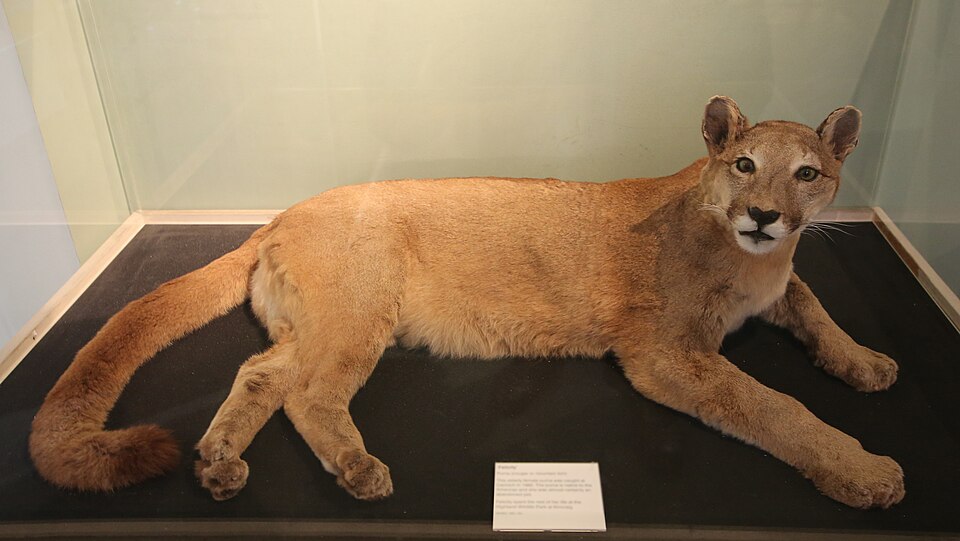
Felicity, the female puma caught in 1980, mounted at Inverness Museum
The specimen caught near Cannich on October 29, 1980, as displayed in a case at Inverness Museum and Art Gallery (accession number INVMG.1985.145): lying down and at rest, as the Highland Wildlife Park staff asked taxidermist Philip Howard.
Read more
Photograph by the user Geni, uploaded to Wikimedia Commons in February 2017 (the camera data give October 9, 2015; the page, October 2016), licensed at the user's choice under the GFDL or several Creative Commons licenses; CC BY-SA 4.0 is used here. Hosted reduced to 960 pixels wide, with no other changes.
Geni, "Felicity Inverness Museum.JPG," Wikimedia Commons, CC BY-SA 4.0 · CC BY-SA 4.0 · open original
What happened
On October 29, 1980, a female puma turned up shut inside a cage trap on the edge of the Guisachan Forest at Tomich, near Cannich, in the old county of Inverness-shire in the Scottish Highlands. According to the Glasgow Herald the next day, the capture ended three years of sightings of a big cat in the area (the museum dates them from 1976), sometimes with cubs and once on the outskirts of Inverness. According to Inverness Museum and Art Gallery, which now holds the mounted animal, a Tomich neighbor named Chisholm had reported her first encounter with a big black cat in 1976 and later said she had seen and heard several big cats near her home. The two sources disagree on her first name: the museum calls her Jessie and the Glasgow Herald calls her Janet, a woman in her early sixties who lived alone at Lillieoak Cottage.
The trap belonged to Donald Noble, known as Ted, a farmer at Kerrow, near Cannich. According to the Glasgow Herald, less than a year earlier he had seen the animal stalking his Shetland ponies, and the family had lost sheep and ponies. The remains of those animals, along with hair, droppings and paw marks, had led experts the paper does not name to agree that a big cat not native to Britain was on the loose.
Noble built a steel trap on his farm and, eight months before the capture, set it by the forest near Chisholm's cottage, on her land according to the museum. The paper says he baited it every few days with a sheep's head tied to a string, so that a door slammed shut behind the animal when it struck at the bait. The museum speaks instead of sheep's offal.
On the morning of the 29th, Chisholm crossed the bog in front of her cottage and found the animal in the trap, spitting and snarling. "I was not frightened in the least," she said, according to the Glasgow Herald: she had seen it around her garden so many times that she thought of it as "a great big cuddly teddy bear." She said that the first time she had come within eight feet (2.4 m) of the animal before it fled, and that she believed she had seen it with cubs. Noble said he was thinking of getting a license to keep the puma and putting up a plaque on the farm. During the day, neighbors and onlookers made the trip up the dirt track to see it.
Eddie Orbell, director of the Highland Wildlife Park, a wildlife park near Kingussie, drove north with a police escort. He set a traveling cage at the mouth of the trap and, according to the paper, after a rap on the bars the puma went into it. That night it was already at the park, where tests were to be done the next day to establish its age. The paper reported two explanations then going around: that a pair of pumas had been let loose in 1976, when a new law began requiring a license to keep dangerous wild animals, or that all the sightings were of one animal whose look changed with mud or wet.
On October 31, the Glasgow Herald told a different story. The animal, now called Felicity, let Orbell stroke her ears, and he said: "This animal is used to captivity and can have been at liberty only for a very short time." Asked whether he meant weeks or days, he replied, "Hours," and added, "Someone has played a very nasty trick." According to Orbell, the puma was much tamer than the park's lynx, and she was well fed and very flabby, which did not fit an animal that had lived in the wild. She had a sore left front paw and, when a dead rabbit was thrown to her, she sniffed it suspiciously and ate only one leg.
Inverness police assigned Sergeant John Cathcart to report on the affair, "from the first sightings to the alleged capture," according to a spokesman quoted by the paper. Cathcart visited the park on October 30 and said he would see everyone involved and look into the possibility of a hoax. Noble declined to comment further to the Glasgow Herald. The paper added that other farmers in the area said they had not suffered losses like his, and that pumas were for sale in Britain; according to Orbell, Edinburgh Zoo had five, with no takers, at very low prices.
According to the museum, experts estimated that the animal had been loose for less than 48 hours; she also did not match what Chisholm and the other witnesses had described, and the sightings went on. At the park, her keepers had to prepare her food because she would not eat rabbits that had not been skinned, another sign that she had been hand-reared. Felicity died in her sleep at the park in early 1985, after falling ill the day before. The museum dates the death to January without giving the day; the first report in its own list of press coverage is in the Press and Journal of February 7. The autopsy, which the museum summarizes without publishing it, put her age at about 20 and gave old age as the cause; a wild puma lives about 12 years. According to the museum, those findings supported the view that she had been raised as a pet and overfed when young.
Taxidermist Philip Howard mounted her in Edinburgh, lying down and at rest, because the park's staff asked that she not be shown snarling. The Scottish Museums Council paid half the cost, and since 1986 she has been on display at the Inverness museum under accession number INVMG.1985.145. Neither the museum nor the Glasgow Herald of October 30 and 31 says what Cathcart's report concluded, and the museum treats the animal's origin as unsolved: whether she escaped, was abandoned or was put in the trap by someone to fool Noble.
Where it happened

Why it matters
This is a case in which there really was an animal: a flesh-and-blood puma, caught alive, examined by a specialist the next day and kept to this day in a museum. The museum calls it probably the most famous big cat capture in the United Kingdom. Even so, it did not settle what the sightings had raised, because everything learned about the animal suggested it was not the one people said they had seen.
The case against a wild puma came from people with names and posts within 48 hours: the director of the park that took her in spoke of hours at liberty, of a fat animal used to people, and of a trick; the police ordered a report that would look into a possible hoax. The 1985 autopsy, with the age it gave, fits the same reading. What remains open is how she got into the trap, not what she was.
The case also shows why big cats turned up out of place in Britain in those years. The Dangerous Wild Animals Act of 1976 required a license to keep such animals, and the day after the capture the Glasgow Herald reported speculation that a pair of pumas might have been released at that time. Orbell added that Edinburgh Zoo had five pumas at very low prices and no takers. A loose puma in the Highlands was therefore more likely a captive-raised animal than part of a wild population.
What the case does not explain is the rest of the sightings. According to the museum, Felicity did not match what Chisholm, who first spoke of a big black cat, and the other witnesses had described, and the reports continued after her capture. The Glasgow Herald of October 30 also mentioned two different big cats, seen in the stretch from Bettyhill, on the north coast of Sutherland, to Farr, near Inverness. The specimen is still in the museum, but no published analysis of it, of its DNA or of its origin is known; the autopsy is known only from the museum's summary.
Documents and sources
Documented evidence
- Glasgow Herald, October 30, 1980, pp. 1 and 2 (Stuart Lindsay): the puma was caught the day before on the edge of the Guisachan Forest at Tomich, near Cannich; the steel trap, built by Ted Noble of Kerrow, had been set eight months earlier and baited with a sheep's head; that night the animal was at the Highland Wildlife Park, near Kingussie.
- Glasgow Herald, October 30, 1980: Chisholm, a neighbor at Lillieoak Cottage, found the animal in the trap in the morning; Eddie Orbell, of the park, drove up with a police escort and moved it into a traveling cage; a front-page photo shows the puma caged that night.
- Glasgow Herald, October 31, 1980, p. 1: Orbell said the animal was used to captivity, could have been at liberty only for "hours," was well fed and very flabby, and that "someone has played a very nasty trick."
- Glasgow Herald, October 31, 1980: Inverness police assigned Sergeant John Cathcart to report on the affair "from the first sightings to the alleged capture," and he said he would look into the possibility of a hoax; Edinburgh Zoo had five pumas with no buyers, according to Orbell.
- Inverness Museum: according to experts, the animal had been loose for less than 48 hours and did not match the witnesses' descriptions; she would not eat unskinned rabbits; she died in early 1985 and the autopsy put her age at about 20.
- Inverness Museum: taxidermist Philip Howard mounted her in Edinburgh, with half the cost paid by the Scottish Museums Council; she has been on display since 1986 under accession number INVMG.1985.145.
Sources
- Stuart Lindsay, "Highland puma in captivity at last" and "Puma goes quietly," Glasgow Herald, October 30, 1980, pp. 1 and 2 — Primary source for the capture: place, date, trap, bait, named witnesses and transfer to the park. Read on the image of both pages in the Google News Archive.
- Stuart Lindsay, "Puma mystery has a tame ending," Glasgow Herald, October 31, 1980, p. 1 — Eddie Orbell's statements on the animal and the police assignment to Sergeant John Cathcart. Read on the page image in the Google News Archive.
- Inverness Museum and Art Gallery (High Life Highland), "Felicity the Puma" — Page of the museum that holds the specimen (INVMG.1985.145): trap, life at the park, death, summarized autopsy, taxidermy and list of press coverage. The autopsy is not published.
- Dangerous Wild Animals Act 1976 (c. 38), legislation.gov.uk — The 1976 law requiring a license to keep dangerous wild animals, which the Glasgow Herald alludes to.