1982·Low Creek, Mill Creek watershed, Umatilla NF, Oregon, U.S.
Hairy hominids·Bigfoot
United States.Umatilla · Forest Service investigates Bigfoot footprints
In June 1982, a U.S. Forest Service biologist examined Bigfoot footprints about 15 inches long found in the Mill Creek watershed of the Umatilla National Forest, on the Oregon side of the Washington state line. His June 18 memo, with photos and plaster casts, concluded that no two-footed being of more than 300 pounds had made them: the stride did not change with the slope, and the group's boots sank deeper than the tracks. A Border Patrol tracker who also saw them on the 17th called them a very clever hoax.
Tier S · SolidCryptidWhat do they mean? →
Strong evidence: a contemporary instrumental record (radar, sensor, film or photo of known provenance) that corroborates several independent witnesses.
What it was
80%hoax
The most likely explanation.
- 80% hoax
- 20% unexplained
See the split across the six explanations
Known cause (ordinary or hoax)80%
Unexplained20%
Separate collection: these figures do not count toward the UAP case totals. How it is split →
Cause the sources propose: hoax
What happened
On June 10, 1982, Paul Freeman, a U.S. Forest Service patrolman assigned to the Mill Creek watershed, said he had come face to face on an old logging road with a hairy creature about 8 feet tall. The watershed, in the Blue Mountains, supplies the drinking water of Walla Walla, Washington, and is closed to the public. The account comes from journalist Vance Orchard, who interviewed Freeman for the Walla Walla Union-Bulletin and collected those articles in his book "Bigfoot of the Blues" (1993). According to Orchard, the encounter took place near Tiger Saddle, a pass on the Oregon side.
According to the Union-Bulletin stories Orchard reproduces, about 25 tracks were left on the road that day, and Forest Service personnel took a cast. The next day, Wayne Long and other employees tried to gauge with a truck the weight needed to press them in, without reaching a figure, and Long said he did not think they were man-made.
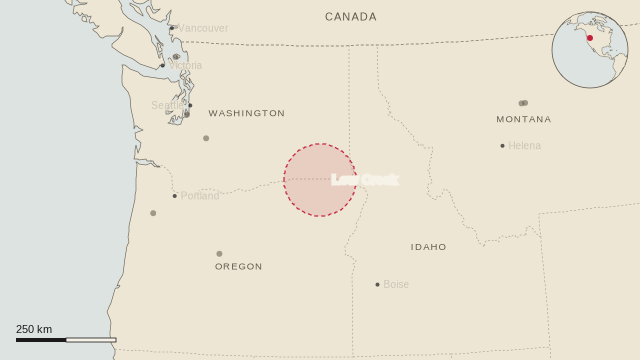
There was a second find. According to Orchard, a week later Freeman and another patrolman, Bill Epoch, came across new tracks elsewhere in the watershed. On June 16, Roger E. Baker, of the Umatilla National Forest's resource staff, asked wildlife biologist Rodney L. Johnson to go with a group the next day to look into the reported find of "Bigfoot" tracks in the Low Creek drainage. Johnson went on the 17th and on the 18th signed a memo on what he saw. Low Creek is a tributary of Mill Creek that runs through Oregon: according to the coordinates in the official U.S. register of geographic names, it flows into Mill Creek less than half a mile from the Washington state line.
The tracks were at three sites: two beside the Low Creek trail and one beside an unnamed trail near the top of a nearby ridge, Low Ridge. At Site A, about 1.5 miles from Mill Creek, there were six tracks along some 25 feet of muddy trail, in dense vegetation. The tracking expert with the group, whom the memo does not name, Johnson wrote, could find no tracks beyond those few in the mud. Plaster casts were made of two, and the clearest were photographed: a right foot about 15 inches long and 7 inches wide, whose heel had been wiped out during the night by an elk's hoofprint, and a left foot 15 by 6.5 inches, with a deformed second toe.
Site B was beside a mud wallow used by elk, next to the Low Creek trail, about 2.75 miles from Mill Creek. There were about 18 tracks over some 40 feet: they started in the soft mud, went up a small rise, down the other side and into the vegetation, where something had left signs of passage for another 30 to 40 feet. The group photographed two tracks before casting them; in another photo, Freeman's boot sits beside one of them for scale. Site C, a dry clearing with about 12 tracks as described by patrolman Epoch, was not visited, because of the time of day and what the group had concluded at Site B.
Johnson wrote that, in his opinion, the tracks at Sites A and B had been made by "something other than" a two-footed being of more than 300 pounds, and he gave eight reasons. The stride was always 4 feet, both at Site A, which was almost flat, and on the slopes at Site B, where a walker shortens the step going uphill and lengthens it going down; and there was no slipping on the slopes. The tracks did not reach the bottom of the mud, and the group's boots sank deeper in the same spots. They began and ended abruptly, while the trails of the area's bears were easy to follow.
At Site B, the fine forest litter seemed to have been brushed aside before the foot came down. The skin markings were sharp on the parts of the sole that, on a foot that size, should be worn smooth and callused, and the other creases were missing; the small toes had no pad at the tips, and the foot seemed to have been rocked from side to side to make the print.
Johnson added a caveat. If the tracks were faked, someone had gone to a great deal of trouble, because the skin markings "appear very natural" and would be very hard to copy. He almost suspected that a cast of a real foot had been used, though in that case the foot's other creases should have shown. He gave the photo negatives and the plaster casts to the district.
On July 28, Joel Hardin, a tracker with the U.S. Border Patrol in Bellingham, Washington, wrote to Wayne Long, supervisor of the Forest Service's Walla Walla district, about the tracks he had examined on June 17 at Long's request. In his view they were "a very clever attempt to perpetrate a hoax" that used Long's office to gain credibility with the public. Since the watershed is closed to the public, with no hikers, campers or anglers, he wrote, human sign was easy to read. The tracks at the two sites he examined were identical, and he believed a person had made them with some kind of soft plaster or rubber-coated foot.
Hardin gave six reasons. The tracks did not reach solid ground in the soft mud and ran in a straight line along an irregular trail. Uphill and downhill they kept the same stride, and the same weight and body angle on heel and ball. On hard stretches they had been ground into the surface to be visible, and they appeared and disappeared with no sign leading to or away from them. He attributed the hoax to someone with normal access to the area, very interested in Bigfoot legends and big enough to press the device into the ground, and he trusted that his memo would close the case.
Where it happened
Why it matters
The two men who examined the tracks on the ground, a wildlife biologist and a professional tracker, each concluded in his memo that they were not the trail of a large two-footed animal. Hardin added that a person had made them. They agree on the main reasons: the same stride on flat ground and on slopes, tracks that do not reach the bottom of the mud, and trails that start and stop with nothing around them. Johnson wrote his the next day, with photos, measurements and casts whose origin is known; Hardin wrote his six weeks later.
The casts ended up at the center of the debate. Anthropologist Grover Krantz of Washington State University, a proponent of the Sasquatch's existence, said at a news conference in Vancouver, Canada, in October 1982, according to the Associated Press, that the casts showed skin ridges and furrows like those of the higher primates, something he thought impossible to fake. In 1983 he published in the journal Cryptozoology a study of three casts that, he wrote, Forest Service personnel made at Elk Wallow on June 17; Site B in the memo was beside an elk wallow. Krantz dates the discovery of those tracks to the 17th itself; the memo says the find had already been reported on the 16th.
Krantz also wrote that the Border Patrol tracker had declared the tracks fakes "because of the presence of these dermal ridges (among other things)." Hardin's memo lists six reasons, and none of them mentions ridges. The one who did look at the skin was Johnson, and he read it both ways: sharp markings on the areas that should be worn smooth struck him as a sign of fakery, though he granted that they appeared very natural and would be very hard to copy.
In 1989, skeptic writer Michael R. Dennett published in Skeptical Inquirer an investigation of the Mill Creek tracks, based on the Johnson and Hardin memos, which he said the Forest Service had not made public. He reported that Freeman had admitted on the television program "Good Morning America," in October 1987, that before 1982 he had tried to make fake tracks, and that a New York City police laboratory identified one of his "hair" samples as exactly like human hair. A Portland cobbler made Dennett, for $25, a set of plaster feet from the mold of a customer with large feet, with which Dennett reproduced tracks showing ridges.
Dennett also consulted the Dutch dermatoglyphics expert A. G. de Wilde, who had studied the casts and saw no difference in principle between their ridges and those of men with large feet, although he added that if the circumstances of the find were reliable, the ridges did not contradict Krantz. Freeman always stood by his account: according to the AP, he left the Forest Service a month after the encounter because of the publicity, and Orchard writes that he kept searching for the creature for years. Jon-Erik Beckjord, who ran the group Project Bigfoot in Seattle in 1982, argued in 1992, according to Orchard, that the Elk Wallow tracks could have been made by an alien Bigfoot, which would have no reason to change its stride on slopes.
The papers resurfaced in 2026. On October 15, the Forest Service posted Johnson's memo, with Hardin's as its seventh page, under the title "Bigfoot/Sasquatch Records," in the frequently requested records section of its Freedom of Information Act (FOIA) reading room. With it are a January 2003 article from the Clark Fork Valley Press of Plains, Montana, about tracks in the snow, and a local history of the Petty Creek valley, also in Montana, written by Leo T. Kinney. The Denver Gazette reported the release on November 23. The published PDF does not include the map of the three sites that the memo says is attached.
Documents and sources
Primary documents
Forest Service memos on the Mill Creek "Bigfoot" tracks (June 18 and July 28, 1982)
Memo by biologist Rodney L. Johnson of the Umatilla National Forest, dated June 18, 1982, with his conclusion that the tracks were not made by a two-footed being of more than 300 pounds, and memo by Border Patrol tracker Joel Hardin, dated July 28, calling them a very clever hoax.
Read more
This is the full seven-page PDF the Forest Service posted on October 15, 2026, in its FOIA reading room: six pages of Johnson's memo and Hardin's page. The photos are barely visible in the pure black-and-white 150 dpi scan, but their captions give the measurements of the two Site A tracks, the elk hoofprint and the comparison of the toes between Sites A and B. The memo once places Site A on the Low Ridge trail and later puts it along Low Creek, and the caption of photo 7 says it shows the same track as photo 4, while the text says photo 5. A work of the U.S. federal government, in the public domain.
U.S. Forest Service, FOIA reading room, "Bigfoot/Sasquatch Records" · Dominio público (Gobierno federal de EE. UU.) · open original
Documented evidence
- U.S. Forest Service memo, Umatilla National Forest (Pendleton, Oregon), file 2600 Wildlife, June 18, 1982, from Rodney L. Johnson, wildlife biologist for the north zone, to Roger E. Baker of the resource staff: six pages on the June 17 visit to the tracks in the Low Creek drainage, with seven photographs.
- The memo describes three sites: Site A, with six tracks over about 25 feet, 1.5 miles from Mill Creek; Site B, beside an elk wallow, with about 18 tracks over some 40 feet, 2.75 miles from Mill Creek; and Site C, with about 12 tracks according to patrolman Epoch, not visited. Plaster casts were made of two tracks at Site A (of the right one, only the front half) and two at Site B.
- Measurements in the memo: a right track about 15 by 7 inches, its heel wiped out by an elk's hoofprint; a left track 15 by 6.5 inches; a stride of 4 feet in all of them, on grades of 2 to 3 percent at Site A and 8 to 25 percent at Site B. One photo shows patrolman Paul Freeman's boot for scale. According to the caption of photo 6, the toes of the left track at Site B were narrower than those of the left track at Site A; Hardin, by contrast, wrote that the tracks at the two sites were identical.
- Johnson's conclusion: the tracks at Sites A and B were made by "something other than" a two-footed being of more than 300 pounds, for eight reasons; if they were faked, someone went to a great deal of trouble, because the markings "appear very natural." He gave the negatives and the casts to the district.
- Memo of July 28, 1982, from Joel Hardin of the U.S. Border Patrol in Bellingham, Washington, to Wayne Long, Walla Walla district supervisor: he examined the tracks on June 17 and judged them "a very clever attempt to perpetrate a hoax," made with a soft plaster or rubber-coated foot, for six reasons. Neither memo names anyone who might have made them. It is the seventh page of the PDF the Forest Service published.
Show 3 more facts
- AP dispatch from Vancouver published in the Tacoma News Tribune on October 24, 1982: Grover Krantz said the casts showed skin ridges that could not be faked; Freeman had seen a creature on June 10, and Forest Service personnel cast its tracks that day; a week later, he and another patrolman reported new tracks; Freeman left the job a month after the encounter.
- Grover S. Krantz, "Anatomy and Dermatoglyphics of Three Sasquatch Footprints," Cryptozoology 2 (1983): three casts made by Forest Service personnel at Elk Wallow on June 17, 1982, with ridges and pores, from one of two individuals whose tracks, according to Krantz, were there; according to Krantz, the Border Patrol tracker declared them fakes because of those ridges, among other things.
- Michael R. Dennett, Skeptical Inquirer 13, no. 3 (Spring 1989), pp. 264–272: quotes the Johnson and Hardin memos; reports that Freeman admitted in 1987 to having tried to fake tracks before 1982 and that one of his "hair" samples proved to be like human hair; reproduced ridged tracks with plaster feet made by a cobbler.
Sources
- U.S. Forest Service, Umatilla National Forest, "Documentation of Investigation into Sighting of 'Bigfoot' Tracks in the Mill Creek Watershed," memo by Rodney L. Johnson (June 18, 1982), with Joel Hardin's memo (July 28, 1982) — Primary source: a 7-page scanned PDF with no text layer; the first six pages are Johnson's memo and the seventh is Hardin's.
- U.S. Forest Service, FOIA reading room, frequently requested records, "Bigfoot/Sasquatch Records" (Oct 15, 2026) — The entry brings together the memo, a January 2003 Clark Fork Valley Press article (Plains, Montana) and a local history of the Petty Creek valley (Montana) by Leo T. Kinney.
- Michael R. Dennett, "Evidence for Bigfoot? An Investigation of the Mill Creek 'Sasquatch Prints'," Skeptical Inquirer 13, no. 3 (Spring 1989), pp. 264–272 — Full scanned issue. Dennett dates Johnson's memo "June 8" and calls Baker a regional administrator; the memo says June 18 and "Resource Staff." He places the watershed in Oregon's Blue Mountains.
- Associated Press, "Prof says print details prove it's Sasquatch," The News Tribune (Tacoma), Oct 24, 1982, reproduced in UFO Newsclipping Service, no. 160 (November 1982), p. 18 — Press of the time: Krantz's news conference and the June timeline. It places the new tracks "on the Washington side," unlike the register of geographic names.
- Grover S. Krantz, "Anatomy and Dermatoglyphics of Three Sasquatch Footprints," Cryptozoology 2 (1983), pp. 53–81 (copy at woodape.org) — The study of the casts with skin ridges; it places the find in southeastern Washington State.
- Vance Orchard, "Bigfoot of the Blues" (1993) — The Walla Walla Union-Bulletin journalist who interviewed Freeman in June 1982; he reproduces his articles and columns of the time and names the second patrolman, Bill Epoch. According to those stories, about 25 tracks were left on the road on June 10; the next day, at Jon-Erik Beckjord’s request, Wayne Long and other Forest Service employees pressed a steel plate the size of the cast into the ground with a truck; it sank half an inch, against two inches for some tracks, and Long said he did not think they were man-made; a Umatilla County search and rescue team found no sign of a hoax either. The story at the time put the creature at about nine feet; the book, at eight.
- U.S. Geographic Names Information System (GNIS), Low Creek, Umatilla County, Oregon, ID 1145594, via TopoQuest — Mouth at 45.99264° N, 118.03578° W, on the Big Meadows, Oregon, map; the Washington line follows the 46th parallel there.
- Spencer McKee, "U.S. government quietly releases Bigfoot-related documents," Denver Gazette (Nov 23, 2026) — The report on the release; it summarizes Johnson's memo.
Referenced by 1 case