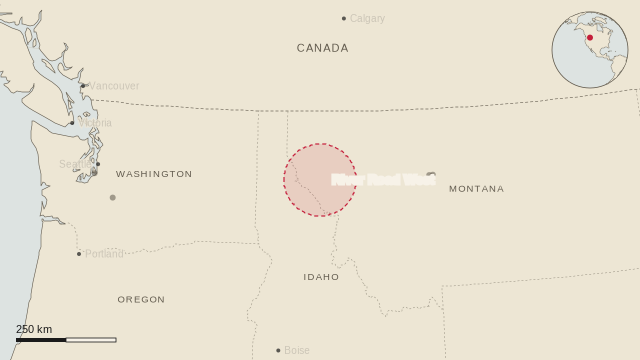
2003·River Road West, near Plains, Sanders County, Montana, U.S.
Hairy hominids·Bigfoot
United States.Plains · a boy finds large footprints in the snow
On January 3, 2003, at about 3 p.m., 8-year-old Austin Petersen found large footprints in the snow beside his neighbor Jim Rohweder's shop on River Road West, near Plains, Montana. According to neighbor Bob Mesing, they measured 16.5 by 8.5 inches; he and the boy's father, Dean Petersen, followed them about 100 yards until they faded in the woods. The local weekly Clark Fork Valley Press reported it on January 15, and the U.S. Forest Service released the article in 2026.
Tier B · IndicativeCryptidWhat do they mean? →
Limited evidence: it falls short of what Tier A requires. Any one of these is enough: a single testimony (or several witnesses who saw it together), testimony gathered years later, or an account without contemporary primary documentation.
What it was
45%ordinary cause
No explanation reaches half.
- 45% ordinary cause
- 35% other known cause
- 20% unexplained
See the split across the six explanations
Known cause (ordinary or hoax)80%
Unexplained20%
Separate collection: these figures do not count toward the UAP case totals. How it is split →
Cause the sources propose: ordinary cause
What happened
On January 3, 2003, at about 3 p.m., 8-year-old Austin Petersen and his father, Dean Petersen, were visiting their neighbor Jim Rohweder by his shop on River Road West, a rural road near Plains in Sanders County, western Montana. The boy spotted some large footprints in the snow. Reporter Ed Moreth told the story in the local weekly Clark Fork Valley Press on January 15, describing Dean Petersen as a former Kalispell policeman. Rohweder, 87, was working on his sawmill engine and at first thought the tracks were a bear's; according to Petersen, a closer look showed a toe-like formation that made them look more human than animal.
Another neighbor, Bob Mesing, a 45-year-old contractor who had lived on the road for 17 years, also saw them. According to Mesing, the tracks were clearest in the open spaces of Rohweder's yard, in about two inches of fresh snow, and there were hundreds of them. To him, whatever made them seemed to have come from the direction of Eddy Creek, a local stream, walked into the yard, turned around and headed toward the Clark Fork River.
Petersen and Mesing searched for about two hours and followed the tracks about 100 yards into the woods. Under the trees there was little snow and the ground was hard and rocky, and there the tracks faded out. Mesing said he could not prove where they came out in the woods because they faded off in the slush, that they searched for more tracks until shortly after dark, and that much of the area is hard to track.
Mesing gave the measurements: 16.5 inches long and 8.5 inches wide at the widest point, just behind the toes. Petersen said the heel was nearly four inches wide and, from the surface of the print, guessed that the animal weighed between 800 and 1,000 pounds. Bob's wife, Colleen Mesing, photographed her own foot next to a track; another of her photos shows a line of tracks along a path near the shop.
The caption of that photo gives an average stride of five feet. Mesing said most of the tracks showed that stride, but some were farther apart, perhaps from a jump or a run. According to him, the heel and toes pressed deeper than the rest, as when a person walks, the arch showed and there were toes, on a foot like a human one but slightly squared. Petersen added that the creature "definitely wasn't flatfooted."
Mesing believed that whatever left the tracks had walked up to the shop during the night and that, when Rohweder's motion-sensor light came on, it turned around, unstartled, and walked away; a prankster, he reasoned, would have run. Petersen said that at 3:30 that same day (the article does not say whether in the early morning) he was woken by his dog barking, and that when he looked outside he saw the shop light on, about 45 yards away, but saw nothing. He also found tracks in front of Rohweder's house.
Near the tracks, the neighbors also found a large pile of dung they could not identify. They planned to send a sample to a lab and then decided against it. Mesing told the reporter they had not notified any authorities of the find, but that he planned to give a sample to Fish and Game, the state wildlife authorities. According to Mesing, rain washed most of the tracks away the next day.
After the find, Mesing and Colleen looked up Bigfoot in a book called "Mysteries of the Unexplained" and found several similarities with what they had seen. The caption of Rohweder's photo adds that he and his wife, Gladys, had lived on River Road West for 30 years, and that Gladys said she saw a strange-looking, hairy, two-legged creature when they first got there.
Where it happened
Why it matters
What survives of this case is an article in a local weekly, with a date, a place, named witnesses and five photos, two of them of the tracks. The article mentions no plaster casts and no measurements taken by anyone other than the neighbors, and the dung sample never reached the lab. The figures it gives, for size, stride and weight, are Mesing's and Petersen's.
The article itself raises the possibility of a hoax. It opens with a line from Mesing about the tracks: "If someone played a hoax, they did a pretty good job." The reporter adds that it had recently been determined that Ray Wallace, a California resident, faked the famous 1958 Bigfoot prints. The witnesses dismissed the idea for their own reasons: Mesing, because there were no other tracks nearby and a prankster would have needed something on his feet; Petersen, because of the flexibility the prints showed going over rocks and sticks. No one in the article suggests who might have made them, and the only animal cause it records is Rohweder's first impression: a bear.
The article does not fully agree with itself, either. The text dates the find to January 3, twelve days before the paper's date. The caption of the photo of Dean and Austin Petersen, one of the article's five, says the tracks appeared "two weeks ago," which roughly fits; the caption of Rohweder's photo says they showed up after a snowfall "last week," which does not. The text says Petersen lived next door to the Rohweders, and his photo caption puts the tracks some 50 yards from his home, which fits. In the scan, a white blot hides the distance in the article's opening sentence, in which Mesing places the tracks at a neighbor's house an unreadable number of miles down River Road. On the front page, a white box covers most of the date.
The article resurfaced in 2026. On October 15, the U.S. Forest Service posted it in its Freedom of Information Act (FOIA) reading room, under the entry "Bigfoot/Sasquatch Records," alongside the memos on the ↗ Umatilla tracks and a local history of the Petty Creek valley, also in Montana, written by Leo T. Kinney. The entry does not explain why the article was in the Forest Service's files. The Denver Gazette reported the release on November 23 and described the article as one about 16-inch footprints in the snow in a rural part of Montana.
Documents and sources
Documents
Clark Fork Valley Press article on the River Road West tracks (January 15, 2003)
Ed Moreth's article in the Plains, Montana, weekly on the tracks found on January 3, 2003, beside Jim Rohweder's shop, with the measurements and the accounts of neighbors Bob Mesing and Dean Petersen.
Read more
It is a scanned one-page PDF combining the front page and the page 2 continuation, with five photos, two by Colleen Mesing and three by Ed Moreth; the U.S. Forest Service posted it on October 15, 2026, in its FOIA reading room. The file name says "JAN 13 2003," but the page 2 header says "January 15, 2003"; on the front page, a white box covers most of the date, of which only "…ry 15, 20" can be read. A white blot also covers part of the opening paragraph and of the second block of page 2. The text and photos belong to the newspaper; the original is linked, with no copy on this site.
U.S. Forest Service, FOIA reading room, "Bigfoot/Sasquatch Records" · view source
Documented evidence
- Ed Moreth, "Mysterious tracks discovered near River Road West," Clark Fork Valley Press, vol. 104, no. 3 (Plains, Sanders County, Montana), front page and page 2, dated "January 15, 2003" in the page 2 header.
- According to the article, 8-year-old Austin Petersen found the tracks at about 3 p.m. on January 3 while he and his father, Dean Petersen, were visiting 87-year-old Jim Rohweder by his shop; Rohweder at first thought they were a bear's.
- Measurements attributed to Bob Mesing: 16.5 by 8.5 inches at the widest point; according to Petersen, the heel was nearly four inches wide, and he guessed a weight of 800 to 1,000 pounds. The caption of a photo by Colleen Mesing gives an average stride of five feet.
- Mesing and Petersen followed the tracks for about two hours and about 100 yards into the woods, until they faded under the trees; according to Mesing, they came from the direction of Eddy Creek and headed toward the Clark Fork River, and rain washed most of them away the next day.
- According to Mesing, the neighbors found a pile of dung nearby that they could not identify; they planned to send a sample to a lab and decided against it, did not notify any authorities, and he planned to give a sample to Fish and Game.
Show 2 more facts
- Photo caption: Jim and Gladys Rohweder had lived on River Road West for 30 years, and Gladys said she saw a strange-looking, hairy, two-legged creature when they first got there.
- U.S. Forest Service, FOIA reading room, "Bigfoot/Sasquatch Records" entry dated October 15, 2026: the article, as the file "Clark Fork Valley Press Article JAN 13 2003.pdf," alongside the 1982 Umatilla memo and Leo T. Kinney's local history.
Sources
- Ed Moreth, "Mysterious tracks discovered near River Road West," Clark Fork Valley Press (Plains, Montana), vol. 104, no. 3, January 15, 2003, front page and p. 2; U.S. Forest Service PDF — Primary source: press of the time, scanned on one page. The page 2 header reads "Valley Press/Mineral Independent, January 15, 2003"; the file name, "JAN 13 2003." The article writes "formally a Kalispell policeman," for "formerly."
- U.S. Forest Service, FOIA reading room, frequently requested records, "Bigfoot/Sasquatch Records" (Oct 15, 2026) — The entry brings together three files: the 1982 Umatilla memo, this article and a local history of the Petty Creek valley (Montana) by Leo T. Kinney.
- Spencer McKee, "U.S. government quietly releases Bigfoot-related documents," Denver Gazette (Nov 23, 2026) — The report on the release; it mentions the article as one about 16-inch footprints in the snow in a rural part of Montana, without naming the witnesses.
Related cases
Cases this case cites and cases with the same likely cause.