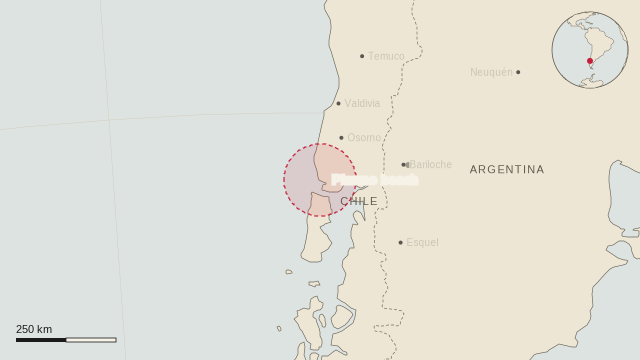
2003–2004·Pinuno beach, Los Muermos, Los Lagos region, Chile
Globsters·Chilean Blob
Chile.Chilean Blob · 12-meter mass washes up on a beach in Chile
In late June 2003 a boneless mass about 12 meters long turned up on Pinuno beach in Los Muermos, in southern Chile. The Centro de Conservación Cetácea, which measured it on June 29, presented it as a possible giant octopus, and the news went around the world. On July 11 Chile's National Museum of Natural History told the EFE news agency it was a sperm whale. In 2004 a study led from the University of South Florida and published in The Biological Bulletin confirmed this by microscope, chemistry and two DNA analyses: it was the almost completely decayed blubber of a sperm whale.
Tier S · SolidCryptidWhat do they mean? →
Strong evidence: a contemporary instrumental record (radar, sensor, film or photo of known provenance) that corroborates several independent witnesses.
What it was
98%ordinary cause
The most likely explanation.
- 98% ordinary cause
- 2% unexplained
See the split across the six explanations
Known cause (ordinary or hoax)98%
Unexplained2%
Separate collection: these figures do not count toward the UAP case totals. How it is split →
Cause the sources propose: ordinary cause
Record of the event
Pierce et al. (2004): the microscope, chemistry and DNA analysis of the Pinuno mass, 3-page extract
Extract of three of the nine pages of the article that identified the Pinuno mass as the decayed blubber of a sperm whale: the abstract (page 125), the electron micrographs of the Chilean tissue, showing collagen fibers and bacteria but no cells, with the amino acid table for the six masses compared (page 129), and the alignment of the Tampa DNA sequence with the sperm whale's (page 130). The full article is on archive.org.
Source: The Biological Bulletin 206: 125-133 (Marine Biological Laboratory, Woods Hole), BioStor copy on archive.org, under a CC BY-NC 3.0 license (non-commercial reproduction with attribution). The figure 1 photo, by Elsa Cabrera, is left out · open original
What happened
In the last week of June 2003, a heavy swell battered the coast of what was then Chile's Region X, now the Los Lagos region. The Maullín harbor master's office, part of the Chilean Navy, told the Centro de Conservación Cetácea (CCC), a Santiago environmental group devoted to whales and dolphins, that two large animals had washed up in the Los Muermos area. One was a male humpback whale about 12 meters long, on Las Mancillas beach. The other lay on Pinuno beach, 3.9 kilometers to the north, and local people described it as another whale. The CCC team went to see it on the morning of Sunday, June 29.
What the team found did not look like a whale. It was a boneless mass 12.40 meters long, 5.80 meters wide and 1.06 meters high, by the team's own measurements, and its flesh was so tough it was hard to cut. Verónica Altayó, a veterinary medicine graduate on the team, said that compared with decaying marine mammals it was "clearly" not a vertebrate "but an invertebrate, with the features of a cephalopod," the group that includes octopuses and squid. On July 1 the CCC announced on its website that a "pulpo gigante" (giant octopus) had washed up on the coast of southern Chile.
The name that spread came from the 19th century. In 1896 a huge shapeless carcass appeared on a beach at St. Augustine, Florida, and the Yale zoologist Addison E. Verrill named it Octopus giganteus, a giant octopus. According to the 2004 article that settled the Chilean case, Verrill named it without seeing the carcass and in 1897 recanted in favor of a whale. According to the CCC, the Italian zoologist Lorenzo Rossi saw the Pinuno photos and said it was not a giant squid but "a specimen similar to the one found in 1896." The French cryptozoologist Michel Raynal, who argued that the giant octopus existed, backed the idea, and the CCC prepared to send samples to France for genetic testing.
The news went around the world, but not everyone accepted the octopus idea. On July 1, Nicholas Curtis, of the biology department at the University of South Florida, where Sidney Pierce, who would later analyze the mass, also worked, wrote to the CCC that research on the 1896 carcass showed it could have been a whale. According to a dispatch from the EFE news agency, the zoologist Jorge Oporto, executive director of the Instituto de Conservación Terra Australis, said early in the week of July 7 that the mass was just a whale's hide. The CCC decided to share samples among scientists on both sides of the question, and to give some to the National Museum of Natural History in Santiago.
On July 7 the CCC reported that the samples had gone abroad. Sidney Pierce, who chaired the biology department at the University of South Florida, had said that from the photos it could be a whale, but he wanted to run the tests to be sure. Raynal acknowledged that every similar tissue sample had turned out to come from a cetacean and that this one probably would too, though the likeness to the Florida carcass impressed him. The CCC said it would also share tissue with Max Telford, a biologist at the University of Cambridge, and with Carlos Olavarría, a Chilean scientist working at the University of Auckland in New Zealand. Two staff members of the Chilean TV channel Canal 13 took more tissue and sent it to Santiago.
On July 11, according to EFE, the National Museum of Natural History gave its verdict. Its scientist Sergio Letelier told the agency that, "having analyzed the genetic material in our laboratories," it was a sperm whale "in its fourth stage of decomposition," bloated by its internal gases. He ruled out a basking shark because the remains lacked the hard scales of that fish's skin. Another museum scientist, Jorge Yáñez, warned that the first reports had come from people who were not zoologists. The dispatch places the remains on La Doncella beach, near Los Muermos, a name used neither by the CCC nor by the article, which speak of Pinuno. No museum publication of its analysis is known.
On July 21 the CCC published Pierce's result: ten days after receiving the samples, his laboratory had identified the tissue as the remains of a sperm whale in an advanced state of decay. The same note carried Pierce's explanation: a dead whale can float for months; the skull and vertebrae come loose and sink, and the blubber keeps rotting until only a web of collagen, the protein that held it together, is left. That is what reaches the beach, and that is why, he said, it no longer looks like the remains of a whale.
Pierce presented the first results in January 2004 at the annual meeting of the Society for Integrative and Comparative Biology in New Orleans, and published it in June in The Biological Bulletin, the journal of the Marine Biological Laboratory at Woods Hole, with five coauthors, Olavarría among them. The electron microscope showed that the mass was almost pure collagen fibers in crisscrossed layers, as in humpback whale blubber and unlike the mantle of an octopus or squid, which is mostly muscle. Chemical analysis found 31% glycine, the typical share in collagen, and two amino acids specific to it, hydroxyproline and hydroxylysine. Two laboratories extracted DNA separately, in Tampa and in Auckland, and both found sperm whale.
The dates in the sources do not quite fit. According to the article, Elsa Cabrera, the CCC's director, sampled the mass at Pinuno "within a few days after it was discovered on 26 July 2003." That cannot be the date of the find, because the CCC took its measurements on June 29 and published Pierce's result on July 21. The CCC's own note of July 7 does not help either: it dates the harbor master's alert to "el pasado 23 de Julio" (last July 23), sixteen days after the note itself. Neither slip affects the identification.
Where it happened
Why it matters
The Pinuno mass was identified down to the species by two laboratories working separately, with DNA sequences anyone can look up in GenBank, the public database run by the U.S. National Institutes of Health. The same article compared the Chilean mass with five other beached "sea monsters": St. Augustine (1896), Tasmania (1960), two from Bermuda and Nantucket (1996). The article dates the first Bermuda mass to 1995, but the 1995 study it cites places it in the summer of 1988; the second washed up in 1997.
Of those five, only the Nantucket mass yielded DNA, from a fin whale; the other four were identified as whales, without reaching the species, by microscope and chemistry, which showed the same whale-blubber collagen. The 1995 study, by contrast, had attributed the 1988 Bermuda mass to a cold-blooded vertebrate. The authors wrote that "once again, to our disappointment," they had found no sign that any of them was a giant octopus or an unknown animal.
The giant octopus idea came from the team that had the mass in front of it, going by its look and texture, at a time when local people were already talking about a whale. Pierce's article says the hasty identifications were made almost entirely by novices who had seen only pictures on the internet, while Chilean scientists who visited the beach, among them G. P. Sanino of the Leviathan marine mammal research center in Santiago, had recognized it as a whale, according to a personal communication the article cites. The case shows why shape misleads: a badly decayed whale keeps little that looks like a whale, and the species was settled by the microscope, the chemistry and the DNA.
Some loose ends remain. The University of South Florida's press release of January 2004 said the Chilean DNA matched that of the Nantucket mass "exactly," but the article assigns the Nantucket mass to a fin whale, not a sperm whale, so that line of the release does not hold. The meeting abstract gave 35% glycine, and the article 31%. The release also puts the mass at about 13 tons, without saying how it was weighed. There is no known estimate of when the sperm whale died: asked by the CCC in July 2003, Pierce said he did not know, but that from the photos it must have been dead a long time.
Documents and sources
Documented evidence
- Centro de Conservación Cetácea note datelined Puerto Montt, June 30, 2003 (posted July 1): over the weekend the team inspected a humpback whale stranded on Las Mancillas beach and, told of a second stranding 3.9 km to the north on Pinuno beach, went there on Sunday morning; it concluded that "it would not be a cetacean, but a large invertebrate."
- CCC note of July 1, 2003, "Giant octopus washes up on the coast of southern Chile": measurements of 12.40 by 5.80 by 1.06 meters, Verónica Altayó's view that it was an invertebrate with the features of a cephalopod, and that of the zoologist Lorenzo Rossi, who compared it to the 1896 Florida carcass; the note says photos sent to experts had confirmed it was "un cefalópodo gigante" (a giant cephalopod).
- CCC note of July 7, 2003: reports the samples sent abroad and names Sidney Pierce (University of South Florida), Michel Raynal, Max Telford (University of Cambridge) and Carlos Olavarría (University of Auckland) as recipients or collaborators; the alert came from the Maullín harbor master's office, dated "23 de Julio," after the note itself.
- EFE dispatch of July 11, 2003 (reprinted by La Nación of Costa Rica): Sergio Letelier of the National Museum of Natural History says the remains are a sperm whale "in its fourth stage of decomposition" and rules out a basking shark; Jorge Yáñez of the same museum dismisses the first reports.
- CCC note of July 21, 2003: ten days after receiving the samples, Pierce reports that the DNA is from a sperm whale; the note also carries his explanation of how a dead whale's blubber is reduced to a collagen matrix.
Show 2 more facts
- Pierce et al., The Biological Bulletin 206 (June 2004), pp. 125-133 (received February 13 and accepted April 5, 2004): electron microscopy, amino acids (31% glycine, with hydroxyproline and hydroxylysine) and mitochondrial DNA; the nad2 gene sequenced in Tampa (587 base pairs) is identical to the sperm whale's, and the control region sequenced in Auckland (552 base pairs) is a 99% match: the text says it differs by a single nucleotide, but figure 5 marks two.
- GenBank records AY582746 (nad2 gene, Pierce, Massey and Curtis) and AY582747 (control region, Olavarría), submitted March 25, 2004: the two sequences from the Chilean mass, classified as Physeter macrocephalus and linked to the article.
Sources
- Pierce, S. K., S. E. Massey, N. E. Curtis, G. N. Smith Jr., C. Olavarría and T. K. Maugel, "Microscopic, Biochemical, and Molecular Characteristics of the Chilean Blob and a Comparison With the Remains of Other Sea Monsters: Nothing but Whales," The Biological Bulletin 206 (June 2004), pp. 125-133 — Primary source for the analysis: methods, results and the comparison with five other masses. Its abstract, like the meeting abstract and the university's press release, puts the stranding in July 2003. Full text read in the BioStor copy on archive.org (biostor-232842).
- Centro de Conservación Cetácea, "Ballena Jorobada vara en playa de la X región" (note of June 30, 2003, posted July 1) — The first visit to Pinuno, on Sunday, June 29, and the distance to the humpback whale at Las Mancillas.
- Centro de Conservación Cetácea, "Pulpo gigante vara en las costas del sur de Chile" (July 1, 2003) — The measurements of the mass and the views of Verónica Altayó and Lorenzo Rossi.
- Centro de Conservación Cetácea, "CCC inicia trabajo cooperativo para develar misterio sobre pulpo gigante de Pinuno" (July 2, 2003) — Nicholas Curtis's message and the sharing of samples, including those given to the National Museum of Natural History.
- Centro de Conservación Cetácea, "Muestras de tejido de criatura marina serán analizadas en seis países" (July 7, 2003) — Who received the samples, the views of Pierce and Raynal, and the Maullín harbor master's alert.
- Centro de Conservación Cetácea, "Experto mundial identifica genéticamente origen de masa de Pinuno" (July 21, 2003) — Pierce's result and his interview. The note's dateline reads "21 de Julio de 2002," a typo for 2003.
- EFE, "El 'monstruo' marino chileno resultó ser un cachalote putrefacto" (Santiago, Chile, July 11, 2003), in La Nación (Costa Rica) — Wire dispatch with statements by Sergio Letelier and Jorge Yáñez of the National Museum of Natural History, and by Jorge Oporto.
- University of South Florida, "Scientists Solve Chilean 'Blob' Mystery" (press release of January 22, 2004, on ScienceDaily) — Announces the SICB meeting presentation and gives the 13-ton weight; its line about the match with the Nantucket mass is contradicted by the article.
- Pierce, Massey, Curtis and Maugel, "Identification of the Chilean sea monster," abstract for the annual meeting of the Society for Integrative and Comparative Biology (New Orleans, January 2004) — First version of the results, with 35% glycine against 31% in the article.
- GenBank (U.S. National Center for Biotechnology Information), records AY582746 and AY582747 — The two DNA sequences from the Chilean mass, classified as sperm whale (Physeter macrocephalus); the second can be looked up by its number in the same database.
Referenced by 4 cases