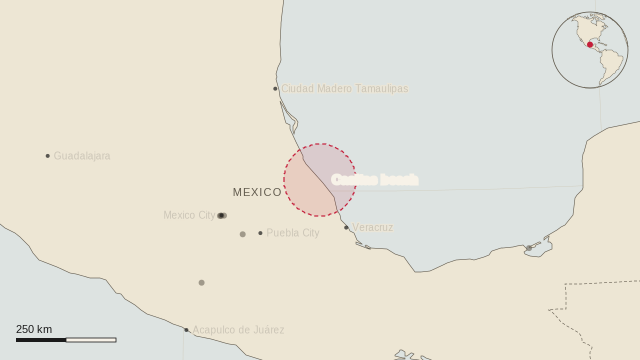
1969·Casitas beach, between Tecolutla and Nautla, Veracruz, Mexico
Globsters·Casitas monster
Mexico.Casitas monster · sea carcass washes ashore in Veracruz
On February 27, 1969, a dead whale was found floating off Casitas beach, between Tecolutla and Nautla on the coast of Veracruz, Mexico. It was badly decomposed and torn apart by marine predators, and local people called it "the Casitas monster," a name that reached the press around the world. On March 8, biologist Bernardo Villa-Ramírez, of Mexico's National Autonomous University (UNAM), examined the damaged skull in Tecolutla, compared it with two museum skeletons and identified it as a sei whale.
Tier S · SolidCryptidWhat do they mean? →
Strong evidence: a contemporary instrumental record (radar, sensor, film or photo of known provenance) that corroborates several independent witnesses.
What it was
98%ordinary cause
The most likely explanation.
- 98% ordinary cause
- 2% unexplained
See the split across the six explanations
Known cause (ordinary or hoax)98%
Unexplained2%
Separate collection: these figures do not count toward the UAP case totals. How it is split →
Cause the sources propose: ordinary cause
What happened
On February 27, 1969, the body of a dead whale was found floating about 12 kilometers east of the beach at Casitas, a village on the Gulf of Mexico coast of Veracruz, between Tecolutla and Nautla. That is the date given by biologist Bernardo Villa-Ramírez, of the Institute of Biology at Mexico's National Autonomous University (UNAM), in the article he published on the case. The sea cast the carcass ashore near Casitas, and from there it was taken to Tecolutla, farther north. According to Villa, the animal was badly decomposed and marine predators had destroyed much of the body.
Villa wrote that these whales seemed to be rare in the Gulf of Mexico, since it was "evident that the fishermen of the region are not familiar with them." For that reason, and because of the state the animal was in, "the locals gave it the name 'the Casitas monster,'" which the national press picked up and which, he said, spread through news media around the world.
Villa examined the remains in Tecolutla on March 8, nine days after they were found. They were in three parts. The first, mainly muscle from the back, already rotten, had been left on the sand near the mouth of the Tecolutla River. The second, the top of the braincase, was on display in the open on a plot next to the building of the Tecolutla Gutiérrez Zamora fishing cooperative, named after Tecolutla and the neighboring town. The third, with the bones of the front of the skull, lay at one end of the cooperative's meeting hall. The lower jaw was missing; Villa thought it had most likely come off at sea, before the carcass drifted near the coast.
The part of the skull shown to onlookers as "the beak" had been cut off by one of the fishermen with a machete, at the base of the upper jaw bones. It was the whale's snout, the long front part of the skull. Villa also explained the other piece of the legend, because, he wrote, it had given rise to "conjectures that led to fantastic descriptions." In whales, the front of the nasal cavity forms a large tube-shaped bone, and the fishermen who cleaned the skull called those bones "cuernitos," little horns. "Because of them," Villa added, "the popular imagination gave the remains of this animal fantastic attributes." For more detail he referred readers to a note in the magazine Técnica Pesquera of March 25, 1969, titled "Amarillismo periodístico alrededor de la ballena encontrada en Tecolutla" (Sensationalist journalism around the whale found in Tecolutla).
Because of the state of the carcass and the machete cut, Villa could take only five measurements of the skull. "The beak," as it was displayed, was 3.20 meters long, and the skull was 1.955 meters wide between the two cheekbone arches. The article does not give a length for the whole animal.
To identify it, Villa compared the skull with the two sei whale (Balaenoptera borealis) skeletons in the National Museum of Natural History, which was then run by UNAM's Institute of Biology. Those skeletons were already in the museum in 1915, with labels saying they had been caught in Campeche, and the American zoologist Gerrit S. Miller had published them in 1928 as the first record of the species on Mexico's Atlantic coast. According to Villa, the comparison showed "a great similarity" with both, "to a greater degree with the adult specimen." The Tecolutla whale was therefore the second record, more than 54 years after those skeletons entered the museum.
Villa published the case in UNAM's Anales del Instituto de Biología, with a map and with photos that the captions credit to Villa himself: the remains floating in the sea, the flesh left on the beach with people around it, the braincase and "the beak." The article's header dates it to 1969, while the journal's current website lists that issue as 1971. The title does not quite match the content either: it speaks of "la ballena rorcual o ballena de aleta," the rorqual or fin whale, a name that today refers to a different species, Balaenoptera physalus, but the scientific name and the comparison in the text are those of the sei whale.
Where it happened
Why it matters
Both pieces that fed the legend are explained by the skull itself: "the beak" was a rorqual's snout, cut off with a machete, and the "little horns" were bones of the nasal cavity. Villa saw the remains nine days after they were found and published, under his own name, the measurements, the comparison and photos the article credits to him. The masses at St. Augustine, Florida ↗ St. Augustine monster, Newfoundland ↗ Fortune Bay sea monster and Pinuno, Chile ↗ Chilean Blob, were boneless skin and blubber, identified by microscope, chemistry or DNA; here part of the skeleton survived, and the species came from comparing bones.
The versions that circulated later stray from that record. In 2008 the British zoologist and science writer Darren Naish gathered the ones he knew on his blog Tetrapod Zoology; for what happened after the find he relied on a detailed report by Rafael A. Lara Palmeros (1994). In those accounts, farmers found the carcass at night at Palmar de Susana, between Tecolutla and Nautla, and kept it secret for a week. The animal was 22 meters long and weighed about 24 tons, and a 1975 book by Jacques Bergier and George Gallet described it as covered in armor plating. Naish also credited Villa with the idea that the animal had been preserved in an Arctic iceberg. Villa's article contains neither that idea, nor that place, nor the armor, nor a length for the whole animal.
Naish concluded that it was a sei whale. According to his summary, biologists at the national university, who kept photos, had reached the same conclusion, and zoologist Bernard Heuvelmans, regarded as the founder of cryptozoology, gave the same identification by letter, according to Lara Palmeros.
The exact species rested only on the comparison with the two Campeche skeletons, and Villa himself noted that another similar whale, Bryde's whale, also lives in the Gulf of Mexico. In 2021 the Gulf's population of Bryde's whales was described as a new species, Rice's whale (Balaenoptera ricei), according to the U.S. National Oceanic and Atmospheric Administration (NOAA). Neither the old name nor the new species changes what the remains were: the skull of a rorqual, the group of whales that includes the sei, Bryde's and Rice's whales.
Documents and sources
Documents
Villa-Ramírez: the sei whale on the Veracruz coast, article with photos of the remains
The article by Bernardo Villa-Ramírez that identified the "Casitas monster" as a sei whale, in the scan published by the journal (nine pages, 129 to 137).
Read more
It includes the map of the site, the photos of the remains floating, of the soft tissue on the beach, of the braincase and of "the beak," all credited to Villa, and the skull measurements. The header dates it to 1969 and the journal's website lists the issue as 1971. The journal publishes no open license: the original is linked, with no copy on this site.
Anales del Instituto de Biología, UNAM, Serie Zoología 40 (1): 129-138; scan on the journal's website · view source
Documented evidence
- Villa-Ramírez, Anales del Instituto de Biología, Serie Zoología 40 (1), pp. 129-130: on February 27, 1969, a dead whale was found floating about 12 km east of the beach at the village of Casitas (20° 15′ N, 96° 47′ W), between Tecolutla and Nautla; Villa examined it on March 8, nine days later, in Tecolutla (20° 29′ N, 97° 01′ W), where it had been taken.
- Same article, p. 130: the remains were in three parts, the back muscles on the beach near the mouth of the Tecolutla River and two parts of the skull on the plot and in the meeting hall of the Tecolutla Gutiérrez Zamora fishing cooperative; the lower jaw was missing, and a fisherman had cut off with a machete the part being shown as "the beak."
- Same article, p. 136: the five skull measurements, namely the length of the snout region as displayed, 3.20 m; its greatest width, 1.63 m; the greatest width of the premaxilla, 0.46 m; the width across the zygomatic arches, 1.955 m; and the greatest width of the exoccipital, 0.68 m.
- Same article, pp. 130 and 136: the skull was compared with the two Balaenoptera borealis skeletons from Campeche in the National Museum of Natural History (numbers 257 and 289, published by Miller in 1928), showing "a great similarity," greater with the adult. The Spanish text calls it the second record of the species on Mexico's Atlantic coast; the English abstract, "the second record for the Gulf of Mexico."
- Same article, pp. 130 and 136: the fishermen who cleaned the skull called the tubular bones of the nasal cavity "cuernitos" (little horns), which, according to Villa, led the popular imagination to give the remains "fantastic attributes"; he refers to the anonymous note "Amarillismo periodístico alrededor de la ballena encontrada en Tecolutla," Técnica Pesquera 15: 6-7 (March 25, 1969).
Show 2 more facts
- Same article, pp. 131-135: five figures, a map of the site and photos the captions credit to B. Villa-R., showing the remains floating near Casitas, the soft tissue left on the Tecolutla beach, the braincase and "the beak" separately, alongside the skull of the adult Campeche specimen mounted in the museum.
- Darren Naish, Tetrapod Zoology (July 2008): gathers the later versions of the case, drawing on a detailed report by Rafael A. Lara Palmeros (1994), with the find at Palmar de Susana, a body 22 m long weighing about 24 tons and the armor a 1975 book by Bergier and Gallet attributed to it, and concludes it was a sei whale. Naish took the "horns" to be the dentaries, the lower jaw bones, which according to Villa were already missing when he examined the remains.
Sources
- Villa-Ramírez, Bernardo, "La ballena rorcual o ballena de aleta, Balaenoptera borealis Lesson, 1828, en la costa de Veracruz, México," Anales del Instituto de Biología, Universidad Nacional Autónoma de México, Serie Zoología 40 (1): 129-138 — Primary source: dates, state of the remains, measurements, comparison with the Campeche skeletons and the origin of "the beak" and the "little horns." The scan's header says 1969 and the journal's website, "Vol. 40 Núm. 1 (1971)." The scan ends on page 137, although the header gives pages 129 to 138.
- Darren Naish, "Tecolutla monster carcass," Tetrapod Zoology (ScienceBlogs), July 2008 — Summary, based on a report by Rafael A. Lara Palmeros (1994), of the later versions of the case (Palmar de Susana, 22 m, Bergier and Gallet's armor, the iceberg) and of the sei whale identification, with Heuvelmans's letter as cited by Lara Palmeros (1994). Secondary source.
- NOAA Fisheries, "New Species of Baleen Whale in the Gulf of Mexico" (January 22, 2021) — The Gulf of Mexico's Bryde's whale population described as a new species, Rice's whale (Balaenoptera ricei), in the journal Marine Mammal Science.
- García-Rivas, Blanco-Parra, Castelblanco-Martínez and Niño-Torres, "Primer registro de la ballena de aleta Balaenoptera physalus para el Caribe mexicano," Hidrobiológica 29 (1): 41-43 (2019) — Current use of the Spanish name "ballena de aleta" (fin whale) for Balaenoptera physalus, not for the sei whale.
Related cases
Cases this case cites and cases with the same likely cause.