1896–1995·Beach about 12 miles south of St. Augustine, Florida
Globsters·St. Augustine monster
United States.St. Augustine monster · huge mass washes up in Florida
On December 5, 1896, according to the Yale zoologist Addison E. Verrill, the sea left a boneless mass about 21 feet long on a beach south of St. Augustine, Florida. The physician DeWitt Webb took it for an octopus, and Verrill, working from letters and photos, named it Octopus giganteus in February 1897. A few weeks later, with pieces of the tissue in hand, he recanted: it had no muscle and looked like the head of a sperm whale. In 1995, microscope and chemical tests on a sample kept in formalin showed it was skin collagen from a warm-blooded animal, a whale.
Tier S · SolidCryptidWhat do they mean? →
Strong evidence: a contemporary instrumental record (radar, sensor, film or photo of known provenance) that corroborates several independent witnesses.
What it was
95%ordinary cause
The most likely explanation.
- 95% ordinary cause
- 5% unexplained
See the split across the six explanations
Known cause (ordinary or hoax)95%
Unexplained5%
Separate collection: these figures do not count toward the UAP case totals. How it is split →
Cause the sources propose: ordinary cause
Record of the event
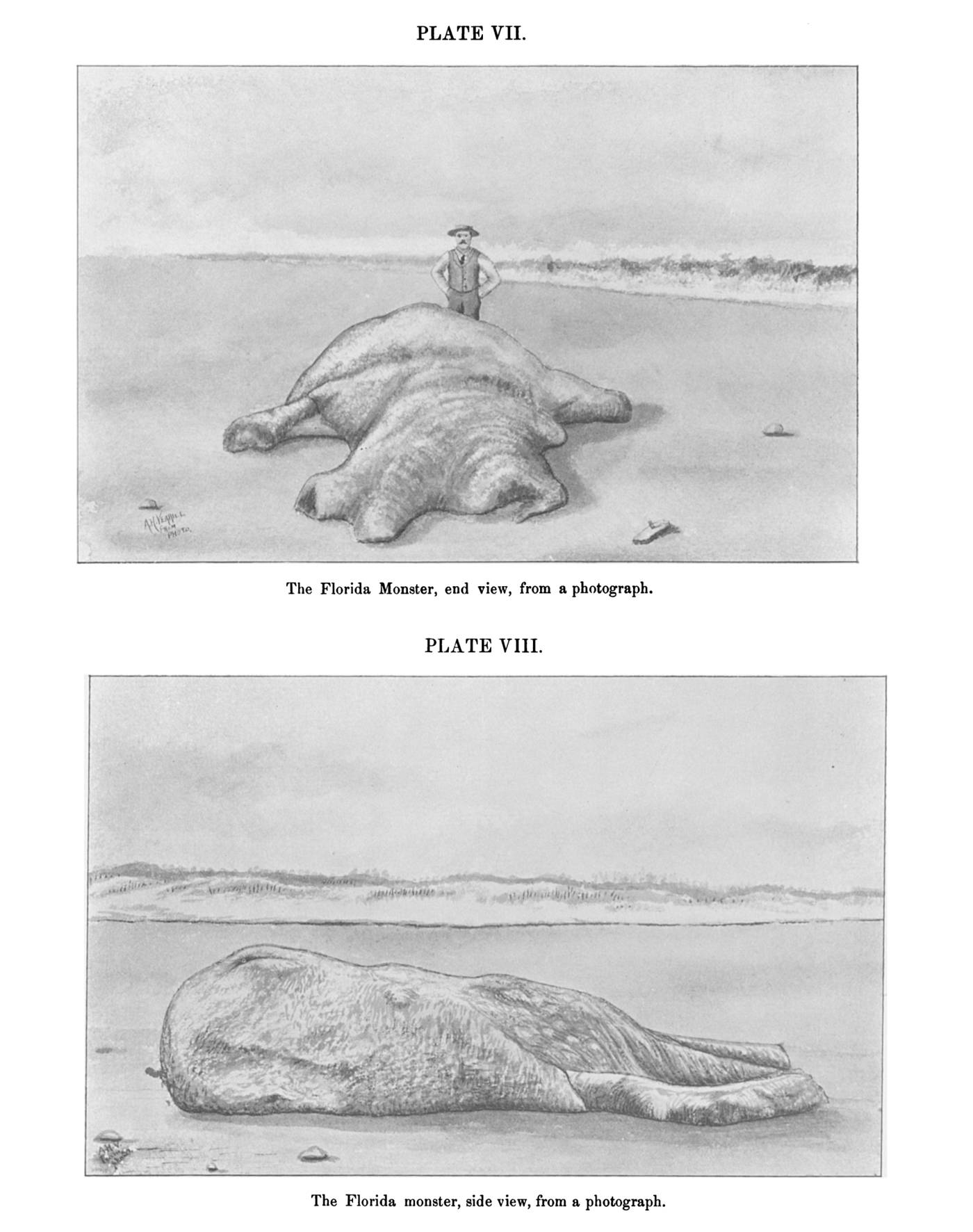
The St. Augustine mass on the beach, drawn from the December 1896 photographs
Two drawings Verrill published in April 1897 as plates VII and VIII of the American Naturalist, copied, his text says, from photographs taken two days after the stranding.
Read more
The end view, with a man standing behind for scale, shows the folds first taken for stumps of arms; the side view shows the long pear shape. The original photos were not reproduced because, Verrill wrote, they were overexposed. JSTOR (Early Journal Content) scan on archive.org; the two plates rotated, combined into one image and converted to grayscale, with no other changes.
A. E. Verrill, "The Florida Sea-Monster," The American Naturalist 31 (April 1897), plates VII and VIII · Public domain · open original
What happened
The Yale zoologist Addison E. Verrill dated the stranding to December 5, 1896. That day the sea washed up part of an enormous marine animal on a beach about 12 miles south of St. Augustine, Florida. It was torn up at one end and had been dead for some time. Two days later DeWitt Webb, a local physician and president of the town's scientific society, went to see it, and Edgar Van Horn and Ernest Howatt photographed it. On December 8 Webb wrote to the zoologist J. A. Allen that "the body of an immense Octopus" had come ashore, with nothing left but the stumps of the tentacles. It measured 18 feet long by 10 feet wide, and Webb thought its size and condition would prevent any attempt to preserve it.
A man named Wilson, who saw the mass when it first came ashore, wrote down that it had arms: one 23 feet long west of the body, a stump and three more to the south that seemed attached to it. The two versions of his memo that Verrill printed disagree on the longest: "over 32 feet" in the American Journal of Science and "over 23 feet" in the American Naturalist, both from April 1897. According to Verrill's February note, Webb wrote to him that a few days after the photos, digging away the sand had uncovered an arm still attached, 36 feet long; in April Verrill credited that find to Wilson. Soon afterward a storm carried the mass off and left it two miles south of where it had stranded, which, Verrill wrote, would explain the loss of the supposed arms.
Webb's letter reached Verrill through a colleague, and Verrill published it in the January 1897 issue of the American Journal of Science. He suggested it might be a giant squid of the genus Architeuthis, with a body and head of 4 to 5 tons. In February, now with four photographs in hand, he wrote in the same journal that it was an eight-armed cephalopod, probably a true octopus, "of colossal size," estimated that the part on the beach weighed at least 6 or 7 tons, and proposed a name for the species: Octopus giganteus. In a note added before printing he reported that Webb had the sand cleared and, with six horses and tackle, had hauled the mass up the beach; it was 21 feet long. Verrill named it without having seen it, as Pierce's team recalled in 2004 in The Biological Bulletin, in an article on a similar mass stranded in Chile.
Because of bad weather and the distance, Webb did not return to the beach for several weeks. He then opened the mass and sent Verrill several thick pieces of the tissue, preserved in formalin. On examining them, Verrill changed his mind: they were white, hard and elastic, made of tightly interlaced connective tissue fibers, and had no muscle, which is essential in a cephalopod. In the April American Journal of Science he titled his note "certainly not a Cephalopod" and wrote that the tissue looked more like that of the upper part of a sperm whale's head than anything else.
Verrill did not treat the question as closed. The shape was unlike a sperm whale's head, which is narrow and squared off in front; Verrill noted that no blowhole had been found and that no whaler who had seen it recognized it as any part of a whale. In a letter to the journal Science dated March 12, he suggested a very large sperm whale with an abnormal and perhaps diseased nose, or, which he thought unlikely, an unknown species of the same family. He said his idea needed more evidence but was, for the moment, the most plausible. In the same issue the naturalist F. A. Lucas, writing from Washington, was blunt: the substance "looks like blubber, and smells like blubber and it is blubber, nothing more nor less."
In the April American Naturalist, Verrill published two drawings made from the photos taken two days after the stranding and summed up what was known. The mass was 21 feet long, with an estimated weight of about 7 tons; it smelled like rancid whale oil, and pieces of it sank in water. Webb had moved it several miles closer to St. Augustine, to the end of a railroad line, and shielded it from the sand. According to Webb's correspondence with William H. Dall, curator of mollusks at the National Museum in Washington, cited by the 1995 analysis, the mass was still on the beach on March 17, and Webb had sent pieces in formalin to both Dall and Verrill. Dall still favored the octopus.
According to the 1995 article, the matter then lay quiet for 70 years. In 1971 F. G. Wood revived it in the magazine Natural History, argued that it had been an octopus about 200 feet from tentacle tip to tentacle tip, and reported that the Smithsonian held large pieces of the tissue. Joseph Gennaro, of the University of Florida, compared that tissue under the microscope with squid and octopus tissue and concluded it was an octopus. In 1986 R. P. Mackal found in a chemical analysis that it was mostly collagen and took that as support for Verrill's octopus.
In April 1995 Sidney K. Pierce, of the University of Maryland, published in The Biological Bulletin, with Gerald N. Smith, Timothy K. Maugel and the ichthyologist Eugenie Clark, an analysis of a St. Augustine sample that, according to the acknowledgments, Gennaro had given them. Under the electron microscope the tissue was almost pure collagen, in bundles laid in crisscrossed layers as in the humpback whale blubber they used for comparison, and nothing like an octopus mantle, which is mostly muscle. A third of its amino acids were glycine, with hydroxyproline and hydroxylysine, the signature of collagen, and its proline plus hydroxyproline, 223 of every thousand amino acids, is that of a warm-blooded animal. The authors concluded it was the skin of an enormous warm-blooded vertebrate, the remains of a whale, and that nothing supported the existence of Octopus giganteus.
Where it happened

Why it matters
The St. Augustine monster shows how a species was born from a letter and a few photographs, and how it fell apart as soon as the tissue arrived: within weeks of naming Octopus giganteus, its own author wrote that it was not a cephalopod. The arms that supported it came from witness notes that disagree on the measurements, and when the mass was dug out and moved none turned up: Verrill concluded that folds of the skin had been mistaken for arms. The name outlived the retraction: in 1971 and 1986 the octopus was argued again from the same tissue, and in 2003, when photos of the Chilean mass at Los Muermos spread online, Octopus giganteus was proposed again (↗ Chilean Blob).
The 1995 article also analyzed the so-called Bermuda Blob, a mass about 2.5 by 1.25 meters that drifted into a lagoon on the island in the summer of 1988 and was photographed and sampled by Teddy Tucker, a local diver and fisherman. Outwardly it was almost identical to the St. Augustine mass and it also turned out to be skin collagen, but the two tissues did not come from the same species. The Bermuda sample had less proline and hydroxyproline, 167 of every thousand amino acids, the figure of a cold-blooded animal, and the authors attributed it to the skin of a cold-blooded vertebrate, by its size a large bony fish or a shark or ray, not a whale. The 2004 article on the Chilean mass tells that sample's story differently: it dates it to 1995, says Clark supplied it, and counts all the masses it studied as the remains of great whales.
The chain of custody of the 1896 sample has gaps. Webb put pieces in formalin and sent them to Dall and Verrill; in 1971 Wood said the Smithsonian held large pieces, and Gennaro studied them. The 1995 article gives catalog numbers for the octopus and whale samples it used for comparison, but not for the St. Augustine one, and thanks Gennaro for it; the 2004 article says Clark handed it over in 1995. There is no DNA either: in 2004 Pierce's laboratory, by then at the University of South Florida, tried to extract it from this sample and failed. The chemistry and the microscope point to a whale, but not to the species, and the authors warn that a century in formalin may have altered the amino acids and that the sample was small.
Documents and sources
Primary documents
Pierce et al. (1995): the analysis that ruled out Octopus giganteus, 3-page extract
Extract of three of the twelve pages of the article that analyzed the St. Augustine and Bermuda samples: the abstract and introduction (page 219), the electron micrographs of both tissues, with crisscrossed collagen layers, bacteria and no cells (page 221), and the final discussion, with the proline and hydroxyproline calculation, the conclusion and the acknowledgments naming who supplied each sample (page 229). The full article is on archive.org.
Source: The Biological Bulletin 188: 219-230 (Marine Biological Laboratory, Woods Hole), BioStor copy on archive.org, under a CC BY-NC-SA 3.0 license (Biodiversity Heritage Library scan, with the rights holder's permission; non-commercial, with attribution and share-alike) · CC BY-NC-SA 3.0 · open original
Documented evidence
- Letter from DeWitt Webb to J. A. Allen, dated St. Augustine, December 8, 1896, and published by Verrill in the January 1897 American Journal of Science (vol. 3, p. 79): "the body of an immense Octopus," 18 by 10 feet, with only the stumps of the tentacles left; Verrill suggests an Architeuthis.
- Verrill, "Additional information concerning the giant Cephalopod of Florida," American Journal of Science, February 1897 (vol. 3, pp. 162-163): working from four photos by Edgar Van Horn and Ernest Howatt, he calls it an eight-armed cephalopod, probably a true octopus, and proposes the name Octopus giganteus; he reports the 36-foot arm found by digging and the 21-foot length measured later.
- Verrill, "The supposed great Octopus of Florida; certainly not a Cephalopod," American Journal of Science, April 1897 (vol. 3, pp. 355-356), reprinted in the Annals and Magazine of Natural History: the formalin-preserved pieces are elastic connective tissue with no muscle, like that of a sperm whale's head; Wilson's memo gives an arm of "over 32 feet" and the mass's drift two miles south.
- Science, March 19, 1897 (vol. 5, p. 476): Verrill's letter of March 12, which refers back to the brief note in which, on March 5, he had already called the mass the remains of a cetacean, proposing the upper part of a sperm whale's head as a hypothesis that still needs evidence, and F. A. Lucas's letter of March 8: "it is blubber, nothing more nor less."
- Verrill, "The Florida Sea-Monster," American Naturalist, April 1897 (vol. 31, pp. 304-307, plates VII and VIII): dates the stranding to December 5, 1896, twelve miles south of St. Augustine; gives 21 by 7 by 4.5 feet and about 7 tons; here Wilson's memo reads "over 23 feet."
Show 2 more facts
- Pierce, Smith, Maugel and Clark, The Biological Bulletin 188 (April 1995), pp. 219-230: electron microscopy and amino acids of the St. Augustine sample (glycine 330 per thousand, proline 169, hydroxyproline 54, lysine 0.4) and of the 1988 Bermuda sample; they conclude skin from a warm-blooded vertebrate for the first and from a cold-blooded one for the second.
- Pierce et al., The Biological Bulletin 206 (June 2004), pp. 125-133: the attempt in Tampa to extract DNA from the St. Augustine sample failed; the article places the sample in Eugenie Clark's hands in 1995 and dates Bermuda Blob 1 to 1995, which cannot be right: the 1995 article that analyzed it was received on October 31, 1994, and dates it to the summer of 1988.
Sources
- Pierce, S. K., G. N. Smith Jr., T. K. Maugel and E. Clark, "On the Giant Octopus (Octopus giganteus) and the Bermuda Blob: Homage to A. E. Verrill," The Biological Bulletin 188 (April 1995), pp. 219-230 — Primary source for the analysis of the St. Augustine and Bermuda samples, and for what is known of Webb's correspondence with Dall and of the work of Wood, Gennaro and Mackal. Full text read in the BioStor copy on archive.org (biostor-10695).
- A. E. Verrill, "A gigantic Cephalopod on the Florida coast," American Journal of Science, 4th series, vol. 3 (January 1897), p. 79 — Webb's letter of December 8, 1896, and Verrill's first hypothesis, a giant squid.
- A. E. Verrill, "Additional information concerning the giant Cephalopod of Florida," American Journal of Science, 4th series, vol. 3 (February 1897), pp. 162-163 — The description of Octopus giganteus from Webb's photos and letters.
- A. E. Verrill, "The supposed great Octopus of Florida; certainly not a Cephalopod," American Journal of Science, 4th series, vol. 3 (April 1897), pp. 355-356 — Verrill's retraction after examining the tissue. Read in the Annals and Magazine of Natural History reprint (BioStor, biostor-88448), which reads "over 32 feet" in Wilson's memo.
- A. E. Verrill, "The Florida Sea-Monster," and F. A. Lucas, "The Florida Monster," Science, new series, vol. 5, no. 116 (March 19, 1897), p. 476 — The two letters that treat the mass as whale remains, with different degrees of certainty.
- A. E. Verrill, "The Florida Sea-Monster," The American Naturalist 31 (April 1897), pp. 304-307, plates VII and VIII — The date and place of the stranding, the final measurements, the move toward St. Augustine and the two drawings made from the photos.
- Pierce, S. K., S. E. Massey, N. E. Curtis, G. N. Smith Jr., C. Olavarría and T. K. Maugel, "Microscopic, Biochemical, and Molecular Characteristics of the Chilean Blob and a Comparison With the Remains of Other Sea Monsters: Nothing but Whales," The Biological Bulletin 206 (June 2004), pp. 125-133 — The failed attempt to extract DNA from the St. Augustine sample, and a different account of its provenance and of the Bermuda sample's. Read in the BioStor copy on archive.org (biostor-232842).
Referenced by 2 cases
Related cases
Cases this case cites and cases with the same likely cause.