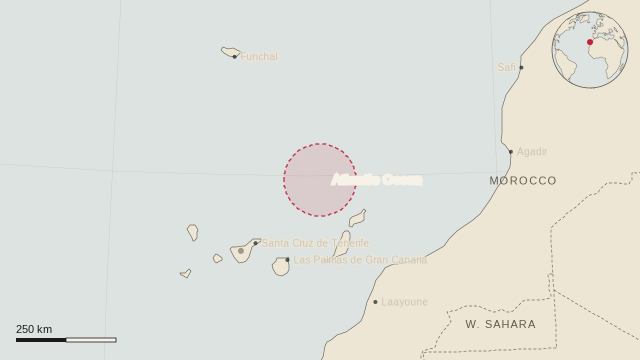
1861·Atlantic Ocean, about 40 leagues northeast of Tenerife (Canary Islands)
Discovered species·Giant squid (kraken)
Spain.Alecton · a French warship tries to capture a giant squid
On November 30, 1861, the Alecton, a small French steam warship sailing from Cádiz to Tenerife, came upon a huge brick-red squid at the surface, 40 leagues northeast of the island. Two days later its commander, Lieutenant Bouyer, reported to the Minister of the Navy that the crew shot at it and threw a harpoon and a slipknot, but hauled aboard only a piece of the tail weighing about 20 kilograms. The report was read at the Paris Academy of Sciences on December 30, together with a letter from the French consul in the Canary Islands, who saw that piece.
Tier A · AcceptableCryptidWhat do they mean? →
Institutional evidence: several identified independent witnesses, or contemporary official documentation, without an instrumental record to corroborate them.
What it was
98%real species, now described
The most likely explanation.
- 98% real species, now described
- 1% other known cause
- 1% unexplained
See the split across the six explanations
Known cause (ordinary, hoax or species now described)99%
Unexplained1%
Separate collection: these figures do not count toward the UAP case totals. How it is split →
Cause the sources propose: real species, now described
What happened
The Alecton was an aviso, a small warship. As its commander later described it, it was a paddle steamer with a wooden hull and a 120-horsepower engine. It left Toulon on November 21, 1861, for the naval station at Cayenne, in French Guiana, where France had a penal colony. It was commanded by Lieutenant Bouyer. In his report to the Minister of the Navy, Bouyer wrote that between Cádiz and Tenerife, from November 27 to December 1, the weather was as favorable as it could be, and he made 7 to 8 knots with a northeast breeze, saving coal by using the sails.
The report, dated Santa Cruz de Tenerife, December 2, says that on November 30, at two in the afternoon and 40 leagues northeast of Tenerife (about 220 km if these were marine leagues), Bouyer came upon "a monstrous animal" that he recognized as the "giant octopus," a creature whose existence, he wrote, seemed to have been relegated to fable. He decided to study it closely and try to capture it. A heavy swell made the ship roll whenever it took the waves on the beam, which hampered maneuvering. The animal, almost always at the surface, moved "with a kind of intelligence" and seemed to want to avoid the ship.
After several approaches in which the crew managed only to hit it with about ten bullets, Bouyer got close enough to throw a harpoon and a slipknot at it. As they were getting ready to tie it with more ropes, a violent movement of the animal pulled the harpoon free. The part of the tail around which the rope was wound broke off, and all they hauled aboard was a piece weighing about 20 kilograms.
According to the report, they saw it close enough to make "an exact painting" of it. Bouyer wrote that it was "the gigantic squid" (l'encornet gigantesque), though the shape of the tail made him think of an undescribed variety. He estimated it at 15 to 18 feet (about 5 to 6 meters) not counting the head, which was shaped like a parrot's beak and surrounded by eight arms 5 to 6 feet long. It was brick red. The officers and sailors asked him to lower a boat to tie it up again and bring it alongside. Bouyer refused: he feared the animal would capsize the boat with its sucker-covered arms and smother some of the men with what he called whips "charged with electric effluvia." He abandoned the mutilated animal, which dived and passed from one side of the ship to the other each time they came near, and the next morning, December 1 at eight, he anchored at Tenerife.
Sabin Berthelot, the French consul in the Canary Islands and a naturalist, wrote on December 12 to the naturalist Alfred Moquin-Tandon. Berthelot went on board the ship at Tenerife, and his version is more detailed and in part different. The crew saw the animal at about half past noon, swimming alongside, and the commander stopped the ship. At the first shots it dived under the ship and came up on the other side. The chase lasted more than three hours. The harpoons went into the soft flesh and came out without holding, and several bullets passed through it to no effect, until one seemed to wound it badly: it threw up foam and blood mixed with a sticky matter that smelled strongly of musk.
At that point, according to Berthelot, they managed to get the slipknot on it, but the rope slid along the elastic body and stopped near the end, at the two fins. They tried to hoist it aboard: most of the body was already out of the water when its weight made the rope cut through the flesh and sever the rear part. The rest fell back into the sea and disappeared. Berthelot wrote that he was shown that rear part on board. He described the animal as 5 to 6 meters long not counting the eight arms, with huge, staring eyes, a parrot-beak mouth nearly half a meter across, an estimated weight of more than 2,000 kilograms and two rounded fins at the end of the body. He sent a drawing made on board by one of the officers, and some old Canary Islands fishermen told him they had seen reddish squid of two meters or more on the high seas.
The two versions do not fully agree. Bouyer writes that he came upon the animal at two in the afternoon; Berthelot, that the crew spotted it at about half past noon. For Bouyer, the piece was lost when the harpoon pulled free and the tied tail broke; for Berthelot, the knot cut through the flesh as the body was hoisted. Berthelot's letter, as printed, also says the Alecton anchored on "November 2," a month before the encounter that the same letter places on November 30; Bouyer gives December 1.
On December 30, 1861, the physiologist Pierre Flourens, permanent secretary of the Academy of Sciences, read Bouyer's report on behalf of Marshal Vaillant. Moquin-Tandon, who was down to speak on the same subject, submitted a note that opened by recalling the kraken of northern legend, which looked "more like an island than an animal," and read the two most important passages of Berthelot's letter; the officer's colored drawing was shown to the Academy. The zoologist Milne Edwards added that the animal seemed to belong to one of the giant cephalopod species known from remains in some museums. Among other cases he cited an animal stranded in Jutland in 1853 which, he said, the Dane Japetus Steenstrup had named Architeuthis dux, and he concluded that there were probably several species much larger than any known invertebrate.
In 1862, the malacologists Hippolyte Crosse and Paul Fischer reprinted Berthelot's letter in the "Journal de Conchyliologie." They judged the drawing, published in the magazine "L'Illustration" on March 1, 1862, "very incomplete but perfectly conclusive" for placing the genus. Although the accounts spoke of eight arms, they concluded it was a ten-armed squid whose two long tentacles were missing or not seen. They put it in the genus Loligo and named it Loligo bouyeri, after the commander.
Bouyer told the story again in 1867, by then promoted to capitaine de frégate (commander), in his travel book on French Guiana. There he adds that the lookout reported something to port, which some took for a capsized boat, a dead horse, a clump of weed or a barrel, until someone saw the legs.
In that book, some figures differ from the 1861 report: he speaks of about twenty bullets instead of ten, a piece of tail of 14 kilograms instead of 20 and a reddish-brown color. He adds that the eyes were the size of a plate, that the whole animal must have weighed two to three tons and that it blew loudly; he did not see it release ink. Of the piece of tail he says it was a soft substance with a strong smell of musk, and that the part along the back, somewhat harder, broke easily with a fracture as white as alabaster. The report was written two days after the encounter, and the book six years later.
Where it happened
Why it matters
Bouyer's report is a first-hand account by a naval officer, written two days later and read at the Academy of Sciences, of a live giant cephalopod at the surface of the sea. Until then, as Moquin-Tandon and Milne Edwards recalled at the same session, science knew these animals from jaws, pieces of arms and bodies stranded or cut up by fishermen, and the sailors' giant octopus was mixed up with fables such as the kraken. The encounter also left something physical: a piece of the tail that consul Berthelot, a naturalist, saw on board at Tenerife.
The case was not enough to describe the animal. No study of the piece of tail is known, and neither the report, nor Berthelot's letter, nor Crosse and Fischer, nor Bouyer's book says what became of it. The drawing was incomplete, showing eight arms rather than a squid's ten, and the species Crosse and Fischer created from it, Loligo bouyeri, rested only on that drawing and the accounts. In 1880 the American zoologist A. E. Verrill wrote that nothing in the figure or the description was enough to fix the species or the exact genus, though the tail fin made it more probably an Architeuthis, and he provisionally called it Architeuthis bouyeri. Verrill dated the encounter to November 1860, a year earlier than the report and the letter say.
The giant squid was not a nameless animal in 1861. Steenstrup had published the genus Architeuthis in 1857, with species based on jaws and other remains, such as the jaws of the animal stranded in Jutland in 1853. According to Verrill, Steenstrup based the species Architeuthis monachus on them. What the Alecton added was the description of a living, whole specimen, seen up close for hours by the crew. It is the reverse of what happened in 2003 with the supposed giant octopus of Pinuno beach, in Chile ↗ Chilean Blob, which turned out to be the blubber of a sperm whale: here the sailors' monster turned out to be a real animal.
The episode also made its way into literature. In Jules Verne's "Twenty Thousand Leagues Under the Seas," the narrator, Professor Aronnax, cites it as the event that no longer allows anyone to deny that giant squid exist, and he tells of the slipknot sliding down to the fins and the tail tearing off as the body is hoisted, as in Berthelot's letter.
Documents and sources
Primary documents
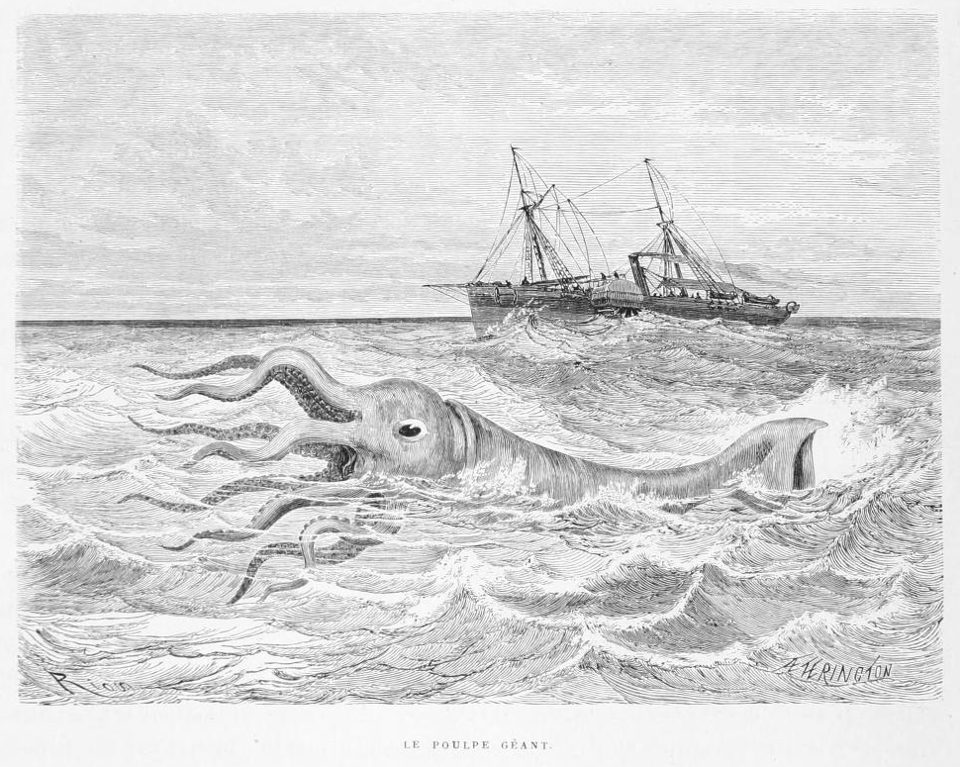
"Le poulpe géant": the Alecton and the squid, in Commander Bouyer's book (1867)
Engraving of the November 30, 1861 encounter that illustrates the commander's own account in his book "La Guyane française," published in Paris by Hachette in 1867: the squid in the foreground, with eight arms and its tail whole, and the Alecton, a paddle steamer, behind it.
Read more
It is an illustrator's reconstruction, not a record of the event: it bears the signature of Riou, who according to the title page illustrated the book from the author's sketches and the albums of several officers, The book's table of engravings gives a sketch by M. Rodolphe, one of those officers, as the original of this plate, without saying whether it is the drawing made on board that Berthelot sent to Moquin-Tandon. Page 20 of the archive.org scan; cropped to the engraving and converted to grayscale, with no other changes. Public domain.
F. Bouyer, "La Guyane française: notes et souvenirs d'un voyage exécuté en 1862-1863," Hachette, Paris, 1867, p. 20 · Public domain · open original
Comptes rendus of the Academy of Sciences, December 30, 1861: Bouyer's report, Berthelot's letter and Milne Edwards's comment
Issue 27 of volume 53 of the "Comptes rendus hebdomadaires des séances de l'Académie des sciences," with the session of December 30, 1861. Pages 1263 to 1267, under the heading "Poulpe géant observé entre Madère et Ténériffe," hold Bouyer's report to the Minister of the Navy, Moquin-Tandon's note with the passages from Berthelot's letter, and Milne Edwards's comment. Full scan on archive.org.
Académie des sciences, Comptes rendus 53 (1861), no. 27; scan on archive.org · view source
Documented evidence
- Report from Lieutenant Bouyer to the Minister of the Navy, dated Santa Cruz de Tenerife, December 2, 1861, read by Flourens at the Academy of Sciences on December 30 (Comptes rendus 53, no. 27, pp. 1263-1265): on November 30, at two in the afternoon and 40 leagues northeast of Tenerife, about ten bullets, a harpoon and a slipknot; on board, a piece of tail of about 20 kilograms; 15 to 18 feet not counting the head, eight arms of 5 to 6 feet, brick red.
- Letter from Sabin Berthelot, French consul in the Canary Islands, to Moquin-Tandon, dated Santa Cruz de Tenerife, December 12, 1861, and read at the same session (Comptes rendus 53, pp. 1265-1267): sighting at about half past noon, a chase of more than three hours, the knot cutting the flesh as the body was hoisted; 5 to 6 meters without the arms and an estimated weight of more than 2,000 kilograms; Berthelot saw the rear part on board. The printed text says the ship anchored on "2 novembre."
- Moquin-Tandon's note introducing the letter states that it "is well recognized today" that there are enormous cephalopods in the ocean; Bouyer, by contrast, speaks of a disputed existence (Comptes rendus 53, pp. 1264-1265).
- Comment by Milne Edwards at the session of December 30, 1861 (Comptes rendus 53, p. 1267): the animal seems to be one of the giant cephalopod species known from remains in museums; he cites the animal stranded in Jutland in 1853 as Steenstrup's Architeuthis dux (according to Verrill, Steenstrup based A. monachus on it; A. dux was another specimen, from the western Atlantic), and the pieces Harting described in 1860 in the Utrecht museum.
- H. Crosse and P. Fischer, "Nouveaux documents sur les Céphalopodes gigantesques," Journal de Conchyliologie 10 (1862), pp. 124-140: they reprint Berthelot's letter (pp. 135-137), give 15 to 18 feet for the body and 20 to 24 for the total length, note that the drawing was published in "L'Illustration" on March 1, 1862, and name the species Loligo bouyeri (p. 138).
Show 2 more facts
- F. Bouyer, "La Guyane française" (1867): in the first chapter, the Alecton leaves Toulon on November 21, 1861; on pp. 19-22, the commander repeats the date, time and place of the report, but gives about twenty bullets, a piece of tail of 14 kilograms, 18 feet from head to tail and a total weight of two to three tons.
- A. E. Verrill (1880), Transactions of the Connecticut Academy of Arts and Sciences 5, pp. 242-243: the figure and the accounts are not enough to fix the species or the exact genus; from the tail fin, "more probably a species of Architeuthis," provisionally designated A. bouyeri. He mistakenly dates the encounter to November 1860. On p. 197 he gives the reference for Steenstrup's genus Architeuthis (1857), and on pp. 238-239 he assigns the 1853 Jutland animal to A. monachus.
Sources
- "Poulpe géant observé entre Madère et Ténériffe," Comptes rendus hebdomadaires des séances de l'Académie des sciences 53, no. 27 (session of December 30, 1861), pp. 1263-1267 — Primary source: Bouyer's report (December 2, 1861), Moquin-Tandon's note with Berthelot's letter (December 12) and Milne Edwards's comment.
- H. Crosse and P. Fischer, "Nouveaux documents sur les Céphalopodes gigantesques," Journal de Conchyliologie 10 (1862), pp. 124-140 — Reprints Berthelot's letter, gives the reference for the drawing published in "L'Illustration" (March 1, 1862) and coins the name Loligo bouyeri.
- F. Bouyer, "La Guyane française: notes et souvenirs d'un voyage exécuté en 1862-1863," Hachette, Paris, 1867, pp. 19-22 — The commander's own later account, with figures that differ from his 1861 report.
- A. E. Verrill, "The Cephalopods of the North-Eastern Coast of America. Part I," Transactions of the Connecticut Academy of Arts and Sciences 5 (1880), pp. 197, 238-239 and 242-243 — Review of the known giant squid: assigns the Alecton animal, with reservations, to the genus Architeuthis.
- J. Verne, "Vingt mille lieues sous les mers," illustrated Hetzel edition, Paris, 1871 — Chapter on the octopuses: the narrator tells the Alecton episode.
Related cases
Cases this case cites and cases with the same likely cause.