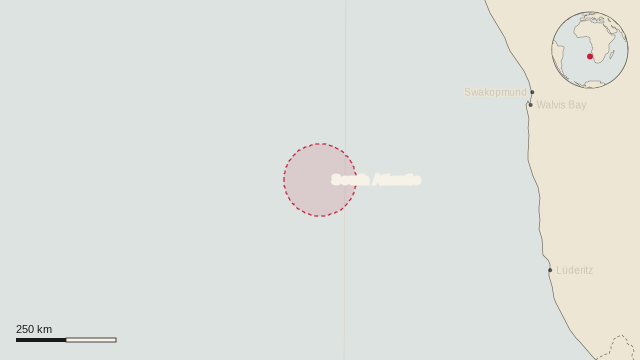
1848·South Atlantic, off the coast of present-day Namibia
Sea serpents·Daedalus sea serpent
Namibia.Daedalus sea serpent · animal seen from a British frigate
On August 6, 1848, in the South Atlantic, Captain Peter M'Quhae and six other men of the British frigate HMS Daedalus watched a long brown animal pass the ship with its head out of the water, and followed it for twenty minutes. In his report to the Admiralty, written two months later, the captain called it "an enormous serpent," with at least 60 ft (18 m) in view. Lieutenant Edgar Drummond's journal instead describes a fish with a dorsal fin. Richard Owen proposed a great seal in 1848, and a 2015 study, a whale.
Tier B · IndicativeCryptidWhat do they mean? →
Limited evidence: it falls short of what Tier A requires. Any one of these is enough: a single testimony (or several witnesses who saw it together), testimony gathered years later, or an account without contemporary primary documentation.
What it was
60%ordinary cause
The most likely explanation.
- 60% ordinary cause
- 40% unexplained
See the split across the six explanations
Known cause (ordinary or hoax)60%
Unexplained40%
Separate collection: these figures do not count toward the UAP case totals. How it is split →
Cause the sources propose: ordinary cause
Record of the event
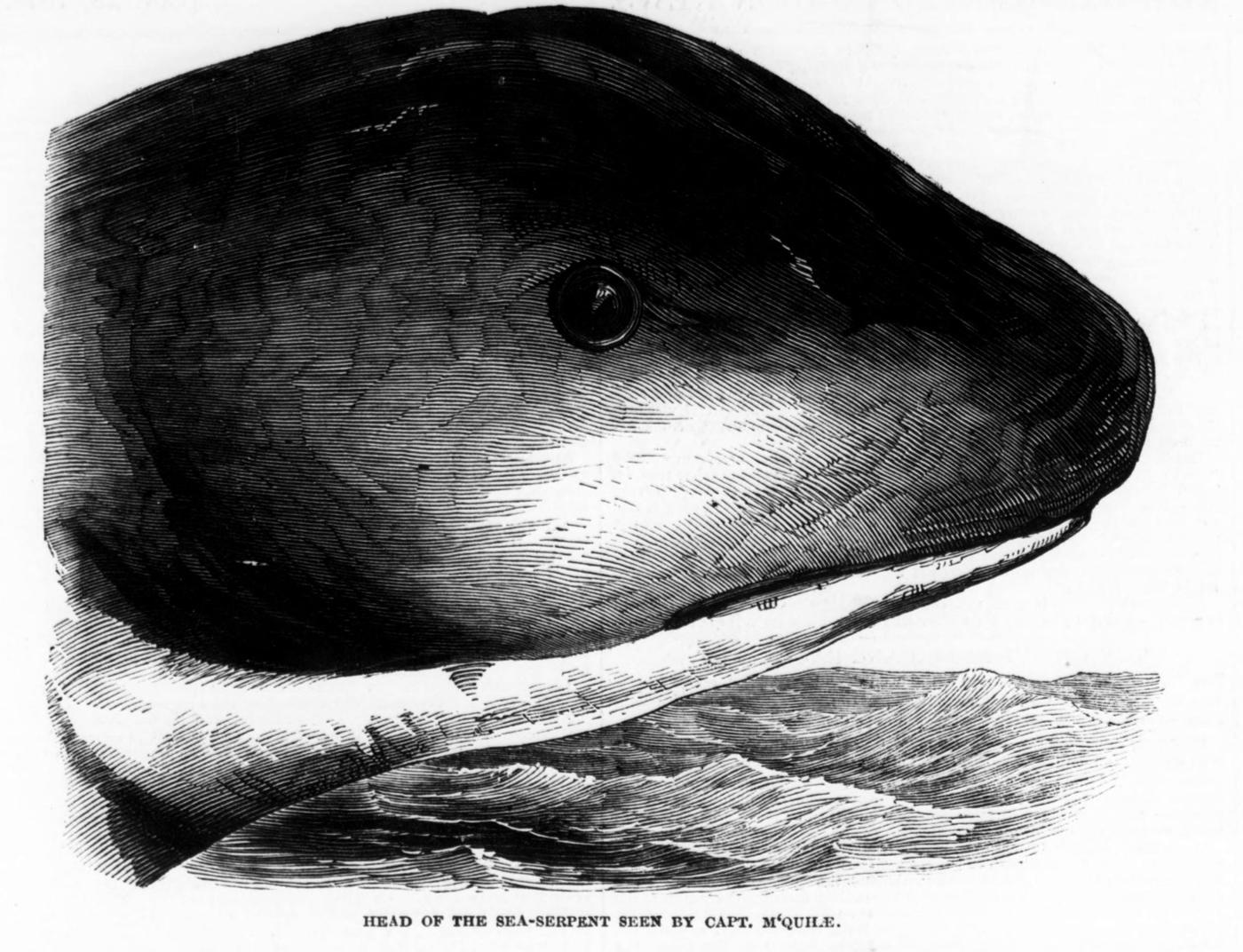
The animal's head from the drawing Captain M'Quhae sent to the Admiralty (1848)
Engraving of the animal's head, copied from the drawing M'Quhae had prepared in October, two months later, from a sketch made right after the sighting, and sent to the Admiralty; according to The Illustrated London News, its artist copied it with the captain's permission.
Read more
Richard Owen wrote in November 1848 that M'Quhae certified this copy as accurate, and based his reading of a mammal on it. It is captioned "Head of the sea-serpent seen by Capt. M'Quhae." Page 265 of The Illustrated London News of October 28, 1848, in the archive.org scan; cropped to the engraving and converted to grayscale, with no other changes.
The Illustrated London News, vol. 13, no. 341, October 28, 1848, p. 265 · Public domain · open original
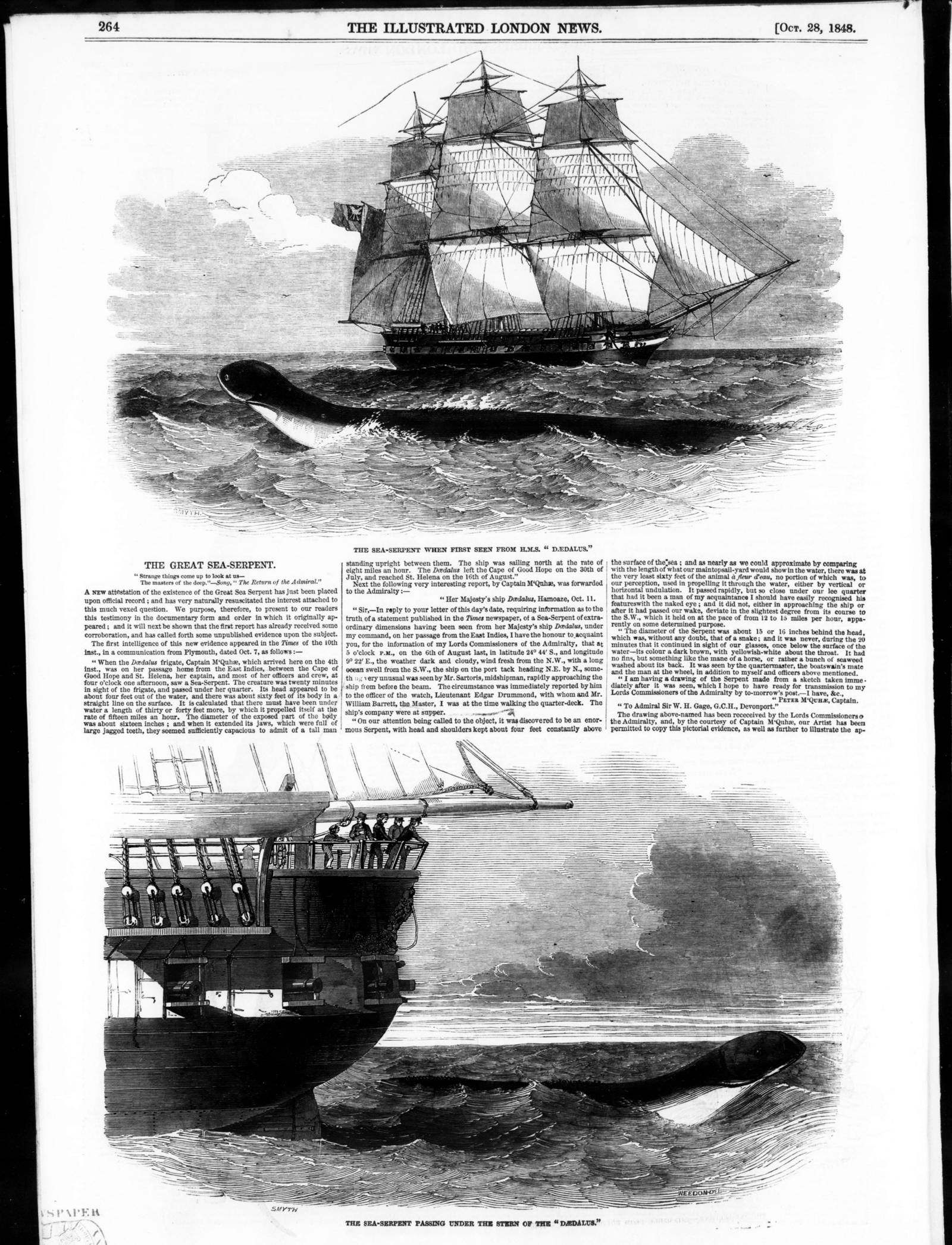
The Illustrated London News of October 28, 1848: the captain's report and two scenes of the sighting
Page with the text of M'Quhae's report to Admiral Gage and the Plymouth note from The Times, between two engravings: the animal as first seen from the frigate, and passing under the stern.
Read more
The weekly says its artist drew the scenes under the captain's supervision and with his approval of the position and shape; they are not drawings made on board. Both engravings are signed Smyth, and the lower one is also signed by Weedon as the draftsman. Page 264 of the archive.org scan, cropped to the page and converted to grayscale, with no other changes.
The Illustrated London News, vol. 13, no. 341, October 28, 1848, p. 264 · Public domain · open original
What happened
On August 6, 1848, the British frigate HMS Daedalus was sailing home from the East Indies through the South Atlantic, between the Cape of Good Hope and the island of St. Helena, under Captain Peter M'Quhae. According to the first press report, she had left the Cape on July 30 and reached St. Helena on August 16. At five in the afternoon, according to the report the captain wrote two months later, Midshipman Sartoris saw something very unusual approaching the ship fast from ahead, on one side.
Sartoris told the officer of the watch, Lieutenant Edgar Drummond, who was walking the quarterdeck (the stern deck from which the ship is commanded) with the captain and the master, William Barrett. The crew were at supper. The sky was dark and cloudy, with a fresh wind from the northwest and a long swell from the southwest. According to M'Quhae, what they saw was "an enormous serpent" that kept its head and shoulders about four feet (1.2 m) above the water at all times. Using one of the ship's yards as a yardstick, they reckoned that at least 60 ft (18 m) of the animal lay on the surface.
The captain wrote that no visible part of the body undulated to drive it forward, and that it passed so close to the stern that, had it been a man he knew, he could have recognized his face with the naked eye. It held its course to the southwest without swerving, at 12 to 15 miles per hour (19 to 24 km/h). It was about 15 or 16 inches (some 40 cm) across behind the head, which was "without any doubt, that of a snake." It was dark brown, with yellowish white about the throat, and had no fins: on its back was something like a horse's mane or a bunch of seaweed.
According to the captain, in the twenty minutes they followed it with their telescopes it never once went under. Besides the officers, it was seen by a quartermaster, a boatswain's mate and the helmsman, whose names the report does not give. M'Quhae added that he was having a drawing prepared from a sketch made right after the sighting.
Lieutenant Drummond told it differently in his journal. He sent the entry, dated the same August 6, to the magazine The Zoologist with a letter signed in Southampton on October 28. He put the ship about 24 miles (39 km) southeast of the position the captain gave, and the time, like him, at about five. He did not call it a serpent but "a most remarkable fish." Only the head and a dorsal fin showed. The head was long, pointed and flattened on top, perhaps ten feet (3 m) long, with the upper jaw jutting well out. The fin showed now and then about twenty feet (6 m) further back, and the captain, he noted, said he saw the tail or another fin the same distance behind it.
According to the journal, the head was held level and somewhat raised and at times dipped under a wave. The animal swam at perhaps 12 to 14 miles per hour and at its closest passed perhaps a hundred yards (90 m) away. It was visible for five minutes to the naked eye and perhaps fifteen more through a telescope, which adds up to the captain's twenty minutes. "It gave one quite the idea of a large snake or eel," he wrote. The two versions clash on three points: the lieutenant saw a fin where the captain saw none, saw the head go under where the captain says it never did, and placed it about 90 m off, farther than the captain's line about recognizing a face suggests.
The frigate reached Plymouth on October 4, and the rumor reached the press before the report. A note dated Plymouth, October 7, ran in The Times (on the 9th according to The Zoologist, the 10th according to The Illustrated London News). It put the sighting at four in the afternoon and added details the captain never wrote: another 30 to 40 ft of body under water, and jaws "full of large jagged teeth" wide enough for a tall man to stand upright between them.
On October 11, Admiral Sir W. H. Gage, at Devonport, wrote asking the captain whether the story was true, and M'Quhae answered the same day from the Hamoaze anchorage, for Gage to pass on to the Admiralty. The Times printed the answer on October 13. On October 28, The Illustrated London News reproduced the report with a copy of the drawing the captain had sent to the Admiralty, showing the animal's head, and with two scenes its artist drew, according to the weekly, under M'Quhae's supervision and with his approval of the position and shape.
The anatomist Richard Owen, of the Hunterian Museum in London, gave his view in a letter to The Times dated November 9. He accepted that the crew had seen a large and strange animal, but read the drawing differently: the domed skull, short muzzle, eye and smooth skin were the features of a mammal, and the "mane" suggested hair. He concluded it was "rather a great seal," perhaps an elephant seal that an iceberg had carried north from the Antarctic islands. The wake of its submerged hind flippers would have been taken for the rest of the body, and the 60 ft was the least reliable part of the report, because it was estimated with the prior idea that it was a serpent.
M'Quhae replied in The Times of November 21. It was not a seal or an elephant seal, he wrote, given its great length and its entirely different face; the head was flat, not a "capacious vaulted cranium," and the length was discussed before all who saw it judged it a serpent. He denied any excitement or optical illusion and stood by the shape, color and measurements in his report to the Admiralty.
Where it happened
Why it matters
The Daedalus case revived the sea serpent debate of its time because a Royal Navy captain signed it in an official report, naming the officers who stood beside him. That authority is what weighed in the 1848 debate. Owen did not question the sailors' good faith: he argued that no carcass or vertebra of a sea serpent had ever turned up on any shore or in any museum, and wrote that more eyewitnesses could be gathered for ghosts than for the sea serpent. M'Quhae answered with the word of someone who had seen it up close.
The record itself holds two versions. Drummond's journal, dated the day of the sighting, describes a fish with a dorsal fin, a flattened head and a jutting upper jaw; the captain's report, written two months later and after the press rumor, describes a finless serpent that never went under. In 1848 it was read in many ways: the geologist Gideon Mantell thought of an unknown cartilaginous fish; the naturalist A. G. Melville, of a shark; and a Times reader who signed as "F. G. S.," of a plesiosaur.
Edward Newman, editor of The Zoologist, gathered in his magazine the letters and reports published in the press. In the preface to the 1848 volume he rejected Owen's seal, citing the "flattened" head in Drummond's journal, and declared himself convinced that a huge sea animal existed that was missing from the works of zoology. In the same volume he dismissed as a hoax a letter claiming that an American brig had fired on a similar animal off Africa in September.
In 2015, the biologist Gary J. Galbreath proposed in the magazine Skeptical Inquirer that the animal was a rorqual, a baleen whale, feeding at the surface with its mouth open, most likely a sei whale. He relied mainly on drawings from Drummond's journal that, according to him, were first published in 1997 in The Log of Mystic Seaport: the long, flat head would be the upper jaw, and the white of the throat, the baleen. Galbreath himself conceded that the sei whale's dorsal fin is usually prominent, not low like the one in the drawing. With no specimen, the explanation depends on which of the two versions one trusts more.
Documents and sources
Documented evidence
- Captain Peter M'Quhae's report to Admiral Sir W. H. Gage, dated Hamoaze, October 11, 1848, answering a letter of the same day: on August 6 at 5 p.m., at 24° 44′ S, 9° 22′ E, an "enormous serpent" with at least 60 ft on the surface, with no fins or undulation, seen for twenty minutes (The Times, October 13, 1848; reprinted in The Zoologist 6, pp. 2307–2308).
- Witnesses the report names: Midshipman Sartoris, who raised the alarm; Lieutenant Edgar Drummond, officer of the watch; the master, William Barrett; and the captain himself. It also mentions, without names, a quartermaster, a boatswain's mate and the helmsman.
- Lieutenant Drummond's journal entry dated August 6, 1848, sent to The Zoologist with a letter signed in Southampton on October 28: position 25° S, 9° 37′ E, about 40 km (25 miles) southeast of the captain's by a calculation made for this case, at about five; "a most remarkable fish" with a flattened head about ten feet long and a dorsal fin, which at times dipped under a wave and passed about a hundred yards off (The Zoologist 6, pp. 2306–2307).
- Plymouth note of October 7, 1848, in The Times (the 9th according to The Zoologist, the 10th according to The Illustrated London News): sighting at four in the afternoon, another 30 to 40 ft under water and jaws "full of large jagged teeth," details the captain's report does not include.
- The Illustrated London News of October 28, 1848, pp. 264–265: the report and three engravings, the head copied from the drawing the captain sent to the Admiralty and two scenes drawn, according to the weekly, under M'Quhae's supervision and with his approval.
Show 3 more facts
- Richard Owen's letter dated November 9, 1848, published in The Times: the features of the head are a mammal's, and the animal was "rather a great seal," perhaps an elephant seal carried north by an iceberg (The Zoologist 6, pp. 2312–2316; The Illustrated London News, November 25, 1848).
- M'Quhae's reply in The Times of November 21, 1848: it was not a seal or an elephant seal, the head was flat, and he stands by the shape, color and measurements in his report (The Zoologist 6, pp. 2323–2324).
- Gary J. Galbreath, Skeptical Inquirer 39 (5), 2015: a rorqual feeding at the surface, most likely a sei whale, based on the drawings in Drummond's journal, first published according to him in 1997 in The Log of Mystic Seaport. One of those drawings marks seven feet for the visible front part and thirty to the fin. He also cites a letter from an anonymous Daedalus officer in The Times of February 16, 1858: about ten miles per hour, no more than 200 yards off and about ten minutes in sight.
Sources
- Edward Newman (ed.), "The Great Sea-Serpent," The Zoologist 6 (1848), pp. 2306–2324 — Collects Drummond's journal entry, the Plymouth note from The Times, M'Quhae's report (The Times, October 13), Owen's letter and the captain's reply (The Times, November 21), along with other 1848 letters. Read on the scan.
- Edward Newman, preface to The Zoologist 6 (1848), pp. vii–xii — The magazine's editor rejects Owen's seal, citing the flattened head in Drummond's journal, and declares himself convinced that a huge undescribed sea animal exists.
- "The Great Sea-Serpent," The Illustrated London News 13, no. 341, October 28, 1848, pp. 264–265 — Reprints the Plymouth note (which it dates to The Times of October 10) and the captain's report, with three engravings approved by M'Quhae according to the weekly.
- Richard Owen, "The Great Sea-Serpent," letter to The Times of November 9, 1848, reprinted in The Illustrated London News 13, no. 345, November 25, 1848 — Owen says he is publishing the answer he gave to a nobleman's question about the Daedalus animal.
- Gary J. Galbreath, "The 1848 'Enormous Serpent' of the Daedalus Identified," Skeptical Inquirer 39 (5), September/October 2015 — Proposes a rorqual feeding at the surface, most likely a sei whale, based on the drawings in Drummond's journal.