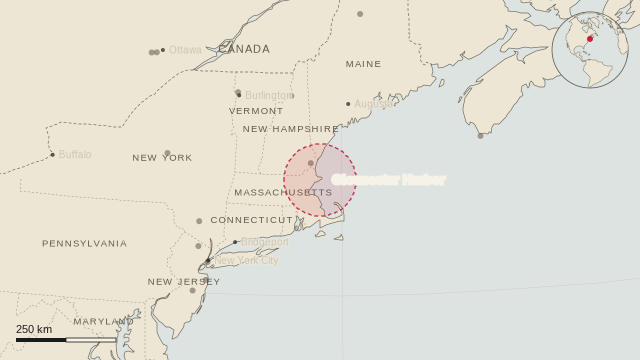
1817–1818·Gloucester Harbor, Cape Ann, Massachusetts, United States
Sea serpents·Gloucester sea serpent
United States.Gloucester sea serpent · dozens see a long animal in the harbor
In August 1817 dozens of people in Gloucester, a port on Cape Ann, Massachusetts, said they saw a dark, elongated animal in the harbor, which several witnesses estimated at 40 to 90 feet. The Linnaean Society of New England asked justice of the peace Lonson Nash to take separate sworn depositions and published eleven on the August sightings, from residents and from the crew of the schooner Laura. In September a snake with a wavy back was exhibited as its young, and the committee judged it probably the same species. In 1818 the naturalist Charles Alexandre Lesueur, who had dissected part of it, reported that it was a diseased specimen.
Tier A · AcceptableCryptidWhat do they mean? →
Institutional evidence: several identified independent witnesses, or contemporary official documentation, without an instrumental record to corroborate them.
What it was
60%ordinary cause
The most likely explanation.
- 60% ordinary cause
- 40% unexplained
See the split across the six explanations
Known cause (ordinary or hoax)60%
Unexplained40%
Separate collection: these figures do not count toward the UAP case totals. How it is split →
Cause the sources propose: ordinary cause
Record of the event
Linnaean Society of New England report (1817): sworn depositions and the Scoliophis snake, 10-page extract
Extract from the report that gathered the sworn depositions about the animal in Gloucester Harbor and described the Scoliophis atlanticus snake.
Read more
It includes the title page; justice of the peace Lonson Nash's letter of August 28, 1817, and the start of Amos Story's deposition (pp. 9-10); the deposition of Matthew Gaffney, who fired at the animal (p. 16); those of the schooner Laura's crew, with the harpoon-shaped tongue (pp. 21-22); the conclusion that the animal's existence was "beyond a doubt" (p. 37); the creation of the genus Scoliophis and Gorham Norwood's deposition (p. 44); the last page, signed on October 11, 1817 (p. 50); and plate I, which draws the snake from the specimen. The full report, 52 pages and two plates, is on archive.org.
Source: Report of a committee of the Linnaean Society of New England, relative to a large marine animal, supposed to be a serpent, seen near Cape Ann, Massachusetts, in August 1817 (Boston, Cummings and Hilliard, 1817); copy in the Ernst Mayr Library of Harvard's Museum of Comparative Zoology, digitized for the Biodiversity Heritage Library · Dominio público (obra de 1817; la Biodiversity Heritage Library la considera libre de derechos) · open original
What happened
In August 1817 word spread through Gloucester, a fishing port on Cape Ann about 30 miles (48 km) from Boston, that a huge serpent-like animal kept appearing in the harbor. It was said to surface only in calm, clear weather, to move very fast and to look jointed, like a line of buoys or casks. On August 18 the Linnaean Society of New England, a natural history society in Boston, named a committee to gather evidence: Judge John Davis, the society's president, the physician Jacob Bigelow and Francis C. Gray.
The next day the committee wrote to Lonson Nash, a justice of the peace in Gloucester, and asked him to examine under oath residents who said they had seen the animal. It sent him rules: each witness would testify separately, and no one would learn what the others had said until all the statements were taken; each account would be written down, read back to the witness, signed and sworn before a magistrate. Then came 25 set questions on distance, color, head, motion and how many people saw it. On August 28 Nash sent eight depositions and wrote that the witnesses, questioned separately, "though they differ in some few particulars, still, for the most part, they agree."
The first sighting on record was that of the mariner Amos Story, on August 10, between noon and one o'clock. Sitting on the shore, he watched it for an hour and a half southeast of Ten Pound Island, inside the harbor, about 100 meters away at its closest. He said the head looked like a sea turtle's, larger than any dog's, that he saw no humps on its back and that it covered a mile in two or three minutes. On August 23, at seven in the morning, he saw it again through a spyglass from about 200 meters: it lay still and stretched out on the water, dark brown, and he saw at least 50 feet of it (15 meters). He gave his deposition that same day.
Solomon Allen, a ship master, saw it from August 12 to 14; on the first day, from a boat that circled it at about 140 meters. He put its length at 80 to 90 feet (24 to 27 meters) and its head as shaped like a rattlesnake's but nearly as large as a horse's. He said it moved to the right and left, that he counted fifty distinct portions out of the water and that twenty or thirty people were in view. On the 14th, between four and five in the afternoon, the ship carpenter Matthew Gaffney was in a boat with his brother Daniel and Augustin M. Webber when the animal passed within about 9 meters. He fired at its head and thought he hit it; the animal turned toward them, sank "directly down, like a rock," went under the boat and came up about 90 meters away.
That same August 14 it was seen by Captain Epes Ellery, shortly after sunset and through a spyglass, and by the merchant William H. Foster, who saw it again on the 17th and that time saw a kind of prong about 30 centimeters long rise from its head. Nash saw it too on the 14th, for nearly half an hour at about 230 meters, and in his letter he contradicted Allen on two points: the motion was vertical, and he never saw more than eight portions at once. "I believe the animal to be straight, and that the apparent bunches were caused by his vertical motion," he wrote. James Mansfield saw it on the 15th, stretched out on the water, 40 to 60 feet long (12 to 18 meters). On the night of the 17th, John Johnston, 17, rowed so close to something straight at least 15 meters long that, he said, he could have reached it with his oar, but there was not enough light to describe it.
On August 18 the merchant William B. Pearson and James P. Collins were in a sailboat off Webber's Cove when the animal passed under their stern and crossed their bow about 27 meters away; Pearson put it at no less than 70 feet (21 meters). Pearson also testified that he had seen Gaffney fire and that afterward the animal seemed more shy. Gaffney said the opposite: it was not more shy and "continued playing as before." The two do agree on how it turned: the head swung back toward the body in a curve shaped like a staple, until it ran parallel to the tail.
The last sighting of the series came on August 28, offshore. The schooner Laura, bound from Newburyport to Boston, lay becalmed off Eastern Point on Cape Ann when the sailors Robert Bragg and William Somerby saw something break the water and come toward them. The animal passed 9 to 12 meters away, with 14 or 15 feet (about 4.5 meters) of its length in view and a head like a serpent's. Both swore that it threw out, several times, a tongue about 60 centimeters long that ended like a harpoon. The master, Sewell Toppan, did not see it, but heard his men call out "look at his tongue," and testified that he had never seen a fish with the least resemblance to it. The times do not match: Toppan says nine in the morning, the sailors ten. They were sworn in Boston on August 30 and September 1.
The committee widened its inquiry. It obtained a sworn statement from the mariner Elkanah Finney about an animal he saw at Plymouth in June 1815, about 400 meters away, lying still like "a string of buoys" and 100 to 120 feet long (30 to 37 meters). It received a letter from the Reverend William Jenks with earlier reports from Maine. The report added an extract from Erich Pontoppidan, bishop of Bergen in Norway (1751), on the North Sea serpent, and concluded that the testimony was "sufficient to place the existence of the animal beyond a doubt."
About four weeks after the depositions arrived, the committee had a snake in front of it. On Saturday, September 27, in a field near Loblolly Cove on Cape Ann, the son of a man named Colbey spotted a snake that, he said, did not move like other snakes. According to his own sworn statement, Gorham Norwood, who was working in the same field, ran it through with a pitchfork, and the boy's father crushed its head with a stone. Many residents said it might be the young of the great serpent; John Gott bought it, and its next owner, Captain Beach Jr., exhibited it in Boston.
The committee examined it and opened one side. It measured 2 feet 11.5 inches (about 90 centimeters), was dark brown above and had 40 humps along its back, formed by undulations of the spine. In the arrangement of its scales and colors it came closest to the black racer (Coluber constrictor), but since the committee knew of no snake with a wavy spine, it created a new genus for it, Scoliophis atlanticus. In the final pages of the report, signed on October 11, 1817, it argued that the snake and the great serpent were probably the same species, and perhaps one the young of the other, and stressed that it had all the Gloucester depositions in hand before the snake turned up.
In April 1818 the Journal de Physique, a scientific journal in Paris, published an unsigned summary of the report; in 1892 the Dutch zoologist A. C. Oudemans attributed that summary to the journal's editor, Henri Ducrotay de Blainville. It accepted that a very large, elongated and fast animal had appeared off Cape Ann, but added that "its being a true serpent begins to be more doubtful," and saw almost no chance that it was the same species as the snake.
In June the journal printed a letter from the French naturalist Charles Alexandre Lesueur, who had dissected another part of the snake with a Dr. Paterson when its owner passed through his city. Lesueur found very irregular vertebrae and ribs, some of them deformed, and concluded that "this singular conformation comes rather from a state of disease than from a natural state," so the genus Scoliophis could not stand. The journal summed it up in a note: the snake was nothing but a diseased specimen very close to the Americans' black snake. On the great sea serpent Lesueur offered no opinion, since he had no observations of his own.
Where it happened
Why it matters
What sets Gloucester apart is the procedure. The committee fixed its rules before hearing anyone: witnesses questioned separately, with the same questions and under oath before a justice of the peace, and everything published within weeks. That is why today one can read what each witness said, with name, trade, date, time and distance, rather than a version boiled down by the newspapers.
Read together, the depositions agree on the general picture: a dark, very long and fast animal that turned by doubling back on itself and sank straight down. On the details they disagree. The estimated length runs from 40 to 90 feet; Allen saw fifty portions and side-to-side motion, Nash never more than eight and vertical motion, and Story no humps at all. The harpoon-tipped tongue was seen only by two sailors on the same ship, which counts as a single testimony. The rules kept the witnesses from copying one another, but they did not shorten the distance: most saw it from more than a hundred meters, and only Gaffney, Johnston and the Laura's crew from about ten meters.
The committee's mistake was to join the case's two layers. In a small snake it found the very thing it was looking for in the harbor, a humped back, and it argued that nearly everything the witnesses stated as fact fit the snake, while what did not fit were the conjectures of men of good faith who saw the animal only in part. The Paris journal rejected the link in April 1818, and in June Lesueur, with the specimen in hand, showed that the snake was a diseased specimen. Oudemans wrote in 1892 that there was no doubt the Scoliophis was a deformed specimen of Coluber constrictor. The snake was explained; the sightings were not.
For the sightings there are proposals, and none is backed by a specimen. Oudemans, in his 1892 treatise on the great sea serpent, included the Gloucester sightings in his catalog and concluded that these animals were an undescribed giant long-necked pinniped. In 2019 the researcher Robert L. France proposed, in a book devoted to the case, a giant bluefin tuna entangled in fishing gear, dragging a line of floats and debris behind it. That same year the skeptic writer Joe Nickell proposed in Skeptical Inquirer a group of narwhals whose tusk would have been taken for the prong or the tongue.
Documents and sources
Documented evidence
- Rules of the Linnaean Society of New England committee, Boston, August 19, 1817: only witnesses who said they had seen the animal, questioned separately, with a written statement read back, signed and sworn before a magistrate, and 25 set questions (1817 report, pp. 7-8).
- Eleven sworn statements on August 1817: eight from Gloucester residents before justice of the peace Lonson Nash, August 21 to 28 (Story, Allen, Ellery, Foster, Gaffney, Mansfield, Johnston and Pearson), and three from the crew of the schooner Laura in Boston, on August 30 and September 1, before justice of the peace Joseph May (1817 report, pp. 10-23).
- Letter from Lonson Nash, August 28, 1817: he saw the animal on August 14 for nearly half an hour at about 250 yards, holds that its motion was vertical and that the humps were an effect of that motion, and disputes Allen's fifty visible portions (1817 report, pp. 9-10).
- Sworn statement of Gorham Norwood, October 7, 1817: the snake was killed on September 27 near Loblolly Cove with a pitchfork and a stone; letter from Nash of October 8 with the distance from the sea paced out (1817 report, pp. 44-46).
- Description of the snake and creation of the genus Scoliophis atlanticus: 2 feet 11.5 inches long, 40 humps along the back, closer to Coluber constrictor than to any other species; conclusion signed by Davis, Bigelow and Gray on October 11, 1817 (1817 report, pp. 38-50, plates I and II).
Show 2 more facts
- Journal de Physique 86, April 1818, pp. 297-304: unsigned summary of the report, which accepts a large animal off Cape Ann but doubts that it was a serpent and that it was the same species as the snake, which it does accept as a new species.
- Letter from Charles Alexandre Lesueur in the Journal de Physique 86, June 1818, pp. 466-469: he dissected part of the snake with Dr. Paterson, found irregular and deformed vertebrae and ribs, and concluded that the Scoliophis was a diseased specimen and that the genus could not stand, at least on the basis of that specimen.
Sources
- Report of a committee of the Linnaean Society of New England, relative to a large marine animal, supposed to be a serpent, seen near Cape Ann, Massachusetts, in August 1817 (Boston, Cummings and Hilliard, 1817) — Primary source: the committee's rules, Lonson Nash's letters, the sworn statements from Gloucester, the schooner Laura and Plymouth, the description of the Scoliophis and the plates. Read in full in the Biodiversity Heritage Library scan; quotations checked against the page image.
- Journal de Physique, de Chimie et d'Histoire Naturelle 86 (Paris, 1818): "Sur un nouveau genre de Serpent, Scoliophis, et le Serpent de mer vu en Amérique en 1817" (April, pp. 297-304) and C. A. Lesueur, "Sur le serpent nommé Scoliophis" (June, pp. 466-469) — The unsigned critical summary of April and Lesueur's letter identifying the snake as a diseased specimen, with the journal's note. Read in the Natural History Museum, London, scan on archive.org, in the public domain.
- A. C. Oudemans, The Great Sea-Serpent: An Historical and Critical Treatise (Leiden, E. J. Brill, 1892) — Bibliography attributing the April 1818 summary to Blainville and the June letter to Lesueur; judgment that the Scoliophis was a deformed specimen of Coluber constrictor, and conclusion that sea serpents were an unknown long-necked pinniped.
- Robert L. France, Disentangled: Ethnozoology and Environmental Explanation of the Gloucester Sea Serpent (Wageningen Academic Publishers, 2019), ISBN 978-90-8686-335-8 — Book on the case. On pp. 231-232 it proposes a giant bluefin tuna entangled in fishing gear as the most likely candidate and rules out Elizabeth Fama's (2012) entangled humpback whale. A copyrighted work; consulted for the proposal, not linked.
- Joe Nickell, "Gloucester Sea-Serpent Mystery: Solved after Two Centuries," Skeptical Inquirer 43(5) (September-October 2019) — Proposes a group of narwhals, whose tusk would explain the prong and the tongue in some depositions.
Referenced by 1 case