2013·Toyon Bay, Santa Catalina Island, California, United States
Sea serpents·Oarfish ("sea serpent")
United States.Catalina Island · instructor finds a dead 17-foot oarfish
On October 13, 2013, Jasmine Santana, an instructor at the Catalina Island Marine Institute, saw a dead oarfish on the bottom of Toyon Bay, on Santa Catalina Island, California, and brought it ashore. The press presented it as an 18-foot sea serpent; the Los Angeles natural history museum recorded it at 5.27 meters (17.3 ft) and holds its tissues. A University of California, Santa Barbara, lab published the parasites in its viscera in 2015. Five days later another oarfish washed up at Oceanside, to the south.
Tier A · AcceptableCryptidWhat do they mean? →
Institutional evidence: several identified independent witnesses, or contemporary official documentation, without an instrumental record to corroborate them.
What it was
99%ordinary cause
The most likely explanation.
- 99% ordinary cause
- 1% unexplained
See the split across the six explanations
Known cause (ordinary or hoax)99%
Unexplained1%
Separate collection: these figures do not count toward the UAP case totals. How it is split →
Cause the sources propose: ordinary cause
Record of the event
Feeney and Lea (2018): the Los Angeles museum's record of California's oarfish, 3-page extract
Extract of three of the eleven pages of the record of California's oarfish published by two ichthyologists at the Natural History Museum of Los Angeles County: the introduction, which explains why only Regalecus russelii has been found in the northeastern Pacific (page 169); records 12 to 16, with the 2013 Toyon Bay fish, its measurements, its dissection and the distribution of its tissues, the Oceanside fish, a 2014 Santa Rosa Island fish and the two Catalina fish of June 2015 (page 173); and the chart of strandings by year with the summary (page 177). The full article is on archive.org.
Source: Bulletin of the Southern California Academy of Sciences 117(3): 169-179, BioStor copy on archive.org, under a CC BY-NC 3.0 license (non-commercial reproduction with attribution). The photo pages, which are by third parties, are left out · open original
What happened
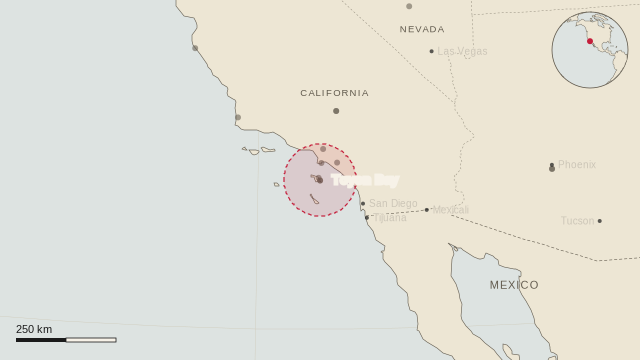
On Sunday, October 13, 2013, Jasmine Santana, a marine science instructor at the Catalina Island Marine Institute, a center that takes schoolchildren to study the ocean, was snorkeling in Toyon Bay, a cove on Santa Catalina Island off the Los Angeles coast. On the bottom, about 5 meters down, she saw a dead fish, long, silvery and shaped like a ribbon. According to the record later published by the ichthyologists Richard Feeney and Robert Lea, of the Natural History Museum of Los Angeles County, Santana grabbed it by the tail and swam it to shore; she put its weight at about 400 lb (181 kg). It measured 5.27 meters (17.3 ft), a figure the two ichthyologists believe was taken with a metric tape at the institute.
Other instructors, who were unloading gear from the institute's school sailing ship, the Tole Mour, saw her wrestling with the animal and went to help. According to NPR, it took at least 15 people to get it up the beach; Mark Waddington, the Tole Mour's captain, put the number at 15 to 20 in an interview with ABC News. The institute described the body as "almost perfectly intact" and called the find a "discovery of a lifetime." The institute added that oarfish are "likely responsible for sea serpent legends."
The press ran with that idea. That week's headlines spoke of an 18-foot sea serpent or sea monster, rounding up, and two weeks later the journal Nature wrote that the U.S. media had reported "gleefully" that two real-life sea monsters had hit the beaches of Southern California. There was nothing unknown about the animal. The oarfish (genus Regalecus) is, according to Nature, the world's longest bony fish; it usually lives below 200 meters, and most of what is known about it comes from stranded specimens.
The institute sent samples to the University of California, Santa Barbara, where the biologist Milton Love coordinated their distribution. In an interview with the weekly Santa Barbara Independent, Love said he planned to extract DNA and compare it with that of Atlantic oarfish, because some specialists suspected there was more than one species. According to Feeney and Lea, Taylor Sakmar of the institute alerted the Los Angeles museum. The fish was dissected: its stomach was empty and it was probably a male.
The museum received samples of tissue, gills, fin rays, heart, liver, kidney, gonads, the tip of the tail and muscle, and cataloged them as LACM 58180-1. The gall bladder, the stomach, the spleen and parts of the gills and intestine went to the Ecological Parasitology Lab at the Santa Barbara campus.
Five days later, on Friday, October 18, another oarfish turned up on the beach at Oceanside, by the harbor breakwater, in northern San Diego County. Suzanne Kohin, a fish ecologist at the Southwest Fisheries Science Center, the La Jolla lab of NOAA (the U.S. ocean and atmosphere agency), recovered it over the weekend, and on Monday, October 21, it was opened there. California Sea Grant, a NOAA marine science program based at the Scripps Institution of Oceanography, headlined its note that day "Second 'sea serpent' carcass was female with cookiecutter shark bites": she was a female releasing eggs, and her skin bore the round scars left by the cookiecutter shark, a small shark that gouges out circular bites.
Antonella Preti, a fish-feeding specialist at the same center, found only parasites, sand and some krill in the stomach. The cause of death was left undetermined: Kohin said "everything" was being considered, which according to the note included tests for radiation, algal toxins, PCBs and mercury, and the note suggested the female might have died of old age. Preti later wrote on a science blog that the otoliths, the tiny ear bones used to estimate age, were not found, and that the fish's parts were shared among Scripps, California State University, Fullerton, and other labs. Feeney and Lea recorded it at 4.45 meters (14.6 ft), with a damaged head.
On June 1, 2015, another oarfish turned up on the same island, in Emerald Bay. It was found by Tyler Dvorak and Amy Catalano, who reported it to the Catalina Island Conservancy, the organization that manages most of the island: a female of about 4.32 meters, which was necropsied before being sent to Fullerton.
Where it happened
Why it matters
What the press called a sea serpent ended up studied in scientific papers. In 2015, eleven researchers led by Armand Kuris, of the University of California, Santa Barbara, published in the Journal of Parasitology, under the title "Monsters of the Sea Serpent," their examination of a small part of the Catalina fish's viscera. They found numerous tapeworm larvae (Clistobothrium cf. montaukensis), two juvenile nematode worms (Contracaecum) and a piece of an adult acanthocephalan, another parasitic worm. They concluded that the fish was fairly heavily parasitized and that the larvae suggest it is eaten by deep-diving hunters such as the shortfin mako shark and by deep-diving mammals such as the sperm whale, in which those parasites reach adulthood.
According to Feeney and Lea, an otolith and two fin rays from the same specimen were taken to study its age, in the work by Stephen Midway and T. Wagner that first described the structures that can be used to age this fish. The Oceanside female was the subject of another study. Taken to Fullerton, it was CT-scanned at the University of California, Los Angeles, and the biologist Misty Paig-Tran, with other specimens, described in the Journal of Anatomy in 2016 bony thickenings in the supports of the dorsal fin that appeared only in fish longer than 3 meters. The 2015 Emerald Bay female went into the study of oarfish reproduction that Kristy Forsgren and her Fullerton team published in 2017: her ovaries were 2.14 meters long and she was in spawning condition.
The published work also corrected the species. Nature, like most accounts of the last century according to Feeney and Lea, called these fish Regalecus glesne, the giant oarfish, and Love wanted to find out from DNA whether there were two species. Feeney and Lea, who examined every California specimen held in four scientific collections, write that only Regalecus russelii has been found so far in the northeastern Pacific, one of the two species recognized in the ichthyologist Tyson Roberts' 2012 revision, which are told apart by the rays in the crests of the dorsal fin and by mitochondrial DNA. The Kuris paper spells the same species russellii.
Feeney and Lea compiled the 19 verified strandings and sightings in California since 1901 precisely because of the confusion. They write that these fish "have been feared as 'sea monsters or serpents' in the past and 'harbingers of earthquakes' more recently," and that the coverage had left misconceptions behind. According to the California Sea Grant note of October 21, 2013, Love spent that day talking to reporters, who were most curious about whether earthquakes had killed the fish.
The two 2013 strandings coincided, according to Feeney and Lea, with the appearance in the North Pacific of the large mass of warm water known as "the Blob," and in 2015 there were five strandings in California. Unlike the ↗ Gloucester sea serpent serpent, seen in the water and never caught, this animal came ashore whole and its tissues carry a catalog number.
Documents and sources
Documented evidence
- Feeney and Lea (2018), record 12: on October 13, 2013, Jasmine Santana of the Catalina Island Marine Institute saw a dead 5.27-meter (17.3 ft) oarfish lying on the bottom of Toyon Bay at about 5 meters and brought it ashore; she estimated its weight at about 400 lb (181 kg). Dissection showed it was probably a male, with an empty stomach; Taylor Sakmar alerted the museum, which holds the tissues as LACM 58180-1 (samples T-001236 to T-001248).
- Feeney and Lea (2018), record 12: the gall bladder, parts of the gills, the stomach, the spleen, part of the intestine and the gastric caecum went to the Ecological Parasitology Lab at the University of California, Santa Barbara; an otolith, a dorsal ray and a pelvic ray were sampled for ageing (Midway and Wagner).
- Kuris and ten co-authors, "Monsters of the Sea Serpent: Parasites of an Oarfish, Regalecus russellii," Journal of Parasitology 101(1) (2015), pp. 41-44: in a small portion of the viscera of the Santa Catalina fish they found numerous larvae of Clistobothrium cf. montaukensis, two juvenile Contracaecum nematodes and a fragment of an adult acanthocephalan of the family Arhythmacanthidae.
- California Sea Grant, October 21, 2013: NOAA's Southwest Fisheries Science Center necropsied that Monday the 14-foot oarfish that had washed up on Friday in northern San Diego County; she was a female releasing eggs, with cookiecutter shark scars, and her stomach held parasites, sand and some krill. The cause of death was left undetermined.
- Feeney and Lea (2018), record 13: the Oceanside fish, found on October 18, 2013, measured 4.45 meters (14.6 ft), had a damaged head and was a female with eggs; some of its tissues are in the Scripps Marine Vertebrate Collection (SIO 13-259) and the rest went to Fullerton and was later CT-scanned at the University of California, Los Angeles (Paig-Tran et al., 2016).
Show 2 more facts
- Feeney and Lea (2018), record 15: on June 1, 2015, Tyler Dvorak and Amy Catalano found an oarfish of about 4.32 meters in Emerald Bay, on Santa Catalina Island; it was necropsied and sent to Fullerton, and its reproductive tissue showed it was a female (Forsgren et al., 2017).
- Nature, October 29, 2013 (Daniel Cressey): the two fish were found on October 13 and 18; the article calls them Regalecus glesne and says Love coordinated the distribution of samples from the Catalina fish.
Sources
- Feeney, R. F. and R. N. Lea, "California Records of the Oarfish, Regalecus russelii (Cuvier, 1816) (Actinopterygii: Regalecidae)," Bulletin of the Southern California Academy of Sciences 117(3) (2018), pp. 169-179 — Primary source for the record: measurements, dissection, distribution and catalog numbers of the two 2013 fish and the 2015 Emerald Bay fish, by ichthyologists at the Los Angeles museum. Full text read in the BioStor copy on archive.org (biostor-253770).
- Kuris, A. M., A. G. Jaramillo, J. P. McLaughlin, S. B. Weinstein, A. E. Garcia-Vedrenne, G. O. Poinar, M. Pickering, M. L. Steinauer, M. Espinoza, J. E. Ashford and G. L. P. Dunn, "Monsters of the Sea Serpent: Parasites of an Oarfish, Regalecus russellii," Journal of Parasitology 101(1) (2015), pp. 41-44 — Published analysis of the viscera of the Santa Catalina fish. Paywalled: the abstract was read (PubMed 25220829); the link to the 2013 fish comes from the Feeney and Lea record.
- California Sea Grant, "Second 'sea serpent' carcass was female with cookiecutter shark bites" (October 21, 2013) — Note from the NOAA program on the necropsy of the Oceanside fish, with statements by Suzanne Kohin, Antonella Preti, Milton Love and James Eckman. Of the Catalina fish it says only that University of California researchers were analyzing it.
- Preti, A., "Fish out of water: the necropsy of the beached oarfish," Southern Fried Science (November 8, 2013) — First-hand account by one of the specialists who necropsied the Oceanside fish: the eggs, the cookiecutter shark wounds, the otoliths that were not found and the distribution of the samples.
- Cressey, D., "Oarfish's misfortune is scientists' boon," Nature (October 29, 2013), doi:10.1038/nature.2013.14040; reprinted in Scientific American as "Oarfish's Death Is Boon to Scientists" — Dates of the two finds, the distribution of the samples and the quote on the "sea monsters" coverage. Read in the Scientific American reprint; the Nature original is paywalled.
- ABC News, "Monster Oarfish, 18 Feet Long, Called 'Discovery of a Lifetime'" (October 16, 2013) — Contemporary press: interview with Mark Waddington, captain of the Tole Mour, and the phrase from the institute's statement.
- NPR, reprinted by KPBS, "18-Foot Oarfish Livens Up A 'Leisurely Snorkel' In California" (October 15, 2013) — Contemporary press: quotes the institute's statement on the state of the body, the 15 people and the sea serpent legends.
- Santa Barbara Independent, "UCSB Scientist to Study Giant Oarfish" (October 16, 2013) — Interview with Milton Love on the samples from the Catalina fish and his plan to compare the DNA.
- E. W. M. Paig-Tran, A. S. Barrios and L. A. Ferry, "Presence of repeating hyperostotic bones in dorsal pterygiophores of the oarfish, Regalecus russellii," Journal of Anatomy 229 (2016), pp. 560-567 — Abstract read: the bony swellings of the dorsal fin have only been documented in fish longer than 3 meters.
- K. L. Forsgren, H. Jamal, A. Barrios and E. W. M. Paig-Tran, "Reproductive Morphology of Oarfish (Regalecus russellii)," The Anatomical Record 300 (2017), pp. 1695-1704 — Abstract read: the female collected in June 2015 (4.32 m) had bifurcated ovaries 2.14 m long and was spawning capable.
Related cases
Cases this case cites and cases with the same likely cause.