2014·Ladakh (India) and Bhutan; also Nepal, Russia, U.S. and Sumatra
Hairy hominids·Yeti
India.Yeti and Bigfoot hairs · their DNA came from known animals
In 2014, Oxford geneticist Bryan Sykes and four other researchers published a DNA analysis of hairs attributed to the yeti, Bigfoot, Russia's almasty and Sumatra's orang pendek. Of 37 samples analyzed, 30 yielded DNA, and all matched known animals: bears, horses, cows, canids, a tapir and a human. Two Himalayan hairs, from Ladakh and Bhutan, matched, according to the authors, a fossil polar bear; in 2015 they conceded the match was with a modern polar bear, and other researchers showed that the fragment read cannot tell the polar bear from the brown bear and put the hairs down to brown bears.
Tier A · AcceptableCryptidWhat do they mean? →
Institutional evidence: several identified independent witnesses, or contemporary official documentation, without an instrumental record to corroborate them.
What it was
95%ordinary cause
The most likely explanation.
- 95% ordinary cause
- 5% unexplained
See the split across the six explanations
Known cause (ordinary or hoax)95%
Unexplained5%
Separate collection: these figures do not count toward the UAP case totals. How it is split →
Cause the sources propose: ordinary cause
Record of the event
Sykes et al. (2014): the paper with the table of the 30 samples and the animal each one's DNA matched
Full three-page paper that identified by their DNA the 30 hair samples attributed to the yeti, the almasty, the orang pendek and Bigfoot.
Read more
Table 1, on page 2, gives for each sample its number, the country or state, the creature it was attributed to, the GenBank species it matched and its common name. Page 3 has the discussion of the two Himalayan hairs linked to the polar bear, the thanks to those who sent samples and to Icon Films, and the GenBank numbers. Published under a CC BY 3.0 license; this is the PDF copy from the PubMed Central open access archive, unchanged.
Bryan C. Sykes, Rhettman A. Mullis, Christophe Hagenmuller, Terry W. Melton and Michel Sartori, "Genetic analysis of hair samples attributed to yeti, bigfoot and other anomalous primates," Proceedings of the Royal Society B 281: 20140161 (2014) · CC BY 3.0 · open original
What happened
On May 14, 2012, the Museum of Zoology in Lausanne, Switzerland, and the University of Oxford issued a joint press release asking museums and collectors to send hair attributed to "anomalous primates": the Himalayan yeti, the almasty of Central Asia, North America's Bigfoot or sasquatch, and others. The project was led by geneticist Bryan Sykes of Wolfson College, University of Oxford. His co-authors on the paper included Terry Melton, of the forensic laboratory Mitotyping Technologies in Pennsylvania, and Michel Sartori, of the Lausanne museum. The other two were Rhettman Mullis, of Bellevue, Washington, and Christophe Hagenmuller, of NaturAlpes in Annecy, France.
Fifty-seven samples came in. The team examined them by eye, under the microscope and with infrared fluorescence to weed out anything that was not hair: one turned out to be plant material and another glass fiber. It picked 37 for genetic analysis based on their provenance or historical interest. The paper thanks mountaineer Reinhold Messner, Peter Byrne, the Bigfoot researcher who in 1976 had asked the FBI to test some hairs (↗ Bigfoot), and 27 other people for sending samples, without saying who sent which.
From each hair, a 2 to 4 cm length was cut and thoroughly cleaned to strip away surface contamination before the DNA was extracted. The team read a short fragment of the mitochondrial 12S gene, part of the DNA passed down only from mother to offspring, and compared each sequence with those in GenBank, the public database of genetic sequences. It deliberately used a set of primers, the short pieces that start the copying of DNA, that works for almost any mammal in a single reaction. The trade-off was that some identifications stopped at the genus: the canid hairs could not be told apart as wolf, coyote or dog. The U.S. Fish and Wildlife Service forensic laboratory in Ashland, Oregon, advised on the methods.
Seven samples yielded no DNA despite several attempts. The other 30 matched sequences of known animals exactly. The 18 attributed to Bigfoot, from six U.S. states, came from five American black bears, four canids, three cows, a raccoon, a sheep, a porcupine, a horse, a deer and a human. The eight almasty samples, sent from Russia, came from three horses, two brown bears, a cow, an American black bear and a raccoon. The only sample from Sumatra, attributed to the orang pendek, came from a Malayan tapir.
Two results drew comment in the paper. There was only one human hair among the 30 samples, from Texas, and its DNA matched the human reference sequence, typical of a maternal line that was probably European; the authors took this as a sign that the cleaning had removed contamination from the people who had handled the hairs. And two samples sent from Russia, the American black bear and the raccoon, came from species native to North America. The paper points this out without explaining it.
The three Himalayan samples gave two different results. The one from Nepal came from a serow, a goat-like mountain animal. The ones from Ladakh, in India, and from Bhutan matched a polar bear. According to the paper, the golden-brown Ladakh hair came from an animal shot about 40 years before the study by an experienced hunter, who said it behaved very differently from a brown bear, which he knew well. The reddish-brown Bhutan hair was picked up in a bamboo forest at about 3,500 meters, in what was identified as the nest of a migyhur, the name for the yeti in Bhutan.
Sykes and his co-authors wrote that the two sequences matched DNA from a polar bear fossil more than 40,000 years old, and not that of modern polar bears. They warned that the fragment was only 104 base pairs long and that the result was preliminary. They suggested the hairs came from an unrecognized bear species, a color variant of the polar bear or a brown bear and polar bear hybrid from the time the two species were beginning to split. If such bears were widespread in the Himalayas, they added, they might well contribute to the biological basis of the yeti legend, especially if they were more aggressive toward people, as the hunter had said.
The paper reached Proceedings of the Royal Society B, a peer-reviewed journal, on January 21, 2014, was accepted on March 27 and appeared in the August 22 issue, after being published online in July. In February 2015, the same journal published an objection by C. J. Edwards, of Oxford's Research Laboratory for Archaeology, and R. Barnett, of the Natural History Museum of Denmark. The exact match, they explained, was not only with the fossil but with a modern polar bear from Little Diomede Island, Alaska. Moreover, the letter that set the two sequences apart from almost all brown bears sat in a run of six cytosines, a spot where degraded DNA often turns a C into a T; and that same letter also turned up in modern brown bears from Alaska, Bulgaria and France.
Edwards and Barnett wrote that the result should have been checked by cloning the copied DNA or by repeating the copying to build a consensus sequence, and that the Bhutan sample was a single hair of undocumented age. They proposed that both hairs came from the Himalayan brown bear, whose coat, usually sandy or reddish-brown, fit their color.
In the same issue, Melton, Sartori and Sykes acknowledged the error: their GenBank search had missed that the same sequence was also listed for the Little Diomede bear, published in the same paper as the fossil, and they had credited the match to the fossil alone. They held that this did not change the link to the polar bear and that the reading of that letter was unambiguous in both samples. They gave the Ladakh hair an age of more than 40 years and the Bhutan hair more than 10, and called for fresh tissue from a living animal to refine the identification.
In March 2015, Eliécer Gutiérrez, of the Smithsonian Institution, and Ronald Pine, of the University of Kansas, repeated the comparison in the journal ZooKeys with 49 brown bears and 32 polar bears. In the fragment they found only four positions that varied, and in the complete 12S gene not one letter that always told the two species apart. Their GenBank search returned two polar bears as the best matches, only just ahead of 98 sequences, 94 of them brown bear. They concluded there was no reason to believe the samples came from anything other than brown bears, and asked for the hunter's story to be documented. In 2017, a University at Buffalo study analyzed a hair from Zanskar, in Ladakh, that its authors said might come from the same animal, and placed it among Himalayan brown bears (↗ Yeti).
Where it happened
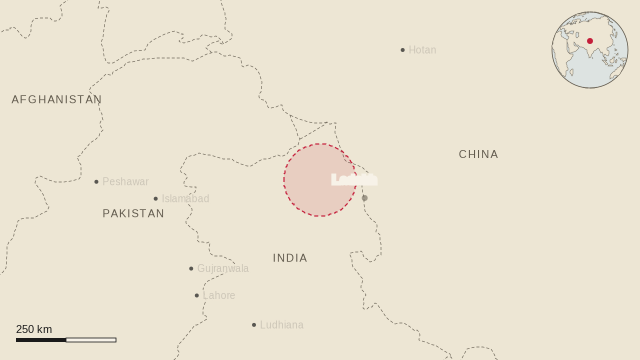
Why it matters
According to its authors, it was the first systematic genetic survey of hair attributed to unknown primates. Before it there were only two isolated analyses, which the paper calls tongue-in-cheek publications: one from 2004 on a yeti sample from Nepal and one from 2005 on a sasquatch hair from Alaska, and both had come back as a hoofed animal. Of the 30 samples that yielded DNA, none came from an unknown primate, and according to the paper the other 28 came from living mammals, often domestic ones, almost all within their normal range. The authors wrote that absence of evidence is not evidence of absence, that the survey could not refute the existence of such primates and that it had not found any evidence in their favor either.
The paper presented its method as a yardstick for any future claim, and explained what error it meant to avoid. Poor cleaning leaves human DNA on old hairs, the authors wrote, and can make a sample read as human or as an unlikely hybrid of a human and another mammal. As an example they cite a 2013 paper by M. Ketchum and others, in the journal De Novo, that proposed a hybrid of a human and another mammal. That only one hair out of 30 came back human was their argument that their protocol avoided the error.
The study's limits are in its own pages. It read a single 104-base-pair fragment of one mitochondrial gene, which does not always reach the species. For each sample, the table gives only the country or state and the creature it was attributed to; collection details appear only for the two Himalayan samples, and the paper does not say who handed them over or name the hunter. Gutiérrez and Pine asked for that story to be corroborated, and Edwards and Barnett described the Bhutan sample as a single hair. The sequences went into GenBank and voucher samples into the Heuvelmans Archive at the Lausanne museum, named after the cryptozoologist Bernard Heuvelmans, which allowed others to repeat the comparison.
The polar bear result did not last long. Within a year, the journal itself had published the objection and the correction of the match, and ZooKeys the conclusion that the fragment cannot tell the brown bear from the polar bear. Melton, Sartori and Sykes kept the link to the polar bear in their reply. The Buffalo study read the complete mitochondrial genome of the Zanskar hair and did not have the Bhutan one, so that sample rests only on the 2014 reading and the replies that disputed it.
The analysis was partly paid for by a television production company: the paper thanks Harry Marshall and Icon Films for their contribution to the costs. It is the same company that, according to the 2017 study, supplied several of its samples. Outside the Himalayas, the paper left unexplained the two Russian samples from North American species; Gutiérrez and Pine used them to point out that the paper took the stated places of origin of the Himalayan hairs for granted, and noted that the raccoon was introduced to several parts of the former Soviet Union.
Documents and sources
Documented evidence
- Sykes, Mullis, Hagenmuller, Melton and Sartori, Proceedings of the Royal Society B 281: 20140161 (received January 21, 2014, accepted March 27, August 22 issue): of 57 samples received after the May 14, 2012, press release, two that were not hair were discarded, 37 were analyzed and 30 yielded DNA; a fragment of the mitochondrial 12S gene (positions 1093–1196 of the human mitochondrial genome) was read.
- Sykes et al. 2014, Table 1 (all matches 100%): yeti, two polar bears (25025, Ladakh; 25191, Bhutan) and a serow (25092, Nepal); almasty (Russia), three horses, two brown bears, a cow, an American black bear and a raccoon; orang pendek (Sumatra), a Malayan tapir; Bigfoot (Arizona, California, Minnesota, Oregon, Texas and Washington), five American black bears, four canids, three cows, a raccoon, a sheep, a porcupine, a horse, a deer and a human.
- Sykes et al. 2014: the human sample (25072, Texas) is identical in hypervariable region 1 to the revised Cambridge Reference Sequence, of likely European maternal descent; the sequences are in GenBank (KJ155696–KJ155724 and KJ607607) and voucher samples are in the Heuvelmans Archive at the Lausanne Museum of Zoology. The paper thanks Harry Marshall and Icon Films for their contribution to the costs of analysis.
- Edwards and Barnett, Proceedings of the Royal Society B 282: 20141712 (February 7, 2015): the two Himalayan sequences are identical to that of a modern polar bear from Little Diomede, Alaska (GU573490); the base that separates them from almost all brown bears is at position 100 of the fragment, inside a run of six Cs; eight modern brown bears share it: five from Alaska's ABC Islands, one from Bulgaria, one from France and one from an unspecified place in Europe. They propose the Himalayan brown bear (Ursus arctos isabellinus).
- Melton, Sartori and Sykes, "Response to Edward and Barnett," Proceedings of the Royal Society B 282: 20142434 (February 7, 2015): they put the error down to an incomplete GenBank search, keep the link to Ursus maritimus, describe the reading as unambiguous and give the Ladakh sample an age of more than 40 years and the Bhutan sample more than 10.
- Gutiérrez and Pine, ZooKeys 487: 141–154 (March 2015): against 49 brown and 32 polar bears, the fragment has four variable positions and the complete 12S gene none that diagnoses either species; in their search, two polar bears get the best score (193) and 98 other sequences, 94 of them brown bear, the next (187). They conclude there is no reason to believe the samples came from anything other than brown bears.
Sources
- Bryan C. Sykes, Rhettman A. Mullis, Christophe Hagenmuller, Terry W. Melton and Michel Sartori, "Genetic analysis of hair samples attributed to yeti, bigfoot and other anomalous primates," Proceedings of the Royal Society B 281: 20140161 (2014) — Primary source, open access (CC BY 3.0); full text and PDF consulted in the PubMed Central open access archive (PMC4100498). The 2015 correction (282: 20150892) changes Sykes's affiliation to Wolfson College, University of Oxford.
- C. J. Edwards and R. Barnett, "Himalayan 'yeti' DNA: polar bear or DNA degradation? A comment on 'Genetic analysis of hair samples attributed to yeti' by Sykes et al. (2014)," Proceedings of the Royal Society B 282: 20141712 (2015) — Full text consulted in PubMed Central (PMC4298200).
- Terry W. Melton, Michel Sartori and Bryan C. Sykes, "Response to Edward and Barnett," Proceedings of the Royal Society B 282: 20142434 (2015) — Full text consulted in PubMed Central (PMC4298211). The title spells Edwards as "Edward."
- Eliécer E. Gutiérrez and Ronald H. Pine, "No need to replace an 'anomalous' primate (Primates) with an 'anomalous' bear (Carnivora, Ursidae)," ZooKeys 487: 141–154 (2015) — Open access (CC BY 4.0); full text consulted in Europe PMC (PMC4366689).
- Tianying Lan et al., "Evolutionary history of enigmatic bears in the Tibetan Plateau–Himalaya region and the identity of the yeti," Proceedings of the Royal Society B 284: 20171804 (2017) — Study that analyzed the Zanskar hair, possibly from the same animal as the Ladakh sample; told in its own case. Icon Films supplied samples and funded the study.
Referenced by 1 case
Related cases
Cases this case cites and cases with the same likely cause.