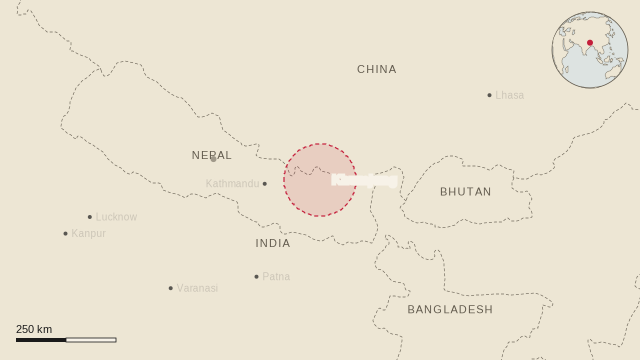
1960–1961·Khumjung, Khumbu Valley, Nepal
Hairy hominids·Yeti
Nepal.Khumjung · Hillary takes the yeti scalp abroad for testing
In late 1960, mountaineer Edmund Hillary, who was leading a scientific expedition in the Everest region, borrowed the "yeti scalp" kept at the monastery of Khumjung in Nepal: a conical cap of skin with a crest of hair. With a village elder as its guardian, he took it to experts in Chicago, London and Paris. In Paris, zoologist Bernard Heuvelmans compared its hair with that of a serow skin, a Himalayan goat-antelope, and found it identical. In January 1961 the scalp went back to Khumjung.
Tier S · SolidCryptidWhat do they mean? →
Strong evidence: a contemporary instrumental record (radar, sensor, film or photo of known provenance) that corroborates several independent witnesses.
What it was
92%ordinary cause
The most likely explanation.
- 92% ordinary cause
- 8% unexplained
See the split across the six explanations
Known cause (ordinary or hoax)92%
Unexplained8%
Separate collection: these figures do not count toward the UAP case totals. How it is split →
Cause the sources propose: ordinary cause
Record of the event
The 1961 Bombay note with Heuvelmans's letter on the Khumjung cap
Editors' note in the Journal of the Bombay Natural History Society, dated March 8, 1961, quoting the letter in which Bernard Heuvelmans changes his mind about the Khumjung yeti scalp after comparing it with a serow skin.
Read more
Three pages (261-263 of volume 58), with the three figures on the hair pattern: a quadruped's back compared with the cap, the effect of stretching the skin over a block, and the pattern before and after. The third page also carries the start of an unrelated note about a dugong. BioStor scan on archive.org, unaltered.
Source: Journal of the Bombay Natural History Society 58 (1): 261-263 (1961), BioStor copy on archive.org, under a CC BY-NC 3.0 license (non-commercial reproduction with attribution) · CC BY-NC 3.0 · open original
What happened
In the 1950s, several Buddhist monasteries in the Khumbu Valley, south of Everest, kept conical caps of skin that they used in their ceremonies and that the monks called yeti scalps. The best known were those of Pangboche and Khumjung. The Journal of the Bombay Natural History Society had published an examination of a hair from the Pangboche cap by Dr. L. A. Hausman of New Jersey. Hausman could not match it to any animal, but he said it had been dyed and that, judging by the photograph, the cap looked molded and sewn.
Zoologist Bernard Heuvelmans, who had gathered the yeti accounts in his book On the Track of Unknown Animals (London, 1958), reached the opposite conclusion. The hair on the Pangboche cap, he wrote, grew in a pattern that made it impossible for it to come from any known four-legged animal. On the back of a hoofed animal, all the hairs point backward, parallel to the midline; on the caps, the hair started parallel at the forehead, turned at a right angle and straightened again at the nape. The Khumjung cap, according to Heuvelmans, was similar.
In September 1960, the Himalayan Scientific and Mountaineering Expedition left Kathmandu under Hillary, the New Zealander who in 1953 had made the first ascent of Everest with Tenzing Norgay. World Book Encyclopedia paid for it. According to construction chief Norman Hardie, its main goal was to study the human body at high altitude over a whole winter, and the yeti search was added partly at the sponsor's request. The yeti party included Marlin Perkins, director of Chicago's Lincoln Park Zoo, biologist Larry Swan and journalist Desmond Doig of The Statesman, a Calcutta newspaper.
During the fall, that party searched the Rolwaling Valley. It followed several lines of supposed yeti tracks to shaded spots, where they kept their original shape and looked like the prints of a small animal such as a fox, according to Thomas Nevison, a doctor and physiologist on the expedition. It also bought blue bear skins from Tibetans. It then crossed into the Khumbu Valley and examined the monasteries' caps. According to the account of expedition doctor Michael Ward, Doig persuaded the elders of Khumjung to lend theirs for a limited time. A village elder would travel with it as its guardian.
That elder, the village headman, appears as Kumbo Chumbi in Ward's account and as Khunjo Chumbi in the press of the time. According to Stars and Stripes, the U.S. armed forces newspaper, he set two conditions: he would go with the cap, and it would be back in the village within a month. Hillary, Doig and Chumbi left Khumjung at the end of November to take it around the world.
On Saturday, December 10, 1960, at Tokyo's airport, Hillary told reporters that he had never believed in the snowman and that the expedition had found rational explanations for most yeti phenomena. The cap, he added, was the only piece of evidence they had not managed to explain: it was shaped like a Tibetan priest's cap, with a crest of hair, and was "a convincing sort of specimen" that people better qualified should examine. They were taking it to the natural history museum in Chicago. Chumbi, for his part, said the yeti existed. Doig told the village legend: the cap was the topknot of a female yeti that a lama had killed about 240 years earlier.
According to primatologist William C. Osman Hill, Hillary put the cap before committees of experts in Chicago, London and Paris in December 1960. He also brought a cap he had molded himself from the skin of a serow (Capricornis sumatraensis), a goat-antelope of the Himalayan forests. The hair pattern, Osman Hill wrote, was reproduced accurately, and the microscope suggested that the hairs of the two caps could come from the same species of hoofed animal or a related one.
In Paris, Hillary showed the cap to Heuvelmans. In a letter to the Bombay society, Heuvelmans said the crest of hair at once reminded him of a serow's mane, but he could not see how a piece of that animal's neck or shoulder could produce such a pattern. His friend, zoologist Ivan T. Sanderson of New York, showed him that when a skin is stretched hard over a hatmaker's block, its layers shift and the hair leans toward the pull. In that way, the original hair tracts ended up in the pattern of a tall primate's head.
The species still had to be checked. The Paris museum had no serow skin, but Heuvelmans found one at the Brussels institute, of the Sumatran subspecies rather than the Nepalese one. He compared its hairs with those of the Khumjung cap, which Hillary had given him, and of the Pangboche cap, which he already had. "They are identical," he wrote. He added that Professor Teizo Ogawa, of the anatomy department at the University of Tokyo, had studied hairs from the Pangboche, Khumjung and Namche Bazar caps under the microscope and shown that they came from the same kind of animal. The journal's editors published the letter in a note dated March 8, 1961.
In January 1961, Hillary flew back to the Khumbu for a one-day visit and left the cap and its guardian in Khumjung. According to Ward, by then the scalp had proved to be a piece of goat skin.
Where it happened
Why it matters
To Hillary himself, the Khumjung cap was the only physical evidence of the yeti that his expedition had not been able to explain in the field, and its hair pattern was Heuvelmans's argument for an unknown primate. That Heuvelmans changed his mind once he had it in hand, and explained why, closed the objection he had raised himself. The serow cap the expedition made showed, moreover, that a skin stretched over a mold reproduces the pattern.
The verdict was not unanimous. Osman Hill, in a review of the yeti evidence published in August 1961 in Oryx, the journal of London's Fauna Preservation Society, called the cap debunked but judged it hasty to settle the whole yeti question on it and Hillary's other evidence. Even on the caps, he cited a very detailed report sent to him by Marca Burns, of the textile industries department at the University of Leeds, who examined skin and hair from the Khumjung cap. The sample closely resembled the serow sample, but it was not identical. Most of the differences could occur between two individuals of the same species, though some could be explained only if the skins came from different species or genera. It did not resemble blue bear or brown bear.
Burns also found mites on both caps. Those on the serow cap belonged to a species common in ruminants, Chorioptes bovis; those on the Khumjung cap, according to Osman Hill, were very different and remained unidentified. No published version of Burns's report is known, so her objections are known only through Osman Hill's summary; nor is any published account of the Chicago and London committees' examination known. Nor is it known how caps of serow skin reached the monasteries; Osman Hill assumed it was through trade.
The expedition's sources do not always agree on names. Ward says the party saw the caps at Dingboche and Khumjung, and Nevison, in his report for the American Alpine Club's journal, attributes the result to the cap from Thyangboche, another monastery in the valley; but the one that traveled, according to the Bombay note, Ward, Hardie and Osman Hill, was the Khumjung cap. Samples of supposed yetis analyzed with DNA more than fifty years later also turned out to be known animals, bears and a serow (↗ Yeti and Bigfoot hairs and ↗ Yeti).
Documents and sources
Documented evidence
- Editors' note, "'Scalp' of the Abominable Snowman," Journal of the Bombay Natural History Society 58 (1): 261-263, dated Bombay, March 8, 1961: Hillary borrowed the Khumjung cap in late 1960 and took it to Heuvelmans; the note quotes Heuvelmans's letter, which compared hairs from the cap with those of a Sumatran serow skin at the Brussels institute and with those of the Pangboche cap: "They are identical." It includes three figures on the hair pattern.
- The same letter: Ivan T. Sanderson showed him that a skin stretched over a hatmaker's block shifts its layers and tilts the hair toward the pull; Teizo Ogawa of the University of Tokyo studied hairs from the Pangboche, Khumjung and Namche Bazar caps (the last of which, the note says, appeared to be a fake) under the microscope and found they came from the same kind of animal.
- Stars and Stripes, December 11, 1960 (Paul Rogers, from Tokyo): Saturday press conference at the airport; Hillary says the cap is the only evidence without a rational explanation and that it is going to the natural history museum in Chicago; the village headman, Khunjo Chumbi, set as conditions that he go with it and that it return within a month.
- W. C. Osman Hill, "Abominable Snowmen: The Present Position," Oryx 6 (2): 86-98 (August 1961), pp. 93-94: committees in Chicago, London and Paris (December 1960); the serow cap molded by Hillary reproduced the hair pattern. He summarizes the report Marca Burns (University of Leeds) sent him: similar to serow without being identical, differences typical of another species or genus, slight similarities to yak, symmetrically arranged pigment granules in some hairs, a primate trait absent in the serow, and unidentified mites, different from the Chorioptes bovis on the serow cap.
- Michael Ward, "Himalayan Scientific Expedition, 1960-61," Alpine Journal 1961, pp. 343-344: investigating the yeti legend is the first of the expedition's three main objects (Hardie gives physiology as the main one); Doig persuaded the Khumjung elders; an elder, Kumbo Chumbi, traveled as guardian; in January 1961 Hillary left the cap and its guardian in Khumjung, by which time it had proved to be "a piece of goat skin."
Show 2 more facts
- Norman Hardie, "Himalayan Scientific and Mountaineering Expedition, 1960-61," Himalayan Journal 22: the yeti party left Kathmandu on September 13, 1960, for the Rolwaling; the search was added partly at World Book's request; Hillary left on a world tour with the Khumjung cap.
- Thomas O. Nevison, preliminary report in the American Alpine Journal 1961: tracks followed into the shade looked like those of a small animal such as a fox; he attributes to the Thyangboche cap the finding of goat fur stretched while fresh, and to the "yeti fur" brought back by Hillary, the Tibetan blue bear.
Sources
- "'Scalp' of the Abominable Snowman," editors' note (H. Santapau and H. Abdulali), Journal of the Bombay Natural History Society 58 (1): 261-263, March 8, 1961 — Primary source: quotes Heuvelmans's letter with his hair comparison. Text read in the scan.
- W. C. Osman Hill, "Abominable Snowmen: The Present Position," Oryx 6 (2): 86-98, August 1961 — Pp. 93-94: the Chicago, London and Paris committees, Hillary's serow cap and the summary of the report Marca Burns sent him.
- Paul Rogers, "'Yeti scalp' fails to convince Hillary," Stars and Stripes, December 11, 1960 — Contemporary press: the Tokyo press conference and the conditions of the loan.
- Michael Ward, "Himalayan Scientific Expedition, 1960-61," Alpine Journal 1961, pp. 343-364 — Account by an expedition member: the loan, the guardian and the return in January 1961 (pp. 343-344).
- Norman Hardie, "Himalayan Scientific and Mountaineering Expedition, 1960-61," Himalayan Journal 22 — Account by the construction chief: the expedition's goals, the yeti party's members and the tour with the cap.
- Thomas O. Nevison, "The 1960-61 Himalayan Scientific and Mountaineering Expedition, Mount Everest and Makalu Region, Preliminary Report," American Alpine Journal 1961 — Report by an expedition member; calls the examined cap the "Thyangboche" one.
Related cases
Cases this case cites and cases with the same likely cause.