1966–1967·Point Pleasant, West Virginia
Winged humanoids·Mothman
United States.Mothman · Point Pleasant residents see a winged creature
Between November 1966 and November 1967, residents of Point Pleasant, West Virginia, said they saw a large gray winged creature with red eyes, mostly near the “TNT Area,” a former explosives complex. On November 15, 1966, two couples said it chased their car; a sheriff's deputy went back with them and found nothing. A biologist put it down to a crane in 1966, and researcher Joe Nickell to a barred owl. On December 15, 1967, the Silver Bridge collapsed, killing 46 people after a corroded link cracked; the timing fused the two events into the Mothman legend.
Tier B · IndicativeCryptidWhat do they mean? →
Limited evidence: it falls short of what Tier A requires. Any one of these is enough: a single testimony (or several witnesses who saw it together), testimony gathered years later, or an account without contemporary primary documentation.
What it was
78%ordinary cause
The most likely explanation.
- 78% ordinary cause
- 2% other known cause
- 20% unexplained
See the split across the six explanations
Known cause (ordinary or hoax)80%
Unexplained20%
Separate collection: these figures do not count toward the UAP case totals. How it is split →
Cause the sources propose: ordinary cause
What happened
The sightings began in November 1966 around Point Pleasant, a small West Virginia town on the banks of the Ohio River. According to the first report by Mary Hyre, the Point Pleasant correspondent, witnesses described a gray winged figure as tall as a man (about six feet, 1.8 m), with large widely spaced red eyes and a big wingspan, able to rise almost vertically and to follow a car at high speed. Many sightings were near the "TNT Area," a former World War II explosives manufacturing and storage complex, full of abandoned bunkers and surrounded by woods and marshland that is now a wildlife reserve.
The most cited episode occurred on November 15, 1966, when two young couples, Roger and Linda Scarberry and Steve Mallette and his wife, were driving through the area and said they saw a winged creature beside the road and were chased by it. According to Hyre, the four fled toward Point Pleasant along Route 62 at 100 miles an hour (about 160 km/h) with the creature behind them. According to researcher John Keel, who recorded it in Flying Saucer Review in 1968, the four said the creature flew over their car without flapping its wings; they reported it to the police, and Deputy Millard Halstead went back to the spot with them without finding it, although his radio then gave out, he said later, a strange sound "like a speeded-up phonograph."
Keel visited Point Pleasant five times from December 1966 and interviewed many witnesses. He tabulated 26 sightings between September 1966 and November 1967: the first, on September 1, in Scott, Mississippi, before the Point Pleasant wave, and the rest in West Virginia, Ohio and Kentucky; ten were near the "TNT Area," and wrote that all the witnesses agreed the wings did not flap. One of the witnesses, Thomas Ury, described it on November 25, 1966 as about six feet (1.8 m) long with an eight-to-ten-foot (2.4 to 3 m) wingspan.
Keel also recorded that in late December 1966 a Gallipolis Ferry farmer shot a snowy owl two feet (60 cm) tall with a five-foot (1.5 m) wingspan, and that the witnesses who went to see it said it in no way resembled what they had seen. He also wrote that in three cases in his table the witnesses may have seen "some kind of huge and unclassified bird"; in one of them, on December 4, 1966, five pilots at the Gallipolis airport saw a giant "bird" that at first looked like a plane to them.
On December 15, 1967, the Silver Bridge, a chain suspension bridge linking Point Pleasant with Kanauga (Ohio), collapsed without warning during rush hour: 31 of the 37 vehicles on it fell, 24 into the river and seven onto the bank on the Ohio side, and 46 people died. The National Transportation Safety Board (NTSB) report, adopted on December 16, 1970, determined a structural cause: the fracture of a single link of the chain, eyebar 330, by stress-corrosion cracking, a flaw that the routine inspections of the era could not detect.
The closeness between the sightings and the tragedy led some people to interpret the creature as a harbinger of the disaster. Keel concluded in 1968 that the creature was tied to UFOs "in some very special and terrifying way," and his book "The Mothman Prophecies" (1975) tied the episode to sightings of lights, to "men in black" and to omens. According to Daniel Reed (Skeptical Inquirer, 2022), some say the creature caused the collapse and others that it came to warn of it. Point Pleasant today has a statue of Mothman and holds an annual festival.
Where it happened
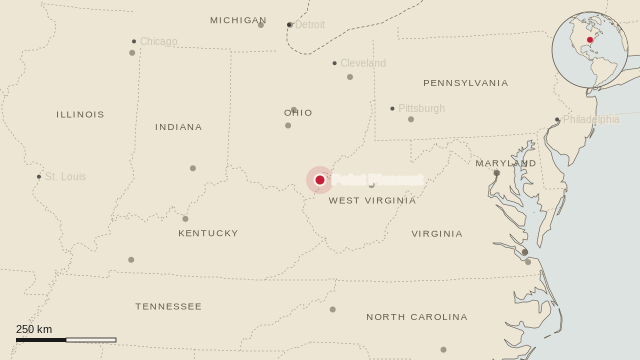
Why it matters
Every ordinary explanation proposed for the sightings is a bird. In 1966, biologist Robert L. Smith of West Virginia University told the Associated Press that the descriptions fit a sandhill crane, with a wingspan of more than seven feet (2.1 m) and reddish skin around the eyes. According to Reed, Ohio University officials said at the time that none had ever been seen in the region (Athens Messenger, November 20, 1966), and a 2018 article in Audubon magazine notes that the species isn't native to West Virginia and that the witnesses described a creature with no neck.
Reed found that the claim that none had ever been seen in the region was inaccurate: the GBIF database, which gathers species records, holds 51 sandhill crane records within 60 miles (about 97 km) of Point Pleasant, although the species does not usually stop in the area, and many more of great blue heron. Reed considers the heron more likely.
Joe Nickell, an investigator with the Committee for Skeptical Inquiry, attributes the sightings to barred owls, Audubon magazine reports. A healthy population of the species lives in the reserve that now occupies the "TNT Area"; its eye reflects an intense red in headlights and its flight is silent. Nickell also points out that at night it is very hard to judge the size of something at an unknown distance: if you misjudge the distance, you misjudge the height by the same proportion. On the red eyes, Reed cites a 2020 Skeptical Inquirer article by Benjamin Radford: of nearly a dozen people connected to the case, only one mentions glowing red eyes, and secondhand, from her father. That count clashes with Hyre's first report, of November 1966, whose witnesses already spoke of large red eyes.
Nothing in the record ties the creature to the bridge: Don Karol, an NTSB investigator, wrote in 2017 that no evidence was ever found connecting Mothman to the collapse. No photograph or physical remains are known either: the account rests on testimony of the time and on press coverage.
Documents and sources
Primary documents
NTSB-HAR-71-1 · the Silver Bridge collapse report (extract)
Highway accident report by the U.S. National Transportation Safety Board on the collapse of the US-35 bridge between Point Pleasant (West Virginia) and Kanauga (Ohio), adopted on December 16, 1970.
Read more
The extract gathers the cover, the synopsis (p. 9) and the cause section (p. 126). It establishes that the bridge fell at about 5 p.m. on December 15, 1967, with 46 dead; that 31 of the 37 vehicles fell with it, 24 into the Ohio River and 7 onto the Ohio shore; and that the cause was a cleavage fracture in the eye of eyebar 330 from the joint action of stress corrosion and corrosion fatigue, a flaw inaccessible to visual inspection. It does not mention any sightings.
National Transportation Safety Board, NTSB-HAR-71-1 (1970), ntsb.gov · Public domain (US Government work) · open original
John A. Keel, 'West Virginia's Enigmatic "Bird"' · Flying Saucer Review 14(4), 1968
Special report by John A. Keel in Flying Saucer Review (vol. 14, no. 4, July-August 1968; file 80.FSR in the collection), written after five visits to Point Pleasant from December 1966.
Read more
It tabulates 26 sightings between November 1966 and November 1967, ten of them near the "TNT Area," and recounts the Scarberry and Mallette case of November 15, 1966, Deputy Halstead's radio and Thomas Ury's sighting of November 25. It says that in three cases (nos. 7, 11 and 15) the witnesses may have seen a "huge and unclassified bird," perhaps brought into the area "to spread confusion," and says the witnesses denied any resemblance to the snowy owl shot at Gallipolis Ferry. Keel ties it to UFOs and the "Men in Black."
Flying Saucer Review 14(4), July-August 1968 (archive.org) · view source
Documented evidence
- First report by Mary Hyre (November 1966, clipping reproduced in Fortean Times 156) and John Keel's interviews from December 1966, who tabulated 26 sightings through November 1967.
- Testimony of November 15, 1966 from two couples who say the creature chased them near the "TNT Area"; Deputy Millard Halstead went back to the spot with them and found nothing.
- Silver Bridge collapse on December 15, 1967, with 46 dead.
- Report NTSB-HAR-71-1 (1970): fracture of "eyebar 330" by stress corrosion and corrosion fatigue; it does not mention any sightings.
- Proposed explanations: sandhill crane (Robert L. Smith, 1966), barred owl (Joe Nickell), a heron (Mason County Sheriff George Johnson in 1966, according to Reed) and great blue heron (Daniel Reed, 2022).
- The sources cited record no photograph or physical remains of the creature. According to Audubon (2018), some sightings were "the product of likely hoaxes," and Reed (2022) does not rule out deliberate lies or embellishment in some accounts.
Sources
- Wikipedia — Mothman
- Wikipedia — Silver Bridge (collapse and eyebar-330 investigation)
- NTSB Safety Compass — 'The Silver Bridge Collapse: Don't Blame the Mothman!' (2017)
- Asher Elbein, «Is the Mothman of West Virginia an Owl?», Audubon (26 oct 2018) — Covers Joe Nickell's barred-owl hypothesis and Robert L. Smith's sandhill-crane hypothesis (1966).
- AP, 'Monster Bird With Red Eyes May Be Crane', Gettysburg Times (Dec 1, 1966) — Biologist Robert L. Smith's sandhill-crane hypothesis.
- Daniel Reed, 'The Mothman and the Crane: A Contemporary Perspective', Skeptical Inquirer 46(4), Jul-Aug 2022, pp. 52-56 — Proposes a great blue heron where no eyeshine was seen.
- NTSB — Highway Accident Report «Collapse of U.S. 35 Highway Bridge, Point Pleasant, West Virginia, December 15, 1967» (NTSB-HAR-71-1, 1970) — Final report: fracture of eyebar 330 from internal cracks undetectable without disassembly.
- John A. Keel, «West Virginia's Enigmatic "Bird"», Flying Saucer Review 14(4), julio-agosto 1968 — Contemporary field report: witness interviews and a table of 26 sightings between November 1966 and November 1967.
- Mary Hyre, «Winged, Red-Eyed 'Thing' Chases Point Couples Across Countryside» (noviembre de 1966), recorte reproducido en Fortean Times 156 (marzo 2002) — Press clipping of the time: «about six feet tall with wings», red eyes and a 100 mph chase along Route 62.
Entity form (1)
Context (not images of the event)
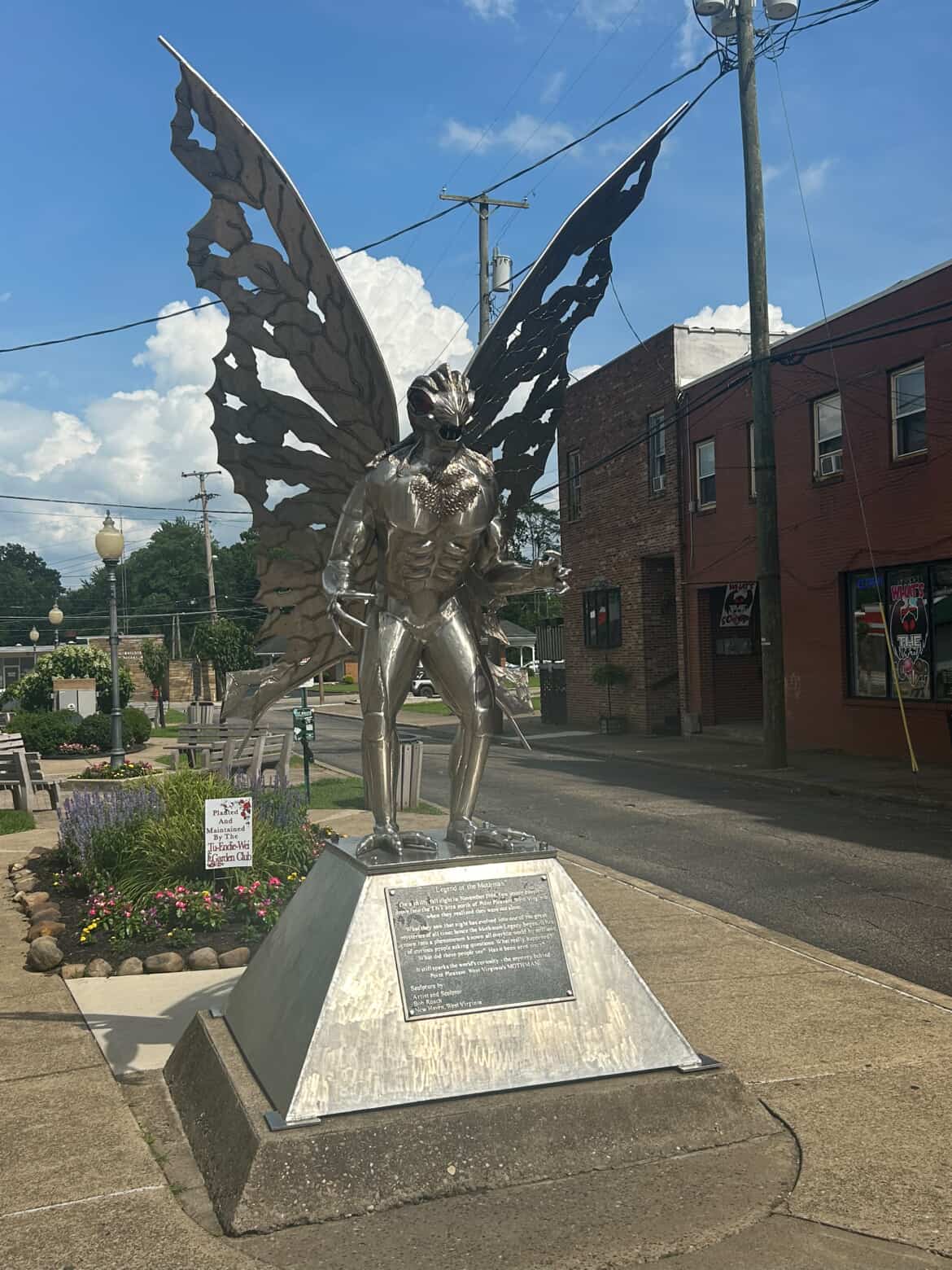
Context · the Mothman statue in Point Pleasant (West Virginia)
Mothman Statue 2025.jpg · Wikimedia Commons · CC BY-SA 4.0 · open original
Referenced by 1 case