1948·Takahē Valley, Murchison Mountains, Fiordland, New Zealand
Lazarus taxa·Takahē
New Zealand.Takahē · a doctor and three friends find a bird thought extinct
On November 20, 1948, Invercargill doctor Geoffrey Orbell and three companions saw three takahē, a large flightless bird, beside a lake in the Murchison Mountains, west of Lake Te Anau, New Zealand. They caught two, photographed them and let them go. There had been no confirmed record of the species since 1898. The government closed the area to the public, and in January and August 1949 two scientific expeditions saw the birds again; the first found a second colony.
Tier A · AcceptableCryptidWhat do they mean? →
Institutional evidence: several identified independent witnesses, or contemporary official documentation, without an instrumental record to corroborate them.
What it was
98%real species, now described
The most likely explanation.
- 98% real species, now described
- 1% other known cause
- 1% unexplained
See the split across the six explanations
Known cause (ordinary, hoax or species now described)99%
Unexplained1%
Separate collection: these figures do not count toward the UAP case totals. How it is split →
What happened
The takahē is a large flightless bird from New Zealand, a member of the rail family. According to a review published in 1974 by biologist Brian Reid in Notornis, the journal of the Ornithological Society of New Zealand, only four live birds were known before 1948, all caught in the southwest of the South Island: at Dusky Sound in 1849, at Deas Cove in 1851, east of the Whitestone River in 1879 and on the shore of the Middle Fiord of Lake Te Anau in 1898. Between 1898 and 1948 there was no confirmed record, and Reid writes that the species was considered "officially" extinct, with the quotation marks in the original, although hunters and explorers kept reporting occasional sightings.
Geoffrey Orbell was a doctor in Invercargill, at the southern tip of the island. Ornithologist Graham Turbott, of the Auckland Museum, wrote in 1951 that Orbell made two visits of discovery to the area, on April 11 and November 20, 1948. According to later accounts by the Department of Conservation and the Otago Daily Times, in April Orbell went deer hunting in the Murchison Mountains, west of Lake Te Anau, with his friends Neil McCrostie and Rex Watson. Beside a lake he heard the call of a bird he did not recognize and saw unusual footprints in the sand, but had no time to follow them. Reid also records that the same month a deer-hunting party heard strange calls in the Snag Burn, without saying whether it was Orbell's.
Orbell went back in November. Joan Telfer, Rex Watson's girlfriend and later his wife, published her account in June 1949 in the women's magazine The Mirror, and the Otago Daily Times quoted extracts in 2013. According to Telfer, on November 19 Orbell, McCrostie, Watson and she left Invercargill, and early the next morning they went up Lake Te Anau by boat. According to the Otago Daily Times and the Department of Conservation, they caught the birds with a net. "Only 9.30am and two Notornis had been captured," she wrote. The commotion flushed a third takahē, which they could not catch.
Watson took photographs with his box camera, and Orbell filmed the birds with a movie camera and a telephoto lens. The Ornithological Society's bulletin, New Zealand Bird Notes, summed it up in January 1949: Orbell's party saw three birds and released the two it caught after photographing them. The valley is now called Takahē Valley, and the lake, Lake Orbell. According to the Department of Conservation's page, which reproduces the clipping, the Otago Daily Times reported on November 22 that a bird believed extinct had been found near Te Anau.
The government acted at once. According to the January bulletin, it set aside a sanctuary of 400,000 acres where dogs and guns were banned and a permit was needed to enter, with severe penalties for anyone who disturbed the birds. The review of Falla's paper in the same bulletin, in July 1949, gave another figure: 436,000 acres of Fiordland National Park closed to the public except by special permit. Neither text explains the difference.
In January 1949, Orbell returned with ornithologist Robert Falla, of the Dominion Museum in Wellington, the national museum. According to New Zealand Bird Notes' review of the paper Falla published in May in the Australian journal Emu, the birds lived in about 500 acres, the basin of a valley some 2,000 feet above the level of Lake Te Anau. They ate the seeds of an alpine grass, the tender bases of sedges and the stalks of a spiny plant. They nested on the ground between tussocks, and the team measured an egg of 73.5 by 48.3 millimeters. Turbott adds that this expedition found a second colony in the neighboring Point Burn valley.
In August 1949, Turbott climbed to the valley in midwinter with two men from the Department of Internal Affairs, field officer K. H. Miers and biologist Gordon Williams. They spent seven days at the camp, with the lake frozen and up to two feet of snow, saw takahē and found grass whose leaf bases the birds had eaten. Orbell had gone up on August 13 and counted two birds in Takahē Valley and five in the Point Burn valley.
Where it happened

Why it matters
The takahē is a Lazarus taxon, a species given up for lost that turns up alive. What sets this case apart from the hunters' rumors that came before it is that the find left proof that could be checked: birds caught and photographed, a film, and within months two scientific expeditions, with a national museum and the state wildlife service, that saw them again, described their habitat and published their data in ornithology journals.
The word "extinct" needs qualifying. Reid pointed out in 1974 that ornithologist W. R. B. Oliver, in his 1930 work, never hinted that the takahē had died out, although none had been caught for more than 30 years, and that Reid himself had found no other reference before the rediscovery that said so. He quoted local historian F. G. Hall-Jones: "No one who gave any thought to Notornis believed the bird to be extinct," and calling the species extinct in 1948 was, in Hall-Jones's view, newspaper sensationalism. Reid also records that explorer Les Murrell told wildlife staff at Te Anau, days after the find, that he had known of takahē in the upper Freeman Burn for at least 20 years and had kept quiet about it.
Nor was the valley unknown to the Māori. According to Reid, ethnographer Herries Beattie identified it with Kohaka-Takahea, the legendary nesting place of the takahē, and historian Hall-Jones with Te Wai-o-pani. In 1949, Miers found remains of Māori occupation under rock shelters in the valley, which radiocarbon dated to around 1720, give or take 60 years.
The find changed the bird's protection before anyone knew how many were left. In 1949 Falla estimated about 100 birds in the two valleys, a figure the paper says may be on the high side. Turbott wrote in 1951 that the summer population in the area was estimated at fewer than 20 birds, with five pairs established in the 1949-50 breeding season. The Department of Conservation now says early researchers put the number at between 80 and 500. Falla also noted that stoats and deer were present in the area, and, according to the review of his paper, Internal Affairs officers already had a plan under way to ease the pressure from predators. Later accounts agree on the four names in the November party, although the 1949 bulletin speaks only of "Dr. Orbell and party."
Documents and sources
Documented evidence
- New Zealand Bird Notes, vol. 3, no. 4 (January 1949), p. 81, "Rediscovery of Notornis": on November 20, 1948, Dr. G. B. Orbell of Invercargill and party rediscovered the takahē in the Lake Te Anau region; they saw three birds and released the two caught after photographing them. The government set aside a 400,000-acre sanctuary, with no dogs or guns and entry by permit.
- New Zealand Bird Notes, vol. 3, no. 6 (published July 1, 1949), pp. 167-168: review of R. A. Falla, "Notornis Rediscovered," Emu 48 (May 1949), pp. 316-322. Habitat of about 500 acres some 2,000 feet above Lake Te Anau; egg of 73.5 × 48.3 mm; estimate of 100 birds in two valleys, "may be on the high side"; stoats and deer present; 436,000 acres of the national park closed except by special permit.
- E. G. Turbott, "Winter observations on Notornis in 1949," Notornis 4(5) (1951), pp. 107-113: dates Orbell's visits of discovery to April 11 and November 20, 1948; the January 1949 expedition with Falla found a second colony in the Point Burn; the August 1949 one, with K. H. Miers and G. R. Williams of Internal Affairs, observed birds in the snow; Orbell saw seven birds on August 13. Turbott puts the summer population at fewer than 20 birds, with five pairs established in the 1949-50 breeding season.
- Brian Reid, "Sightings and records of the takahe (Notornis mantelli) prior to its 'official rediscovery' by Dr G. B. Orbell in 1948," Notornis 21(4) (December 1974), pp. 277-295: four live birds recorded before 1948 (1849, 1851, 1879 and 1898), no confirmed record between 1898 and 1948, and unconfirmed sightings during that period. Reid quotes Minister of Internal Affairs W. E. Parry on November 26, 1937: for a species believed extinct, "the best course is not to disclose any different information."
- Joan Telfer (later Watson), account published in The Mirror in June 1949, quoted by the Otago Daily Times (2013): the party of Orbell, McCrostie, Watson and Telfer left Invercargill on November 19; by 9:30 a.m. on the 20th they had caught two birds, and a third got away.
- E. G. Turbott, "A selected bibliography on Notornis," Notornis 4(5) (1951), pp. 115-117: lists the 1948-1951 writings after the rediscovery, among them a note by Falla in New Zealand Science Review (1948) and articles by Orbell in The Illustrated London News (January and February 1949).
Sources
- "Rediscovery of Notornis," New Zealand Bird Notes (bulletin of the Ornithological Society of New Zealand), vol. 3, no. 4, January 1949, p. 81 — Period document, in the Birds New Zealand archive; the scan includes the cover, the contents and the first page of the note.
- Review of R. A. Falla, "Notornis Rediscovered" (Emu 48, May 1949, pp. 316-322), New Zealand Bird Notes, vol. 3, no. 6, July 1, 1949, pp. 167-168 — Falla's Emu paper could not be opened (the publisher returns 403); its data are taken from this period review.
- E. G. Turbott, "Winter observations on Notornis in 1949," Notornis 4(5) (1951), pp. 107-113 and plates
- E. G. Turbott, "A selected bibliography on Notornis," Notornis 4(5) (1951), pp. 115-117
- Brian Reid, "Sightings and records of the takahe (Notornis mantelli) prior to its 'official rediscovery' by Dr G. B. Orbell in 1948," Notornis 21(4) (1974), pp. 277-295
- Allison Rudd, "Takahe rediscovery media sensation," Otago Daily Times (January 24, 2013) — Quotes extracts from Joan Telfer's account published in The Mirror in June 1949; the original was not consulted.
- New Zealand Department of Conservation, "The takahē story" — Present-day context: the April 1948 trip, after deer and also takahē, the net, Orbell's film, the Otago Daily Times clipping of November 22, 1948, and the estimate of 80 to 500 birds.
- Alina Suchanski, "Call of the wild, call of the takahe," Otago Daily Times (October 28, 2018) — Context: the April 1948 hunting trip with McCrostie and Watson, the call and the footprints.
Context (not images of the event)
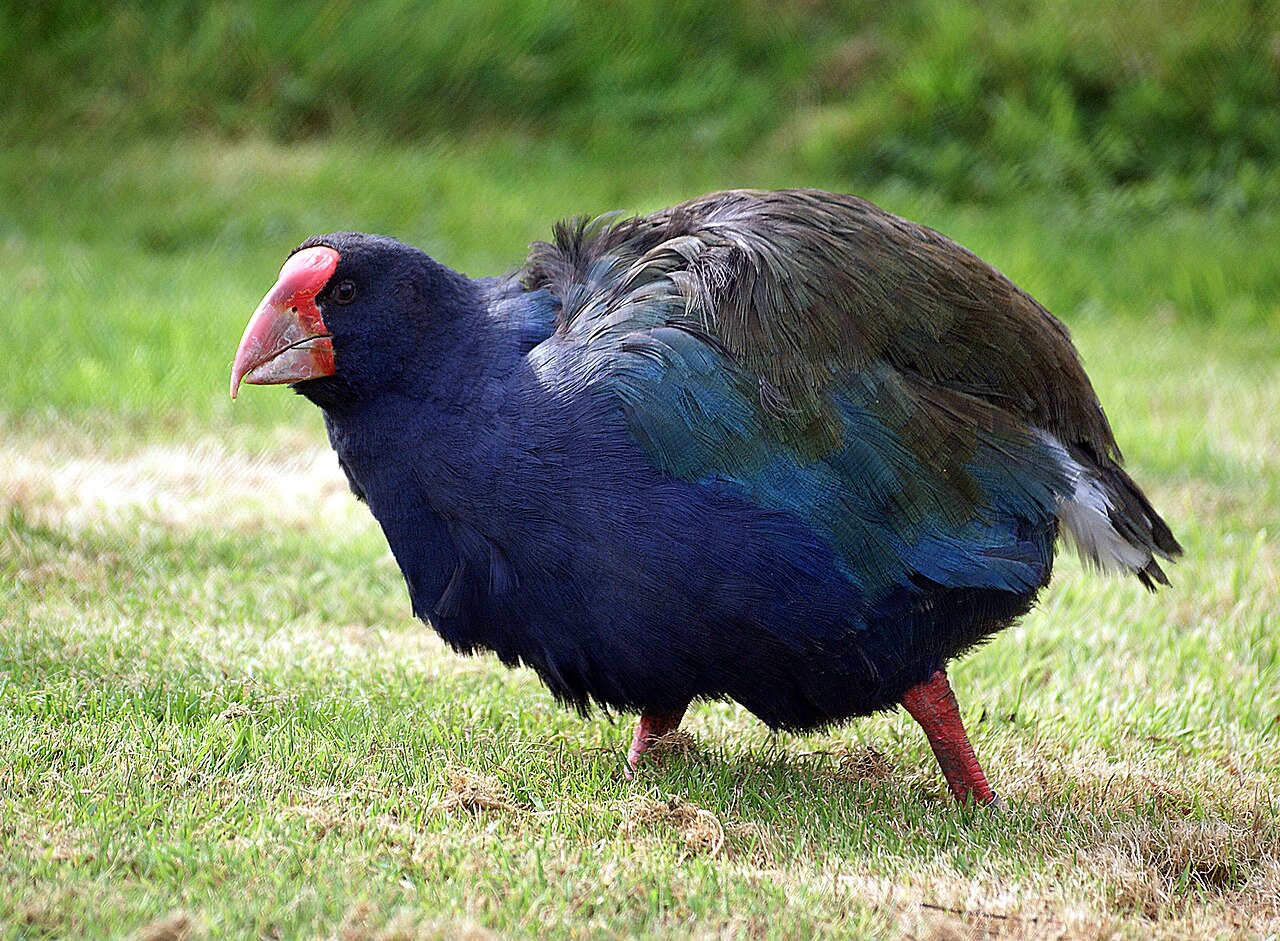
Context · an adult takahē (Porphyrio hochstetteri), photographed in 2011
An adult takahē, with the species' blue and green plumage and red bill. The photo dates from 2011, not from the rediscovery: the 1948 photographs are held by the Alexander Turnbull Library, whose permission is needed to reproduce them. Photo by Bernard Spragg on Wikimedia Commons, dedicated to the public domain (CC0).
South Island Takahe. (Porphyrio hochstetteri) (8177479445).jpg · Bernard Spragg · Wikimedia Commons · CC0 · open original
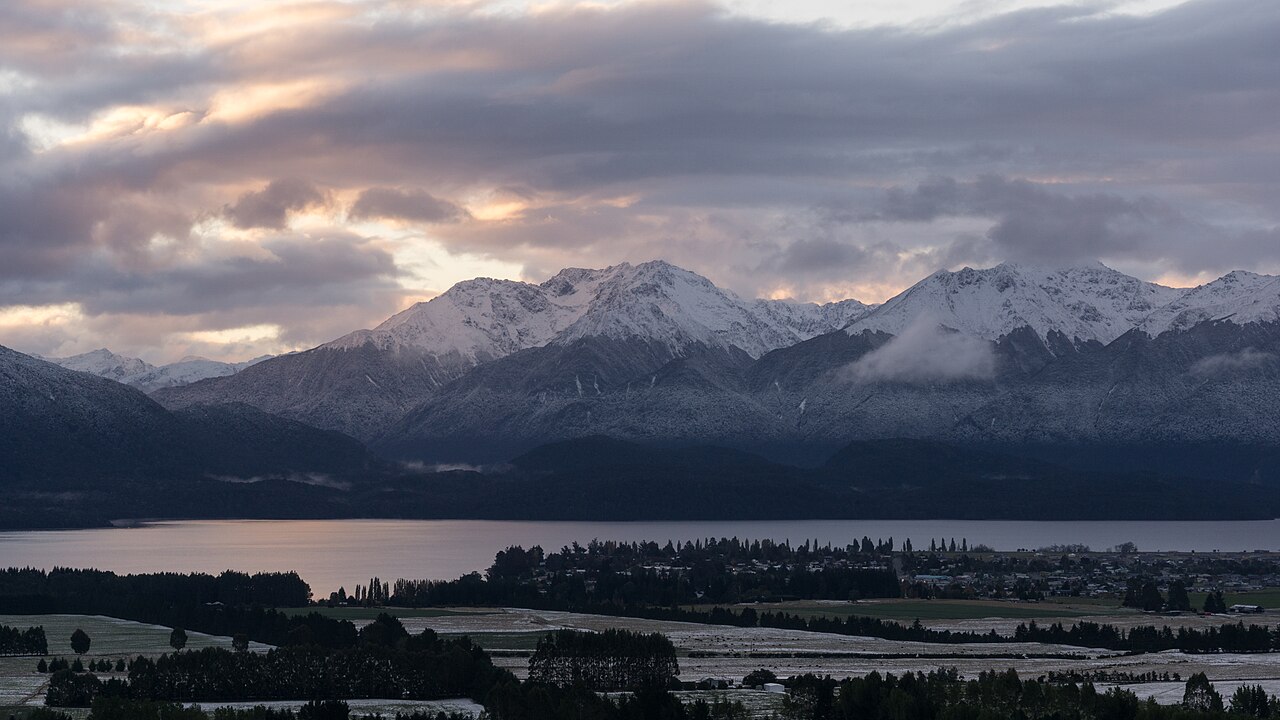
Context · Lake Te Anau with the Murchison Mountains behind
Lake Te Anau seen from the town of the same name, with the snow-covered Murchison Mountains behind; Takahē Valley lies within that range, across the lake. Photo by Tim Burgess (2015) on Wikimedia Commons, under a CC BY-SA 4.0 license; hosted recompressed, with no other changes.
Te Anau and Murchison Mountains.jpg · Tim Burgess · Wikimedia Commons · CC BY-SA 4.0 · open original