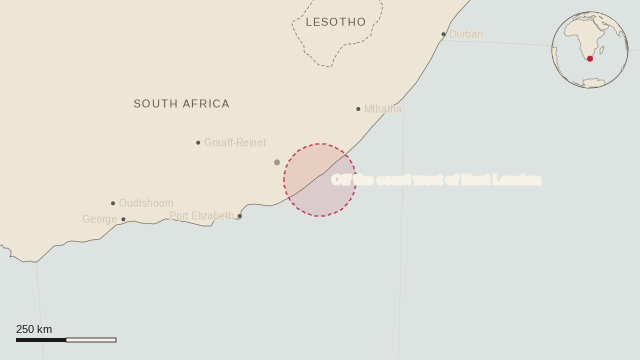
1938·Off the coast west of East London, South Africa
Lazarus taxa·Coelacanth
South Africa.Coelacanth · a trawl net brings up a fish thought long extinct
On December 22, 1938, a trawl net brought up a live fish about 1.5 meters long from some 40 fathoms, a few miles west of East London, South Africa. It died soon after, and the curator of the town's museum, Courtenay-Latimer, sent a sketch to the fish specialist J. L. B. Smith. Smith identified it as a coelacanth, a group known only from fossils, and described it in Nature in March 1939 under the name Latimeria chalumnae. The body had been thrown away: the mounted skin, the skull and a few bones were left.
Tier S · SolidCryptidWhat do they mean? →
Strong evidence: a contemporary instrumental record (radar, sensor, film or photo of known provenance) that corroborates several independent witnesses.
What it was
98%real species, now described
The most likely explanation.
- 98% real species, now described
- 1% other known cause
- 1% unexplained
See the split across the six explanations
Known cause (ordinary, hoax or species now described)99%
Unexplained1%
Separate collection: these figures do not count toward the UAP case totals. How it is split →
Cause the sources propose: real species, now described
Record of the event
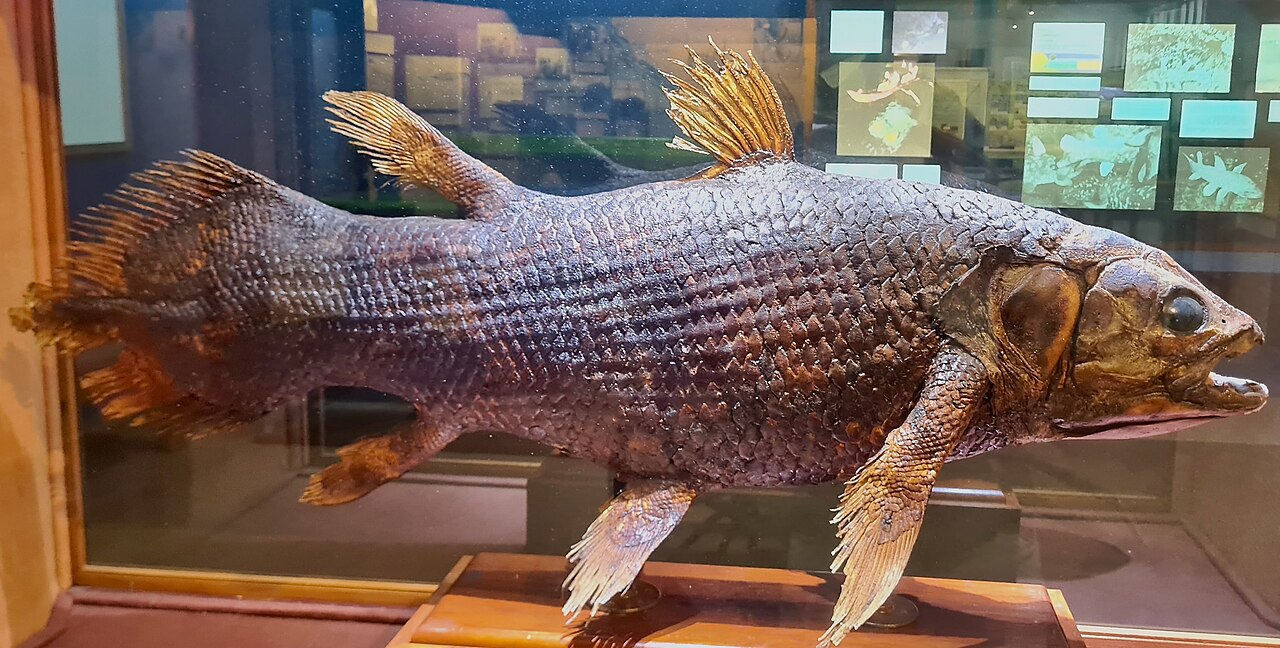
The coelacanth caught in 1938, mounted, at the East London Museum (2025 photograph)
The specimen Smith described in 1939, as it is displayed today in a case at the East London Museum: the skin mounted by the taxidermist, with the three-lobed tail, the lobe-shaped fins and the scales that Smith compared with those of fossil coelacanths.
Read more
Photograph by Bernard Dupont, taken January 27, 2025, published on Wikimedia Commons as the species' holotype, under a CC BY-SA 2.0 license; hosted reduced to 1,280 pixels wide, with no other changes.
Bernard Dupont, "West Indian Ocean Coelacanth (Latimeria chalumnae) holotype," Wikimedia Commons (from Flickr), CC BY-SA 2.0 · CC BY-SA 2.0 · open original
What happened
On December 22, 1938, a trawl net brought up a strange fish from about 40 fathoms (some 73 meters), a few miles west of East London, a port on the southeast coast of South Africa. According to the account later published by J. L. B. Smith, a fish specialist at Rhodes University College in Grahamstown, the fish was alive when it was caught. It died soon after and was handed over to Courtenay-Latimer, the curator of the East London Museum.
Courtenay-Latimer wrote to Smith and sent him a sketch and brief notes on the specimen. Because of the seasonal disruption of the mail, the letter did not reach him at Knysna, about 400 miles (some 640 kilometers) away, until ten days later. According to Smith, the sketch and notes were enough to see that the fish belonged to a type thought long extinct. He telephoned the museum at once and learned that, since the museum had no means to preserve it, the rotting body had been thrown away beyond recovery and a local taxidermist had mounted the skin.
Without the body, Smith questioned Courtenay-Latimer and the taxidermist separately and at length, since both had looked closely at the carcass, and got at least some definite information about the missing parts. The skull, the last part of the backbone and part of the bones that support the pectoral fins had survived. According to Smith, the specimen was 1,500 millimeters long and weighed 127 pounds (about 58 kilograms) when caught. It was a bright metallic blue, which faded to brown once preserved. The skeleton was made of cartilage, the backbone seemed to be a tube and the whole fish was extraordinarily oily.
On March 18, 1939, Smith announced the find in the British scientific journal Nature, in a two-page article titled "A Living Fish of Mesozoic Type," with a photograph of the mounted specimen. He presented it as a crossopterygian, a lobe-finned fish, of a type thought to have died out by the end of the Mesozoic. He placed it in the coelacanth family and linked it to Macropoma, a fossil genus from that era: the tail, the lobe-shaped fins, the scales with small bumps and the bones of the mouth and skull were all typical of the group.
Smith also noted what set it apart from known coelacanths. It had small spiracles, openings in the head, and a lateral line that ran to the end of the tail. The pectoral fins grew from a pronounced stalk, the armor on the skull was reduced and next to the operculum, the gill cover, there were two small, heavily ornamented bones. He expected other specialists to want a new family for it, or even a new order, but he kept it among the coelacanths: some of those fish, he noted, had changed little from the Devonian to the Cretaceous. He proposed the name Latimeria chalumnae, a new genus and species, and promised a full description in the Transactions of the Royal Society of South Africa.
The same issue of Nature ran an unsigned note on the find in its news section, calling it an event of outstanding importance. The note accepted the family Smith proposed, though in some respects it saw the specimen as closer to genera of the early Mesozoic, such as Undina, than to the later coelacanths of the Macropoma type. It recalled that no fossils of the family were known from after the Cretaceous, and regretted that throwing away the body left the study far from complete. It remained to be seen, it said, whether the bony swim bladder of the fossils had been observed in the living fish, and to confirm the nostrils that seemed to show in the photograph.
Smith's article also records a story that rests only on the word of the man who told it. An amateur angler from East London, whom Smith describes as a responsible citizen, looked at the mounted specimen and said that about five years earlier he had found exactly such a fish, though considerably larger, half rotten on a lonely beach east of the town. When he came back with help, the tide had taken it. Smith flagged the "larger" with a "sic" and used the story, along with the fact that the fish was alive when caught, to argue that another specimen was not so unlikely.
The second came fourteen years later and far from South Africa. In "The Second Cœlacanth," published in Nature on January 17, 1953, Smith wrote that there was overwhelming evidence the 1938 fish was a stray, and that he had been searching for a complete specimen ever since. He had a leaflet printed in English, French and Portuguese with a photograph of the coelacanth and a reward of 100 pounds for each of the first two specimens. With the help of the authorities, thousands were handed out along the coasts of the western Indian Ocean, and for six years Smith and his wife traveled much of the East African coast talking about the fish.
On the evening of December 20, 1952, a fisherman on the island of Anjouan, in the Comoro archipelago, caught one on a hook at about 8 fathoms, over rocky ground some 200 meters offshore from the village of Domoni. The next day at the market, a man who recognized it from the leaflet kept it from being cut up, and it was carried across the island to Mutsamudu, where Captain E. E. Hunt was, and handed over to his trading schooner. Hunt had no formalin and had it cut open for salting, which destroyed the brain, until he got formalin on the island of Pamanzi.
Smith flew to Pamanzi to collect it in a military Dakota aircraft provided by South African Prime Minister D. F. Malan, and the round trip from Durban took 37 hours. He described the specimen as a new genus, Malania anjouanae, and placed it only provisionally in the family of Latimeria. He wrote that the damage was outweighed by the discovery of the home of at least one coelacanth species: the local fishermen knew the fish well and said that one or two a year had been caught there for as long as they could remember.
Where it happened
Why it matters
The East London fish belongs to what is known as a Lazarus taxon: a group known only from fossils that turned up alive. What sets it apart from almost every other cryptid is the trail it left. There is a physical specimen, mounted and on display in the town's museum, a photograph published in 1939, a description signed by the man who studied it and a scientific name tied to that specimen. Anyone who wants to question the identification can go back to the object, which a sighting does not allow.
The evidence has gaps, and the sources of the time spell them out. By the time Smith heard of the fish, the body was gone. What he says about the lost parts came from questioning the curator and the taxidermist, and the article does not say which detail came from whom or which ones he saw in the remains. The Nature note regretted that Smith's detailed report would be very far from complete and left two questions open, the bony swim bladder and the nostrils. The two 1939 readings agreed on the family but not entirely on its closest relatives: Smith linked it to Macropoma, from the Upper Cretaceous, and the note saw it in some respects as closer to Undina, from the early Mesozoic.
The amateur angler's story is the kind of account that props up other cryptids: a large animal on a beach, seen by one person and lost before anyone else saw it. Here Smith used it only to argue that another specimen might turn up, because the 1938 fish already proved the species existed. What proves nothing is the story itself, which left no remains.
The 1952 catch changed the meaning of the first. Smith had assumed that the East London fish was a stray, and the search with leaflets and a reward led to a place where the fishermen knew it and, by their account, caught it every year. To museum science, the coelacanth had been gone since the Cretaceous; to the fishermen of Anjouan it was a familiar catch. In 1953 Smith also disputed the view of E. I. White, of the British Museum, that the fish almost certainly came from deep water, and argued that it lived at moderate depth among rocks that were seldom fished. The Anjouan specimen came from about 8 fathoms, over rock, 200 meters from shore.
Documents and sources
Documented evidence
- Smith, Nature 143: 455 (March 18, 1939): the fish was caught by trawl net at about 40 fathoms, a few miles west of East London, on December 22, 1938; it was alive when caught and, having died soon after, was handed over to Courtenay-Latimer, curator of the East London Museum.
- Smith 1939, p. 455: the letter with the sketch took ten days to reach him at Knysna; the museum, lacking the means to preserve it, threw away the body and a local taxidermist mounted the fish. The skull, the end of the backbone and part of the pectoral girdle survived. It was 1,500 mm long and weighed 127 pounds when caught; it was a bright metallic blue that faded to brown.
- Smith 1939, pp. 455–456: he links it to the Mesozoic genus Macropoma, coelacanth family, order Actinistia, and proposes the name "Latimeria Chalumnæ gen. et sp. nov." The photograph on p. 455 is captioned "Cœlacanthid Fish from East London, South Africa."
- Smith 1939, p. 455: an amateur angler from East London, after examining the mounted specimen, said he had found an identical but considerably larger fish, half decomposed, on a beach east of the town about five years earlier; the tide took it before he came back with help.
- "Discovery of a Living Crossopterygian Fish," unsigned note in the News and Views section, Nature 143: 464 (March 18, 1939): it accepts the family, of which the fish would appear to be a typical member, and in some respects sees a closer likeness to Undina than to Macropoma, recalls that there are no fossils of the family from after the Cretaceous, adds that in the fossils the central part of the backbone was probably cartilage too, and cites an article by E. I. White in The Illustrated London News of March 11.
- Smith, "The Second Cœlacanth," Nature 171: 99–101 (January 17, 1953): a fisherman caught the second specimen on a hook on December 20, 1952, at about 8 fathoms and some 200 meters offshore from Domoni, Anjouan (Comoros), at about 12° 15′ S and 44° 33′ E; Smith named it Malania anjouanae and wrote that local fishermen caught one or two a year.
Sources
- J. L. B. Smith, "A Living Fish of Mesozoic Type," Nature 143: 455–456 (March 18, 1939) — Primary source. Full text read in the scan of Nature issue 3620 on archive.org (sim_nature-uk_1939-03-18_143_3620), pages 455 and 456.
- "Discovery of a Living Crossopterygian Fish," Nature 143: 464 (March 18, 1939), News and Views section — Unsigned note in the same issue; read in the same archive.org scan, page 464.
- J. L. B. Smith, "The Second Cœlacanth," Nature 171: 99–101 (January 17, 1953) — Read in the scan of Nature issue 4342 on archive.org (sim_nature-uk_1953-01-17_171_4342).
- Nature, vol. 143, no. 3620 (March 18, 1939), full scan on archive.org