1900–1901·Fort Mbeni (now Beni), Semliki Forest, DR Congo
Discovered species·Okapi
Democratic Republic of the Congo.Okapi · strips of skin from the Congo reveal an unknown animal
In 1900, British official Harry Johnston heard in Uganda of an animal of the Congo forest that the Pygmies called "o'api." At the Belgian post of Mbeni, in the Congo Free State, he was given two strips of its skin, cut up by soldiers to make belts; he never saw the animal alive. In London, Philip Sclater assigned them in February 1901 to a new zebra, Equus johnstoni. A complete skin and two skulls sent by the Swedish officer Karl Eriksson showed it was a relative of the giraffe, and in June 1901 Ray Lankester created the genus Okapia for it.
Tier S · SolidCryptidWhat do they mean? →
Strong evidence: a contemporary instrumental record (radar, sensor, film or photo of known provenance) that corroborates several independent witnesses.
What it was
99%real species, now described
The most likely explanation.
- 99% real species, now described
- 1% unexplained
See the split across the six explanations
Known cause (ordinary, hoax or species now described)99%
Unexplained1%
Separate collection: these figures do not count toward the UAP case totals. How it is split →
Record of the event
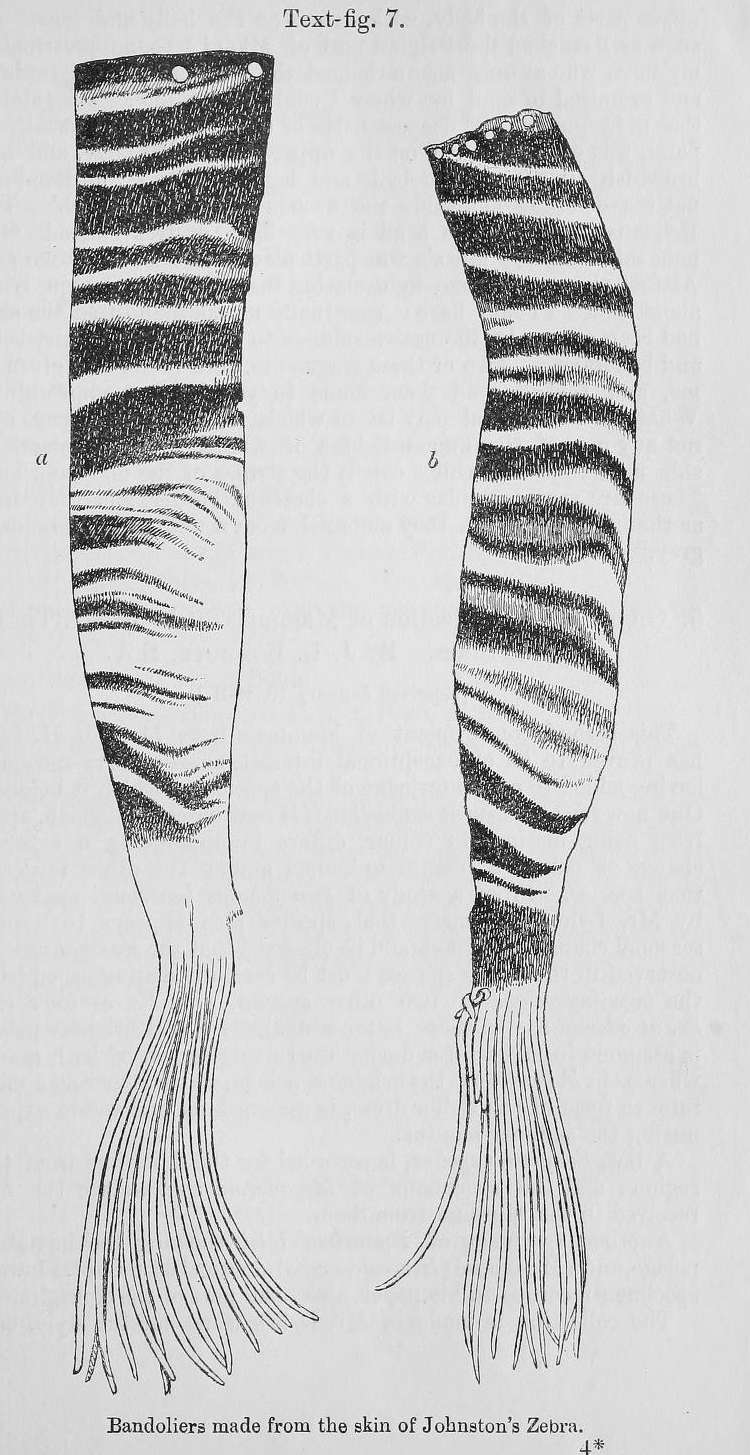
The two strips of skin Johnston sent to London, published as "Equus johnstoni" (1901)
Engraving of the two bandoliers made from okapi skin, the only physical evidence of the animal in London until June 1901: strip a measures about 36 inches and strip b about 30, fringes included.
Read more
It is text-figure 7 of Sclater's note of February 5, 1901, captioned "Bandoliers made from the skin of Johnston's Zebra"; Lankester reproduced it in his 1902 memoir and determined that the strips had been cut from the haunches. Page 51 of Proceedings of the Zoological Society of London 1901, vol. I, in the archive.org scan; cropped to the figure and converted to grayscale, with no other changes.
P. L. Sclater, "On an apparently new species of zebra from the Semliki Forest," Proceedings of the Zoological Society of London 1901, vol. I, p. 51, text-figure 7 · Public domain · open original
What happened
In his book "In Darkest Africa," the explorer Henry Morton Stanley wrote that the Wambutti, Pygmies of the Congo forest whom he had met in 1888, knew a donkey they called "atti," that they sometimes caught it in pits and that it ate leaves. The passage caught the attention of Harry Johnston, a British official posted to the Uganda Protectorate and a fellow of the Zoological Society of London. As he wrote himself, it struck him as odd because horses of the ordinary zebra type avoid dense woodland.
Around March 1900, as Johnston later recalled, a group of Congo Pygmies staying with him at Entebbe, in Uganda, gave him the animal's name: "o'api." A German adventurer had captured them, and taking them home was one of Johnston's reasons for going into the Congo. They described an animal that was brown or dark gray on the upper body, with stripes on the belly and legs.
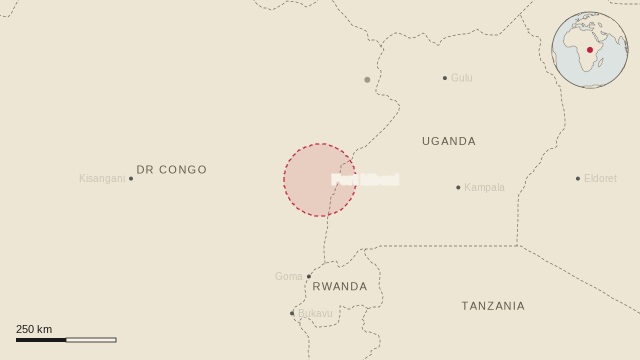
In early July 1900, Johnston reached the Semliki Forest, west of the river of the same name, in the Congo Free State. At the Belgian post of Mbeni, its commander, Lieutenant Meura, confirmed that the animal existed. According to the Belgians, it lived in the deepest part of the forest, went about in pairs and had a very long head. The Bambuba, a people living alongside the Pygmies, called it "okapi." He was told there was a skin, but the native soldiers had cut it up to make belts and bandoliers. Johnston was given two of those pieces.
Johnston never saw the animal. As he told it in November 1901, he searched the nearer part of the forest and got only one more strip of skin, from a local man. His August 1900 letter, written after his return, mentions only two pieces, and two were what reached London. He then had to leave because the porters of his caravan fell ill with fever, and the Belgians turned out their soldiers to carry his loads back to British territory. Meura promised to get him a complete skin, but died soon afterward of blackwater fever, a severe complication of malaria.
On August 21, 1900, from Fort Portal, in Uganda, Johnston wrote to Philip Lutley Sclater, secretary of the Zoological Society of London. According to the minutes, the letter, read at the society on November 20, said he had obtained something close to proof that an unknown horse lived in the forest. According to Lankester, the strips reached London that same month, and Sclater showed them at the meeting of December 18, 1900. They looked to him unlike the skin of any known zebra.
On February 5, 1901, Sclater presented his conclusion to the society: whether or not the natives' account was accurate, the two strips did not match any known zebra. He gave them, provisionally, the name Equus johnstoni, with a question mark after the genus, pending better specimens. The strips measured about 36 and 30 inches with their fringes, and their black bands had a reddish edge on each side. Sclater thought they came from the outer side of the legs.
Two weeks later, on February 19, the biologist W. G. Ridewood showed the society hairs from the strips under the microscope and said he could see no difference in structure from the hair of two species of zebra. At the same meeting a letter was read from Professor James Cossar Ewart, who had received a piece of the skin through the zoologist F. E. Beddard. Ewart had compared the hair with that of antelopes, oxen, deer and members of the horse family, and concluded that the strips came from a zebra, one different from the quagga, the mountain zebra and Burchell's zebra.
Meanwhile, Karl Eriksson, a Swede who had been a noncommissioned officer in his country's army and was Meura's second in command at Mbeni, kept the promise. He sent Johnston a complete skin and two skulls, obtained by native soldiers of the Free State near the fort. According to Johnston, the shipment left the Congo around February 1901, reached Entebbe in March and caught up with him at the end of that month at Eldama Ravine, in the east of the protectorate. The lower jaw of the larger skull was still attached to the skin, so Johnston took that skull to belong to the same animal. The horny hoofs had been lost, but the toe bones remained, two on each foot.
With the skin and skulls in front of him, Johnston confirmed that this was not a horse but a cloven-hoofed ruminant, and the skull made him think of the giraffe and of Helladotherium, an extinct short-necked, hornless relative of the giraffe known from fossils. With a letter dated March 31, 1901, he sent Sclater a watercolor he had painted from the fresh skin. He wrote that the colors were not exaggerated and that, if the skin were not there as evidence, the animal would be thought an invention of his imagination. Sclater showed it to the society on May 7, and at that meeting Ridewood said the hair resembled that of the giraffe as much as that of the zebra.
On June 18, 1901, the skin and both skulls were shown to the society, with Johnston present, and remarks by Ray Lankester, director of the natural history departments of the British Museum, were read. According to Lankester, the skin and skulls had reached the museum the day before. Lankester at once recognized an animal of the giraffe family and not a bovid: among other features, by the large gap in the skull in front of the eyes and the long toothless stretch of the lower jaw. He created the genus Okapia, and the species became Okapia johnstoni. The animal was not adult: according to Lankester, it was about two-thirds of its full size. The abstract of his memoir published by the society and the memoir itself say the specimens arrived in July, a date that does not fit with their being shown on June 18.
Lankester read his full memoir on November 19, 1901, and the society published it in August 1902. Comparing the strips with the complete skin, he found they had been cut from the haunches and certainly came from an okapi, so the name johnstoni Sclater had given them stood. In an appendix dated May 27, 1902, he added that the Congo Free State's museum in Brussels had received at the beginning of that month the skin of an adult female and most of the skeleton of an adult male, reportedly from Mawambi. The male's skull had two conical bony horns about three inches long, and Lankester corrected his inclination to believe that the adult okapi had none.
Where it happened
Why it matters
Johnston, Sclater and Lankester, the three men who made the okapi known in London, never saw it alive. Everything passed through intermediaries: the Pygmies who described it, the Belgian officers who knew of it, the native soldiers who cut up the first skin and those who obtained the second. The informants' descriptions got the essentials right: a forest animal with striped legs and a long head, hunted in pits. What failed was the category: a donkey in Stanley's book, a horse for Johnston and a zebra for Sclater.
The first physical evidence pointed to the wrong family, and a laboratory analysis backed it up. With two strips of striped hair, Sclater placed the animal in the horse genus, and Ewart, after comparing the hair with that of several families, concluded it was a zebra. To Ridewood, the hair had the same structure as zebra hair in February, and in May it resembled giraffe hair too. What settled the question were the bones: the toes of a cloven hoof and, above all, the skull, whose giraffe-family features Lankester recognized as soon as he had it in front of him.
The provenance of the specimens has gaps that the sources themselves acknowledge. The skin and skulls came from the area around Mbeni, but the sources do not say who killed the animal or where. In November 1901, Johnston could not find the note Eriksson sent with the shipment, though he quoted a few phrases from it. That the larger skull and the skin came from the same individual is Johnston's inference, based on the jaw attached to the skin. Nor do the sources agree on its sex: the June 1901 minutes described it as probably male; in November, Lankester said nothing in the skin showed it, and in 1902 he suggested it was a female.
The species name preserves the first mistake: Okapia johnstoni carries the epithet Sclater gave to a supposed zebra, because the strips turned out to come from an okapi. According to Lankester, the okapi and the giraffe were the only survivors of a family that had had many genera in the Miocene. The 1901 sources gave two different pictures of its status. Lankester wrote, from an estimate by Johnston, that it occupied an area of forest the size of Wales and that there were certainly many thousands. The Times article of May 7, 1901, on the other hand, said that from what Johnston had learned there the natives were rapidly driving it to extinction, and called on King Leopold II of Belgium to protect it.
Documents and sources
Primary documents
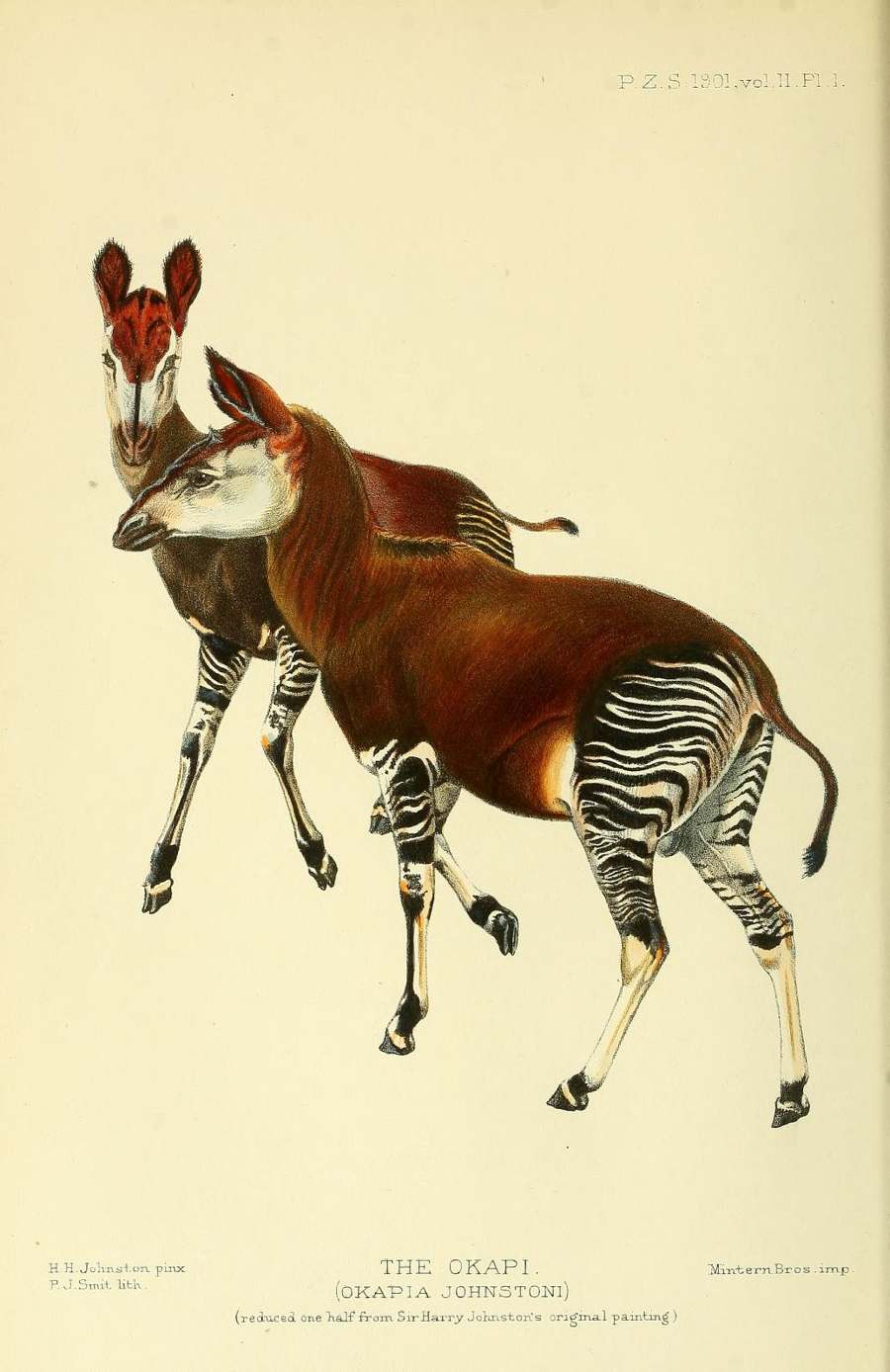
Johnston's watercolor painted from the fresh skin, published as a plate in 1901
Lithograph of the watercolor Harry Johnston painted from the complete skin sent by Eriksson, using the skull as a guide to the shape of the head, and sent to Sclater with his letter of March 31, 1901.
Read more
It shows two okapis and is captioned "The Okapi (Okapia johnstoni)," reduced to half the original. Sclater showed the original at the Zoological Society on May 7, 1901; plate I of Proceedings of the Zoological Society of London 1901, vol. II, was printed already bearing the genus name Lankester created in June. Lithograph by P. J. Smit, printed by Mintern Bros.; archive.org scan, reduced in size with no other changes.
Proceedings of the Zoological Society of London 1901, vol. II, plate I · Public domain · open original
Documented evidence
- Letter from Harry Johnston to P. L. Sclater dated Fort Portal (Uganda), August 21, 1900, read at the Zoological Society of London on November 20, 1900 (Proceedings 1900, pp. 774-775): the Pygmies called the animal "o'api" and the Bambuba "okapi"; the soldiers at Mbeni had cut a skin into belts and bandoliers, and Johnston was given two pieces. He adds that he never saw the animal.
- Sclater, meeting of December 18, 1900 (Proceedings 1900, p. 950): he shows the two bandoliers just received and judges them unlike any known zebra. On February 5, 1901 (Proceedings 1901, vol. I, pp. 50-52, with text-figure 7) he describes them as Equus (?) johnstoni; they measure about 36 and 30 inches with the fringes.
- Meeting of February 19, 1901 (Proceedings 1901, vol. I, pp. 87-88): Ridewood sees no difference in structure between the hair of E. johnstoni and that of two zebras; Ewart, in a letter to Beddard, concludes the strips come from a zebra different from the quagga, the mountain zebra and Burchell's zebra.
- Meeting of May 7, 1901 (Proceedings 1901, vol. II, pp. 2-6 and plate I): Sclater shows Johnston's watercolor and reads his letter of March 31 from Eldama Ravine, and a Times article of the same day: the complete skin and two skulls were obtained by Free State soldiers near Mbeni and given to Johnston by the Swedish officer K. Eriksson, who according to The Times had until recently been the fort's commandant. Ridewood finds the hair similar to that of the giraffe and the zebra.
- Lankester, meeting of June 18, 1901 (Proceedings 1901, vol. II, pp. 279-281): the skin and two skulls reached the museum on June 17; the skull is that of a giraffid; he creates the genus Okapia for the species Okapia johnstoni, a synonym of Equus johnstoni Sclater.
Show 2 more facts
- Lankester, "On Okapia, a new genus of Giraffidae, from Central Africa," read November 19, 1901, and published in Transactions of the Zoological Society of London 16 (August 1902), pp. 279-314: quotes Johnston's November 1901 letter on Meura, Eriksson and the shipment, and says the skin reached London in July 1901 and that the bandoliers were cut from the haunches and certainly came from an okapi. He adds that the natives often compared the animal to a donkey or a zebra, because it has no horns and long ears.
- Lankester 1902, appendix dated May 27, 1902 (pp. 304-307): the Congo Free State's museum in Brussels received at the beginning of May the skin of an adult female and the nearly complete skeleton of an adult male, reportedly from Mawambi. The male's skull bears bony horns about three inches long and is only 2 mm longer than Johnston's larger skull. Lankester suggests the difference may be because Johnston's specimen was a female.
Sources
- Proceedings of the Zoological Society of London 1900, pp. 774-775 (Johnston's letter of August 21, 1900, read November 20) and p. 950 (bandoliers shown December 18) — Primary source; text read in the archive.org scan.
- P. L. Sclater, "On an apparently new species of zebra from the Semliki Forest," Proceedings of the Zoological Society of London 1901, vol. I, pp. 50-52 — Original description of Equus (?) johnstoni, received February 4 and read February 5, 1901. Primary source.
- Proceedings of the Zoological Society of London 1901, vol. I, pp. 87-88: W. G. Ridewood and a letter from J. C. Ewart on the hair of Equus johnstoni (February 19, 1901) — Primary source for the two microscope examinations of the hair: Ridewood saw no difference in structure from the hair of two zebras, and Ewart assigned it to a zebra.
- Proceedings of the Zoological Society of London 1901, vol. II, pp. 2-6 and plate I: Johnston's watercolor and letter, extracts from The Times and Ridewood's note (May 7, 1901) — Primary source; the Times article is cited through the minutes.
- E. Ray Lankester, communication on Okapia johnstoni, Proceedings of the Zoological Society of London 1901, vol. II, pp. 279-281 (June 18, 1901), and abstract of his memoir, pp. 472-474 (November 19, 1901) — Creation of the genus Okapia. Primary source. The abstract of November 19 already says the specimen might be a female, and dates the arrival to July, a few days before Johnston returned, although he attended the June 18 meeting.
- E. Ray Lankester, "On Okapia, a new genus of Giraffidae, from Central Africa," Transactions of the Zoological Society of London 16 (1902), pp. 279-314, plates XXX-XXXII — Full memoir, with the history of the discovery from a November 1901 letter by Johnston and the appendix of May 27, 1902. According to that letter, Eriksson's note said he was sending a skin and skull, and separately another skull, and described the hoofs as bluish black and like an antelope's; Johnston read in it his surprise at finding them cloven.