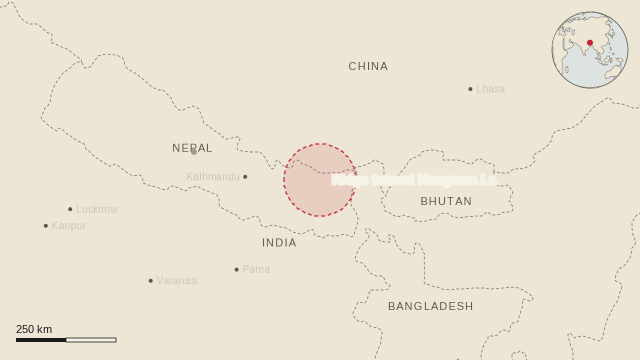
1972·Ridge toward Kongmaa La, between the Barun and Kasuwa, Nepal
Hairy hominids·Yeti
Nepal.Arun Valley · tracks between two scientists' tents
Before dawn on December 18, 1972, on a snowy ridge at about 12,000 ft above the Arun Valley in eastern Nepal, ornithologist Edward Cronin and physician Howard Emery found a line of footprints running between their two tents. The Sherpas with them said they were a yeti's. The two scientists photographed them before the sun reached them, and their colleague Jeffrey McNeely later brought up plaster to make casts. The journal Oryx published a photograph of one of the prints in 1973. Cronin attributed the tracks to an unknown primate; researcher Daniel Taylor argued in 2017 that they were an Asian black bear's.
Tier A · AcceptableCryptidWhat do they mean? →
Institutional evidence: several identified independent witnesses, or contemporary official documentation, without an instrumental record to corroborate them.
What it was
60%ordinary cause
The most likely explanation.
- 60% ordinary cause
- 40% unexplained
See the split across the six explanations
Known cause (ordinary or hoax)60%
Unexplained40%
Separate collection: these figures do not count toward the UAP case totals. How it is split →
Cause the sources propose: ordinary cause
What happened
In 1972, the Arun Valley Wildlife Expedition began fieldwork in the forests of that valley in eastern Nepal, between Everest and Kangchenjunga, on behalf of the Association for the Conservation of Wildlife, a Bangkok organization. It was co-led by ornithologist Edward W. Cronin and mammalogist Jeffrey A. McNeely, who both worked for the association. Parasitologist Howard B. Emery also served as the group's physician.
On December 14, Cronin and Emery left base camp, in the Kasuwa River valley, for a first winter visit to the high ridges leading to Kongmaa La, north of that valley. McNeely went with them part of the way, but heavy snow turned him and the porters back. On the 17th, with two Sherpa assistants, the two scientists reached a ridge with a view of Makalu and, in the late afternoon, camped in a hollow of firm snow at about 12,000 ft. According to Cronin, the flat area, less than half an acre, held no animal tracks at all. They pitched two tents, ate dinner around a campfire and went to bed at dark.
Shortly before dawn on the 18th, Emery climbed out of the tent and called Cronin: beside the path they themselves had trodden was a line of fresh footprints that ran between the two tents. The Sherpas said they were a yeti's. According to the account Cronin published in 1979, the two photographed them before the sun reached them, on crystalline snow much like the snow mountaineer Eric Shipton had found in 1951, when he photographed the most famous yeti footprint. In the middle of the hollow there were ten to fifteen clear prints of both feet. They measured about 9 inches long by 4¾ inches wide, with a short, broad, opposable big toe, toes of unequal size and a wide, rounded heel. The steps were very short, often less than a foot.
Cronin followed the trail back down the north slope, which drops to the Barun River, until deep snow stopped him; there the prints were just holes with no detail. To the south, the sun had melted the snow and the trail was lost among rocks and scrub, although farther up they saw what looked like prints of the same animal crossing the ridge several times. They ruled out a prank by the Sherpas because, Cronin wrote, they would not have had time to make the whole trail visible from the top. A Sherpa went down to alert the rest of the expedition, and McNeely came up later with plaster to make casts. For the next three days they kept watch at night by a bright moon and checked other snowfields, but found no further tracks.
In January 1973, the expedition reported "three incidents involving yeti," of which only one had produced "solid evidence." The conservation journal Oryx quoted this in the introductory note to McNeely, Cronin and Emery's article "The Yeti — not a Snowman," in May 1973. According to that note, written by the journal rather than the authors, on December 18 Cronin and Emery's tent "was visited by an animal which left tracks that are not referable to any known animal." The journal printed one of the prints beside Shipton's and credited the photograph to McNeely; Cronin's book does not mention that photograph and says McNeely reached the ridge later, with the plaster.
The body of the article does not describe the episode. It is a review of the evidence for the yeti built around Shipton's photograph: the authors argue that his footprint looks nothing like those of the region's bears or langurs and most like a mountain gorilla's. They put forward Gigantopithecus, a giant fossil ape of southern Asia, as the yeti's ancestor, and conclude that it should be sought in the mountain forests, between 2,800 and 4,500 meters, not in the snow, which the animal would only cross to get from one valley to another.
Where it happened
Why it matters
These tracks were recorded by scientists who were studying the area's wildlife and knew its bears' tracks. In the chapter on the case in his book The Arun (1979), Cronin drew eleven conclusions. The prints were made at night and photographed before the sun reached them, so they were not small prints enlarged by melting. During the expedition they had photographed the tracks of large mammals in the snow, and comparing those with these, they ruled out "with assurance" any known normal animal of the eastern Himalayas. And the left-right pattern, with no overlapping prints, pointed to an animal walking on two feet.
According to the same book, zoologist George Schaller, who had spent a year studying mountain gorillas in Africa, examined the casts and said they showed "a close resemblance" to that gorilla's prints. Cronin weighed about 185 pounds in winter clothes and boots, and his own prints were slightly deeper; from that he estimated that the animal weighed about 165 pounds. He attributed them to a young male or a female of the same species that left Shipton's, since they were shorter and had a shorter big toe. Even so, he did not close the question: he wrote that it might be "a known species in a deformed or abnormal condition," although in his view the evidence pointed to a new form of bipedal primate.
The opposite explanation comes from researcher Daniel C. Taylor, who searched for the yeti in the same region for decades. In Yeti: The Ecology of a Mystery (2017) he argues that the famous tracks were made by the Asian black bear: the hind paw lands on part of the front paw's print and lengthens it, and cubs that climb trees press down a separate inner digit that looks like a thumb in the snow. Of the 1972 prints he says they are about four inches shorter than Shipton's because in each print the hind paw overlapped the front one less, and that the nail marks did not show in that soft snow.
In the excerpt of the book published in 2019 by Scroll.in, that argument takes up two sentences and does not analyze the expedition's photographs or casts, which Cronin said had already been compared with those of large mammal tracks in snow.
What survives of the event is the photographs and the casts. There is no known published study of the casts beyond Schaller's comment as Cronin reports it. Physical samples attributed to the yeti have been analyzed: in 2017, DNA from nine of them, including a hair collected in 1959 in the same Barun Valley, came back as bears and a dog (↗ Yeti).
Documents and sources
Documents
McNeely, Cronin and Emery, "The Yeti — not a Snowman," Oryx (May 1973), with the photograph of the 1972 footprint
The nine-page article in which Oryx first reported the tracks of December 18, 1972: the standfirst sums up the expedition's January 1973 report, and a plate prints the photograph of one of the footprints, credited to Jeffrey McNeely, beside Eric Shipton's from 1951 and a plate of drawings of the feet of bears, a langur, a gorilla, a human and the hypothetical reconstruction of the yeti's foot. The 1972 footprint appears in the snow beside a glove, for scale. It is not hosted here because the rights belong to Cambridge University Press.
Source: Oryx 12 (1): 65-73, Cambridge University Press · view source
Documented evidence
- McNeely, Cronin and Emery, "The Yeti — not a Snowman," Oryx 12 (1): 65-73 (May 1973): the journal's standfirst quotes the January 1973 report ("three incidents," one with "solid evidence") and dates the animal's visit to Cronin and Emery's tent to December 18; the plate prints the footprint, credited to Jeffrey McNeely, beside Shipton's from 1951.
- Edward W. Cronin, The Arun (Houghton Mifflin, 1979), pp. 166-168: departure from base camp on December 14, camp at about 12,000 ft on the 17th, discovery before dawn on the 18th, ten to fifteen clear prints of about 9 by 4¾ inches, photographs before the sun reached them, some right footprints on the expedition members' own trail and the plaster McNeely brought up for the casts.
- Cronin, The Arun, pp. 169-170: eleven conclusions, among them that the prints came from no known normal animal of the eastern Himalayas, based on comparison with tracks photographed during the expedition, the bipedal gait, the estimated weight of about 165 pounds and George Schaller's comment on the casts. In conclusion 10 he notes that the animal stepped along rhododendron branches, a technique he had seen snow leopards and bears use.
- Cronin, The Arun, p. 171: the animal might be "a known species in a deformed or abnormal condition," although in his view the evidence pointed to a new form of bipedal primate.
- Daniel C. Taylor, Yeti: The Ecology of a Mystery (Oxford University Press, 2017), excerpt on Scroll.in (April 30, 2019): attributes Shipton's prints to the Asian black bear and includes Cronin and McNeely's 1972 prints, about four inches shorter, with no nail marks because of the soft snow. Cronin, by contrast, described the snow in the hollow as firm and crystalline (pp. 166-167).
- Odette Tchernine, "The Yeti—some of the Evidence," Oryx 12 (5): 553-555 (November 1974): a review of the evidence for the yeti and the sasquatch that cites the photographs by Shipton (1951) and Don Whillans (1970) and does not mention the Arun tracks.
Sources
- J. A. McNeely, E. W. Cronin and H. B. Emery, "The Yeti — not a Snowman," Oryx 12 (1): 65-73 (May 1973) — First publication of the event: the journal's standfirst, with the January 1973 report, and the plate with the photograph of the footprint. The body of the article is a general review of the evidence for the yeti and does not describe the episode. It puts Smythe's 1937 tracks down to bears, which often set the hind foot on the forefoot's print, and rejects that origin for Shipton's. Read in full in the Cambridge PDF, with the plates checked on the image.
- Edward W. Cronin, Jr., The Arun: A Natural History of the World's Deepest Valley (Boston, Houghton Mifflin, 1979), chapter 8, "The Night of the Abominable Snowman," pp. 166-171 — Cronin's firsthand account: dates, measurements, photographs, casts and his eleven conclusions. Figures and quotations were checked against the page scans. Controlled lending on archive.org.
- Daniel C. Taylor, Yeti: The Ecology of a Mystery (Oxford University Press, 2017), excerpt "A researcher proved Yeti footprints were made by bears – but understands why the myth persists," Scroll.in, April 30, 2019 — Excerpt from the book published with the publisher's permission: the Asian black bear explanation and the sentence on the 1972 prints. The full book was not consulted.
- Odette Tchernine, "The Yeti—some of the Evidence," Oryx 12 (5): 553-555 (November 1974) — Context: the review Oryx published the following year. It does not mention the Arun tracks, and it places the reproduction of Shipton's photograph in the May 1972 issue, whereas McNeely, Cronin and Emery's article is from May 1973.
- Tianying Lan, Stephanie Gill, Eva Bellemain, Richard Bischof, Muhammad Ali Nawaz and Charlotte Lindqvist, "Evolutionary history of enigmatic bears in the Tibetan Plateau–Himalaya region and the identity of the yeti," Proceedings of the Royal Society B 284: 20171804 (2017) — Context: the DNA analysis of nine samples attributed to the yeti, including a hair collected in 1959 in the Barun Valley, which turned out to be a Tibetan brown bear's.
Context (not images of the event)
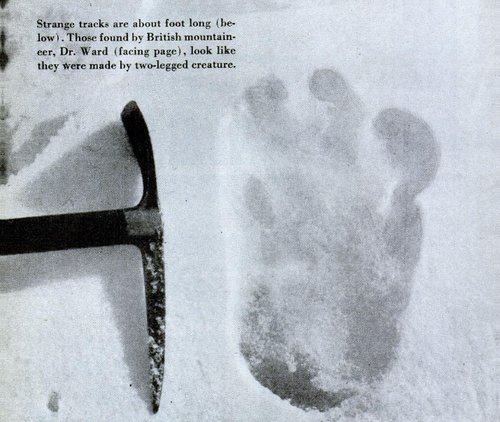
Shipton's footprint (Menlung Glacier, 1951), the one Cronin and Taylor compare the 1972 prints with
The photograph Eric Shipton took in 1951 on the Menlung Glacier, near the Nepal–Tibet border, of a footprint found by mountaineer Michael Ward, with an ice ax for scale.
Read more
It is the yeti's reference image: Oryx printed it in 1973 beside the Arun footprint, Cronin wrote that the resemblance between the two was unmistakable, and Taylor uses it for his bear explanation. It is not a photograph of the 1972 event. This copy is the reproduction from the December 1952 issue of Popular Science, with its caption, according to the Wikimedia Commons description.
Source: Eric Shipton (1951), reproduced in Gardner Soule, "The World's Most Mysterious Footprints," Popular Science (December 1952); Wikimedia Commons copy · Dominio público en EE. UU. (publicada entre 1931 y 1963 sin renovación del copyright) · open original
Related cases
Cases this case cites and cases with the same likely cause.