2003–2018·La Noria, Tarapacá region, Chile
Alleged extraterrestrial beings·Ata, the Atacama skeleton
Chile.Ata, the Atacama skeleton · DNA shows a human fetus
In 2003 the 6-inch (15 cm) mummified body known as Ata turned up in La Noria, an abandoned nitrate town in the Tarapacá region of Chile's Atacama Desert; the 2013 documentary "Sirius" presented it as possible evidence of extraterrestrial life. A team from Stanford and the University of California sequenced its DNA and in 2018 concluded in the journal Genome Research that it was a human girl of Chilean ancestry, probably born premature. Anthropologists challenged its medical conclusions and the study's ethics, and Chile's National Monuments Council ruled its export illicit trafficking.
Tier S · SolidCryptidWhat do they mean? →
Strong evidence: a contemporary instrumental record (radar, sensor, film or photo of known provenance) that corroborates several independent witnesses.
What it was
99%ordinary cause
The most likely explanation.
- 99% ordinary cause
- 1% unexplained
See the split across the six explanations
Known cause (ordinary or hoax)99%
Unexplained1%
Separate collection: these figures do not count toward the UAP case totals. How it is split →
Cause the sources propose: ordinary cause
Record of the event
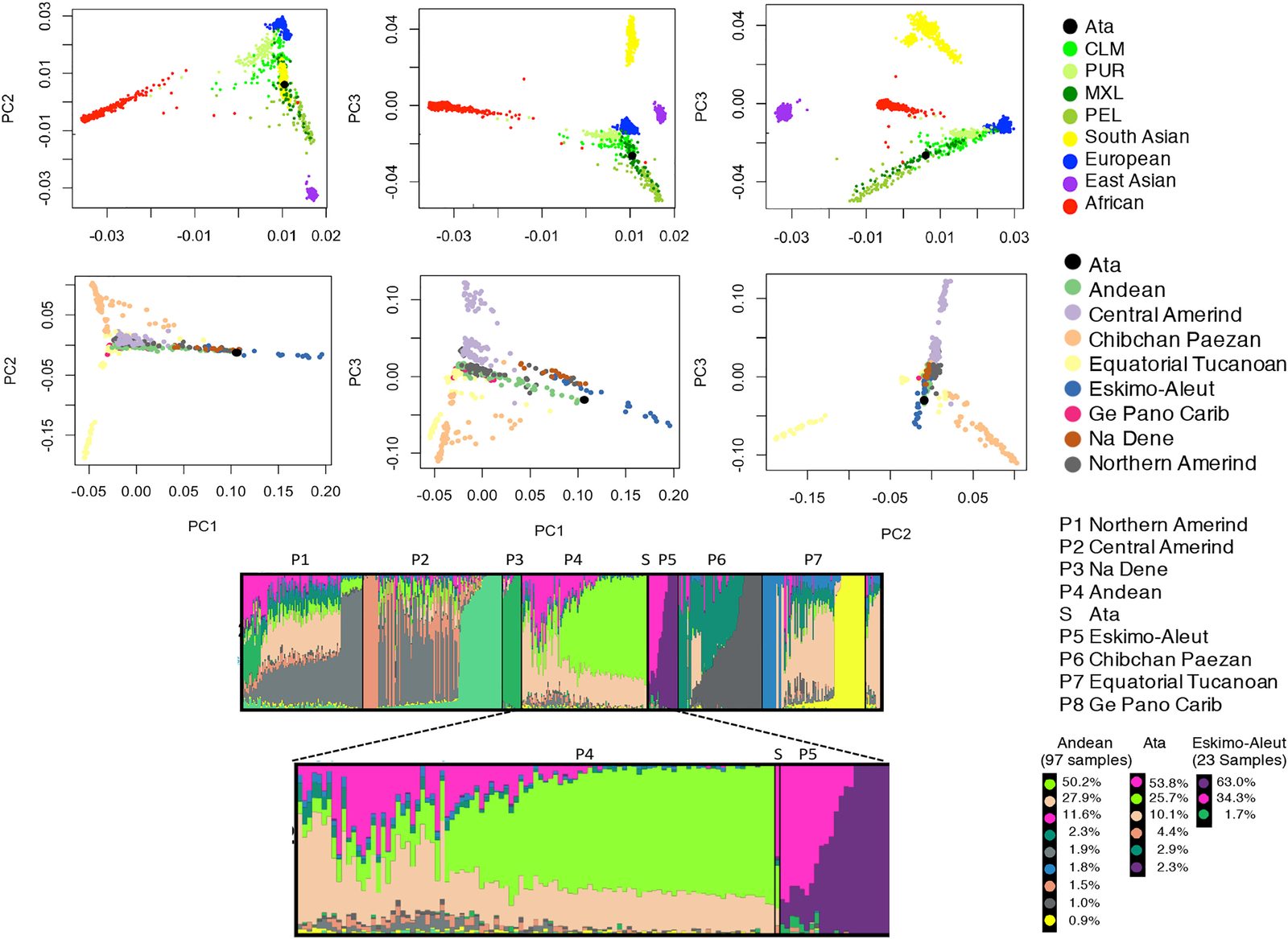
Ata's genetic ancestry: Figure 2 of the Genome Research study (2018)
Figure from the genome analysis that places Ata's DNA (black dot) among reference populations. At top, against five major populations of the 1000 Genomes Project, it falls among the admixed populations of the Americas; in the middle, against 52 Native American populations, it sits next to the Andean ones; at bottom, the admixture analysis estimates 53.8% European ancestry and the rest mostly Indigenous Andean. It does not show the body.
Bhattacharya et al., "Whole-genome sequencing of Atacama skeleton shows novel mutations linked with dysplasia," Genome Research 28(4):423–431 (2018), Figure 2 (panel letters removed) · CC BY 4.0 · open original
What happened
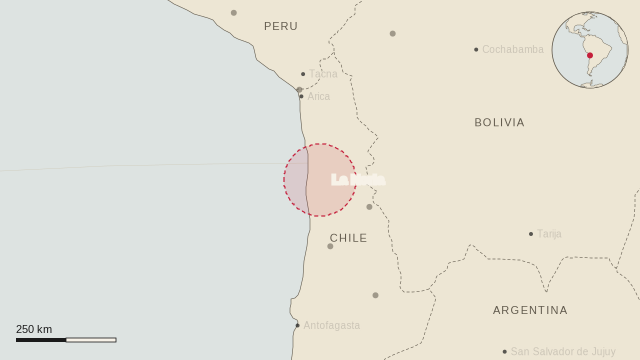
La Noria is a former nitrate works in the Tarapacá region, in the Atacama Desert of northern Chile: an abandoned mining town. In 2003 the tiny, partly mummified body later known as Ata, about 6 inches (15 cm) long, turned up there. Accounts of the find differ. According to Chile's National Monuments Council, the state body that protects archaeological heritage, the body was removed from an archaeological site, and the Chilean press placed the grave next to the town church. Researchers Garry Nolan and Atul Butte, who studied it years later, wrote in 2018 that some accounts say it was found on a shelf in a building near the church.
According to the complaint recorded in the council's minutes, the body was reportedly sold to a businessman from Iquique and is held in a private collection in Barcelona; Nolan and Butte wrote that it was sold at least twice in Chile before it reached Spain. According to Nolan and Butte, for years Chilean and international media covered it in outlandish and dehumanizing terms, and some claimed it came from another planet. In 2013 it was presented that way in "Sirius," a documentary produced by American Steven Greer, founder of the Disclosure Project, a campaign for governments to reveal what they know about UFOs. According to the 2018 scientific paper, the film proposed that it could be a preserved humanoid or evidence of extraterrestrial life; according to Nolan and Butte, the documentary team claimed it was thousands of years old.
While the documentary was being made, Stanford University immunologist Garry Nolan offered to analyze the body's DNA. According to Nolan and Butte, none of the study's senior authors ever saw or handled the body: the "Sirius" team removed a piece of bone of about one cubic millimeter in Spain, and one of its members flew it to the United States. The X-rays, also made in Spain, went to Ralph Lachman, a Stanford pediatric radiologist and specialist in bone dysplasias, the disorders of bone growth.
The preliminary report, published in 2018 as a supplement to the study, concluded that the body was human and not another primate. Its mitochondrial DNA, the kind inherited from the mother, belonged to a lineage found on the west coast of South America. It had only 10 ribs on each side instead of the usual 12. The report noted that by size it could have been a fetus, but from the density of the growth plates in the bones a specialist in children's bone disorders put its age at death at 6 to 8 years. In May 2013 the Stanford student newspaper wrote that the size matched that of a fetus of about 22 weeks, and reported Lachman's view that natural mummification could make the bones look older. With the preliminary analysis available then, the report found no relevant changes in the known dwarfism genes.
On March 22, 2018, the journal Genome Research published the full genome analysis, signed by Sanchita Bhattacharya of the University of California, San Francisco, Nolan, Butte and twelve other authors, Lachman among them. Almost 97% of the sequences aligned with the human reference genome. The sex was female, with two X chromosomes. The ancestry was mixed: compared with Native American reference populations, it was 54% European and the rest mostly Indigenous Andean, and the closest DNA among those compared was that of three people from Chiloé, in southern Chile. Judging by the size of the DNA fragments, the body was less than 500 years old.
The authors highlighted seven variants in genes already linked to bone development disorders, including two collagen genes; collagen is the protein that gives structure to bone and cartilage. Their prediction software rated the variants as possibly damaging, and a second round of sequencing aimed at those regions confirmed them. They concluded that a chance combination of mutations could explain the size, the ribs, the shape of the skull and the apparent bone age, and that, given the size and the severity of the mutations, a premature birth was likely. They also suggested, as speculation, that exposure to the area's nitrates before birth might have damaged the DNA. They wrote that no hypothesis was set aside during the analysis and that the body had "a purely earthly origin."
In July 2018, eight researchers led by bioarchaeologist Siân Halcrow of the University of Otago (New Zealand) replied in the International Journal of Paleopathology. They included anthropologist Kristina Killgrove and Chilean researcher Bernardo Arriaza of the University of Tarapacá. According to Otago's press release, they found no evidence of the anomalies: every feature the Stanford team cited is part of a fetus's normal skeletal development, and the mutations found are "possibly coincidental." In an interview with Gizmodo, Killgrove said the body looked like a normal fetus of about 15 to 16 weeks' gestation, younger than the 22 weeks in the 2013 report; both estimates agree that it was a fetus. Arriaza called it a pregnancy loss, possibly from the very recent past.
In Chile the response centered on ethics and the law. On March 23, 2018, the day after publication, science communications consultant Gabriel León reported the case to the National Monuments Council, which sent the file to the prosecutor's office in Pozo Almonte as a complaint of appropriation, receiving and sale of a national monument.
According to the newspaper La Tercera, a letter to Genome Research signed by a dozen researchers, the Chilean Society of Biological Anthropology and the Chilean College of Archaeologists said that doing research without considering where the samples came from, publishing the genetic data and ignoring the consequences was "frankly scandalous" ("francamente escandaloso"). Anthropologists Nicolás Montalva, María José Herrera and Francisca Santana-Sagredo pointed out that Chile's national monuments law requires a council permit to take samples out of the country, and that they knew of none in this case.
The journal defended its peer review in a May 2018 statement. The sample, of uncertain biological origin, did not meet the U.S. federal definition of human subjects research, so it needed no ethics approval; even so, the concerns of some Chilean scientists, their government and some members of the public had to be taken seriously. Nolan and Butte wrote in the same journal that they had no part in removing, selling or exporting the body, that at the start nobody knew whether it was human, and that it should be returned to Chile. "This was a girl with many DNA mutations, not anything more exotic," they wrote.
On January 9, 2019, the full council adopted the opinion of its archaeological heritage committee. The body is archaeological because it was removed from an archaeological site. Its date is uncertain, for lack of physical anthropology studies, and taking it out of the country without permission was illicit trafficking. The council agreed to ask prosecutors about the investigation, to explore with its illicit trafficking working group how to recover the body, and to ask Genome Research to retract the paper. La Tercera reported in November 2018 that the prosecutor's office and the Investigations Police were investigating the exhumation, and that the prosecutor did not yet know whether he could order the body's return. No public outcome of the investigation has been reported, nor any return of the body to Chile, and PubMed Central lists the paper without a retraction.
Where it happened
Why it matters
The question the documentary raised, whether the body was human, was answered by the DNA: a human genome, female, of mixed Chilean ancestry, less than 500 years old. None of the critics disputes that: Halcrow and her colleagues call it a partially mummified human fetus. The idea of a being from another world rested on the body's shape and on a bone age of 6 to 8 years that Lachman himself saw as clashing with its size. Unlike the figures seized in Lima in 2023 ↗ Nazca mummies, which turned out to be dolls built from animal bones, Ata is the body of a girl who died before birth or shortly after.
The dispute that followed is a medical one. The 2018 authors read the body's shape as a bone dysplasia and looked for its causes in the genome; the anthropologists replied that in a fetus of that age there is nothing abnormal to explain, which is why they consider the mutations possibly coincidental. The 2018 study relied on X-rays made in Spain for the documentary and on a sample whose removal is described in two ways. The paper's methods mention marrow from the ribs and the right upper arm bone, plus scrapings from inside the skull; the later note by Nolan and Butte mentions a single piece of about one cubic millimeter removed by the documentary team. The sources do not reconcile the two accounts. In Nolan and Butte's version, the sample reached the laboratory from the documentary team's hands, so the laboratory did not control how it was taken.
The case also opened a debate on the ethics of studying human remains of doubtful origin. The journal acknowledged that human subjects research policies do not typically cover samples of uncertain biological origin and committed to start a discussion to set policies on historical and ancient DNA. In Chile the council treated the body as archaeological heritage taken out of the country illegally, and the debate moved from where the body came from to where it should go: Chilean scientists and the study's own authors called for its return to Chile, and the council agreed to explore how to recover it. The 2018 paper says it was found in the "Atacama region" of Chile, but La Noria lies in the Tarapacá region: Atacama is the desert, not the administrative region.
Documents and sources
Documented evidence
- Bhattacharya et al., "Whole-genome sequencing of Atacama skeleton shows novel mutations linked with dysplasia," Genome Research 28(4):423–431, published online March 22, 2018: whole-genome sequencing at an average 11.5x coverage; about 97% of reads aligned to the human genome; female (two X chromosomes); mixed ancestry, 53.8% European against Native American reference populations, closest to three Chilote individuals; fragments of about 300 base pairs, consistent with less than 500 years.
- The same paper highlights variants in seven genes (COL1A1, COL2A1, KMT2D, FLNB, ATR, TRIP11 and PCNT), predicted as possibly damaging and confirmed by targeted sequencing (six in a single copy, the PCNT one in both). It concludes it is "entirely plausible" that their chance combination explains the size, the 10 ribs, the skull and the apparent bone age, and that the body was likely a premature birth.
- The paper's supplemental note, "Preliminary Report on the Atacama Specimen," on the analysis begun in the fall of 2012: X-rays and CT scans; 10 ribs; age at death of 6 to 8 years according to a specialist in pediatric bone disorders, from the density of the growth plates, who concluded it was a human child with an apparently severe form of dwarfism; mitochondrial DNA of haplogroup B2, from the west coast of South America; and, at that resolution, no relevant changes in the known dwarfism genes.
- Nolan and Butte, "The Atacama skeleton," Genome Research 28(5):607–608, published online March 30, 2018: no senior author saw or handled the body; the "Sirius" team removed about one cubic millimeter of bone in Spain, the study's only biological sample; the X-rays were made in Spain. The methods of the March paper describe instead marrow from the ribs and right humerus and skull scrapings, and the paper credits coauthor Emery Smith with removing the rib bone. Both authors call for the body's return to Chile.
- Genome Research editorial (May 2018): the journal stands behind its peer review; the sample was not human subjects research as defined by the U.S. federal Office for Human Research Protections, so it needed neither approval nor exemption; the concerns of Chilean scientists, their government and the public must be taken seriously; the journal will start a discussion on policies for historical and ancient DNA samples.
Show 2 more facts
- Halcrow et al., International Journal of Paleopathology 22:97–100 (online July 17, 2018), eight authors from New Zealand, the U.S., Sweden and Chile: they call the body a "partially mummified human foetus" and question the dysplasia, the genomic interpretation and the study's ethics. The University of Otago press release (July 18, 2018) says the features cited are part of a fetus's normal development.
- Minutes of the regular session of Chile's National Monuments Council of January 9, 2019, item 78: an email of March 23, 2018, reported the case; official letter CMN 1511-18 sent the prosecutor's office in Pozo Almonte the complaint of appropriation, receiving and sale of a national monument; the body is archaeological, its date uncertain and its export illicit trafficking; the council agrees to consult the prosecutor, explore recovery and request the paper's retraction.
Sources
- Bhattacharya, S. et al., "Whole-genome sequencing of Atacama skeleton shows novel mutations linked with dysplasia," Genome Research 28(4):423–431 (online March 22, 2018), PubMed Central copy — Primary source for the genome analysis (CC BY 4.0 license, doi 10.1101/gr.223693.117). Its PubMed Central record does not flag it as retracted.
- Supplemental material to Bhattacharya et al., "Preliminary Report on the Atacama Specimen" (supplemental note) — Report of the 2012–2013 preliminary analysis: X-rays, estimated bone age and mitochondrial DNA.
- Nolan, G. and Butte, A., "The Atacama skeleton," Genome Research 28(5):607–608 (online March 30, 2018) — The senior authors explain how they obtained the sample, report the accounts of the find and call for repatriation. They add that the European admixture in its DNA suggests the body may be considerably younger than 500 years.
- Editors of Genome Research, "A statement about the publication describing genome sequencing of the Atacama skeleton," Genome Research 28(5):xiv (May 2018) — The journal's position on the peer review and the ethics of the study.
- Halcrow, S. E. et al., "On engagement with anthropology: A critical evaluation of skeletal and developmental abnormalities in the Atacama preterm baby…," International Journal of Paleopathology 22:97–100 (2018) — Critical reply by anthropologists and paleopathologists. Cited through its PubMed abstract (PMID 30025270) and the University of Otago press release.
- University of Otago, "Otago-led research cites faulty science and ethics in DNA analyzes of 'Ata'" (press release, July 18, 2018), via EurekAlert — Conclusions of Halcrow's team and words of Halcrow and Bernardo Arriaza.
- George Dvorsky, "Experts Say Recent 'Alien' Mummy Study Was Deeply Flawed and Unethical," Gizmodo (July 19, 2018) — Interview with Kristina Killgrove, the source of the estimate of 15 to 16 weeks' gestation.
- Cara Reichard, "Professor debunks theories of skeleton's alien origins," The Stanford Daily (May 20, 2013) — Report on the 2013 analysis, with the comparison of the size to that of a fetus of about 22 weeks and Lachman's explanation about mummification.
- Chile's National Monuments Council, minutes of the regular session of January 9, 2019 (item 78, Archaeological Heritage Committee) — Primary source for the complaint, the body's archaeological status and the council's decisions (page 36).
- José Miguel Jaque, "Científicos chilenos instalan debate ético por estudio a restos de Ata," La Tercera (March 30, 2018) — Letter from Chilean researchers to Genome Research and the National Monuments Council's position. It also reports that, according to The New York Times, Genome Research editor Hilary Sussman blamed a "technical error" for the study's ethics not being reviewed.
- Ximena Astudillo, "El último viaje de la momia extraterrestre chilena," La Tercera (November 28, 2018) — Investigation by the Pozo Almonte prosecutor's office and the Investigations Police, which according to sources close to the inquiry interviewed the person who reportedly admitted digging up the body near the church; prosecutor Hardy Torres on the body's return.
- Nicolás Montalva, María José Herrera and Francisca Santana-Sagredo, "The case of the girl from La Noria: implications for ethics in research with human remains," Etilmercurio (2018) — Chilean anthropologists on the national monuments law and the permits required to study human remains. Citing El Mercurio, they note that forensic anthropologist Francisco Etxeberría said in 2007 that Ata was clearly a human fetus.
Related cases
Cases this case cites and cases with the same likely cause.
Associated actors (1)
