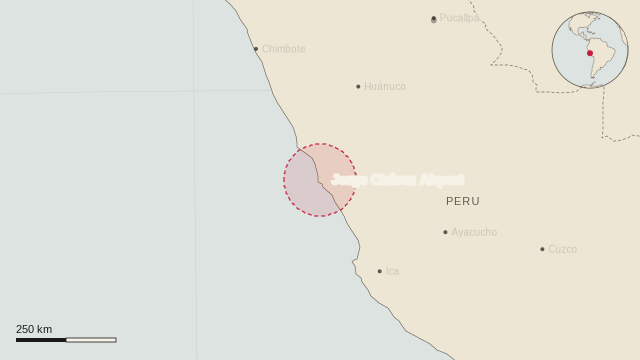
2023–2024·Jorge Chávez Airport, Callao (Lima), Peru
Alleged extraterrestrial beings·Nazca mummies
Peru.Nazca mummies · two figures seized at Lima airport
In October 2023, DHL workers at Lima's Jorge Chávez Airport found two clothed, mummy-like figures in a box bound for Mexico, and Peru's Ministry of Culture seized them as possible pre-Hispanic remains. On January 12, 2024, the Institute of Legal Medicine of Peru's Public Ministry presented its forensic findings: according to the ministry, they were dolls made of mammal skulls and bird bones held together with modern glue. They are not the "Nazca" bodies Jaime Maussan showed Mexico's Congress in September.
Tier A · AcceptableCryptidWhat do they mean? →
Institutional evidence: several identified independent witnesses, or contemporary official documentation, without an instrumental record to corroborate them.
What it was
97%hoax
The most likely explanation.
- 97% hoax
- 3% unexplained
See the split across the six explanations
Known cause (ordinary or hoax)97%
Unexplained3%
Separate collection: these figures do not count toward the UAP case totals. How it is split →
Cause the sources propose: hoax
What happened
In October 2023, workers in the export section of the courier company DHL were checking shipments at its cargo warehouse in Callao, the city next to Lima that is home to Jorge Chávez International Airport. In a cardboard box, under some sponges, they found two small figures. According to Peru's Ministry of Culture, they were two dolls dressed in cloth and wearing shoes trimmed with glitter and lace ribbons, assembled from what looked like archaeological bone remains. The workers alerted customs officers of Peru's tax and customs agency (Sunat) and the ministry's specialists. The shipment's routing sheet listed the sender as a man living in Palpa, in the Ica region, and the recipient as a woman in Mexico.
Specialists from the Recovery Unit, the ministry's office at the airport, drew up an official record, seized the pieces and took them to the ministry's headquarters for evaluation. Culture Minister Leslie Urteaga visited the DHL warehouse, and on October 14 the ministry announced the seizure as an attempt to smuggle out remains "presumably of pre-Hispanic origin." That statement does not say on what day the box was found, and the other sources disagree. The radio network RPP dates the find to October 10. The ministry's January 2024 statement puts the seizure in "October 2023," and the state news agency Andina on September 22, three weeks before the ministry's announcement.
The box turned up shortly after a widely covered hearing. On September 12, Mexican journalist Jaime Maussan had shown Mexico's Chamber of Deputies two small bodies with elongated heads and three-fingered hands that, he said, had been found in the Nazca region and were not human (↗ Mexican Congress). According to the official newspaper El Peruano, Minister Urteaga said after appearing before a committee of Peru's Congress that no Peruvian scientific body had confirmed that they were nonhuman remains. According to the news site Exitosa, she also recalled that the ministry had filed a criminal complaint over "the removal of pre-Hispanic property" against people said to be connected with those who showed the bodies in Mexico.
On January 12, 2024, the Institute of Legal Medicine and Forensic Sciences, the forensic service of Peru's Public Ministry (the national prosecutor's office), presented the results of its examination in the auditorium of the National Museum of Archaeology, Anthropology and History of Peru, in Lima's Pueblo Libre district. Evelyn Centurión, head of recoveries, attended for the Ministry of Culture. The press accounts quote mostly the institute's forensic archaeologist, Flavio Estrada Moreno. According to Andina, he explained that the two pieces, labeled individual 1 and individual 2 in the report, were studied with X-rays, which show the inside without opening them, and that individual 2, which was intact, was left in its clothes because there was no need to remove them.
"We realized that the skull is that of a four-legged mammal from this planet and the body is made of the bones of a bird," Estrada said, according to the ministry's statement. He added that, compared with animal bones, the skull was the size of a camelid's, the group that includes the llama and the alpaca, whose remains are found "very commonly" in Nazca and in various cemeteries around the country. According to Andina, he also pointed to metal plates on the chest and abdomen, placed there to suggest something anomalous. The ministry's statement sums up the conclusion: the figures were not mummies but constructions shaped like a human body, made of animal bones held together with modern synthetic glue, and so they were not assembled in pre-Hispanic times.
Reports of the press conference do not describe the materials in the same way. According to the EFE news agency, in the version run by the newspaper Gestión, the reports presented listed camelid bones, wool, polypropylene, rubber, textile fibers and glue, with a piece of plastic stuck on the back as if it were skin. EFE calls the institute's forensic pharmacist Humberto Ávalos; RPP calls him Ernesto Ávalos, a pharmaceutical chemist. Another piece was shown at the same press conference: a three-fingered hand the ministry had held since 2019. The Associated Press, in the version run by the Canadian network Global News, attributes to the prosecutor's office the finding that the objects, including that hand, were made of paper, glue, metal and human and animal bones. The ministry's statement mentions human bones only in that hand.
The hand was also examined at the ministry's request. A private individual had given it to the ministry in April 2019, saying it came from Nazca. According to the ministry, it was made of human bones, cotton and glue; according to RPP, which quotes Ávalos, it also had a metal plate in the palm. Estrada summed up the whole set in words reported by EFE and Global News: "They are not extraterrestrials, they are not intraterrestrials, they are not a new species, they are not hybrids, they are none of the things this group of pseudoscientists, who for six years have been presenting these objects, say they are." He named no one, according to EFE. "This, in simple terms, is a fraud," he also said.
Where it happened
Why it matters
The two Lima figures are not the bodies Maussan showed in Mexico. Those were presented by Maussan to a foreign Congress, backed by his own analyses. The Lima figures were seized by the Peruvian state with an official record, stayed in its custody and were examined by its forensic service, which gave the results in public with the examiners present. According to Global News and Voice of America, the experts did not say that the DHL dolls were connected with the bodies in Mexico, though they repeated that those were not extraterrestrial either. The two sets of figures look alike and are said to come from the same area, between Palpa and Nazca, but they are different objects.
It was not the first examination of its kind. In 2017, when similar "Nazca" figures first circulated, a report by Peru's prosecutor's office described them as "recently manufactured dolls" covered with a mixture of paper and synthetic glue to simulate skin, according to the quote reported by AP. The 2024 conclusion is the same, but this time about pieces the state held from the moment they were found, with a known chain of custody: the DHL box, the ministry's record and the laboratory of the Institute of Legal Medicine. Estrada did not say whom he meant by "this group of pseudoscientists," but his "six years" match that series, known since 2017.
The examination leaves questions open. No published copy of the forensic report is known: what is known of it comes from the ministry's statement and from reports of the press conference, which do not agree on every material or on the pharmacist's first name. According to the ministry, finding out whether the bones came from animals of pre-Hispanic times would take another test, such as carbon-14 dating: the modern glue dates the assembly, not the bones. And according to AP, it had not yet been determined in January who owned the objects.
For the Peruvian authorities, this was above all a heritage case. From the start the ministry treated it as possible trafficking in archaeological remains, and at the presentation its head of recoveries stressed the controls against the illegal export of cultural property. Estrada, according to EFE, said that "pseudoscience distorts the history" of the country and that those who had promoted the idea of alien help had "some economic interest." It remains to be seen whether anyone was ever held to account for the DHL shipment: the criminal complaint the minister mentioned in September concerned the bodies shown in Mexico.
Documents and sources
Documented evidence
- Peru's Ministry of Culture statement, October 14, 2023: Minister Leslie Urteaga verified at DHL's Callao warehouse the seizure of two dolls assembled from presumed archaeological bone remains, found in a cardboard box by export staff; sender living in Palpa (Ica), recipient in Mexico; specialists from the airport Recovery Unit drew up the official record.
- Date of the find or the seizure in each source: October 10, 2023, for the find (RPP); October for the seizure (Ministry of Culture statement of January 12, 2024, AP and Voice of America); September 22 for the seizure (Andina, January 12, 2024). The ministry's October statement gives no day.
- Minister Urteaga's remarks after the Maussan hearing: no Peruvian scientific body had confirmed that the bodies shown in Mexico were nonhuman remains, and a criminal complaint over the removal of pre-Hispanic remains was under way. El Peruano (with reporting from Andina) places her words on a Thursday, after the Economy Committee; Exitosa published them on September 13, 2023, on her way out of the Budget Committee.
- Ministry of Culture statement of January 12, 2024: the Institute of Legal Medicine and Forensic Sciences presented at the National Museum of Archaeology, Anthropology and History of Peru, with head of recoveries Evelyn Centurión, the results on the "presumed humanoid mummies" and a three-fingered hand; the figures are constructions of animal bones and synthetic adhesives, and dating the bones would take a test such as carbon-14.
- Andina, January 12, 2024: according to Flavio Estrada, the pieces, labeled individual 1 and 2, were studied with X-rays; individual 2 was intact and was not undressed; the skull is that of a four-legged mammal and the body is made of bird bones, with metal plates on the chest and abdomen.
Show 3 more facts
- EFE in Gestión, January 12, 2024: the reports presented with forensic pharmacist "Humberto Ávalos" list camelid bones, wool, polypropylene, rubber, textile fibers, glue and a piece of plastic on the back as skin. RPP calls the same expert Ernesto Ávalos, a pharmaceutical chemist, and attributes to him that the hand had a metal plate in the palm.
- Global News, with reporting from AP and Reuters, January 15, 2024: the prosecutor's office said the objects (two dolls and a three-fingered hand) were made of paper, glue, metal and human and animal bones; the dolls were about two feet (some 60 cm) long; their owner had not been determined; the experts did not link them to the bodies in Mexico. AP's original story of January 12 mentions the bones of birds, dogs and other animals and does not include that last point, which Voice of America does report.
- The three-fingered hand was handed to the Ministry of Culture by Germán Ronceros in April 2019; according to the January 12, 2024, statement, it is made of human bones, cotton and glue.
Sources
- Peru's Ministry of Culture, "Especialistas del Ministerio Público confirmaron que momias incautadas en el aeropuerto Jorge Chávez no son reales" (January 12, 2024) — Official source for the forensic results: the Institute of Legal Medicine's conclusions, Flavio Estrada's words and the examination of the three-fingered hand.
- Peru's Ministry of Culture, "Incautan restos óseos de presunto origen prehispánico que iban a ser enviados ilícitamente a México" (October 14, 2023) — Official source for the seizure at the DHL warehouse: how the pieces were found, the sender and recipient, and the Recovery Unit's record.
- Andina news agency, "Perú: Peritaje desmiente que 'momias humanoides' sean reales" (January 12, 2024) — State news agency: the X-rays, individuals 1 and 2 and the metal plates, in Estrada's words. Gives September 22 as the date of the seizure.
- EFE news agency, "Perú tilda de fraude supuestas momias de extraterrestres que iban a ser enviadas a México," in Gestión (January 12, 2024) — Account of the press conference: Estrada's remarks on fraud and pseudoscience and the list of materials in the reports.
- Michelle Butterfield, "'Totally made up story': Mystery of Peru 'alien' corpses finally solved," Global News, with reporting from The Associated Press and Reuters (January 15, 2024) — What the prosecutor's office said about the materials, the size of the dolls, the undetermined owner, the lack of a link to the bodies in Mexico and the quote from the 2017 report.
- RPP, "Momias Nasca de presunto origen extraterrestre son falsas, concluye peritaje del Ministerio Público" (January 12, 2024) — Gives October 10 as the date of the find and attributes the metal plate in the hand to Ernesto Ávalos.
- Voice of America, "Perú niega que 'muñecos humanoides' incautados tengan origen extraterrestre" (January 12, 2024) — Account of the press conference: the experts did not link the DHL dolls to Maussan's bodies.
- El Peruano, "Mincul: ninguna entidad científica peruana respalda hallazgo de momias de 'seres no humanos'" (September 14, 2023) — The state's official newspaper, with reporting from Andina: Minister Urteaga's words after the Mexico hearing and the criminal complaint under way.
- Exitosa, "Mincul sobre 'seres no humanos' expuestos en México: hay una denuncia penal contra los que facilitaron cuerpos" (September 13, 2023) — The minister's literal words on the subject of the complaint: the removal of pre-Hispanic property.
Referenced by 2 cases
Related cases
Cases this case cites and cases with the same likely cause.
Associated actors (1)
