2007·Cuero, DeWitt County, Texas
Chupacabras·Chupacabra
United States.Cuero chupacabra · a lab analyzes a hairless animal
In July 2007, Phylis Canion and some of her neighbors found three dead animals of about 40 pounds near her ranch in Cuero, in South Texas. Canion suspected that hers, with grayish-blue, mostly hairless skin, was the chupacabra that had been killing her chickens, and kept its head in her freezer. The KENS 5 television station took a sample to Texas State University, and on November 1 the university announced that, according to biologist Michael Forstner's laboratory, its mitochondrial DNA was a virtually identical match to the coyote. The cause of the hair loss was left to further tests.
Tier A · AcceptableCryptidWhat do they mean? →
Institutional evidence: several identified independent witnesses, or contemporary official documentation, without an instrumental record to corroborate them.
What it was
95%ordinary cause
The most likely explanation.
- 95% ordinary cause
- 5% unexplained
See the split across the six explanations
Known cause (ordinary or hoax)95%
Unexplained5%
Separate collection: these figures do not count toward the UAP case totals. How it is split →
Cause the sources propose: ordinary cause
What happened
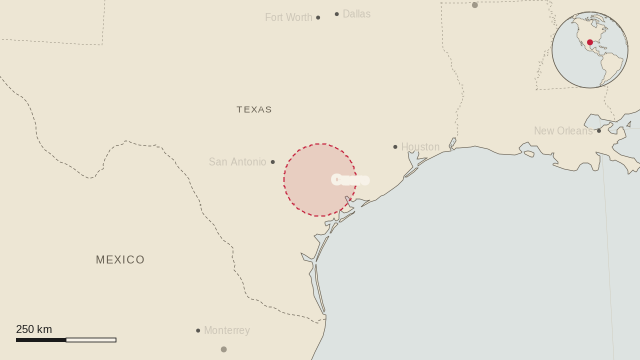
In July 2007, Phylis Canion and some of her neighbors found three dead animals of about 40 pounds, over four days, near her ranch outside Cuero, a small town in DeWitt County, in South Texas. The Associated Press reported it on August 31. Canion, a lifelong hunter, told the AP she had never seen anything like it. According to the AP, the head had big ears, large fangs and grayish-blue, mostly hairless skin. The AP calls Canion's find roadkill outside the ranch, and CBS places the bodies on a road outside it; the release Texas State University published the same day, August 31, says Canion found hers in late July on her property and picked it up off Highway 183.
Canion suspected it was the chupacabra, the "goat sucker" of a legend from Puerto Rico and Mexico, which kills livestock and drinks their blood. She told the AP that over the previous two years something had killed as many as 26 of her chickens without eating them or carrying them off, and had drained all their blood. According to the university's release, she also said the animal had killed many cats in the area. She thought heavy rains had driven the animals out of their dens and that hers might have some wolf in it. She took the head of the animal she had found and kept it in her freezer: she wanted to learn what it was through DNA and then mount it on her wall.
Travis Schaar, a veterinarian at the Main Street Animal Hospital in nearby Victoria, had seen Canion's find and told the AP it was probably a strange breed of dog, one that might let its prey bleed out and lick up the blood. Meanwhile, Canion was selling $5 T-shirts that read "2007, The Summer of the Chupacabra, Cuero, Texas."
Canion called KENS 5, the San Antonio station affiliated with the CBS network, and the station sent a tissue sample to Texas State University, in San Marcos. The August release, written by Marc Speir, says the biology department had received the remains but not the skull, which was still at Canion's home. From the pictures, biologist Michael Forstner already saw a canid, a member of the dog family, and ruled out a new life form.
On Thursday, November 1, 2007, the university announced the result. According to the release, reporter Joe Conger of KENS 5 had handed the sample to John Baccus, director of the Wildlife Ecology program, and Baccus passed it on to Forstner's laboratory. The station paid for the test. Forstner assigned the work to doctoral student Jake Jackson and master's student Jim Bell, and Jackson extracted the DNA. The team amplified a fragment with PCR, a technique that copies DNA so it can be read, and sequenced it. The researchers chose the control region of the mitochondrial DNA, which Forstner said is very informative in mammals.
The comparison with GenBank, the public database of genetic sequences, gave the answer. Forstner said there were other analyses, but that the first match settled it. The sequence was a virtually identical match to the coyote (Canis latrans). He himself had expected a domestic dog. The DNA did not explain why the animal had no hair: Forstner said they had taken more skin samples to look for the cause. Neither the release nor CBS's November 2 story gives the results of those tests.
By late August, the case was already known across the country. According to the August release, it had reached radio shows from Los Angeles to New York and comedian Jimmy Kimmel's monologue. CBS reported, citing KENS, that the interest reached as far as Saudi Arabia, and that in October hundreds of Cuero High School students wore T-shirts with the creature on a "Chupacabra Day."
A year later, the chupacabra came back to Cuero in another animal. On August 13, 2008, Scientific American's news blog reported that a sheriff's deputy in training, Brandon Reidel, had caught it on video, without saying when. In the video, the animal appeared to have a long snout, front legs slightly shorter than its hind legs and short hair. Two days later, the same blog quoted Scott Henke, a biologist at Texas A&M University-Kingsville. Although it was hard to identify from the tape, Henke said it was a dog, perhaps a bullmastiff, a pit bull or a mutt, because coyotes run more gracefully.
Where it happened
Why it matters
Forstner said it in the November release: genetic material from an animal linked to a legend is rarely available. The release adds that what usually turns up is blurry photos, low-light video and other evidence that cannot be tested. In Cuero there was a head in a freezer, and the sample can be traced from start to finish: the head Canion kept, the sample the KENS 5 reporter carried, the program director who received it and the two students who sequenced it, with the method described.
The result has limits that the sources themselves reveal. Mitochondrial DNA is inherited only from the mother, so the test shows the animal's maternal line, not whether it also had dog ancestry. The release does not publish the sequence, the percentage of the match or a GenBank accession number, and it does not say what the other analyses were. Of the three animals the AP says were found in July, the sources speak of only one sample, from Canion's animal. The sources also differ on minor details: the August release and the AP spell her name Phylis, and the November release Phyllis; the AP puts Cuero 80 miles (128 km) southeast of San Antonio, and the CBS story 90 miles (about 145 km).
For the missing hair, a state wildlife biologist offers an ordinary explanation. In September 2010, Texas Parks & Wildlife magazine quoted John Young, a mammalogist with the state's Parks and Wildlife Department. According to Young, chupacabras were the most reported cryptid in Texas, and every dead one that had been examined had turned out to be a coyote or a fox with mange. Mange, he explained, can leave a coyote with no hair at all and with grayish-blue skin, and the sun dries the body out and pulls back the skin of the mouth, so the teeth look bigger. That is the look the AP described in 2007, although the article does not mention Cuero.
The case also shows how the label sticks to different animals. Schaar thought it was a dog, Forstner expected a dog and the DNA came back coyote; a year later, Henke saw a dog in Reidel's video. What ties the Cuero stories together is a look, a hairless or thin-haired canid, and not a species.
Documents and sources
Documented evidence
- Texas State University, release by Marc Speir (August 31, 2007): Canion found a blue-skinned carcass in late July and picked it up off Highway 183; KENS 5 sent a tissue sample to the biology department, which did not have the skull. Forstner: from the pictures, a canid; the tests were already under way on a Beckman Coulter CEQ 8800 sequencer.
- AP, story by Elizabeth White (August 31, 2007): over four days in July, Canion and some neighbors found the bodies of three animals of about 40 pounds near her ranch; Canion suspected one had killed as many as 26 of her chickens in two years. Veterinarian Travis Schaar, of Victoria, thought it was a strange breed of dog.
- Texas State University, release posted by Jayme Blaschke (November 1, 2007): the sample went from Joe Conger (KENS 5) to John Baccus and on to Michael Forstner's laboratory; Jake Jackson and Jim Bell did the work; KENS 5 paid for the test. Method: DNA extraction, PCR, automated sequencing of the control region (D-loop) of the mitochondrial DNA and comparison with GenBank.
- The same release: the sequence was "a virtually identical match to DNA from the coyote (Canis latrans)"; more skin samples were taken to look for the cause of the hair loss. CBS/AP (November 2, 2007) reports the Thursday announcement and gives no results for those samples.
- Scientific American news blog, David Biello (August 13 and 15, 2008): a sheriff's deputy in training, Brandon Reidel, filmed a short-haired animal in Cuero; biologist Scott Henke, of Texas A&M-Kingsville, said from the video that it was a dog.
- Texas Parks & Wildlife, article by Mike Cox (September 2010): mammalogist John Young, of the Texas Parks and Wildlife Department, said every dead "chupacabra" examined had been a coyote or a fox with mange. He added that when genetic testing comes back "only 99 percent coyote," some people take it as proof of something different, "but that other 1 percent is dog."
Sources
- Texas State University, "Texas State researchers solve mystery of Cuero chupacabra," press release posted by Jayme Blaschke (November 1, 2007) — Primary source for the result: chain of the sample, names of the team, method and conclusion. Read in the Wayback Machine copy of December 4, 2024.
- Texas State University, Marc Speir, "Chupacabra? Texas State testing DNA of strange Cuero creature," news release (August 31, 2007) — Read in the Wayback Machine copy of May 16, 2008. Gives the find as Canion told it and the arrival of the sample at the laboratory.
- Elizabeth White (AP), "Monster or dog? 'Goatsucker' tale debated," on NBC News (August 31, 2007) — The three animals found in July, the chickens, veterinarian Travis Schaar's view and the T-shirts.
- CBS/AP, "It's Not 'Chupacabra,' Just A Coyote," CBS News (November 2, 2007) — Reports the university's announcement and Cuero High School's "Chupacabra Day." It spells her name Phylis, like the AP and the August release.
- David Biello, "Chupacabra strikes Texas town?" Scientific American news blog (August 13, 2008) — The 2008 video shot by sheriff's deputy Brandon Reidel.
- David Biello, "Texas biologist: Cuero chupacabra is a pit bull," Scientific American news blog (August 15, 2008) — Biologist Scott Henke's view of the 2008 video.
- Mike Cox, "What Was That? Tales of mysterious creatures abound in the land of chupacabras," Texas Parks & Wildlife Magazine (September 2010) — Mammalogist John Young's view on mange; it does not mention Cuero.
Context (not images of the event)
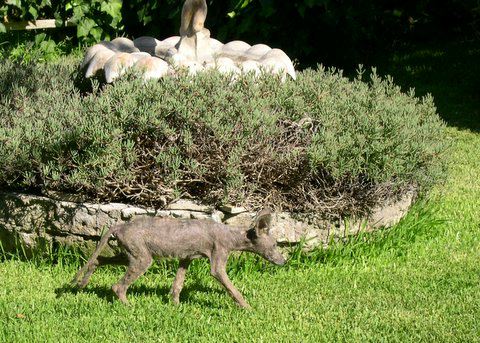
A young coyote with sarcoptic mange: another animal, not the one from Cuero
A young coyote left almost hairless by sarcoptic mange, a skin disease caused by mites. It is a live animal, so it is not the one from Cuero: it is shown because a mammalogist with the Texas Parks and Wildlife Department attributes the look of supposed chupacabras to mange, and the 2007 sources do not give the results of the skin tests on Canion's animal.
Read more
The photo was uploaded to the English Wikipedia on September 2, 2007, as an image from the media archive of Wildlife Services, part of the U.S. Department of Agriculture, and moved to Commons in 2008. No place or date is given, and since 2009 the Commons page has read only "El Chupacabra." Its license tag lists it as the work of a federal employee, in the public domain.
U.S. Department of Agriculture, Wildlife Services (media archive), via Wikimedia Commons, "File:Coyote with mange.jpg" · Public domain · US Government work · open original
Referenced by 1 case