1995·Orocovis, Canóvanas and Yabucoa, Puerto Rico
Chupacabras·Chupacabra
Puerto Rico, U.S..Puerto Rico chupacabra · dead animals and armed hunts
In March 1995, eight sheep, a cow and a bull were found dead in Orocovis, in central Puerto Rico. According to the writer Luis Alfonso Gámez, who summarized an EFE dispatch, the police blamed stray dogs. In August the deaths continued in Canóvanas, where Madelyne Tolentino described a creature walking on two legs and residents named it the chupacabras. The mayor, José "Chemo" Soto, organized armed hunts. In early December, an EFE dispatch reported that a police officer in Yabucoa had shot a rhesus macaque he mistook for the creature. No published necropsy is known.
Tier B · IndicativeCryptidWhat do they mean? →
Limited evidence: it falls short of what Tier A requires. Any one of these is enough: a single testimony (or several witnesses who saw it together), testimony gathered years later, or an account without contemporary primary documentation.
What it was
82%ordinary cause
The most likely explanation.
- 82% ordinary cause
- 3% other known cause
- 15% unexplained
See the split across the six explanations
Known cause (ordinary or hoax)85%
Unexplained15%
Separate collection: these figures do not count toward the UAP case totals. How it is split →
Cause the sources propose: ordinary cause
What happened
In March 1995, several farm animals were found dead in Orocovis, a municipality in the mountainous center of Puerto Rico. According to Luis Alfonso Gámez, a journalist and skeptic writer who traced the origin of the case in the magazine El Escéptico in the summer of 1999, they were eight sheep, a cow and a bull. Gámez relied on a dispatch from the EFE news agency filed by Claudio Matos on March 31, 1995, under the headline "Descartan seres extraños sean autores muerte de ganado" (strange beings ruled out as the killers of livestock). In his summary, the police and the authorities concluded that the livestock had been killed by "perros realengos," as stray dogs are called on the island, because the bites on the animals' necks and legs showed it. Some residents still blamed extraterrestrial beings.
In August, the deaths returned in Canóvanas, a municipality in the island's northeast, east of San Juan. Gámez counts 150 dead farm animals there. According to their owners, the carcasses were dry, without a drop of blood, and had small holes that they blamed on an unknown animal that sucked blood. Gámez places in September the moment when residents began to call it the chupacabras, the "goat sucker," for its taste for goats, and to describe it.
The first description came from Madelyne Tolentino, who lived in the Campo Rico neighborhood of Canóvanas. Benjamin Radford, a skeptical investigator who interviewed her in 2010, places her encounter on a weekday in the second week of August 1995, between 1 and 4 p.m., through the window of her mother's house. In a March 1996 interview with a group of Puerto Rican UFO researchers, which Radford quotes, Tolentino described a creature about four feet (1.2 meters) tall that walked on two legs, with three long fingers and something like feathers on its back. In 2010 she told Radford it was about three feet tall and had five fingers with nails like a person's. According to Radford, no one called the police or the press at the time, and the story appeared more than a month later in the tabloid El Vocero and on the radio.
The mayor of Canóvanas, José "Chemo" Soto, organized search parties to hunt the creature. According to Gámez, up to two hundred hunters took part in some of them, none succeeded, and Soto defended them this way: "Today it attacks animals, but tomorrow it could attack people." In May 1996, the journalist Robert Friedman wrote in The San Juan Star that people in town called the mayor "Chemo Jones" for his weekly chupacabra hunts through the hills, with a caged goat as bait. According to Friedman, Soto gave that warning on El Show de Cristina, a Miami talk show broadcast throughout Latin America: "Whatever it is, it's highly intelligent. Today it is attacking animals, tomorrow it may be attacking people."
On December 8, 1995, the Colombian newspaper El Tiempo ran an EFE dispatch headlined "A la caza del chupacabras" (hunting the chupacabras). It said that in recent weeks residents of two Puerto Rican municipalities had been chasing a creature that killed domestic animals by sucking their blood and left a pair of wounds on their necks. Some described it as an extraterrestrial, others as a "diabolical malformation" with long hair all over its body, a red crest and sharp claws. The dispatch also cited the newspaper El Vocero: Scott Rapoport, chief correspondent of the American program Inside Edition, had met with Soto to organize an expedition of 200 local guides who knew the terrain. The dispatch attributes the program to the NBC network.
The same dispatch reported the latest news from the hunt. In Yabucoa, in the east of the island, the area with the most reports of the supposed chupacabras, police officer Pedro Julio Vega had shot dead a rhesus macaque after mistaking it for the creature. Some veterinarians pointed out that a macaque's bite did not match the two-tooth wounds on the dead animals. The dispatch gives no date for the shooting and does not say where the monkey came from.
The chief veterinarian of the Department of Agriculture also pointed to dogs, according to Jorge Martín, a Puerto Rican UFO researcher, editor of the magazine Evidencia OVNI and an advocate of a non-terrestrial origin for the creature. According to Martín, Héctor García, director of the Veterinary Services Division of the Puerto Rico Department of Agriculture, said "it could be dogs," that the small puncture wounds on the necks were similar to those left by a dog's fangs, and that his division had seen nothing unusual in the animals it examined, including no loss of blood. Martín also quoted veterinarian Ángel Luis Santana, of the private Gardenville Clinic in San Juan, who said the culprit could be a member of a religious sect, another animal, or someone who wanted to make fun of the Puerto Rican people.
Where it happened

Why it matters
The events of 1995 are the origin of the chupacabras: of its name, of its first description and of a pattern that later repeated in other countries. By May 1996, according to Friedman, it was already blamed for victims in the Dominican Republic, Costa Rica, Mexico and Miami. In the Sweetwater neighborhood of South Miami, 69 goats, chickens, geese and ducks died in a single night; Miami police and a local zoologist blamed a large dog, while residents blamed the chupacabras. In 2007, in Texas, the DNA of a hairless animal also called a chupacabra turned out to be a coyote's ↗ Cuero chupacabra.
The record of the Puerto Rican case is weaker than the Texas one. No specimen was examined: the only animal killed that the EFE dispatch reports is the Yabucoa macaque, and no published analysis of its body or published necropsy of the dead animals is known. The authorities' judgment comes secondhand: that of the Orocovis police through Gámez's summary of the EFE dispatch, and that of the Department of Agriculture through a quotation by Martín, who rejected that conclusion. Gámez adds that scientists blamed the Canóvanas attacks on feral dogs or on exotic animals brought illegally to the island, such as panthers, and that examinations of the bodies showed no single pattern, but bites, injuries and infections.
According to Radford, UFO researcher Jorge Martín's famous drawing of the creature was presented as based on Tolentino's description, and he argues that she took that description from Sil, the monster in the film Species, released in 1995. He also notes that her two accounts do not match: in the 1996 version, her mother ran after the creature and a young man caught it and pried its mouth open; in the 2010 version, mother and daughter stayed inside the house and the young man never saw it. Gámez points to another reason the case spread: in his view, with municipal elections a few months away, the hunts helped the mayor divert attention from the town's problems, with areas that had been without water for weeks.
The chupacabras also had forerunners on the island. Marvette Pérez, an Arecibo-born curator of Hispanic history at the Smithsonian's National Museum of American History, reminded Friedman of the Moca vampire, which a couple of decades earlier had sucked the blood of animals around that mountain town, and saw a phenomenon of the Spanish-speaking Caribbean: "It's part of our folklore," she said, adding that the chupacabras had not appeared on the English-speaking islands.
Documents and sources
Documented evidence
- Luis Alfonso Gámez, "El viaje trasatlántico del 'chupacabras'," El Escéptico no. 5 (summer 1999), p. 58: in March 1995, in Orocovis, eight sheep, a cow and a bull died; the police and the authorities blamed stray dogs because of the bites on the necks and legs. He cites an EFE dispatch by Claudio Matos of March 31, 1995.
- The same article: in August 1995, 150 farm animals died in Canóvanas; in September residents named the supposed predator the chupacabras. Mayor José Soto Rivera organized search parties of up to two hundred hunters. Héctor García, of the veterinary division of the Department of Agriculture, saw nothing extraordinary in the deaths (according to Robert Todd Carroll).
- EFE in El Tiempo (Bogotá), "A la caza del chupacabras" (December 8, 1995): residents of two municipalities were hunting a creature that left two wounds on the neck; according to El Vocero, Scott Rapoport of Inside Edition was planning an expedition of 200 local guides with Mayor Soto; in Yabucoa, police officer Pedro Julio Vega killed a rhesus macaque he mistook for the chupacabras.
- The same dispatch: some veterinarians noted that a rhesus macaque's bite did not match the two-tooth wounds on the dead animals.
- Jorge Martín, editor of Evidencia OVNI, in an article reproduced on The Chupacabra Home Page run by Princeton students: Héctor García, director of the Veterinary Services Division of the Department of Agriculture, said "it could be dogs" and that his division saw nothing unusual in the animals examined, including no loss of blood. Martín also quotes veterinarian Carlos Soto, who saw a regular pattern in the wounds, and says a blood sample from Campo Rico matched no known species, without naming the laboratory.
Show 2 more facts
- Robert Friedman, The San Juan Star (May 6, 1996): Soto held weekly hunts with a caged goat as bait and warned that the creature was "highly intelligent"; in Sweetwater (Miami), police and a zoologist blamed a large dog for the deaths of 69 animals.
- Benjamin Radford, Skeptical Inquirer (May/June 2025): Madelyne Tolentino saw the creature in Campo Rico (Canóvanas) in the second week of August 1995; her 1996 account and the one she gave Radford in 2010 differ on its size, its fingers and the chase.
Sources
- EFE, "A la caza del chupacabras," El Tiempo (Bogotá), December 8, 1995 — Primary press source from the time: the hunt in two municipalities, the expedition Mayor Soto and Inside Edition were planning according to El Vocero, and the rhesus macaque shot by police officer Pedro Julio Vega in Yabucoa. The archive credits EFE.
- Luis Alfonso Gámez, "El viaje trasatlántico del 'chupacabras'," El Escéptico no. 5 (summer 1999), pp. 58-63 — The full issue of the magazine in the repository of ARP-Sociedad para el Avance del Pensamiento Crítico; the article starts on page 58. It summarizes Claudio Matos's EFE dispatch of March 31, 1995, on Orocovis, whose original could not be read.
- Luis Alfonso Gámez, "El viaje trasatlántico del chupacabras," Magonia (May 5, 2007) — The same text on the author's blog, with the full reference list: the text of a talk given in November 1998 in Santa Fe (Granada).
- Robert Friedman, "The chupacabra becomes a recurring legend," The San Juan Star, May 6, 1996 — Transcription on The Chupacabra Home Page, a site run by Puerto Rican students at Princeton University, with a few bracketed notes by the transcribers; Gámez cites the article from this same page. Soto's weekly hunts, his warning, the Sweetwater case and Marvette Pérez's view.
- Jorge Martín, "The Chupacabras Phenomenon," on The Chupacabra Home Page (undated) — An English version of a text by the UFO researcher, editor of Evidencia OVNI, who argues for a non-terrestrial origin. It is an excerpt Steve Wingate posted to the newsgroup alt.alien.visitors, credited to Graham Sheppard, and the events it describes date it to early 1996. It reports, in English, the statements of Héctor García, of the Department of Agriculture, and of veterinarian Ángel Luis Santana.
- Benjamin Radford, "Chupacabra Revisited: Dueling Origin Stories of the Hispanic Vampire," Skeptical Inquirer, vol. 49, no. 3 (May/June 2025) — Madelyne Tolentino's encounter according to her 1996 interview and Radford's own 2010 interview, and Radford's thesis about the film Species.
Context (not images of the event)
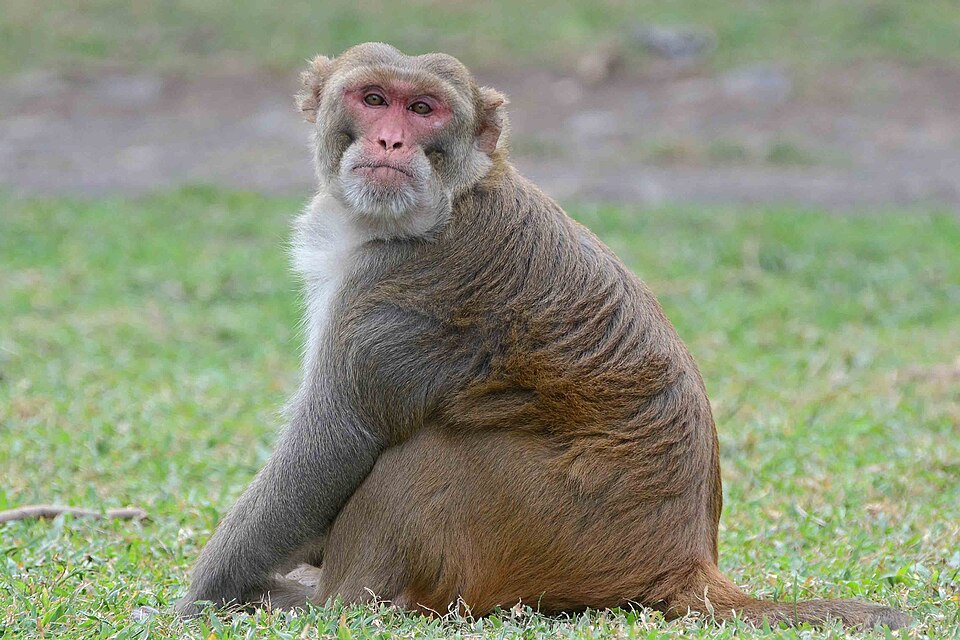
A rhesus macaque in eastern Puerto Rico: another animal, not the one from Yabucoa
A rhesus macaque sitting on the grass at Punta Santiago, in the municipality of Humacao, next to Yabucoa, photographed by Geoff Gallice on January 19, 2012.
Read more
It is not the 1995 monkey: it is shown because, according to an EFE dispatch published by El Tiempo on December 8, 1995, a police officer hunting the chupacabras in Yabucoa shot a macaque of this species. The photo was posted on Flickr under a CC BY 2.0 license and is hosted reduced to 960 pixels wide, with no other changes.
Geoff Gallice (Flickr), via Wikimedia Commons, "File:Macaca mulatta, Puerto Rico.jpg" · CC BY 2.0 · open original
Related cases
Cases this case cites and cases with the same likely cause.