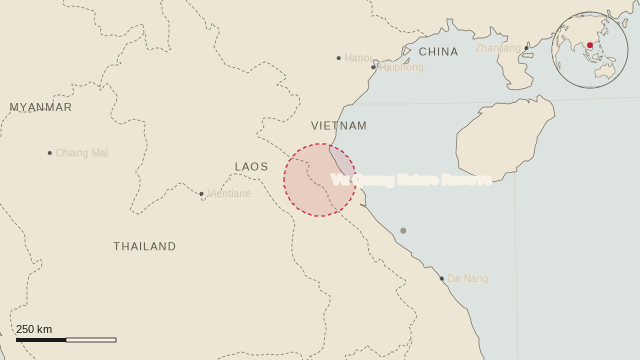
1992·Vu Quang Nature Reserve, Ha Tinh province, Vietnam
Discovered species·Saola
Vietnam.Saola · horns in hunters' homes reveal a new bovid
In May 1992, a team from Vietnam's Ministry of Forestry and the World Wide Fund for Nature (WWF) surveying the wildlife of the Vu Quang reserve, near the border with Laos, found, in hunters' homes, long, straight horns of a bovid that no one had described. With more than 20 specimens and DNA analysis, the journal Nature described it in June 1993 as a new genus and species, Pseudoryx nghetinhensis: the saola. According to a 2025 study that published the genomes of 26 individuals, no scientist has yet seen one alive in the wild.
Tier S · SolidCryptidWhat do they mean? →
Strong evidence: a contemporary instrumental record (radar, sensor, film or photo of known provenance) that corroborates several independent witnesses.
What it was
98%real species, now described
The most likely explanation.
- 98% real species, now described
- 1% other known cause
- 1% unexplained
See the split across the six explanations
Known cause (ordinary, hoax or species now described)99%
Unexplained1%
Separate collection: these figures do not count toward the UAP case totals. How it is split →
What happened
In May 1992, a joint team from Vietnam's Ministry of Forestry and the World Wide Fund for Nature (WWF) surveyed the Vu Quang Nature Reserve, in Ha Tinh province, in the north-central part of the country near the border with Laos. According to the scientific paper the team published the following year, it found three sets of long, straight horns in local hunters' homes. They came from a bovid, the family of cattle, goats and antelopes, that matched no known species. None of those remains still had its teeth.
A 2013 WWF publication by Elizabeth Kemf tells the story in more detail. On the last day of the survey, Vietnamese biologist Do Tuoc, of the Forest Inventory and Planning Institute in Hanoi, set out alone with a list of village hunters. In the first two houses he collected skulls of the animal, and in the third he saw a pair of unusual horns fixed to a wooden pillar. "The first time I saw them, I thought they must be from a new species," Tuoc recalls in the publication. To him they looked like the trophy of an Arabian oryx, a desert antelope, in the middle of a humid evergreen forest. Tuoc hurried to show the skulls and horns to his research partner, biologist John MacKinnon.
The sources do not tell that first find the same way. Press releases from the International Union for Conservation of Nature (IUCN) in 2012 and WWF in 2013 sum it up as a skull with horns seen in one hunter's home, and Smithsonian magazine wrote in 2008 that Tuoc first saw a partial skull mounted in a hunter's home in Vu Quang. The researchers' paper speaks of three sets of horns in several homes, and Kemf's account of remains in three houses. The press releases and the Smithsonian feature abbreviate; the detailed count is the one in the paper signed by the people who made the find.
According to the paper, Vietnamese scientists went back to the area four times after the first trip. In neighboring Nghe An province they found more places where the animal lived and some partial remains. In all, the authors examined more than 20 specimens: three with a complete upper skull and its teeth, two with a lower jaw and its teeth, and three complete skins. Kemf gives a slightly different figure for those trips, which she dates between May 1992 and early 1993: 20 specimens and one complete skin, which was stuffed and put on display at the Hanoi institute. She adds that tissue samples were sent to Denmark and the United States for testing, and that in March 1993 WWF and the Vietnamese government announced that the animal was a new genus.
On June 3, 1993, the scientific journal Nature published the description under the title "A new species of living bovid from Vietnam." It was signed by Vu Van Dung, Pham Mong Giao, Nguyen Ngoc Chinh and Do Tuoc, of the Hanoi institute, together with Peter Arctander and John MacKinnon. They wrote that the specimens were distinct in appearance, anatomy and DNA sequence, and could not be assigned to any known genus. Only two bovid genera were known from that part of Asia: Bos, the wild cattle, and Naemorhedus, the gorals and serows. They described a new genus and species, Pseudoryx nghetinhensis, and announced a three-month field study to observe the living animal.
At first it was called the Vu Quang ox. Later it took the name used by villages on both sides of the border, saola, which villagers quoted by Kemf say refers to the long, parallel posts that hold the spindle of a spinning wheel, much like its horns. In May 1994 a female calf was captured near Vu Quang, four or five months old and weighing 18 kilograms. It was taken on June 9 to the institute's botanical garden in Hanoi and died because of an unsuitable diet.
In 1996, a pregnant female was held in captivity in Bolikhamxay province, Laos. Biologist William Robichaud, later coordinator of the IUCN's saola working group, observed her and remembered her for her calm. According to Kemf, he watched her for three weeks, until she too died because of an unsuitable diet. According to the 2025 genetic study, local people caught more than 20 saola alive in the 1990s, and none survived in captivity.
According to the 2025 study, no scientist has observed a saola alive in its habitat, and by then automatic cameras had recorded it five times in Vietnam and Laos. According to the IUCN, cameras photographed it in Bolikhamxay in 1999, and in 2010 villagers in that province captured one that died a few days later. In September 2013, a camera set by WWF and Vietnam's Forest Protection Department in the Central Annamite Mountains photographed a saola; WWF announced it on November 12. According to Dang Dinh Nguyen, director of the saola nature reserve in Quang Nam, the last sighting in Vietnam had been in 1998.
In June 2025, the journal Cell published the genomes of 26 saola, by a team led from the University of Copenhagen. Most of the samples had been collected during the discovery and used in the 1993 description; they were mostly bits of skin, hair and bone from trophies in hunters' villages. The analysis placed the saola as a relative of cattle and the water buffalo, split from them about 14 million years ago. It found two very distinct populations, one in the north, including Vu Quang, and one in the south, mostly in Quang Nam province, which split and began to shrink between 5,000 and 20,000 years ago.
Where it happened
Why it matters
Hunters in the Annamite Mountains knew it, hunted it, named it and kept its horns as trophies, but its remains matched no described genus, according to the 1993 paper. It reached science through the horns and skulls hanging in those homes. Those remains, with their origin recorded by named scientists and examined through anatomy and DNA, were enough to describe a new genus before any researcher had seen the animal alive.
The chain of evidence has grown stronger over time. In 1993 the authors already set the saola apart from the two bovid genera known in the region by its anatomy and DNA. In 2025, the study published in Cell went back to most of those samples and confirmed with whole genomes that it is a lineage of its own among the bovids, related to cattle and buffalo. The 1993 paper presented it as the first comparable find of a large mammal in more than 50 years, since the kouprey, a wild ox from Indochina described in 1937.
Little is known about the living animal. According to the 2025 study, almost everything comes from remains, mostly skulls and a few skins, from accounts by people in the region and from the few camera-trap photos. Population figures are estimates: in 2012, Robichaud spoke of a couple of hundred if things were good and tens if they were bad, and the 2015 IUCN assessment, cited by the 2025 study, put it at 50 to 300. The sample records are also incomplete: a horn bought at a souvenir shop in Hue and logged as southern turned out to be genetically northern, and the authors think it most likely that someone moved it from there, possibly through the illegal wildlife trade.
The discovery had consequences beyond zoology. According to Smithsonian, the Vietnamese government created the Pu Mat and Vu Quang national parks in response to it. The main threat, according to the IUCN and WWF, is the wire snares that hunters set for deer and civets. The 2025 study calculates that bringing together animals from both populations in a captive breeding program would reduce the load of harmful mutations and improve the species' chances, if living animals can be found.
Documents and sources
Documented evidence
- Vu Van Dung, Pham Mong Giao, Nguyen Ngoc Chinh, Do Tuoc, Peter Arctander and John MacKinnon, "A new species of living bovid from Vietnam," Nature 363: 443–445 (published June 3, 1993): in May 1992, the joint Ministry of Forestry and WWF survey of the Vu Quang reserve (Ha Tinh) found three sets of long, straight horns in hunters' homes, without teeth; after four more visits, and with finds in Nghe An, the authors examined more than 20 specimens, including three complete upper skulls with teeth, two lower jaws and three complete skins.
- Nature 1993: the specimens differ in appearance, anatomy and DNA sequence from every known genus; only Bos and Naemorhedus (which then included Capricornis) were known in the region, so a new genus and species are described. The authors call it the first comparable find of a large mammal in more than 50 years, since the kouprey (1937).
- Elizabeth Kemf, "The Saola's Battle for Survival on the Ho Chi Minh Trail," WWF (August 2013): on the last day of the survey, Do Tuoc collected skulls in two hunters' homes and saw horns fixed to a pillar in a third; between May 1992 and early 1993, four more trips gathered 20 specimens and one complete skin; tissue samples were sent to Denmark and the United States, and the new genus was announced in March 1993.
- Kemf (WWF, 2013): a female calf captured near Vu Quang in May 1994, four or five months old and weighing 18 kilograms, arrived on June 9 at the botanical garden of the Forest Inventory and Planning Institute in Hanoi and died because of an unsuitable diet; in 1996, William Robichaud observed for three weeks a pregnant female held captive in Bolikhamxay (Laos), which died of the same cause. Smithsonian (2008) gives another account: she died 18 days after her capture, her pregnancy was discovered only then, and the cause of death could not be determined.
- IUCN, press release of May 21, 2012: the 1992 team found a skull with long, straight horns in a hunter's home; villagers in Bolikhamxay captured a saola in 2010 that died a few days later, and before that capture the last confirmed wild record was camera-trap photos from 1999 in the same province. Robichaud estimates a couple of hundred animals if things are good and tens if they are bad.
Show 2 more facts
- WWF, press release of November 12, 2013 (WWF-Canada copy): a camera set by WWF and the Forest Protection Department photographed a saola in September 2013 in Vietnam's Central Annamite Mountains; according to Dang Dinh Nguyen, of the saola reserve in Quang Nam, the last sighting in Vietnam dated from 1998.
- Garcia-Erill et al., "Genomes of critically endangered saola are shaped by population structure and purging," Cell 188: 3102–3116 (June 12, 2025): a reference genome and genomes of 26 saola from 31 samples, mostly those collected during the discovery and stored at the University of Copenhagen; the saola is related to cattle and the water buffalo, split from them about 14 million years ago; two highly differentiated populations, north and south (FST of 0.49), which split between 5,000 and 20,000 years ago.
Sources
- Vu Van Dung, Pham Mong Giao, Nguyen Ngoc Chinh, Do Tuoc, Peter Arctander and John MacKinnon, "A new species of living bovid from Vietnam," Nature 363: 443–445 (1993) — Primary source, paywalled; the opening paragraph, with the find and the specimen count, is open access on nature.com.
- Genís Garcia-Erill, Shanlin Liu, Minh Duc Le et al., "Genomes of critically endangered saola are shaped by population structure and purging," Cell 188: 3102–3116 (2025) — Open access (CC BY-NC-ND 4.0); full text consulted. Describes the origin of the samples and the genomic results.
- Elizabeth Kemf, "The Saola's Battle for Survival on the Ho Chi Minh Trail," WWF, Gland (August 2013) — WWF publication with the account of the find, the follow-up trips and the captive saola of 1994 and 1996.
- IUCN, "Saola still a mystery 20 years after its spectacular debut," press release (May 21, 2012) — Press release from the IUCN saola working group, WWF and the Wildlife Conservation Society: the 1999 and 2010 records and the population estimate.
- WWF, "Saola rediscovered! 'Asian Unicorn' sighted in Vietnam for first time in 15 years," press release (November 12, 2013), WWF-Canada copy in the Internet Archive — Copy of the WWF-Canada page archived on January 5, 2026.
- Richard Stone, "A Wildlife Mystery in Vietnam," Smithsonian Magazine (August 2008) — Background feature: the skull Do Tuoc saw, the origin of the name, the national parks created after the find and the captive saola, including two young animals handed to Tuoc in Hanoi in June 1993 that died of infections within months.
Context (not images of the event)
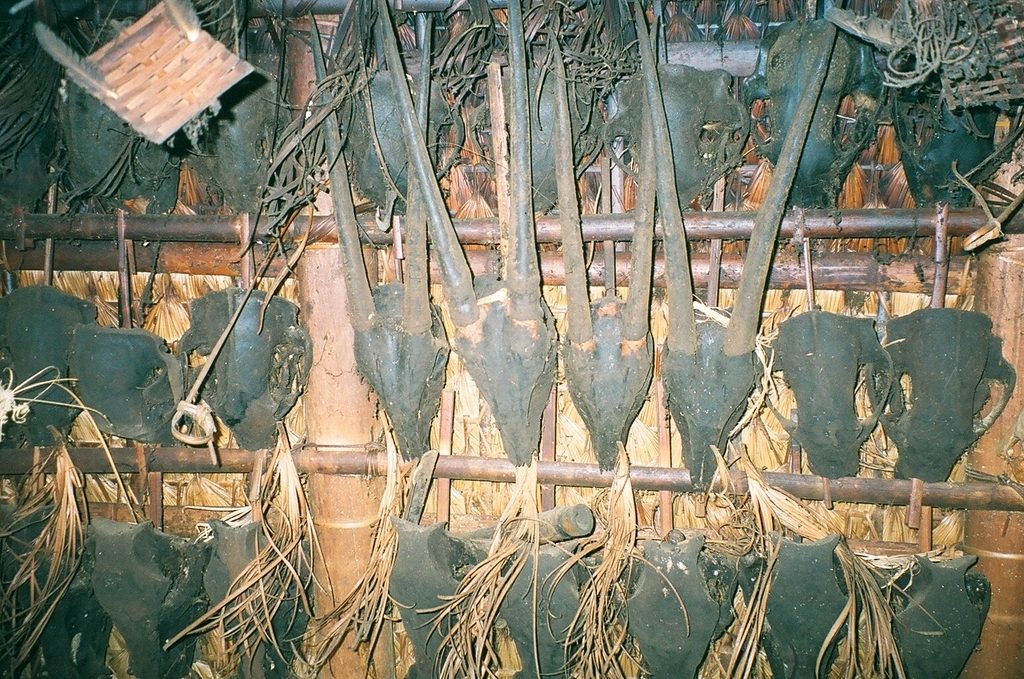
Saola skulls with horns kept as trophies in a hunters' home in Vietnam (2004)
A row of skulls with long, straight horns, hung in a dwelling alongside other trophies, like those scientists found in 1992.
Read more
James Hardcastle published it on iNaturalist, in an observation dated June 1, 2004, that also includes photos of a confiscated animal and of a field trip with forest rangers. According to his note, this and other photos come from interviews with Ka Tu hunters in the A Luoi and A Vuong districts, in central Vietnam, farther south than Vu Quang; the note gives the name Minh Hoang in parentheses and does not say who took each photo. Licensed CC BY 4.0; hosted recompressed, with no other changes.
James Hardcastle, iNaturalist, observation 255606, photo 318197 (via Wikimedia Commons, "Pseudoryx nghetinhensis 318197.jpg") · CC BY 4.0 · open original