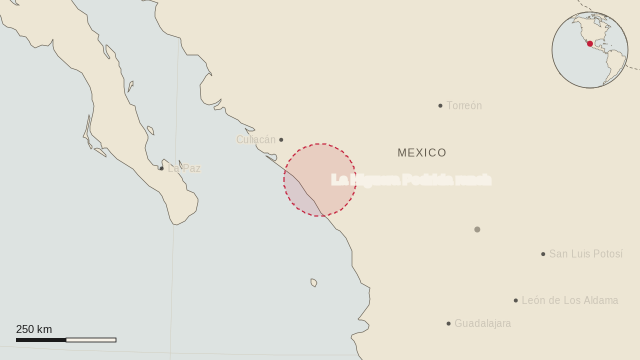
1986·La Higuera Podrida ranch, San Ignacio district, Sinaloa, Mexico
Alien big cats·Onza
Mexico.Sinaloa onza · DNA showed the cat a rancher shot was a puma
On the night of January 1, 1986, rancher Andrés Rodríguez Murillo shot a big cat near his ranch in the San Ignacio district of Sinaloa, Mexico. A neighbor, Manuel Vega, identified it as an onza, Mexico's supposed third big cat, leaner and longer-legged than the puma. The body was frozen in Mazatlán, where an American team including zoologist Troy Best dissected it in February. In 1996, an analysis of its mitochondrial DNA and proteins, carried out at the U.S. National Cancer Institute, concluded that it was a puma.
Tier S · SolidCryptidWhat do they mean? →
Strong evidence: a contemporary instrumental record (radar, sensor, film or photo of known provenance) that corroborates several independent witnesses.
What it was
94%ordinary cause
The most likely explanation.
- 94% ordinary cause
- 6% unexplained
See the split across the six explanations
Known cause (ordinary or hoax)94%
Unexplained6%
Separate collection: these figures do not count toward the UAP case totals. How it is split →
Cause the sources propose: ordinary cause
What happened
Farmers and ranchers in the Sierra Madre Occidental of northwestern Mexico speak of three big cats: the león (the puma), the tigre (the jaguar) and the onza, which they describe as puma-colored but leaner, longer-legged and more aggressive. Jesuit missionaries already set it apart from the puma in the 18th century, and in 1961 Arizona hunter Robert Marshall devoted a book to it, "The Onza." In October 1985, Marshall and J. Richard Greenwell, secretary of the International Society of Cryptozoology, based in Tucson, Arizona, traveled to Sinaloa. There, rancher Ricardo Urquijo Jr. lent them the skull of a supposed onza that Jesús Vega had killed about ten years earlier.
According to the society's newsletter for spring 1986, on the night of January 1 that year Andrés Rodríguez Murillo, owner of the small La Higuera Podrida ranch in the San Ignacio district, was hunting deer with Ricardo Zamora about 4 kilometers from his house, in a valley behind Cerro del Perico. At about 10:30 p.m., by the light of a lantern, they saw the eyes of a large animal shining and first took it for a deer. At about 15 meters, the crouching outline looked like that of a big cat, and Rodríguez, afraid it was a jaguar about to charge, shot it. When they looked it over, the two men concluded that it was not a jaguar and did not look like a puma either.
Rodríguez remembered the visit of the two Americans and their interest in unusual cats. The men got back to the ranch at about 1 a.m. and sent word to another rancher, Manuel Vega, an experienced hunter, who came that same night and at once identified the animal as an onza: he said it was almost identical to one his father, Jesús Vega, had killed. At daybreak, Vega went to Coyotitán, next to the Urquijo family's San Miguel ranch. Ricardo Urquijo Sr., a former mayor of Mazatlán, had the body collected, and that afternoon another of his sons, Rafael, drove it to Mazatlán, about two hours away, where it went into the freezers of a fishing company. About 17 hours passed between the animal's death and its freezing.
Greenwell planned the dissection with Troy Best, a mammalogist at the University of New Mexico who had measured some 1,600 puma skulls in U.S. collections, and with Ned Gentz, a graduate student at the same university. Because a Mexican export permit was hard to obtain, they chose to work in Mexico and take only tissues and bones home on scientific loan. On February 20, 1986, with Rodríguez, Vega and Ricardo Urquijo Jr. watching, they opened the body at the Regional Diagnostic Laboratory of Animal Pathology in Mazatlán, part of Mexico's Ministry of Agriculture. It was a healthy female, at least 4 years old, that had given birth at some point and had deer hooves in her stomach.
The newsletter recorded what seemed to set her apart. She weighed about 27 kilograms, against 36 to 60 for an adult female puma; her total length, 186 centimeters, was normal for a female puma, but her tail, at 73, was very long for a female puma of her size. Her ears were about 10 centimeters long, long for a puma, and small horizontal stripes ran along the inside of her forelegs. Her body fat, modest but adequate, showed according to the newsletter that she was slender by nature and not a starving puma. In a comparison with three female pumas, which the newsletter called very preliminary and still speculative, her leg bones were as long as those of robust male pumas two to three times her weight. Best and Greenwell suspected a new species.
German mammalogist Helmut Hemmer, of Johannes Gutenberg University in Mainz, had proposed in 1984 that the onza might be a survivor of the Pleistocene North American cheetah, Acinonyx (Miracinonyx) trumani. Before the dissection, Greenwell had compared the Vega skull and an earlier onza skull, known as the Carpenter skull, with those fossils, held by paleontologist Daniel Adams at the University of California, and the differences ruled the idea out; Hemmer, who received casts of both skulls, agreed. In April 1986 he examined the bones of the Rodríguez animal in Tucson and, according to the newsletter, was convinced it was not a normal puma.
Then the study stalled. In winter 1988, the newsletter reported that researchers at Texas Tech University had compared onza tissue with that of pumas from Big Bend, Texas, by electrophoresis, a technique that separates proteins in an electric field, and had found no significant differences, though they sent no formal report with the data. Greenwell answered that the animal might still be a new species or a regional genetic quirk. The same issue reported that in early 1987 a Mazatlán hunter had killed another animal in the San Ignacio district that locals described as identical, a male, whose bones were thrown away.
The result came out in 1996 in Cryptozoology, the journal of the International Society of Cryptozoology, which sent every article to at least two outside reviewers. The authors were Peter Dratch, Wendy Roslund, Janice Martenson, Melanie Culver and Stephen O'Brien, of the U.S. National Cancer Institute in Maryland and the National Fish and Wildlife Forensics Laboratory in Ashland, Oregon. Best and Greenwell had sent them frozen liver, heart and blood. They cut mitochondrial DNA from the heart, the DNA passed down only from the mother, with 28 enzymes. The onza shared every fragment, 122 of 122, with four North American pumas; it shared 28.3% with the cheetah and 17.7% with the jaguar.
A 245-base-pair stretch of the mitochondrial ND5 gene was identical to that of more than 50 pumas from western North America. Because that DNA says nothing about the father, the onza could still have been the hybrid of a female puma and a male jaguar. The authors ruled that out with proteins, which carry both parents' inheritance: the onza's albumin matched 40 puma samples and not five jaguar or three cheetah samples, and they also cited the Texas electrophoresis, which they knew of through Greenwell. They concluded that "the 1986 Onza specimen was a puma, and did not represent a distinct, new, or relict species," most likely a puma adapted to the sierra, "or perhaps emaciated."
Where it happened
Why it matters
A land cryptid rarely leaves a whole body behind. The Rodríguez animal did: named zoologists measured and dissected it seven weeks after its death, and the analysis of its tissue was published with authors, methods and tables. The 1986 newsletter called it the first onza specimen available to science since the one hunter Dale Lee killed in 1938 for his client Joseph Shirk, a few miles from the same spot, whose skull was later lost. With DNA and proteins, the question the onza had posed for centuries finally got a testable answer for one particular animal: puma.
The two accounts the society published do not agree on everything. The 1996 paper, which sums up the event from the newsletter and from a 1987 piece by Greenwell in BBC Wildlife, says Rodríguez first took the animal for a jaguar and brought it to Vega's home; the newsletter, written a few months after the events, says he first thought he saw a deer and that Vega came to Rodríguez's ranch. The paper also credits Greenwell with showing that the 1986 specimen was not a Pleistocene cheetah, but according to the newsletter that comparison used two earlier skulls, before the dissection. None of these differences affects the genetic analysis, which used tissue from the 1986 animal.
The analysis speaks for this animal, not for every onza. The early suspicion rested on measurements: long legs compared with just three female pumas, long ears and stripes on the forelegs. No published study of its bones against a broad sample of pumas, like the one Best and Greenwell planned, has come to light, nor have the results of the hair and insulin tests announced in 1986. The 1996 authors' account of its leanness, a puma adapted to the sierra or an emaciated one, partly clashes with the dissection, which had found a healthy animal with adequate body fat.
Other physical evidence of unknown creatures has met the same end once it reached a laboratory, such as the samples attributed to the yeti (↗ Yeti): a known animal. It remains to be seen whether the other skulls attributed to the onza, such as Jesús Vega's, would give the same answer.
Documents and sources
Documents
International Society of Cryptozoology newsletter, spring 1986: the account of the kill and the dissection
The society's newsletter issue that tells how the animal was killed, frozen and dissected, with the photograph of the body before the dissection in Mazatlán, one of Troy Best about to open it and one of Helmut Hemmer comparing onza and puma ulnas in Tucson. It was edited by J. Richard Greenwell, who took part in the dissection. The photographs belong to the society, all rights reserved; the archive.org copy is linked, with no copy on this site.
The ISC Newsletter, vol. 5, no. 1 (1986), copy at archive.org · view source
Dratch and others (1996), the genetic analysis that identified the onza as a puma, in volume 12 of Cryptozoology
The eight-page paper in which five geneticists from the U.S. National Cancer Institute and the National Fish and Wildlife Forensics Laboratory in Ashland, Oregon, published the analysis of the 1986 specimen's mitochondrial DNA and proteins, with a photograph of the animal, the table of shared fragments, the ND5 gene alignment and the albumin gel. It is on pages 42 to 49 of the volume, a PDF of about 12 MB. The rights belong to the International Society of Cryptozoology; the archive.org copy is linked.
Cryptozoology 12: 42-49 (1996), copy of the volume at archive.org · view source
Documented evidence
- International Society of Cryptozoology, The ISC Newsletter, vol. 5, no. 1, spring 1986, pp. 1-2: Andrés Rodríguez Murillo, of the La Higuera Podrida ranch (San Ignacio district), shot the animal at about 10:30 p.m. on January 1, 1986, while hunting deer with Ricardo Zamora; Manuel Vega identified it as an onza that night, and the body was frozen in Mazatlán about 17 hours after death.
- Same newsletter, pp. 2-3: dissection on February 20, 1986, at the Regional Diagnostic Laboratory of Animal Pathology in Mazatlán, by J. Richard Greenwell, Troy Best and Ned Gentz. Female at least 4 years old, about 27 kg, 186 cm total length and 73 cm tail; ears about 100 mm and horizontal stripes on the inside of the forelegs. Tissue, blood, hair, the skull and leg bones were taken to the United States.
- Same newsletter, p. 4: Helmut Hemmer, who in 1984 had proposed that the onza was the fossil cheetah Acinonyx trumani, agreed it was not after receiving casts of the Vega and Carpenter skulls; in April 1986 he examined the bones of the Rodríguez specimen in Tucson and was "convinced that the Onza is not a normal puma."
- The ISC Newsletter, vol. 7, no. 4, winter 1988, p. 5: researchers at Texas Tech University found no significant differences between onza tissue and that of Big Bend pumas by electrophoresis, without sending a formal report; in early 1987 another supposed onza, a male, was killed in the San Ignacio district, and its bones were lost.
- Dratch, Roslund, Martenson, Culver and O'Brien, Cryptozoology 12: 42-49 (1996), pp. 44-45 and Table 1: with 28 restriction enzymes, mitochondrial DNA from the heart shared 122 of 122 fragments with four North American pumas, 34 of 120 (28.3%) with the cheetah and 24 of 135 (17.7%) with the jaguar.
- Same paper, pp. 45-48: 245 base pairs of the ND5 gene identical to the sequence of more than 50 pumas from western North America, 87% similar to the cheetah's and 83% to the jaguar's; the albumin matched 40 puma standards and not five jaguar or three cheetah standards. Conclusion: the 1986 specimen was a puma.
Sources
- Peter A. Dratch, Wendy Roslund, Janice S. Martenson, Melanie Culver and Stephen J. O'Brien, "Molecular genetic identification of a Mexican Onza specimen as a puma (Puma concolor)," Cryptozoology 12: 42-49 (1996) — Primary source for the analysis. Cryptozoology was the journal of the International Society of Cryptozoology (1982-1996), edited by J. Richard Greenwell, which sent its articles to at least two outside reviewers. Read in full on the page images, pages 42 to 49. The abstract is also on NSUWorks (nsuworks.nova.edu/cnso_bio_facarticles/253).
- International Society of Cryptozoology, "Onza Specimen Obtained—Identity Being Studied," The ISC Newsletter, vol. 5, no. 1, pp. 1-6 (spring 1986) — Contemporary account of the kill, the freezing and the dissection, with names, times and measurements; unsigned, in the newsletter Greenwell edited. It is the source for the names of Ricardo Zamora, the La Higuera Podrida ranch and the Urquijo family. It spells "Manual Vega" where the 1996 paper has "Manuel Vega." Read on the images of pages 1 to 6.
- International Society of Cryptozoology, "Two New Onza Skulls Found," The ISC Newsletter, vol. 4, no. 4 (winter 1985) — Background: Helmut Hemmer's hypothesis, the October 1985 visit by Greenwell and Robert Marshall to Sinaloa, and Ricardo Urquijo's loan of the Vega skull.
- International Society of Cryptozoology, "Onza Identity Still Unresolved," The ISC Newsletter, vol. 7, no. 4, p. 5 (winter 1988) — State of the study two years on: the Texas Tech electrophoresis, with no formal report, Best and Greenwell's view and the male killed in 1987.
Related cases
Cases this case cites and cases with the same likely cause.