1959·Boianai, Papúa Nueva Guinea
Papúa Nueva Guinea.Padre Gill · Boianai
Las noches del 26 y 27 de junio de 1959, en la misión anglicana de Boianai (Papúa Nueva Guinea), el reverendo William Booth Gill y unas tres docenas de personas (entre ellas maestros y un asistente médico) observaron una gran nave en forma de disco con figuras humanoides en su parte superior. Según el relato, las figuras parecían realizar tareas; cuando los testigos saludaron con la mano, las figuras devolvieron el saludo. Gill recogió declaraciones firmadas. Es un reporte de entidades con 38 testigos, según el croquis firmado.
Tier B · IndiciarioContactado¿Qué significan? →
Evidencia limitada: un solo testigo, un testimonio recogido años después o un relato sin documentación primaria de la época.
Qué fue
60%sin causa conocida
Explicación más probable: no humano, sin control de ningún estado
Ver el reparto entre las seis explicaciones
Sin causa conocida
Causa natural o humana
Leer el porqué completo
Las condiciones del cielo en ese momento fueron probablemente responsables de las formas y otras características». Pero la propia tarjeta lo limita a «algunos» avistamientos, no dice cuáles, y no explica las figuras humanas que los testigos dibujaron sobre el objeto; es un resumen de archivo, no un análisis de cada noche.Documentos primarios
Project Blue Book, expediente «New Guinea», junio-julio de 1959: ficha, informe del agregado aéreo en Australia (21 ene 1960) y hoja firmada del 26 de junio (3 págs.)
Tres páginas del expediente de Blue Book. La ficha resume «Bright white light, upon hovering appeared to have men moving about on top» y cierra el caso como «Other: Misinterpretation of Astro Bodies», con el comentario de que el oficial que preparó el informe apuntaba a Júpiter, Saturno y Marte, a satélites de EE. UU. y la URSS, y a las condiciones del cielo. El Air Intelligence Information Report 1,403,022, del agregado aéreo de EE. UU. en Australia (preparado por el mayor Mance C. Smith, 21 ene 1960), remite el informe de la Victorian Flying Saucer Research Society basado en la correspondencia del reverendo de la misión y una evaluación de «an interested local agency». La tercera página reproduce el croquis de las apariciones de figuras de las 19:00 a las 19:12, con la nota «This paper drawn up and signed by chief observers at 7:30 p.m. June 26, 1959»; las firmas están tachadas en la copia.
Project Blue Book · NARA, microfilm T-1206 (copia de archive.org, «1959-06-8406927-NewGuinea», págs. 1, 11 y 2) · Dominio público · obra del Gobierno de EE. UU. · abrir original
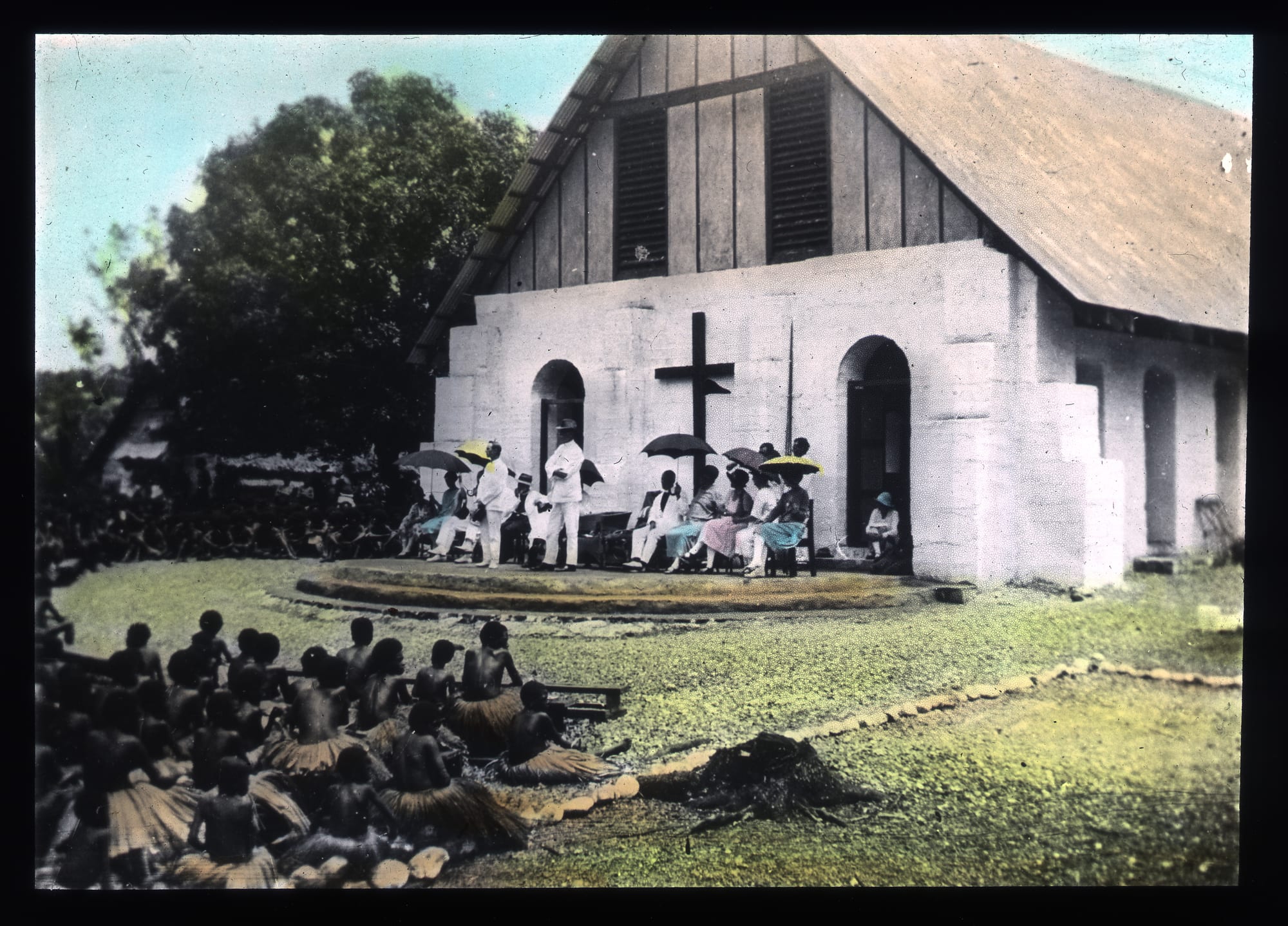
Contexto · Boianai (Papúa Nueva Guinea)
All Saints Church, Boianai, Papua New Guinea (9602443073).jpg · Wikimedia Commons · Dominio público · abrir original
La noche en cuestión
El 26 de junio de 1959, hacia las 18:45, en la misión anglicana de Boianai, sobre la costa de la bahía de Goodenough en el este de Papúa Nueva Guinea, el reverendo William Booth Gill (un misionero australiano de 31 años, licenciado en Teología) salió de la casa de la misión y vio una luz blanca brillante en el cielo del noroeste, sobre el mar. Según contó años después a J. Allen Hynek, al salir vio a Venus y, además de Venus, una luz blanca brillante algo por encima del planeta; un maestro de la misión, Stephen, llegó a las 18:52 y confirmó que no era una estrella. Sobre una forma grande y discoidal se distinguían cuatro figuras de aspecto humanoide que aparecían y desaparecían de la cubierta superior, como si estuvieran ocupadas en alguna tarea; de tanto en tanto un haz de luz azulado se proyectaba hacia arriba. Según el croquis firmado, el objeto principal fue visible con claridad entre las 18:55 y las 19:22 para 38 testigos, papúes de la misión entre los que había maestros y asistentes médicos; a las 19:10 el techo de nubes cubría el cielo a unos 2.000 pies, y Gill anotó objetos que entraban y salían de las nubes proyectando un halo sobre ellas. La actividad, con hasta cinco luces a la vez, se prolongó unas cuatro horas, y en sus notas de esa noche Gill llegó a escribir «satellites?».
La noche siguiente, el 27 de junio, el fenómeno se repitió. Gill anotó el primer avistamiento a las 18:02: el sol ya se había puesto tras las montañas, pero siguió habiendo bastante luz durante quince minutos. Sobre el objeto grande aparecieron cuatro figuras, dos de ellas inclinándose y alzando los brazos como si ajustaran algo, y dos objetos menores permanecían inmóviles a lo lejos. Gill levantó el brazo y saludó; para sorpresa del grupo, de una docena de personas, la figura hizo lo mismo; otro testigo agitó los dos brazos, las figuras de los extremos lo imitaron y las cuatro parecieron devolver el saludo. Con una linterna, Gill dirigió una serie de destellos largos hacia el objeto, que respondió con un vaivén de péndulo y pareció acercarse durante medio minuto; luego las figuras desaparecieron «bajo cubierta». A las 18:30 Gill entró a cenar; a las 19:00 el objeto seguía allí, algo más pequeño, y los observadores fueron a la iglesia para las vísperas. Preguntado por Hynek, Gill dijo que a veces él mismo se lo preguntaba, y que pensó que podía ser «a new device of you Americans»; al día siguiente, según el mismo relato, los nativos preguntaron a un comerciante de la zona si había visto «la Fuerza Aérea americana». A las 22:40 una fuerte explosión despertó a la misión sin que se viera nada. El episodio terminó sin que la nave fuera identificada.
Gill documentó el caso con rigor inusual para la época: tomó notas con horas mientras ocurría, mandó dibujar a tres observadores por separado lo que veían y obtuvo la firma de 27 de los 38 testigos, advertidos de que solo firmaran si estaban seguros. Su propio informe enumera las objeciones posibles, desde una alucinación compartida hasta la sugestión de testigos subordinados al observador europeo, y en él Gill rebajó sus estimaciones de tamaño tras practicar la medida a mano alzada; pero el mismo informe dice que la experiencia lo llevó del escepticismo a la convicción de que lo que vio «cannot be explained away in terms of natural phenomena», y en la carta que escribió al día siguiente del primer avistamiento a su colega David Durry afirmó que «there is no doubt whatever that they are handled by beings of some kind». El agregado aéreo de EE.UU. en Australia remitió el expediente a Blue Book en enero de 1960 junto con la evaluación de un organismo local: en diciembre de 1959 Gill dijo a sus entrevistadores que no estaba convencido de que lo visto fueran ovnis y que aceptaría cualquier explicación lógica, y que la prensa y los grupos ovni habían distorsionado algunos hechos. La Real Fuerza Aérea Australiana respondió por carta que no podía llegar a conclusiones positivas, pero que no creía que fueran vehículos espaciales tripulados y que el análisis de rumbos y ángulos indicaba que al menos tres de las luces eran planetas, como Júpiter, Saturno y Marte, con la refracción y el tiempo tropical como causa de la impresión de tamaño y movimiento; Blue Book cerró el caso como mala interpretación de cuerpos astronómicos. Hynek, que habló con Gill en Melbourne y visitó Boianai con el reverendo Crutwell unos quince años después, localizó a seis de los testigos originales, que contaron el suceso con mucho detalle, y rechazó la explicación astronómica para el objeto principal: buena parte se vio bajo un cielo cubierto, con objetos que descendían por debajo de las nubes a menos de 2.000 pies y las iluminaban; Gill estimó su tamaño en unas cinco pulgadas a brazo extendido, y la segunda noche empezó con luz de día, cuando ningún planeta habría causado aquella agitación. Hynek también cita una evaluación de la fuerza aérea australiana según la cual lo más probable eran reflejos en una nube de una fuente de luz importante de origen desconocido, y recoge que, a la misma hora del primer avistamiento, el comerciante Ernie Evenett, de Samurai, vio llegar desde el norte un objeto verdoso y muy brillante con una estela de llama blanca, que se detuvo a unos 500 pies por encima de él y mostraba la silueta de un balón de rugby con ojos de buey iluminados. Aun así, conviene encuadrar el caso como lo que es: un encuentro cercano de tercer tipo, extraordinario y multitudinario, pero testimonial, sin sensor ni traza física.
Por qué importa
El caso del Padre Gill es, en su categoría, lo más fuerte que existe: un encuentro cercano de tercer tipo con decenas de testigos sobrios y creíbles (encabezados por un clérigo con formación) y con algo casi único en la casuística, una interacción aparente (el saludo devuelto) sostenida durante dos noches y respaldada por declaraciones firmadas. Por eso es citado durante décadas como uno de los mejores reportes de 'ocupantes'. Y por eso mismo marca con nitidez el techo de su tipo: por extraordinario y multitudinario que sea, sigue siendo un caso puramente testimonial, sin radar, fotografía ni traza material. Es folclor documentado de altísima calidad testimonial, con esa frontera explícita: peso histórico y humano enorme, evidencia dura nula.
Lo que queda en papel
Evidencia documentada
- Avistamiento de dos noches (26–27 jun 1959) en la misión de Boianai; 38 testigos la primera noche, 27 de los cuales firmaron, incluidos maestros y asistentes médicos
- Figuras humanoides en la cubierta del objeto; interacción aparente (saludo devuelto) la segunda noche
- Informe detallado y declaraciones firmadas reunidos por el reverendo William B. Gill
- La RAAF atribuyó al menos tres luces a Júpiter, Saturno y Marte y Blue Book lo cerró como cuerpos astronómicos; Hynek objetó el cielo cubierto, la altura bajo las nubes y la luz de día de la segunda noche; sin radar, foto ni traza física
Fuentes
- Father Gill / Papua New Guinea Sighting — UFO Evidence — Agregador; fuente secundaria.
- Patrick Gross — 'Father Gill sighting, Papua-New Guinea, 1959'
- Project Blue Book — expediente «New Guinea», junio-julio de 1959 (informe del agregado aéreo de EE.UU. en Australia, ene 1960) — Fuente primaria: tarjeta del caso, notas horarias y croquis firmados de Gill, evaluación local de dic 1959 y carta de la RAAF (Júpiter, Saturno y Marte).
- J. Allen Hynek — «The Hynek UFO Report» (1977), cap. 9, «A Strange New Device of You Americans» — Relato del investigador que entrevistó a Gill y a seis testigos; cita las notas de Gill y una evaluación de la RAAF.
Casos relacionados
mismo objeto · misma época
Redmond, Oregon · policía, FAA y seis F-102
1959 · Tier A
mismo objeto · misma época
Isla Decepción · luces sobre las bases antárticas (1965)
1965 · Tier A
mismo objeto · misma época
Edwards AFB · las cintas de 1965
1965 · Tier A
mismo objeto · misma época
Ellsworth AFB · el «mejor reporte» de Blue Book
1953 · Tier S