Sección B · Informantes / denunciantes (histórico) · 1923–1960
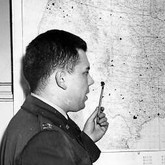
Edward J. Ruppelt
Captain USAF + Director Project Blue Book (1951–1953) + acuñó el término 'Unidentified Flying Object'
St. Louis Post-Dispatch, 8 mar 1953 (recorte de la foto en en.wikipedia) · Dominio público en EE.UU. (PD-US)
Biografía
Primer director profesional del programa de la Fuerza Aérea estadounidense para investigar el fenómeno (Proyecto Libro Azul). Su libro de 1956 es la primera memoria escrita desde dentro de ese aparato y defendió una metodología rigurosa frente a la presión superior por catalogar todo como 'identificado'. Murió de un infarto a los 37 años, uno de los casos del patrón 8c, muerte prematura de testigos críticos.
Documentos primarios
DOW-UAP-PR160 · audio de la presentación del capitán Edward J. Ruppelt, marzo de 1952 (PURSUE Release 06)
Audio (DOW-UAP-PR160) y transcripción íntegra de 19 páginas (DOW-UAP-D154) de una presentación del capitán Edward J. Ruppelt, jefe de Blue Book, de la segunda quincena de marzo de 1952, publicados en la sexta entrega de PURSUE el 18 de septiembre de 2026. Ruppelt expone que de unos 800 casos en archivo cerca del 20% resiste toda explicación, y en la sala desinfla dos casos: Fort Monmouth, un globo mayor de lo normal más operadores de radar alterados, y Mantell, falta de oxígeno mientras perseguía Venus o un globo Skyhook. Se acompaña la carta del congresista Eric Burlison al MIT Lincoln Laboratory (7 de mayo de 2026) que reclamaba el carrete «AF-ATIC-FILM, 03/52». Ningún documento de la entrega nombra al laboratorio: la identificación la hizo la oficina de Burlison.
Department of War · PURSUE Release 06 (18 sep 2026), vía DVIDS · Dominio público · obra del Gobierno de EE. UU. (17 USC §105) · abrir original
DOW-UAP-D154 · transcripción íntegra de la presentación del capitán Edward J. Ruppelt, marzo de 1952: 19 páginas, de la prueba de micrófono a la última pregunta del público (PURSUE Release 06)
Department of War · PURSUE Release 06 (18 sep 2026) · Dominio público · obra del Gobierno de EE. UU. (17 USC §105)
La carta que demanda esta grabación: el congresista Eric Burlison a MIT Lincoln Laboratory (7 may 2026), pidiendo determinar si el reel-to-reel 'AF-ATIC-FILM, 03/52' —el briefing de Ruppelt rotulado 'flying saucer talk'— sobrevive, preservarlo y transferir una copia de preservación a NARA (Record Group 615) bajo la UAP Records Collection de la FY 2024 NDAA.
U.S. House of Representatives · Committee on Oversight and Government Reform · Dominio público · obra del Gobierno de EE. UU. (17 USC §105)
DOW-UAP-D086 — Report of Flying Discs, Marina de EE.UU. (Quinto Distrito Naval, dic 1948)
Cinco documentos desclasificados en la tercera entrega de PURSUE (12 de junio de 2026) sobre los primeros estudios militares de los «discos voladores» en Estados Unidos: el «Report of Flying Discs» de la Marina (Quinto Distrito Naval, Norfolk, 13 de diciembre de 1948, DOW-UAP-D086); el «Flying Saucer Study» del Ejército (Army Field Forces, 1949, D084); los dos volúmenes de la «Analysis of Flying Objects in the United States» de la USAF, con las fichas «Check-List UFO» de los objetos 1 a 172 (D087 y D088); y la transmisión interna, de marzo de 1953, del informe del Panel Robertson de la CIA, que recomendó una política pública de desmitificación (D085). Documentan cómo se estudió y se encuadró el fenómeno, no que los objetos fueran anómalos.
Department of War / U.S. Navy (PURSUE Release 03) · Dominio público · obra del Gobierno de EE. UU. · abrir original
DOW-UAP-D084 — Flying Saucer Study, Ejército de EE.UU. (Army Field Forces, 1949)
Department of War / U.S. Army (PURSUE Release 03) · Dominio público · obra del Gobierno de EE. UU. · abrir original
Ver los otros 3 documentos
DOW-UAP-D087 — Analysis of Flying Objects in the US, objetos 1-100 (Check-List UFO, USAF)
Department of War / USAF (PURSUE Release 03) · Dominio público · obra del Gobierno de EE. UU. · abrir documento
DOW-UAP-D088 — Analysis of Flying Objects in the US, objetos 101-172 (Check-List UFO, USAF)
Department of War / USAF (PURSUE Release 03) · Dominio público · obra del Gobierno de EE. UU. · abrir documento
DOW-UAP-D085 — transmisión del informe del panel científico de la CIA (Panel Robertson, 1953)
Department of War / CIA (PURSUE Release 03) · Dominio público · obra del Gobierno de EE. UU. · abrir documento
Twining Memo
Carta clasificada SECRET del 23 de septiembre de 1947, titulada «AMC Opinion Concerning "Flying Discs"», firmada por el teniente general Nathan F. Twining, comandante del Air Materiel Command, y dirigida al general Schulgen. Afirma que «the phenomenon reported is something real and not visionary or fictitious», admite que algunos incidentes pueden ser fenómenos naturales como meteoros y recomienda un estudio con prioridad y nombre clave, que cristalizó en Project Sign. Su límite es su base: es la opinión de ingenieros y analistas sobre informes de interrogatorio de testigos, no una investigación de campo propia, y menciona la falta de restos recuperados. El texto se publicó en 1969 en el Apéndice R del informe Condon.
Project Blue Book — USAF (1952–1969)
Project Blue Book fue el programa oficial de la USAF entre marzo de 1952 y diciembre de 1969, sucesor de Sign y Grudge, operado desde el Air Technical Intelligence Center en Wright-Patterson. Según la hoja informativa de la USAF, entre 1947 y 1969 recibió 12.618 avistamientos, de los que 701 (5,6%) quedaron como «Unidentified». Su cierre, anunciado el 17 de diciembre de 1969, se apoyó en el informe Condon y en su revisión por la Academia Nacional de Ciencias. El memorándum Bolender (20 de octubre de 1969) recordó que los informes que afectaran la seguridad nacional iban por otros canales y «are not part of the Blue Book system». Los expedientes están en los Archivos Nacionales desde 1976 (Record Group 341).
Por qué está acá · 1 piezas
- 1956
The Report on Unidentified Flying Objects
Primeras memorias oficiales desde dentro del programa USAF Blue Book
Fuentes
- Edward J. Ruppelt, 'The Report on Unidentified Flying Objects' (1956) — Memoria del director del Proyecto Libro Azul.
- USAF Twining Memo, 23 Sep 1947 (escaneo, copia NICAP) — Fuente primaria: escaneo de las tres páginas de la copia de archivo, con el sello de desclasificación
- Condon Report (1969), Apéndice R: carta del general N. F. Twining, texto completo (NCAS) — Fuente primaria: primera publicación del texto íntegro
- National Archives — Project Blue Book (Record Group 341) y hoja informativa de la USAF — Fuente primaria: descripción de los expedientes y copia de la hoja informativa de la USAF (12.618 avistamientos entre 1947 y 1969, 701 sin identificar, conclusiones del cierre).
- Condon, E. U. (ed.) — 'Scientific Study of Unidentified Flying Objects' (Colorado Project, 1968) — Fuente primaria: informe que sirvió de base al cierre de Blue Book.
Casos asociados (3)
Kenneth Arnold · el avistamiento que acuñó 'platillo volador' (EE.UU., 1947)· 1947
El 24 de junio de 1947, el piloto privado Kenneth Arnold volaba cerca del Monte Rainier…
Caída de Mantell· 1948
El Capitán Thomas Mantell murió al estrellarse su F-51 tras subir por encima de los…
Washington Flap· 1952
Los fines de semana del 19 y el 26 de julio de 1952, los controladores del radar del…
Biografía resumida a partir de fuentes públicas, clasificada por sección (A-F).